Europe’s infrastructure repair crisis has found a new contender in Munich.
Sitegeist, a robotics spinout from Technical University Munich, has secured €4 million in pre-seed capital to deploy automated, AI-enabled modular robots across live construction sites. The raise signals early investor conviction that automation, not incremental labor supply will define the next phase of infrastructure renewal.
The round was led by b2venture and OpenOcean, alongside industry investors Alexander Schwörer and Mario Wettengel. Prominent angels including Verena Pausder, Lea-Sophie Cramer, Andreas Kupke, Sven Degener, Inga vom Holtz and Paolo Oppelt also participated.
The capital will fund team expansion and accelerate on-site deployment with concrete renovation companies facing mounting order books.
Automation Targets Europe’s Infrastructure Bottleneck
Across Germany, bridges, tunnels, parking structures and public buildings require urgent structural repair. According to KfW data from 2025, Germany’s infrastructure backlog runs into the hundreds of billions of euros. Similar deficits stretch across North America and other developed markets.
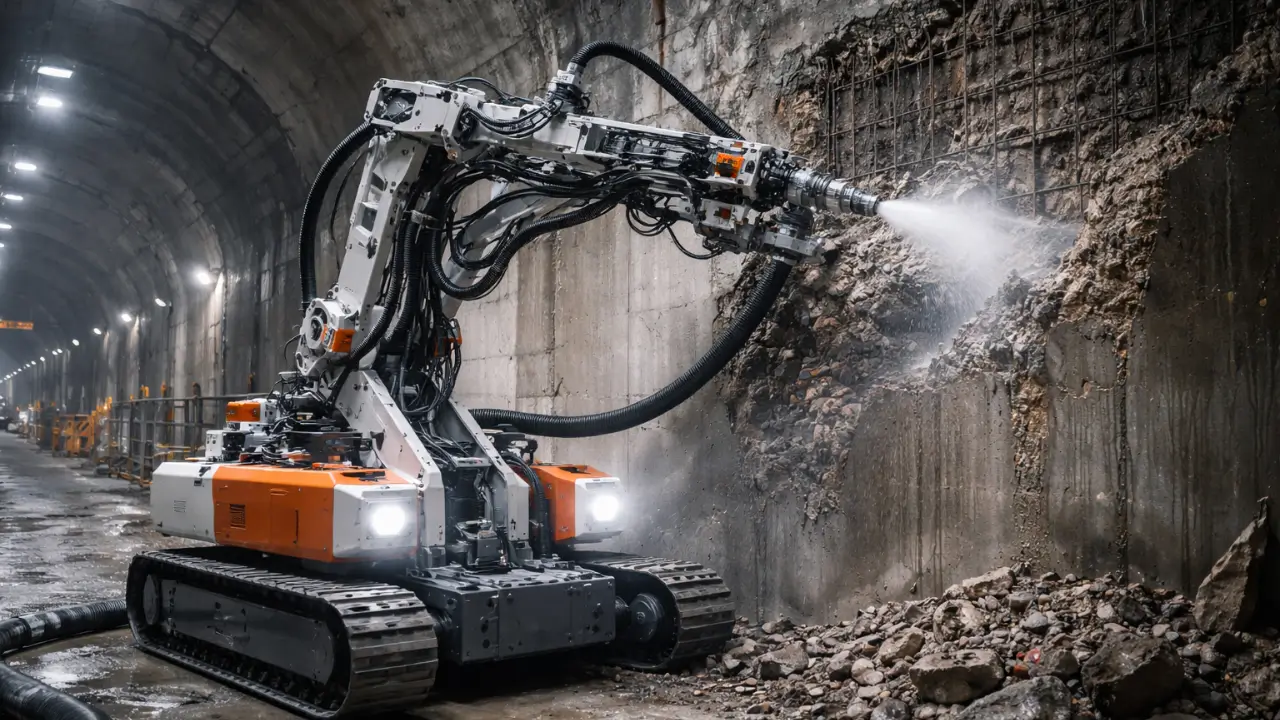
However, labor constraints compound the challenge. Concrete renovation demands physically intensive, precision-driven removal of deteriorated material using high-pressure water or abrasive blasting. Crews must preserve embedded steel reinforcement while maintaining safety standards. As a result, firms operate at capacity, often booking projects months or years in advance. Sitegeist aims to remove that bottleneck.
Unlike automation systems dependent on pre-modeled digital environments, the company’s robots operate directly on existing structures. Using perception systems, AI-driven decision support and adaptive control, the machines interpret complex geometries and variable material conditions in real time. Consequently, operators can deploy them immediately without prior digitization.
“Infrastructure renovation is hitting a critical bottleneck, especially in concrete repair,” said Dr. Lena-Marie Pätzmann, Co-founder and CEO of sitegeist. “Today, deteriorated concrete is still removed using manually-intensive processes that are hard to scale. We’re tackling this challenge with the first ever specialized automated and modular robots that can perform concrete renovation directly on existing structures. We’re thrilled to have won such renowned investors who share our mission. This backing enables us to move faster in bringing automated renovation to critical infrastructure worldwide.”
Strategic Shift: From Labor Dependency to Robotic Throughput
Concrete repair sits at the center of the infrastructure maintenance value chain, yet it remains largely manual and site-specific. Shortages of qualified labor, rising safety expectations and low process efficiency constrain output. Therefore, capacity, not demand, limits the market.
Sitegeist’s modular robotic platform seeks to increase throughput while improving quality control and reducing rework. The company works directly with renovation contractors on active sites and intends to expand across adjacent phases of the renovation workflow.
“The way concrete is removed today by workers is devastating and extremely arduous. This is the perfect case for augmenting humans with robots,” said Florian Schweitzer, Partner at b2venture. “What sets Sitegeist apart is its team, which will literally go through walls to bring autonomy into highly unstructured, real-world construction environments. The team combines deep robotics expertise with a pragmatic understanding of how renovation actually works on site, which gives them the potential to define this category.”
“The most exciting AI-powered robots today don’t have fingers and thumbs,” said Sam Hields, Partner at OpenOcean. “Sitegeist’s non-humanoid robots are purpose-built to solve real-world problems, and their ability to operate in harsh environments with superhuman strength and autonomy is genuinely game- changing. This is exactly the kind of task we want AI to automate: a manual, expensive process with low talent availability. With an aging population and a skills shortage in physical industries like construction, robotics will help us refit our infrastructure for the future – and TUM and Munich have proven this is the one of the best places to build teams to do it.”
Founded by Dr. Lena-Marie Pätzmann, Claus Carste, Julian Hoffmann and Nicola Kolb, the company emerged from a robotics research institute led by Prof. Matthias Althoff at TUM. The founders combined research depth with hands-on exposure to Munich’s startup ecosystem.
Now, with fresh capital and live-site validation underway, Sitegeist positions itself at the intersection of AI autonomy and infrastructure renewal. As Europe confronts structural decay and workforce attrition simultaneously, construction robotics funding may shift from speculative bet to strategic necessity.