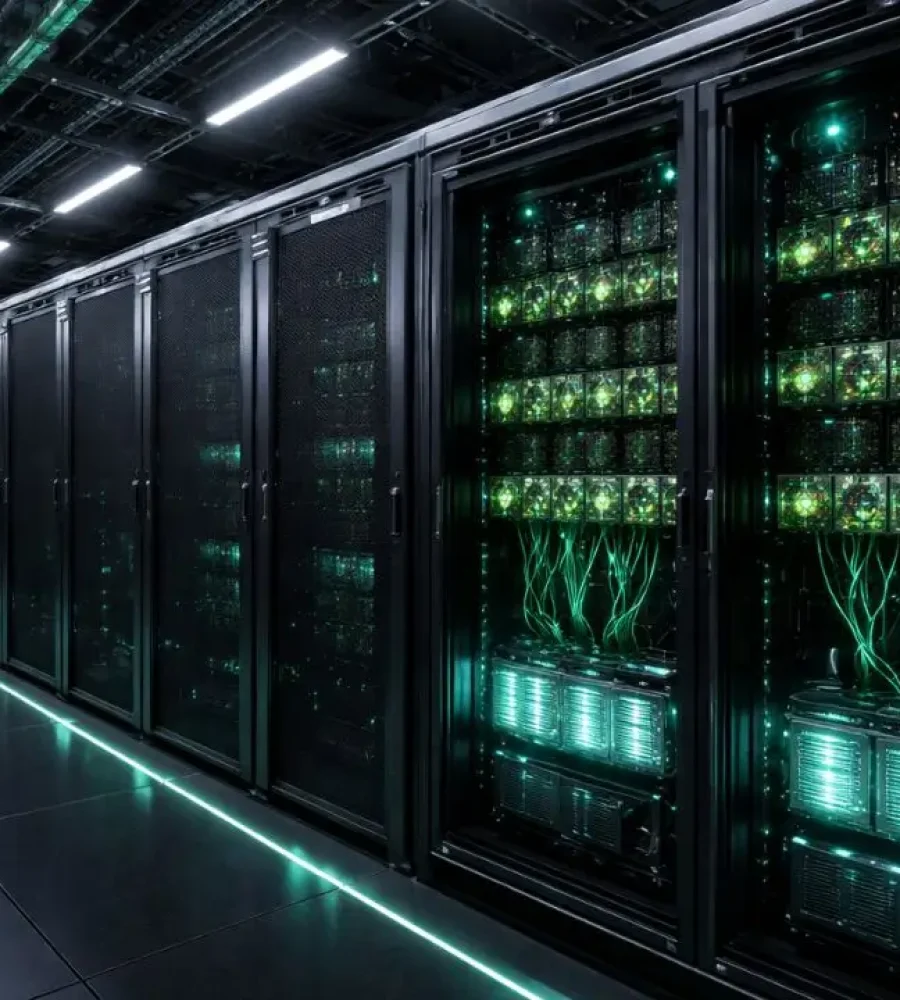
SoftBank Group is moving aggressively to secure energy capacity for the next phase of artificial intelligence expansion, outlining plans for a massive gas-fired power plant in Ohio designed specifically to support hyperscale data centers.
The proposed facility will deliver 9.2 gigawatts of power generation capacity, making it one of the largest single-site power developments globally. Construction will take place at the Portsmouth site operated by the U.S. Department of Energy, signaling a repurposing of legacy federal infrastructure into AI-era assets.
Masayoshi Son, CEO of SoftBank Group, emphasized the scale ambition during the announcement: “This is a size bigger than any power plant, I think, in the world,” Son said at a ceremony in Ohio to announce the project.
“At least in the United States, for sure, this is the biggest power generation in one location. The goal is to develop “the smartest intelligence in the world” he added
Powering the Next Wave of AI Compute Demand
The Ohio plant forms part of a broader strategy to enable up to 10 gigawatts of data center capacity at the site. As a result, the project directly aligns energy supply with compute demand, an increasingly critical constraint in AI infrastructure deployment.
AI workloads, including large language models and generative systems, require sustained high-density power. Consequently, energy availability has become a gating factor for scaling next-generation compute clusters. SoftBank’s approach integrates power generation with compute infrastructure, effectively collapsing a traditionally fragmented supply chain.
The U.S. Department of Energy highlighted the site’s transformation, “Once a cornerstone of America’s national security during the Cold War, enriching uranium for our nation’s defense, the Portsmouth site is now being transformed to help the United States win the AI race,” it said.
Geopolitics and Capital Flows Reshape AI Infrastructure
The initiative also reflects a broader geopolitical alignment between Japan and the United States. The project sits within a $550 billion Japanese investment framework tied to reduced trade tariffs, reinforcing cross-border capital flows into strategic technology infrastructure.
OpenAI, backed by SoftBank, remains a central beneficiary of expanding compute capacity. The growing demand for AI model training and inference continues to drive unprecedented infrastructure investments across regions. At the same time, SoftBank’s consortium, announced on March 21, brings together U.S. and Japanese industrial players to co-develop both the power plant and associated AI infrastructure. This collaborative model spreads capital risk while accelerating deployment timelines.
Globally, the buildout of AI-ready data centers has entered a phase of industrialization. However, access to reliable, large-scale energy supply increasingly dictates where and how fast these facilities can be deployed.
Gas-fired generation, while controversial from a sustainability perspective, offers dispatchable and scalable power that aligns with AI’s continuous compute requirements. Therefore, SoftBank’s decision reflects a pragmatic trade-off between speed, reliability, and environmental considerations. Meanwhile, Ohio’s emergence as an AI infrastructure node underscores a shift away from traditional coastal tech hubs toward regions with available land, grid capacity, and regulatory alignment.
Strategic Implications for the AI Infrastructure Stack
SoftBank’s Ohio project signals a deeper structural shift: energy and compute are converging into a unified infrastructure layer. This model reduces latency between power supply and compute consumption while improving cost predictability for large-scale AI operations.
Moreover, the scale of the project suggests that future AI competitiveness will hinge not only on algorithms and models but also on control over energy ecosystems. As investment accelerates, integrated power-and-compute strategies could define the next generation of infrastructure leaders. SoftBank’s move positions it at the intersection of capital, energy, and artificial intelligence, three forces now shaping the global technology landscape.