
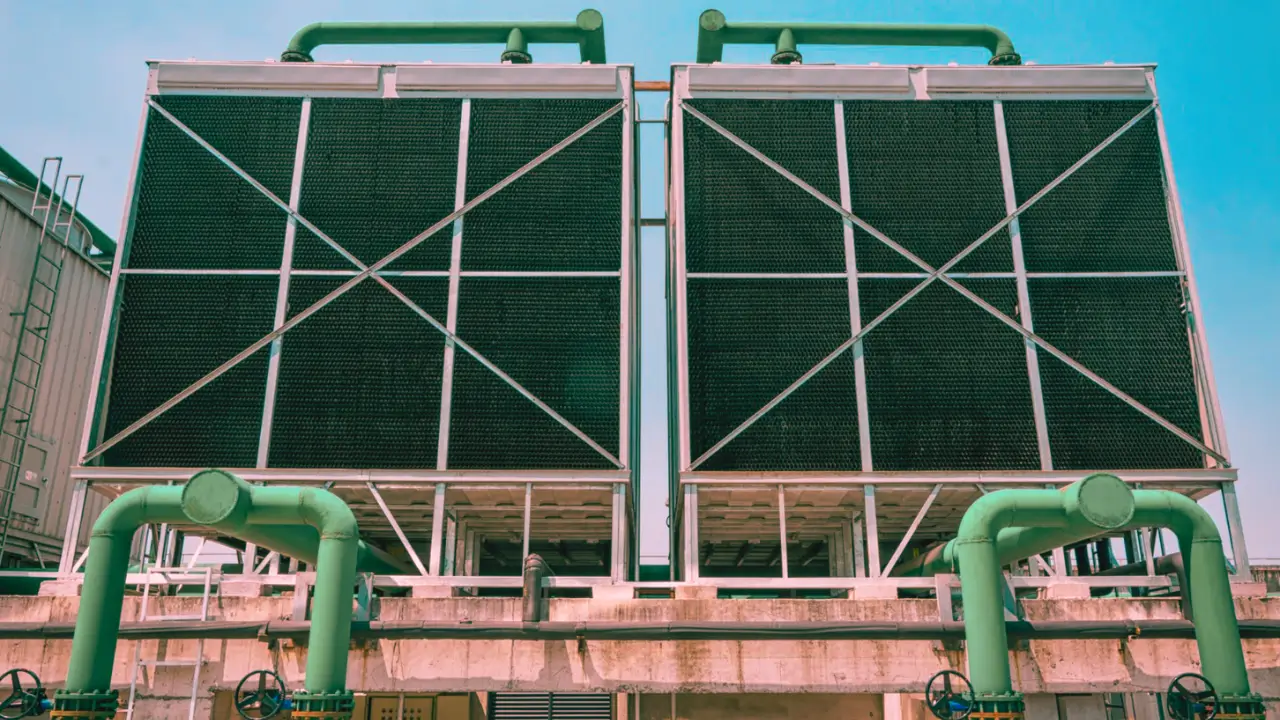
High-density AI computing is reshaping data center priorities. As a result, power delivery, interconnects, and cooling now operate as a single system. Thermal limits increasingly drive architectural decisions at every level. In response, liquid cooling has emerged as the preferred thermal strategy for AI workloads.

At the center of this shift are Coolant Distribution Units, commonly known as CDUs. These systems manage and control coolant flow across AI infrastructure. In doing so, they stabilize temperatures and support reliable operation under fluctuating loads. Given these pressures, one question stands out. Why do CDUs matter so much for AI infrastructure?
Understanding Coolant Distribution Units
At a basic level, a Coolant Distribution Unit forms part of a closed-loop liquid cooling system. It regulates coolant flow, temperature, and pressure with high precision. More importantly, the CDU connects facility cooling infrastructure to the cooling loops attached to CPUs, GPUs, and ASICs.
In practice, CDU designs scale across different environments. Some support a single rack. Others operate at the row or facility level. Consequently, operators can cool dense AI clusters without redesigning the entire data center.

In a typical setup, the CDU delivers coolant to cold plates mounted directly on processors. These cold plates absorb heat from critical components. Next, the heated coolant returns to the CDU. Inside the unit, a heat exchanger transfers that heat to the facility cooling loop. Importantly, this separation improves both safety and reliability.
How CDUs Enable High-Density AI Cooling
To better understand their value, it helps to examine what CDUs actually do.
First, pumps circulate coolant through secondary loops connected to servers and cold plates. Second, internal heat exchangers move thermal energy into the primary cooling system. Third, sensors track temperature, pressure, and flow in real time. These readings feed control systems that adjust operations dynamically. Finally, many CDUs include redundancy features. These include backup pumps, dual power feeds, and hot-swappable components.
Beyond these core functions, modern CDUs generate extensive telemetry. As a result, operators gain deeper visibility into cooling performance. In turn, they can detect anomalies early and refine cooling strategies over time.
Single-Phase CDUs: Power and Limitations
Today, most liquid cooling deployments rely on single-phase CDUs. In these systems, the coolant remains liquid throughout the cooling cycle. Typically, operators use water or glycol-based mixtures.
Over time, single-phase technology has matured. For example, liquid-to-liquid CDUs like CoolIT Systems’ AHx240 support loads up to 240 kW per unit. These systems also offer dynamic heat management and built-in redundancy. Similarly, row-level units from vendors such as Airedale by Modine can exceed 2 MW in heat removal capacity.
In many environments, single-phase CDUs perform well. They integrate easily into existing facilities. They also offer predictable fluid behavior and wide vendor support. Moreover, they usually require less specialized training.
However, limitations emerge as heat densities rise. As compute loads increase, maintaining thermal uniformity becomes harder. Consequently, operators must increase pumping power or expand physical footprints. Both options raise costs and reduce efficiency.
Two-Phase CDUs: Principles and Advantages
To move beyond these limits, some operators now deploy two-phase CDUs. Unlike single-phase systems, two-phase cooling relies on a phase change within the coolant. Specifically, the fluid vaporizes as it absorbs heat at the cold plate.
Next, the vapor travels back to the CDU. There, it condenses into liquid. During condensation, it releases heat into a heat exchanger. This cycle repeats continuously. Crucially, it leverages the latent heat of vaporization. This mechanism transfers far more energy than sensible heat alone.
As a result, thermal efficiency improves dramatically. Two-phase systems also maintain near-constant temperatures during phase change. Therefore, they deliver excellent thermal uniformity under extreme loads.
Key Technical Benefits
Building on these fundamentals, two-phase CDUs offer several advantages.
First, they achieve higher efficiency. Latent heat transfer allows more heat removal with less fluid flow. Second, pumping energy decreases. Lower mass flow reduces power consumption. Third, fluid loops become more compact. This supports denser hardware configurations. Finally, many two-phase systems use dielectric refrigerants. As a result, electrical risk from leaks decreases.
Taken together, these benefits make two-phase cooling attractive for AI training clusters and HPC environments. In such settings, traditional cooling approaches approach their limits.
Two-Phase CDUs and the Limits of Single-Phase Cooling
As AI workloads expand, several trends expose the constraints of single-phase cooling.
First, heat flux continues to rise at the chip level. Single-phase fluids struggle to absorb this heat efficiently. Consequently, operators must deploy larger pumps and heat exchangers. Costs increase, while efficiency declines.
Second, thermal uniformity becomes critical. Uneven temperatures can cause throttling and long-term reliability issues. Because two-phase systems hold coolant at a stable temperature during phase change, they naturally improve uniformity.
Third, energy efficiency targets grow stricter. Hyperscalers optimize aggressively for lower Power Usage Effectiveness. In this context, two-phase CDUs reduce pumping and circulation energy.
That said, challenges remain. Operators must carefully select fluids that balance performance and environmental impact. Control systems must also manage vapor dynamics and pressure. In addition, system design must ensure safe operation through robust connectors and pressure vessels.
Real-World Implementations and Industry Trends
In response, vendors continue to expand CDU portfolios. Many now support both single-phase and two-phase solutions. For example, ACT offers two-phase CDUs ranging from 15 kW to 1 MW. These platforms use dielectric fluids and advanced diagnostics to improve scalability.
Meanwhile, single-phase vendors continue to innovate. Companies such as CoolIT Systems and JetCool deliver modular designs with capacities in the hundreds of kilowatts. At the facility level, firms like Motivair and Airedale by Modine support multi-megawatt heat removal for dense deployments.
Integration, Control, and What Comes Next
Importantly, CDUs no longer function as passive components. Instead, they integrate tightly with data center control platforms. Sensors stream real-time data into DCIM systems. As a result, operators gain predictive control and finer operational tuning.
At the same time, machine learning begins to influence cooling strategies. Algorithms can adjust temperatures, flow rates, and valves dynamically. Early studies show meaningful efficiency gains when AI controls cooling loops.
Looking ahead, hybrid cooling models will likely become more common. These designs may combine single-phase, two-phase, and immersion cooling. As AI models scale further, CDUs will continue to evolve in both intelligence and performance.
In summary, Coolant Distribution Units play a critical role in high-density AI computing. They deliver precise cooling, operational resilience, and system-level integration. While single-phase CDUs dominate today, two-phase systems represent the next frontier. By exploiting phase change and dielectric fluids, they extend cooling performance beyond current limits. As AI compute accelerates, CDUs will remain foundational to efficient and scalable data center design.









