
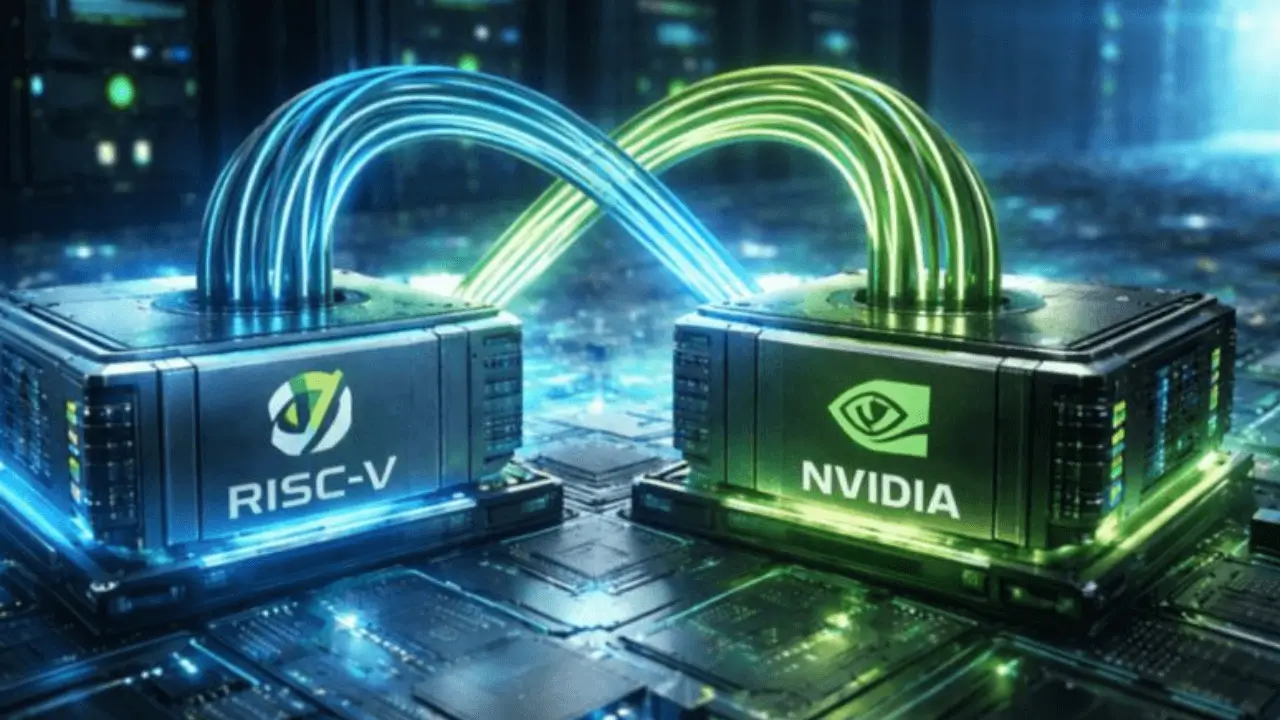
SiFive’s latest partnership signals a shift in how AI infrastructure gets assembled. In the opening move of this collaboration, the SiFive NVLink Fusion integration places Nvidia’s high-bandwidth interconnect directly into RISC-V data center products. The step widens design choices for operators building large-scale AI systems. It also positions SiFive closer to the center of next-generation compute architectures.
RISC-V chip designer SiFive has signed an agreement with Nvidia to incorporate Nvidia NVLink Fusion into its data center offerings. As a result, SiFive can connect its RISC-V CPUs to Nvidia GPUs and accelerators through a high-bandwidth interconnect. This approach allows multiple GPUs to share compute and memory resources. Consequently, AI data center operators gain greater flexibility in system configuration.
Historically, RISC-V platforms lacked access to advanced interconnect technologies at this level. By contrast, proprietary ecosystems often controlled those pathways. This agreement changes that dynamic. It introduces a direct route between RISC-V processors and Nvidia’s AI acceleration stack. Therefore, system architects can now consider RISC-V in deployments that demand dense GPU connectivity.
In a statement, Patrick Little, President and CEO of SiFive, said, “AI infrastructure is no longer built from generic components, it is co-designed from the ground up. By integrating NVLink Fusion with SiFive’s high-performance compute subsystems, we’re enabling customers with an open and customizable CPU platform that pairs seamlessly with Nvidia’s AI Infrastructure to deliver exceptional efficiency at data center scale.”
That statement underscores a broader industry trend. AI platforms increasingly rely on tightly coupled hardware designs. Open instruction sets now seek parity with established architectures. This partnership reflects that momentum.
Analysts See AI as Catalyst for RISC-V Growth
Market analysts have long questioned when RISC-V would move beyond niche deployments. According to David Harold, senior analyst with Jon Peddie Research, AI may provide that inflection point. He acknowledged that RISC-V adoption has progressed slowly. However, he argued that conditions now favor change.
“AI is the making of RISC-V,” he explained. “ARM doesn’t have the same capabilities for pushing into the space. RISC-V is going to be tied to AI in the same way that x86 was tied to Windows and ARM was to mobiles.” He added that the Nvidia agreement offers a meaningful boost for SiFive.
This view aligns with recent industry moves. AI workloads demand specialized acceleration and flexible system design. RISC-V’s open model appeals to companies seeking customization. When paired with Nvidia’s established AI infrastructure, the platform gains credibility among hyperscale operators.
Furthermore, the deal reduces a historical barrier. Lack of access to premium interconnects limited RISC-V’s reach in data centers. NVLink Fusion addresses that gap. As a result, RISC-V enters conversations previously dominated by x86 and ARM.
Questions Emerge Around UALink’s Future Role
While the Nvidia-SiFive agreement expands options, it also raises questions for competing technologies. NVLink Fusion has a rival in UALink, an interconnect launched last spring. Many observers viewed UALink as an open-source alternative to Nvidia’s proprietary approach.
SiFive’s move toward NVLink Fusion includes no reference to UALink. That absence signals a setback for the newer interconnect, despite its early backing. The decision suggests that performance and ecosystem maturity still drive purchasing choices in AI infrastructure.
Last year, Nvidia appeared to hedge its bets. The company took a stake in Synopsys, a member of the UALink Consortium. That move reflected broader industry caution. Many firms aim to support multiple standards while markets evolve.
Other players follow similar strategies. Chip designer ARM participates in the NVLink Fusion ecosystem. At the same time, ARM holds membership in the UALink Consortium. Intel, a founding member of UALink, also works with Nvidia on chips that incorporate NVLink. These overlaps highlight uncertainty rather than consensus.
For now, SiFive’s alignment with Nvidia strengthens its position in AI data centers. It also reinforces NVLink Fusion’s role as a preferred interconnect for high-performance AI systems. Whether UALink gains comparable traction remains unclear.
As AI infrastructure continues to evolve, partnerships like this one shape the competitive landscape. Open architectures now compete on integration, not ideology alone. In that context, SiFive’s decision marks a notable step in RISC-V’s data center journey.











