Skip to content
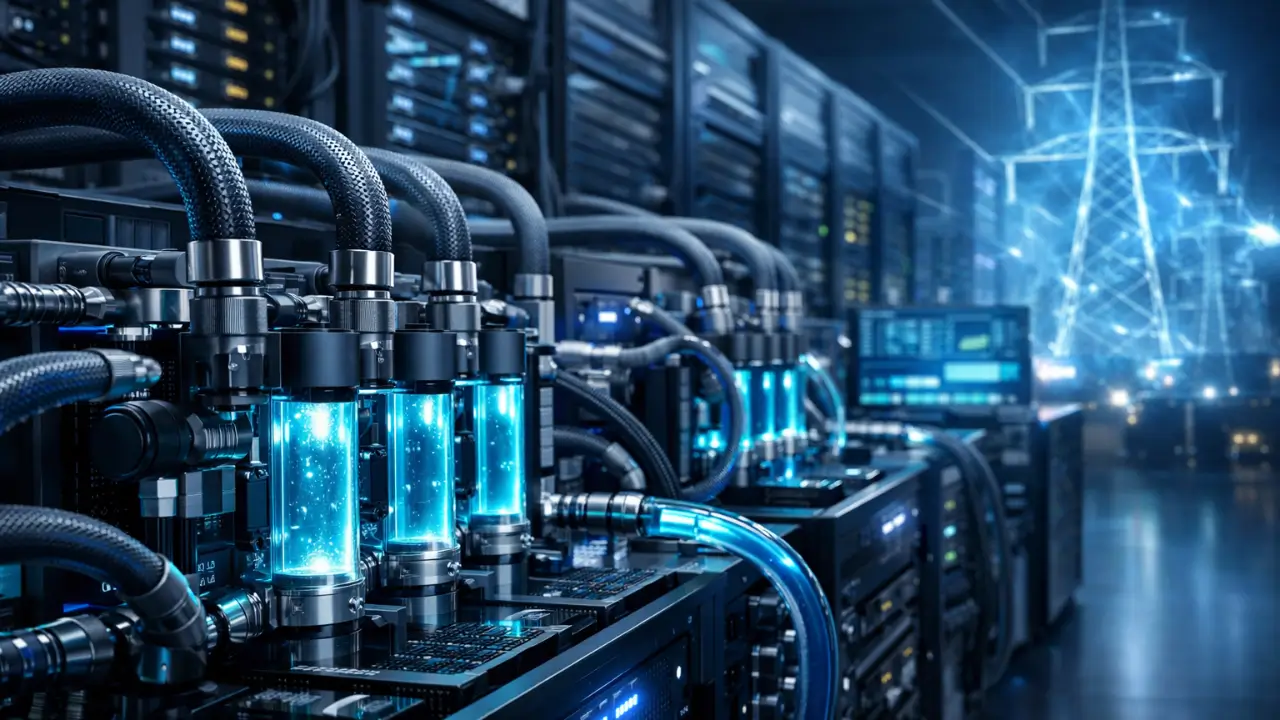
For decades, cooling ranked as a secondary engineering problem. Power shaped data center design. Cooling followed. That hierarchy has collapsed.

As AI workloads push power density higher, liquid cooling power strategy is emerging as a defining factor in modern data center design.
Modern compute no longer scale linearly with electrical input. It concentrates energy into shrinking silicon surfaces. Thermal limits now dictate usable power. Liquid cooling has moved from optimization to enablement.
This shift marks a structural change. Cooling decisions now determine how much power infrastructure can safely deliver. In high-density environments, cooling architecture defines the power ceiling.

The Physics That Broke Air Cooling’s Monopoly
Air cooling dominated because it matched historical heat flux levels. CPUs dissipated tens of watts per square centimeter. Fans and raised floors handled the load.
That assumption failed as transistor density increased. Power density rose faster than airflow capacity. Air’s low heat capacity became a bottleneck. Air removes heat through convection. Its volumetric heat capacity remains roughly 1,200 times lower than water. This constraint is physical, not economic.
At high densities, airflow velocity must increase exponentially. Fan power rises. Acoustic limits appear. Turbulence reduces efficiency. Eventually, air stops scaling.
AI Accelerators Changed the Thermal Equation
AI accelerators reshaped server thermals more than any previous workload. GPUs operate at sustained power levels once reserved for entire racks. Modern accelerators exceed 700 watts per package. Heat concentrates across small die areas. Junction temperatures approach material limits.
Unlike CPUs, GPUs maintain high utilization for extended periods. Thermal spikes no longer define design. Steady-state dissipation does. Air cooling struggles under these conditions. It fails to maintain consistent delta-T margins. Thermal throttling reduces effective compute output.
Liquid cooling stabilizes junction temperatures. It sustains peak performance without aggressive power capping.
Power Density Is Now the Primary Design Variable
Data center design once optimized floor space. That model has inverted. Power density drives layout, airflow, and structural planning. Legacy facilities assumed 5–10 kW per rack. Modern AI deployments exceed 40 kW. Some approach 100 kW.
At these levels, cooling determines whether power is usable. Electrical capacity alone means nothing without thermal evacuation. Liquid cooling decouples rack density from airflow constraints. It allows vertical scaling without proportional cooling penalties.
This capability reframes cooling as a power delivery mechanism.
Heat Flux, Not Rack Count, Limits Compute Growth
Executives often track megawatts deployed. Engineers track watts per square centimeter. Heat flux defines failure risk. Silicon reliability degrades rapidly above threshold temperatures. Mean time between failures declines.
Liquid cooling addresses heat flux directly. It extracts energy at the source, not after diffusion into air. This distinction matters at scale. It preserves silicon lifespan and predictable performance.
Direct-to-Chip Cooling Emerges as the First Breakthrough
Direct-to-chip liquid cooling targets processors directly. Cold plates interface with CPUs and GPUs. Coolant removes heat before air interaction. This approach increases thermal efficiency dramatically. It reduces reliance on high-speed fans. It lowers server inlet temperature sensitivity. Direct-to-chip systems integrate into standard racks. They preserve serviceability. They support hybrid air-liquid environments.
Hyperscalers adopted this architecture first. Enterprise adoption followed as tooling matured.
Immersion Cooling Redefines the Boundary Conditions
Immersion cooling submerges hardware in dielectric fluids. Heat transfers directly to liquid across all surfaces. This method eliminates air entirely. It removes fans. It simplifies thermal pathways.
Immersion supports extreme densities. It enables uniform temperature distribution. It reduces component-level hotspots. However, it introduces operational trade-offs. Hardware compatibility limits choice. Maintenance workflows change. Supply chains remain immature.
Immersion excels in specialized environments. It complements, not replaces, direct-to-chip systems.
Liquid Cooling Alters Power Utilization Effectiveness
PUE measures total facility energy divided by IT energy. Cooling efficiency directly affects this ratio. Liquid cooling reduces parasitic energy consumption. Pumps consume less power than high-velocity fans at scale.
Lower fan usage cuts server power draw. Reduced heat recirculation improves system stability. Facilities using liquid cooling consistently report lower PUE under high-density loads. This efficiency gain translates into higher usable power per megawatt delivered.
Thermal Stability Unlocks Sustained Performance
Thermal throttling remains invisible to non-engineers. It silently erodes compute output. Liquid cooling stabilizes silicon temperatures. It maintains consistent clock speeds. It prevents thermal cycling stress. For AI workloads, sustained throughput matters more than peak benchmarks.
Stable thermals improve job completion times. They reduce retraining cycles. They increase infrastructure utilization. Cooling choices now shape performance economics.
Cooling Infrastructure Now Dictates Electrical Design
Liquid cooling changes electrical topology. Higher densities demand redesigned power distribution. Busways replace traditional cabling. Power shelves scale vertically. Cooling loops integrate with rack-level power systems.
Electrical engineers must now coordinate with thermal teams early. Sequential design no longer works. This integration elevates cooling decisions to architectural priority.
The Supply Chain Shift Behind Liquid Cooling
Liquid cooling requires new suppliers. Cold plates, manifolds, pumps, and fluids replace CRAC units. OEMs redesigned servers for liquid compatibility. Standardization improved interoperability.
This ecosystem matured rapidly after AI demand surged. Cooling vendors now influence platform roadmaps alongside silicon designers.
Beyond Air—Thermal Limits of Tradition
Air cooling depends on moving large volumes of air past hot surfaces. The physics are simple but inherently limited. Air has low thermal conductivity and heat capacity compared with liquids. It also requires high mass flow rates to remove concentrated heat at modern rack densities. When rack power crosses tens of kilowatts, air systems quickly hit practical limits of airflow, pressure drop, and electrical draw.
Here’s why liquid wins by physics: liquids like water or dielectric fluids carry heat much more efficiently, narrowing temperature gradients and reducing reliance on massive airflow. This efficiency improves thermal stability and reduces power consumed by cooling infrastructure.
Direct-to-Chip Liquid Cooling: The First Breakthrough
Direct-to-chip liquid cooling emerged as a transformative approach. It places cold plates directly against heat-generating components. Coolant flows through channels near CPUs and GPUs, capturing heat before it diffuses into system air.
This reduces delta-T and lowers system thermal resistance dramatically. Compared with air, direct liquid systems can remove more heat with less pumping power and at more predictable temperatures. They support higher heat flux densities and maintain thermal margins needed for sustained performance.
Direct-to-chip architecture also simplifies integration with rack-level plumbing and external cooling loops, enabling higher rack power densities without proportional increases in auxiliary power consumption.
Immersion Cooling Takes Thermal Removal To Extremes
Immersion cooling immerses servers directly in non-conductive dielectric liquids. Heat transfers uniformly across the entire system surface, eliminating hot spots and letting systems reliably run at very high power densities.
This approach dramatically redefines system thermal boundaries. Rather than trying to blow air past hot plates, immersion cooling lets liquid absorb and transport heat out of hardware economically. It supports much higher rack densities than air or direct-to-chip cooling alone.
Yet immersion also brings operational complexity. Engineers must handle fluid compatibility, hardware accessibility, and maintenance workflows differently, which adds cost and disruption for retrofits.
Water’s Efficiency and PUE Impacts
Liquid cooling often uses water or dielectric fluids because of their much higher heat capacity than air. Water’s heat capacity per unit volume is orders of magnitude greater, which translates into better cooling with lower mass flow.
Better cooling efficiency lowers PUE (Power Usage Effectiveness) because less power is consumed by fans and chillers for the same IT load. Many data centers with liquid systems operate with lower total energy per unit compute compared with air-cooled peers.
Moreover, liquid systems enable waste heat reuse through higher coolant temperatures — an emerging sustainability strategy for campus heat recovery.
AI Workloads Amplify Thermal Stress
AI infrastructure, particularly GPUs and accelerators, generates heat at unprecedented rates. AI clusters often run at peak utilization for extended periods rather than the bursty patterns of traditional workloads.
Sustained heat generation narrows thermal headroom and increases demand for efficient heat removal. Liquid cooling systems limit thermal throttling, enabling consistent performance even at high compute loads.
This shift makes cooling architecture a central factor in overall performance strategies rather than a peripheral support function.
Reliability Engineering and Redundancy
Liquid cooling systems introduce new reliability concerns, such as potential leaks and pump failures. These risks require robust redundancy and monitoring controls.
Engineering controls include multi-path coolant loops, leak detection systems, redundant pumps, and specialized CDUs (Coolant Distribution Units).
This reliability focus is analogous to power distribution Uptime practices in electrical design. Cooling engineers now coordinate early with power teams, rather than acting as an afterthought.
Power Distribution and Cooling Integration
As coolant systems take on more of the thermal load, electrical design has adapted. Higher rack densities demand tighter integration of power delivery and thermal loops.
Power busways, distributed power units, and rack-level power shelves now interoperate with cooling manifolds and CDUs. Failure domains cross boundaries: an electrical trip can cascade into thermal stress, and vice versa.
This integration elevates cooling decisions to architectural priority during the earliest design phases of data center infrastructure.
Market Dynamics of Liquid Cooling Adoption
Liquid cooling is no longer fringe. Analysts report rapid growth in adoption, especially in AI-optimized facilities. Some forecasts show growth rates in double digits, reflecting how compute density drives cooling technology demand.
Immersion systems capture significant attention because they accommodate densities that traditional cooling cannot. Liquid architectures are co-evolving with compute roadmaps rather than trailing them.
Sustainability and Resource Considerations
While liquid cooling improves energy efficiency, it raises questions about resource use. Water consumption and fluid lifecycle must be managed responsibly.
Operators increasingly optimize coolant loops for minimal water usage and greater reuse potential. Heat reuse strategies return thermal energy to campus systems, integrating cooling into wider ESG goals.
Cooling Now Shapes Silicon Roadmaps
Thermal constraints increasingly influence silicon design. Chipmakers no longer assume unlimited cooling headroom. They design power envelopes around realistic thermal evacuation limits.
As transistor scaling slows, performance gains come from parallelism and higher utilization. Both increase sustained power draw. Cooling capacity now defines achievable clock speeds. Liquid cooling enables higher sustained thermal design power. This capability feeds directly into processor roadmap decisions.
Thermal Design Power Becomes a Negotiation
Thermal Design Power once described worst-case scenarios. Today, it reflects expected operating reality. AI accelerators operate near peak TDP continuously. Vendors tune firmware assuming liquid cooling availability.
This creates a feedback loop. Better cooling allows higher power envelopes. Higher envelopes demand better cooling. Cooling architecture now participates in silicon-platform negotiations.
Failure Modes Shift from Thermal to Mechanical
Air-cooled failures often stem from thermal hotspots. Liquid cooling reduces these risks but introduces mechanical considerations. Leaks, pump degradation, and connector failures replace fan failures and airflow blockages.
Engineering teams mitigate these risks through redundancy, material selection, and continuous monitoring. The net reliability outcome often improves, despite new failure modes.
Leak Detection Is a First-Class System
Modern liquid systems deploy continuous leak detection. Sensors monitor conductivity, pressure, and flow anomalies. Control systems isolate loops within seconds. This response prevents cascading failures. Well-designed liquid systems tolerate component failure without service interruption. Reliability engineering has matured rapidly.
Coolant Chemistry Becomes Strategic
Coolant selection impacts efficiency, safety, and sustainability. Water offers unmatched heat capacity but requires corrosion control. Dielectric fluids eliminate electrical risk but raise cost and lifecycle questions.
Operators balance thermal performance, material compatibility, and environmental impact. Coolant chemistry now affects long-term operating economics.
Higher Coolant Temperatures Change Everything
Liquid cooling supports higher operating temperatures. This reduces or eliminates chillers. Warm-water cooling enables free cooling across most climates. It also unlocks waste heat reuse for district heating or industrial processes. Cooling shifts from energy sink to energy asset.
Water Usage Misconceptions and Reality
Liquid cooling does not automatically increase water usage. Many systems reduce overall water consumption. Closed-loop liquid systems minimize evaporation. They outperform evaporative air cooling in water-stressed regions. Metrics must consider total lifecycle water intensity, not visible plumbing. Cooling strategy increasingly intersects with regional water policy.
Cooling Redefines Facility Architecture
Liquid cooling reshapes data center layouts. Raised floors become optional. Ceiling plenums shrink. Mechanical rooms contract. CDU placement becomes strategic. Facilities optimize for vertical density rather than horizontal sprawl. This architectural shift reduces land use per megawatt.
Edge and Modular Deployments Benefit Disproportionately
Edge sites lack space and airflow. Liquid cooling solves both constraints. Modular data centers deploy higher densities without complex mechanical systems. This accelerates deployment timelines and simplifies permitting. Cooling enables geographic flexibility.
Economics Favor Liquid at High Density
Liquid cooling carries a higher upfront cost. It delivers lower operating cost at scale. Savings come from reduced energy consumption, higher compute utilization, and smaller facilities. The break-even point moves lower as power densities rise. For AI workloads, liquid cooling often wins economically.
Cooling Decisions Now Precede Power Procurement
Power contracts assume usable capacity. Cooling defines usability. Utilities increasingly ask about cooling strategies for high-density sites. Permitting authorities assess thermal and water impacts alongside electrical load. Cooling strategy influences site selection.
Cooling Is Now a Boardroom Topic
Cooling choices affect capital efficiency, risk, and scalability. They shape AI competitiveness and time-to-market. Boards increasingly review cooling strategy alongside power and real estate. Liquid cooling has crossed into executive governance.
Beyond Liquid—The Next Thermal Frontier
Liquid cooling solves today’s density challenges. It will not be the final state. Future systems will integrate two-phase cooling, advanced dielectric fluids, and on-package heat extraction. These approaches target extreme heat flux at the silicon interface.
Chiplets, 3D stacking, and advanced packaging intensify localized heat. Cooling must evolve alongside these designs. Thermal strategy now co-develops with semiconductor architecture.
Two-Phase Cooling Moves from Lab to Field
Two-phase cooling leverages phase change to absorb heat efficiently. Boiling removes heat at constant temperature. This technique handles extreme heat flux without massive flow rates.
Historically complex, two-phase systems now gain commercial traction due to AI demand. They promise another step-change in power density.
Standardization Becomes a Strategic Risk
Rapid liquid adoption outpaced standardization. Vendors built proprietary interfaces. This fragmentation risks lock-in and operational complexity. Industry groups now push standards for manifolds, connectors, and CDUs. Standardization determines scalability.
Interoperability Defines Long-Term Value
Interoperable cooling systems reduce supplier risk. They simplify expansion and retrofits. Hyperscalers demand open designs. Enterprises follow their lead. Cooling now resembles power infrastructure, not auxiliary equipment. Strategic buyers evaluate ecosystems, not components.
Regulatory Pressure Accelerates Liquid Adoption
Governments scrutinize data center energy and water use. High-density air cooling struggles to meet efficiency mandates. Liquid cooling improves PUE and enables heat reuse. Regulators recognize this advantage. Policy increasingly rewards thermally efficient designs.
ESG Metrics Depend on Thermal Architecture
Cooling affects Scope 1 and Scope 2 emissions. Efficient thermal systems reduce indirect emissions per unit compute. Waste heat recovery improves sustainability reporting. Cooling strategy now feeds ESG disclosures.
The CXO Decision Framework
Cooling decisions now demand executive oversight. The correct framework evaluates five dimensions: density, efficiency, reliability, scalability, and regulation. Liquid cooling performs best when density exceeds air’s economic threshold. This threshold continues to drop.
When Liquid Cooling Becomes Non-Optional
Liquid cooling is no longer optional when:
- Rack density exceeds 30–40 kW
- Workloads run sustained AI inference or training
- Power availability outpaces cooling capability
- ESG constraints tighten
- Expansion timelines compress
At this point, air cooling becomes a constraint, not a cost saver.
Why Liquid Cooling Is a Power Strategy
Power without cooling is stranded capacity. Liquid cooling converts electrical availability into usable compute. It increases the effective megawatts delivered to silicon. This conversion defines competitive advantage. Cooling now sits upstream of power strategy.
Taken together, these forces redefine the role of cooling within modern infrastructure strategy.
From Cooling System to Power Conversion Layer
The most important conceptual shift in modern data centers is subtle. Liquid cooling no longer exists to protect equipment. It exists to convert electrical potential into usable computation with minimal loss.
In traditional facilities, power delivery and cooling functioned as loosely coupled systems. Electrical infrastructure defined capacity, while cooling attempted to keep pace. That model breaks at high density because electricity without thermal evacuation produces stranded capacity. Megawatts reach the building but never reach silicon at sustained levels.
Liquid cooling collapses this gap. It transforms cooling from a protective mechanism into an active conversion layer between grid power and compute output. The effectiveness of that layer now determines how much purchased electricity becomes productive work.
This framing matters for executives because it shifts accountability. Cooling efficiency directly affects capital productivity, return on invested infrastructure, and time-to-scale for AI programs. The question is no longer whether systems stay within safe limits. The question is how much compute each megawatt actually produces.
Why This Shift Is Structurally Permanent
Several forces make this transition irreversible. None are cyclical. All reinforce each other.
First, silicon roadmaps favor parallelism over frequency. More cores, more accelerators, and more memory stacks concentrate heat even when individual transistors improve. Thermal density rises even as efficiency improves.
Second, AI workloads reward sustained throughput, not burst performance. Training and inference pipelines punish throttling. Any cooling architecture that relies on transient headroom creates hidden performance tax.
Third, power availability is increasingly constrained. Grid connection delays, utility caps, and regulatory scrutiny mean operators cannot assume abundant incremental power. Extracting more usable compute from existing allocations becomes a strategic necessity.
Liquid cooling addresses all three forces simultaneously. It supports higher sustained power envelopes, reduces throttling risk, and increases effective compute per megawatt. These advantages compound over time rather than fade.
The Organizational Impact Most Companies Miss
The technical case for liquid cooling is now well understood. The organizational implications are not.
Most enterprises still treat cooling as a facilities responsibility, separate from IT strategy and product planning. That separation introduces friction precisely where coordination matters most. Decisions about accelerator selection, rack density, and deployment timelines increasingly depend on thermal architecture.
Leading operators restructure accountability. Infrastructure, facilities, and platform teams align around shared performance and utilization metrics. Cooling engineers participate earlier in capacity planning and vendor selection. Financial models incorporate thermal constraints alongside power pricing.
This organizational realignment mirrors what happened with power twenty years ago. Once power density became strategic, it moved into executive oversight. Cooling is now following the same path.
Liquid Cooling as a Competitive Differentiator
As liquid cooling becomes mainstream, differentiation shifts from adoption to execution.
Not all liquid systems deliver equal outcomes. Differences in coolant temperatures, loop design, redundancy strategy, and integration depth produce materially different results. Two facilities may deploy similar hardware yet achieve meaningfully different utilization and reliability profiles.
Operators that treat liquid cooling as a core platform capability gain compounding advantages. They deploy faster, operate closer to design limits, and adapt more easily to new silicon generations. Over time, these advantages translate into lower cost per unit compute and faster AI iteration cycles.
Late adopters face a different trajectory. Retrofitting liquid systems under operational pressure costs more and disrupts production workloads. In extreme cases, thermal limits force underutilization of expensive accelerators.
What the Next Five Years Will Reward
Looking forward, the market will reward operators who internalize one principle: power strategy without thermal strategy is incomplete.
Successful data centers will be designed around end-to-end energy conversion efficiency, from grid interconnect to silicon junction. Cooling decisions will precede hardware selection. Site selection will consider thermal reuse and water resilience alongside latency and power cost.
Liquid cooling will not eliminate constraints. It will redefine them. The winners will be those who understand cooling not as a support system, but as the mechanism that unlocks scale.
In the AI era, competitive advantage increasingly depends on invisible layers. Thermal architecture is now one of them.
The Strategic Inversion Is Complete
Cooling once followed power. Now power follows cooling. Infrastructure teams plan thermal architecture before electrical upgrades. Silicon roadmaps assume liquid availability. Real estate layouts respond to cooling density. This inversion defines the next decade of computing.
Final Synthesis
Liquid cooling is no longer an engineering optimization. It is a power strategy, a performance enabler, and a governance issue. Organizations that treat cooling as an infrastructure strategy gain scalability. Those that do not will hit invisible limits. In the AI era, heat defines power. Liquid cooling decides who can use it.