
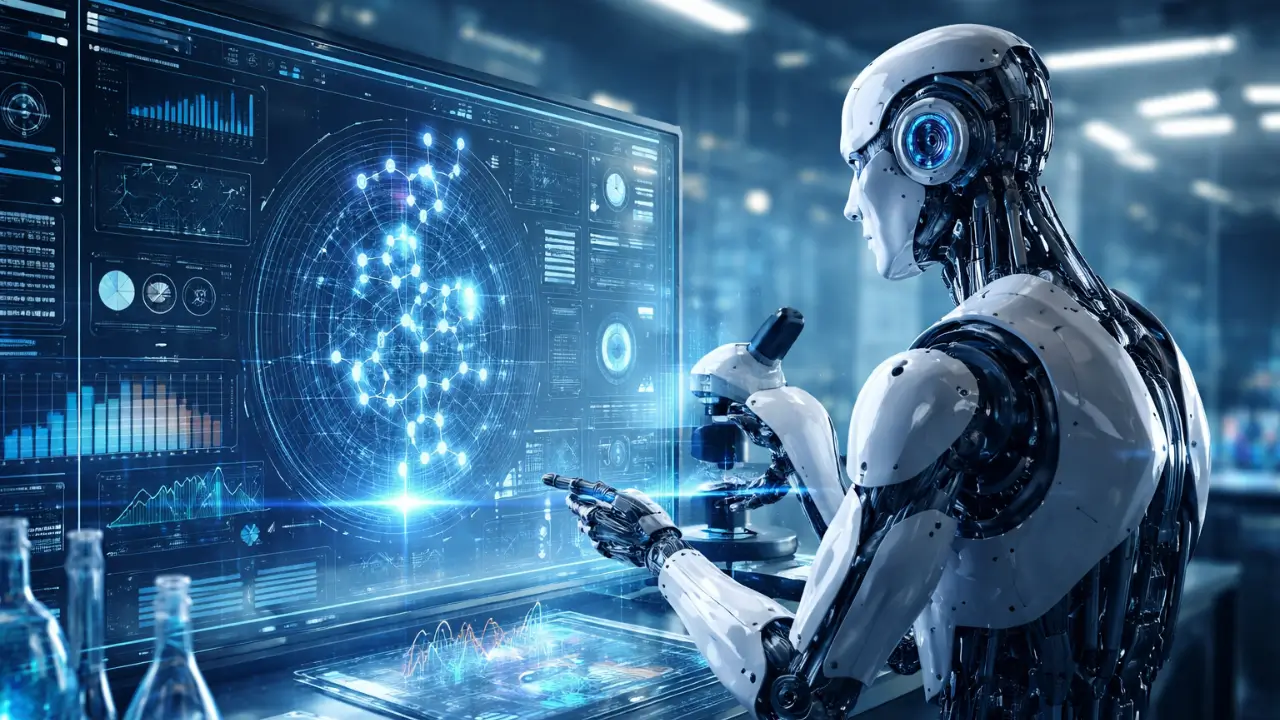
Initially, digital twins developed within industrial engineering as virtual counterparts to physical systems such as turbines, assembly lines, and electrical infrastructure. These early twins integrated sensor data with physics-based models to replicate how assets behaved under operational stress. Over time, advances in machine learning enabled these representations to update continuously rather than remain static. As a result, digital twins evolved from monitoring tools into systems capable of prediction and optimization. This technical progression created an architectural template that researchers later adapted for scientific environments. Consequently, laboratories began exploring how experimental processes themselves could be mirrored computationally.

Why Scientific Automation Needed a Cognitive Core
Meanwhile, laboratory automation expanded rapidly through robotics that could execute protocols with precision and repeatability. However, decision-making around experimental design, interpretation, and iteration remained human-centered. As automation scaled, labs generated increasing volumes of data without equivalent gains in insight. Digital twins addressed this imbalance by introducing a cognitive layer that contextualizes experimental outcomes. Instead of treating experiments as discrete events, twins allow robotic systems to reason across experimental histories. This capability marked a structural shift from automated execution toward autonomous scientific reasoning.
At the operational level, robot scientists depend on digital twins that encode the state of laboratory instruments, reagents, and environmental variables. These models combine real-time telemetry with statistical and physics-informed simulations to estimate experimental outcomes. Based on those estimates, the system selects experiments expected to provide the most informative results. Robotic platforms then carry out the selected protocols under tightly controlled conditions. The resulting data feeds directly back into the digital twin for model refinement. Through this loop, experimentation becomes iterative and self-directed rather than manually sequenced.
Increasingly, self-driving laboratories emphasize continuity across experimental cycles. Rather than resetting after each run, digital twins retain contextual information such as uncertainty bounds and prior assumptions. This persistence enables systems to learn from negative or inconclusive results as well as successes. Reviews of autonomous laboratories describe this approach as continuous learning rather than batch experimentation. However, such persistence depends on careful data management and model governance. Not all automated labs currently implement fully persistent knowledge representations.

Redefining the Role of Human Scientists
As digital twins assume responsibility for routine experimental planning, human scientists increasingly operate at a strategic level. Researchers now define objectives, constraints, and evaluation criteria rather than individual experimental steps. This redistribution preserves scientific judgment while amplifying experimental throughput. Importantly, human oversight remains essential for validating assumptions encoded in computational models. Academic literature consistently emphasizes the need for human-in-the-loop review. Consequently, robot scientists function as extensions of human inquiry rather than autonomous replacements.
Quantified Performance in Early Robot Scientists
Importantly, several numeric performance metrics from early robot scientists can be verified when appropriately contextualized. Published descriptions of the Eve system indicate that it was engineered to support screening rates exceeding 10,000 compounds per day in high-throughput configurations. This capacity reflects the platform’s design potential under controlled research conditions rather than a guaranteed operational norm. Similarly, the earlier Adam system generated over 10,000 reliable experimental measurements per day through continuous monitoring. These figures demonstrate feasibility at the prototype level. They do not represent standardized benchmarks across all autonomous laboratories.
Economic Implications for Research and Industry
From an economic perspective, digital-twin-driven experimentation has shown potential to improve efficiency in targeted research contexts. Studies on Eve demonstrated that machine-learning-guided screening could reduce the number of compounds requiring full evaluation. This approach contrasts with brute-force screening of entire chemical libraries. However, peer-reviewed publications do not provide universal cost-reduction figures. Reported efficiencies depend on assay complexity, domain constraints, and system maturity. Therefore, economic benefits should be interpreted as context-specific rather than generalized guarantees.
Data Integrity and Model Risk
Despite their promise, digital twins introduce new categories of scientific risk. Model drift can occur as experimental conditions evolve beyond the data used for training. Sensor inaccuracies may also propagate errors through decision loops. Recognizing these challenges, researchers emphasize recalibration and cross-validation as standard safeguards. Frameworks such as the NIST AI Risk Management Framework recommend documenting model assumptions and limitations. Trust in autonomous experimentation depends as much on governance as on technical performance.
Standardization and Interoperability Challenges
As adoption expands, interoperability between digital twins becomes increasingly important. Laboratories often rely on heterogeneous instruments that produce proprietary data formats. Without common ontologies, sharing models or workflows becomes difficult. Researchers advocate for machine-readable experiment descriptions and standardized metadata. Initiatives aligned with FAIR data principles aim to address these challenges. Experience from industrial digital twins suggests that standardization is essential for scaling.
Regulatory and Intellectual Property Considerations
In parallel, regulatory and intellectual-property frameworks are adapting to autonomous discovery systems. When a digital twin proposes an experiment and a robot executes it, attribution of invention becomes complex. Organizations such as WIPO have acknowledged that existing IP regimes were not designed for AI-assisted research. Regulatory agencies also require clear audit trails to evaluate safety-critical outcomes. Early adopters increasingly involve legal teams during system design. Formal standards and case law remain in development.
The Near-Term Trajectory of Autonomous Discovery
Looking ahead, evidence suggests that adoption of digital twins in labs will remain incremental. High-value, repetitive tasks such as compound screening and materials optimization will likely dominate early deployments. As models mature, digital twins may encode increasingly subtle experimental relationships. Researchers anticipate hybrid environments where machines handle systematic exploration while humans guide scientific direction. In this configuration, digital twins act as invisible AI brains sustaining experimental continuity. Their influence will expand alongside improvements in modeling and governance.











