 Skip to content
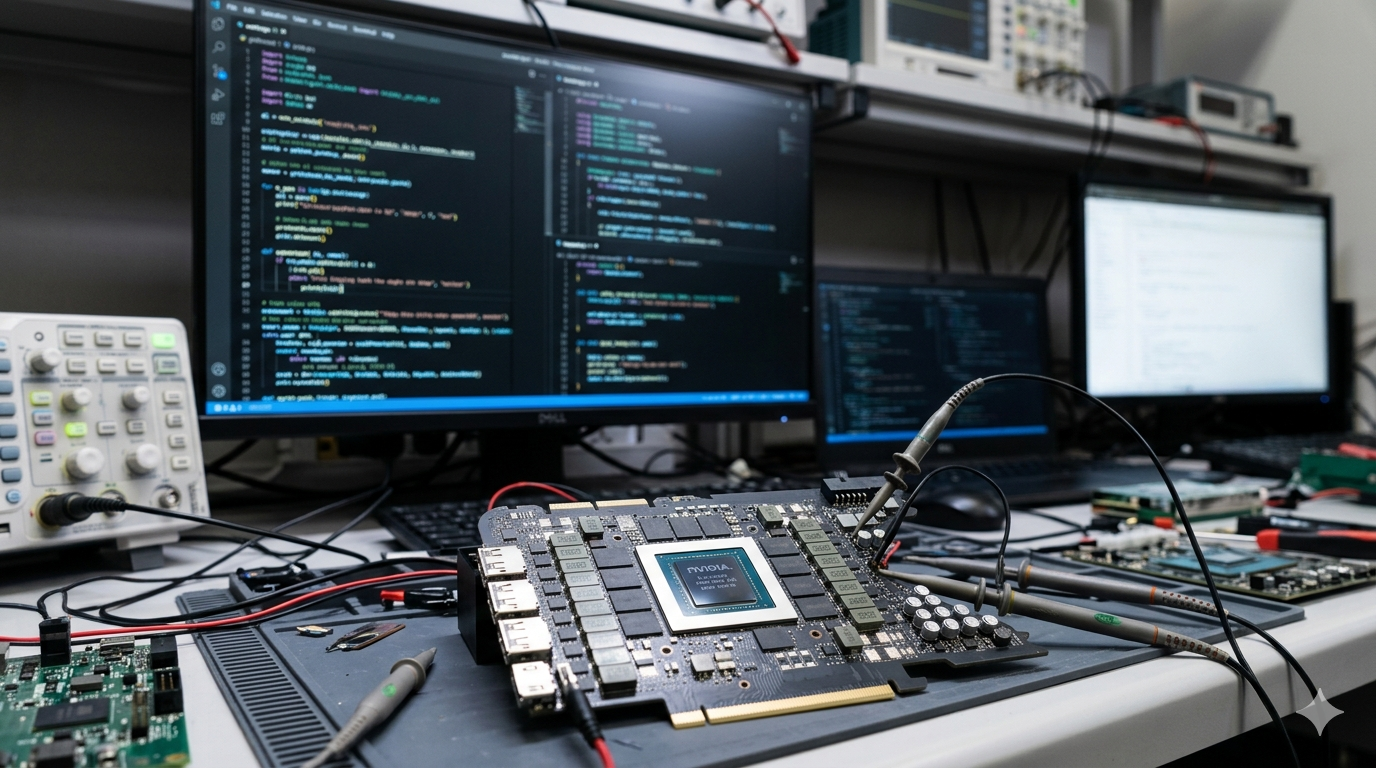
The conversation about AI hardware almost always focuses on the wrong thing. Benchmark scores, teraflops, memory bandwidth, rack power requirements: these are the numbers that fill product announcements and analyst reports. They are real and they matter. But they are not the primary reason why Nvidia has maintained its dominant position in AI compute through three hardware generations, multiple competitive challenges, and the largest infrastructure buildout in computing history.

The real moat is CUDA. Not the GPU. CUDA. Understanding why changes how you evaluate every competitive claim, every custom silicon announcement, and every projection about market share shifts in AI compute over the next five years.
What CUDA Actually Is
CUDA is a programming model that allows software developers to write code that runs directly on Nvidia GPU hardware, using the GPU’s thousands of parallel processing cores to execute computations that would run far more slowly on a conventional CPU. First released in 2006, CUDA gave researchers and developers a general-purpose way to use GPU hardware for non-graphics workloads at a time when doing so required writing specialised graphics shader code. The AI research community adopted CUDA early because deep learning maps naturally onto the parallel processing architecture that GPUs provide. Training a neural network involves repeatedly computing the same mathematical operations across billions of parameters, which is exactly the kind of workload that GPU parallelism accelerates effectively.
Over the years since that early adoption, CUDA evolved from a general-purpose programming interface into an entire ecosystem. Nvidia built libraries, compilers, debuggers, profiling tools, and AI-specific frameworks on top of the core CUDA platform. Libraries like cuDNN for deep neural network operations and cuBLAS for linear algebra are so deeply integrated into the AI software stack that virtually every major AI framework, including PyTorch and TensorFlow, depends on them for performance. The AI development community has not just adopted CUDA. It has built on top of it for nearly two decades, creating a depth of optimisation and tooling that no alternative ecosystem can yet match.

Why Switching Is Harder Than It Looks
Nvidia’s leadership in AI compute stems from software as much as silicon, and this is why every competitive challenge to Nvidia’s GPU dominance has encountered the same fundamental problem: the hardware may be comparable or even superior on some benchmarks, but the software compatibility is not. An enterprise deploying an AI workload on Nvidia hardware benefits from years of community optimisation. The PyTorch kernels that execute critical operations on CUDA-enabled hardware have been tuned, profiled, and debugged by thousands of researchers and engineers across thousands of production deployments. That accumulated optimisation is not transferable to an alternative hardware platform without significant re-engineering effort.
For enterprises running production AI workloads, that switching cost is not theoretical. Teams accustomed to Nvidia’s profiling tools, debugging environment, and library ecosystem face genuine retraining and re-optimisation costs when moving to alternative hardware. Models that achieve certain performance characteristics on CUDA hardware may behave differently on competing platforms, requiring validation that takes time and engineering effort. The risk of performance regression on production workloads is a real deterrent to migration even when the alternative hardware offers comparable raw compute performance on paper.
Where Custom Silicon Fits In
Custom silicon programmes at hyperscalers represent the most credible long-term challenge to Nvidia’s CUDA moat, precisely because they sidestep the moat rather than trying to break it. Google’s TPUs run on a software stack that Google controls entirely. Amazon’s Trainium and Inferentia hardware runs on Neuron, Amazon’s own compiler and runtime framework. Microsoft’s Maia chips run on software that Microsoft optimises for its specific workloads. By building vertically integrated hardware and software stacks for their own workloads, hyperscalers avoid the CUDA compatibility requirement entirely, building parallel ecosystems optimised for their specific model architectures and inference requirements.
The constraint is that this approach only works at scale for organisations that can justify the investment in building and maintaining a custom software stack. Hyperscalers can make that investment because they operate at a scale where even small improvements in cost per token translate into hundreds of millions of dollars annually. Most enterprises cannot. For the broad enterprise market, CUDA compatibility remains a practical requirement that limits how much of the AI hardware market can realistically be contested by non-Nvidia hardware in the near term.
What Changes the Equation
The industry understands the factors that could meaningfully erode CUDA’s software moat over time, even if the timeline remains uncertain. Open-source AI compiler infrastructure, particularly the MLIR and Triton projects, is reducing the effort required to achieve good performance on non-Nvidia hardware by allowing AI models to compile efficiently across heterogeneous architectures. As these tools mature, the optimisation gap between CUDA and alternatives will narrow. Model-level portability is advancing alongside compiler tooling, with AI models increasingly moving from Nvidia training hardware to alternative inference platforms without manual re-optimisation, using export formats and runtime environments that abstract away hardware-specific details. That portability has progressed further in inference than in training, which is why custom silicon has gained more ground in inference deployments than in training workloads.
The CUDA moat will erode. The software ecosystem that Nvidia has built over nearly two decades of AI development is too valuable for the industry to remain permanently dependent on a single company’s platform. But the erosion will happen gradually, driven by specific workloads and deployment contexts where the switching economics become favourable, rather than through a wholesale migration that the benchmark comparisons might suggest is straightforward. Operators and investors who understand that distinction are better positioned to evaluate AI hardware competitive dynamics than those treating the hardware race as a pure specifications contest.












