
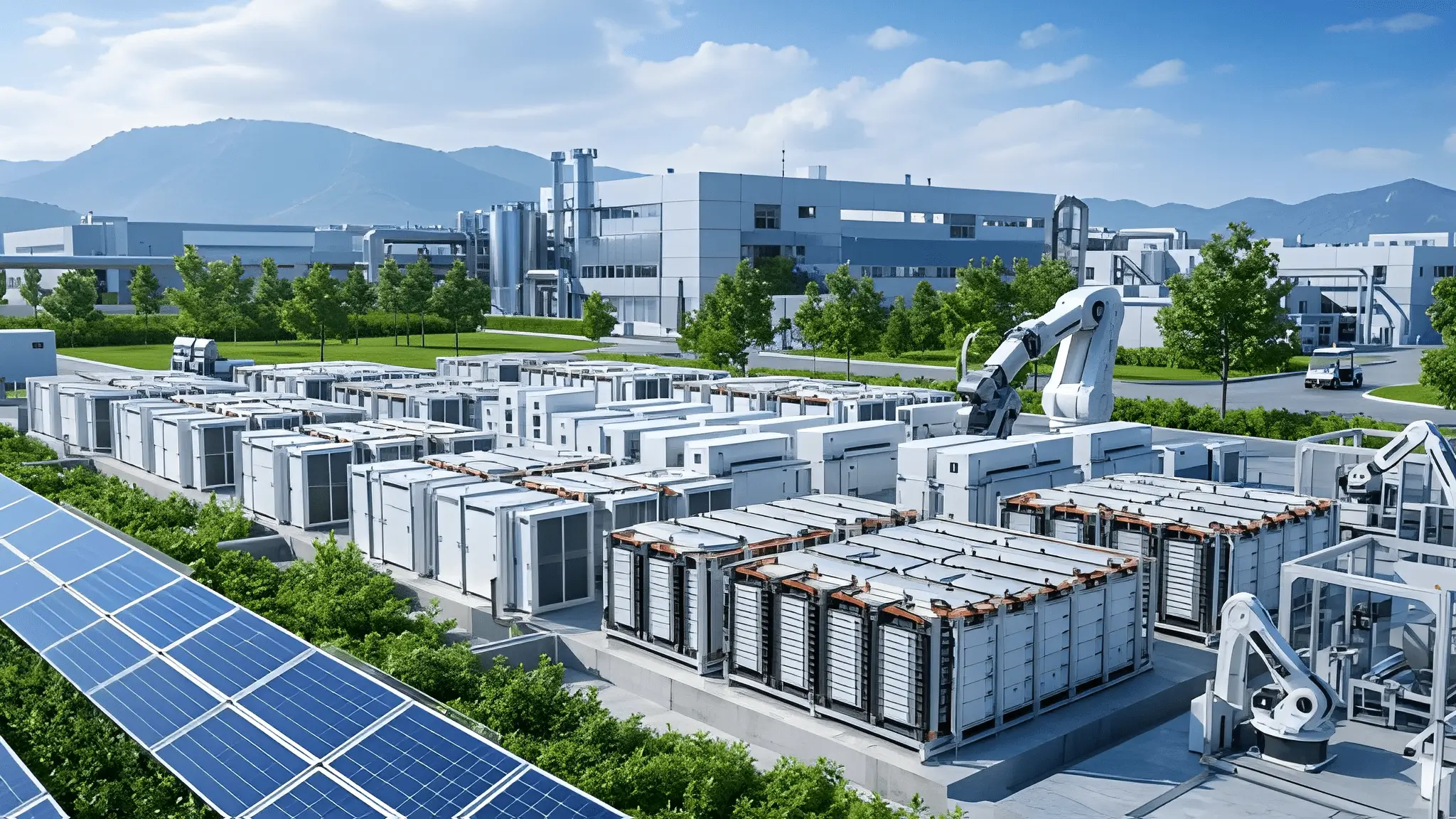
SoftBank Group is moving deeper into the infrastructure stack not just computing, but power itself. Its telecom arm, SoftBank Corp., is preparing to convert part of an Osaka facility into a large-scale battery production line designed to support AI data centers.

The shift signals a broader industry inflection: compute is no longer the only constraint. Energy, how it’s stored, distributed, and secured is becoming the defining bottleneck. Inside Osaka Prefecture, the Sakai plant once considered for robotics is being repositioned as an energy asset. Sources indicate that SoftBank aims to operationalize battery production within five years, aligning manufacturing timelines with its expanding AI infrastructure footprint.
This is not a marginal upgrade. The company is designing a facility capable of producing batteries at gigawatt-hour scale modest compared to China’s largest plants, but significant within Japan’s domestic ecosystem. The intent is clear: build enough capacity to stabilize its own data center operations before expanding outward to enterprise customers.
Masayoshi Son’s Infrastructure Thesis Expands
Masayoshi Son has long positioned SoftBank at the center of the AI economy through aggressive capital deployment. Billions have already flowed into data centers, cloud platforms, and startups including OpenAI.

However, this battery initiative extends that thesis into physical resilience. By integrating energy storage into its stack, SoftBank reduces reliance on external grids and mitigates volatility tied to renewable energy intermittency. The telecom unit has become a key execution layer for this vision structuring partnerships, deploying infrastructure, and now manufacturing critical components.
Chief Executive Officer Junichi Miyakawa is expected to formally unveil the battery initiative as part of an upcoming five-year strategy. The plan remains under internal review, though approval from Son signals strong executive backing. A SoftBank representative declined to comment.
Miyakawa’s broader agenda emphasizes domestic manufacturing resilience. Supply chain disruptions and geopolitical tensions have exposed vulnerabilities across technology ecosystems. Localizing battery production positions SoftBank to operate with greater autonomy while contributing to Japan’s industrial policy goals.
Data Centers Drive Energy Reinvention
SoftBank’s battery push cannot be separated from its data center expansion. The company has already acquired a former LCD facility from Sharp Corporation for ¥100 billion, transforming it into a next-generation data center campus.
With roughly 840,000 square meters of space, the site represents one of Japan’s most ambitious infrastructure conversions. Initial deployment targets 150 megawatts of capacity, with long-term scaling potential exceeding 400 megawatts.
Battery systems will play a critical role in stabilizing these operations, smoothing demand spikes, optimizing load balancing, and ensuring uptime in an increasingly compute-intensive environment.
SoftBank is evaluating multiple battery chemistries for large-scale production. Lithium iron phosphate (LFP) remains the industry standard due to safety and cost advantages. Yet the company is also exploring next-generation alternatives emerging from Japan and South Korea.
The decision carries strategic weight. Chinese manufacturers dominate global battery supply chains, particularly in energy storage systems. According to SNE Research, China accounted for 64% of the ESS market in 2025, far outpacing North America’s 16% share. SoftBank’s technology selection will determine whether it competes on cost parity or attempts differentiation through innovation.
SoftBank’s Endgame: Control the Stack
Battery demand is accelerating globally as renewable energy adoption scales. Intermittency from solar and wind generation creates instability that storage systems must absorb. Data centers among the largest electricity consumers are amplifying this demand curve.
However, Japan faces an additional constraint: grid capacity. Renewable expansion has been limited not by generation potential, but by transmission and storage bottlenecks. Large-scale batteries offer a pathway to unlock that stranded capacity.
SoftBank is not simply building batteries or data centers. It is assembling an integrated infrastructure model where compute, connectivity, and energy operate as a unified system.
This approach reflects a deeper strategic shift across the AI economy. Owning GPUs is no longer sufficient. The companies that control power generation, storage, and optimization will define the next phase of competitive advantage. SoftBank appears determined to be one of them.











