
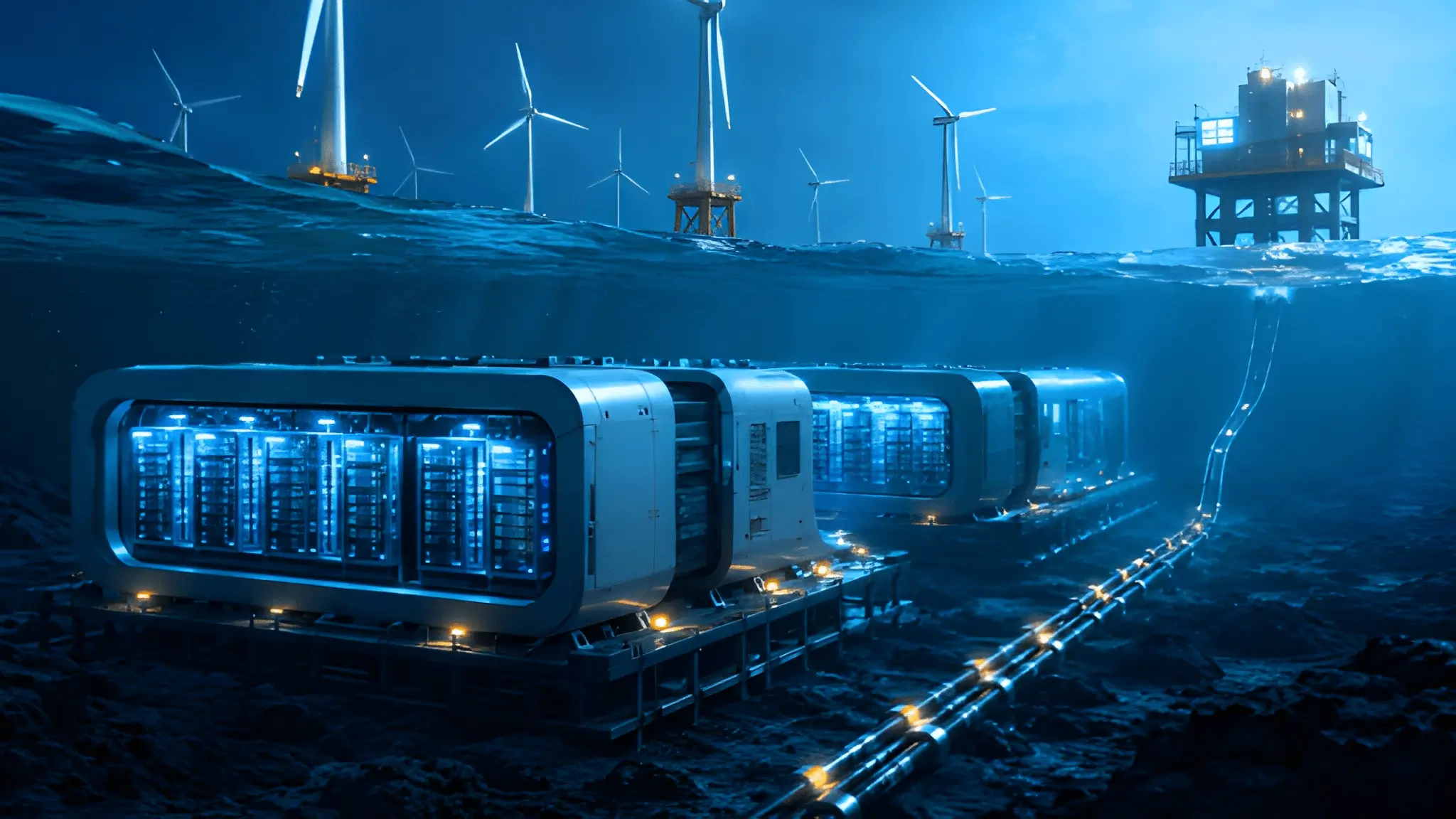
A project that only months ago existed as a promising engineering milestone has now crossed into commercial reality. Off the coast of Shanghai, Chinese engineers have switched on what is being described as the world’s first operational underwater data center powered primarily by offshore wind energy, marking a notable step in the search for alternative infrastructure models capable of supporting the next generation of digital demand. The installation sits within the Lin-gang Special Area and represents a rare attempt to redesign not only how data centers are powered but also where they are physically located. As artificial intelligence workloads place growing pressure on electricity grids, water systems and available land, infrastructure developers have increasingly begun exploring unconventional environments for future compute capacity. China’s underwater facility arrives at a moment when governments and operators are searching for ways to expand digital infrastructure without creating equivalent growth in resource consumption.

The first phase of the project had already been completed by October 2025, yet questions remained regarding when the facility would become fully operational and whether the concept could progress beyond a demonstration stage. Those questions now carry greater significance following the activation of the offshore installation in late May. Unlike conventional data centers that occupy large industrial campuses, the Shanghai facility relocates computing equipment beneath the ocean surface while connecting its operations to nearby offshore renewable generation. The result is a model that combines energy production, cooling infrastructure and digital processing capacity within a tightly integrated coastal system. Industry observers have long viewed underwater computing as a theoretical solution to escalating resource pressures. The transition from construction to operation provides one of the first opportunities to evaluate those assumptions under real-world conditions.
Why Cooling Has Become the Industry’s Biggest Challenge
The timing of the project reflects broader concerns surrounding data center sustainability. While computing facilities do not technically require freshwater to operate, operators often favor it because it simplifies cooling system management and reduces exposure to corrosion, mineral buildup and biological contamination. Freshwater remains easier to process and circulate through cooling equipment than seawater, making it the preferred option across many established facilities worldwide. However, rapid growth in digital infrastructure has intensified scrutiny over water consumption, particularly in regions facing increasing resource constraints. Communities, regulators and utility providers have become more attentive to the cumulative environmental impact of large-scale computing operations. Consequently, the search for alternative cooling methods has become one of the most active areas of infrastructure innovation.
The Shanghai underwater facility addresses this challenge by using the surrounding ocean as a natural heat sink rather than relying on traditional freshwater-based cooling systems. Engineers designed the installation with sealed thermal management architecture that transfers heat away from computing equipment while avoiding direct exposure between sensitive hardware and seawater. This approach allows the ocean itself to absorb thermal loads that would otherwise require substantial mechanical cooling systems. Because cooling typically represents one of the largest operational energy demands within a data center, even modest efficiency improvements can generate meaningful reductions in electricity consumption over time. Supporters of underwater computing argue that the stable temperatures found beneath the ocean surface create conditions particularly well suited to this strategy. If those assumptions hold true over long operating periods, underwater deployments could reshape how operators think about cooling economics.
Offshore Wind Becomes Part of the Compute Stack
The project’s energy architecture adds another dimension to its significance. Built by a subsidiary of China Communications Construction, the facility incorporates a circulating copper-pipe heat exchange system that reportedly reduces electricity consumption by 22.8%. At the same time, nearby offshore wind generation is expected to provide approximately 95% of the electricity required to support operations across the installation’s 192 server racks. Rather than treating renewable energy as a separate procurement exercise, the project integrates power generation and computing infrastructure into a single offshore ecosystem. That alignment reflects a broader industry trend toward locating digital infrastructure closer to dedicated energy sources rather than depending entirely on existing transmission networks. As grid constraints emerge in major technology markets, proximity to power generation increasingly influences infrastructure strategy.
This model also highlights an important shift occurring across the global data center sector. Historically, developers selected locations based on fiber connectivity, available land and access to electricity. Today, power availability often ranks above every other consideration. The rise of AI training and inference workloads has dramatically increased electricity requirements, creating competition for grid resources in many regions. New facilities frequently encounter delays linked to transmission upgrades, interconnection queues or power allocation limits. Under those circumstances, projects capable of pairing renewable generation directly with computing infrastructure attract growing interest from investors and policymakers alike. Shanghai’s underwater deployment therefore serves as a test of whether integrated energy-compute systems can alleviate some of those emerging bottlenecks.

A Platform Designed for Long-Term Expansion
State media reports indicate that the underwater facility currently operates at approximately 2.3 megawatts. While that figure remains modest compared with some of the largest hyperscale campuses under development globally, the project’s future ambitions are considerably larger. Plans call for expansion toward 24 megawatts, a level that some reports compare to the electricity needs of roughly 20,000 households. Such scaling potential reflects a key reality within modern digital infrastructure planning. Operators increasingly prioritize facilities capable of supporting future hardware generations rather than simply meeting present demand. Compute density continues rising as processors become more powerful, making long-term expansion capability a central element of infrastructure value.
That future-oriented approach appears embedded within the design philosophy of the Shanghai project. Instead of constructing a fixed-capacity installation with limited growth options, developers created a platform capable of accommodating additional computing resources as requirements evolve. The strategy mirrors broader trends across the industry, where infrastructure investment increasingly centers on flexibility and lifecycle optimization. Data center operators now evaluate assets not only according to current utilization rates but also based on their ability to absorb future technology shifts. In that context, the underwater facility represents an experiment in designing infrastructure for decades of adaptation rather than a single generation of computing equipment.
Efficiency Gains Could Be Substantial
Researchers and engineers have long argued that underwater environments offer significant thermal efficiency advantages. Tsinghua University Professor Li Zhen highlighted the potential scale of those benefits while discussing the project’s cooling characteristics.
“For an undersea data center of the same scale, the electricity used for cooling would only account for about one-tenth of total power consumption,” Tsinghua University Professor Li Zhen told China Daily. “If data centers of the same scale were placed underwater, even allowing extra margins, cooling consumption could fall to around 30-billion kW. That would save about 50 billion kWh of electricity each year.”
The figures underscore why interest in alternative cooling architectures has accelerated globally. Energy consumption associated with cooling remains a persistent challenge across both enterprise and hyperscale environments. Even incremental efficiency improvements can translate into substantial cost reductions when deployed across large fleets of facilities. Therefore, if underwater deployments consistently demonstrate lower cooling requirements, the economic implications could extend well beyond environmental considerations. Reduced energy demand would affect operating margins, infrastructure planning and power procurement strategies simultaneously. The industry will now watch closely to determine whether operational data supports the theoretical advantages outlined by researchers.
The Risks Beneath the Surface
Despite the project’s technological promise, important questions remain unresolved. Underwater computing remains largely untested at meaningful commercial scale, leaving uncertainty regarding maintenance requirements, equipment longevity and operational resilience. Conventional data centers benefit from decades of accumulated experience and established service ecosystems. Underwater installations do not yet possess the same track record. Operators must demonstrate that submerged infrastructure can withstand long-term exposure to marine conditions while maintaining reliability standards expected by enterprise and cloud customers. Investors and customers alike will seek evidence that the benefits outweigh the added complexity.
Environmental considerations present another area requiring closer scrutiny. Although underwater facilities reduce freshwater consumption and dramatically lower land-use requirements, they introduce new variables into local marine ecosystems. Continuous heat transfer into surrounding waters raises questions about potential ecological effects over extended periods. Scientists and regulators will likely examine whether thermal discharge influences marine habitats, species behavior or broader environmental conditions. These concerns do not necessarily undermine the concept, yet they illustrate why operational performance data will prove essential during the coming years. The technology’s success may depend as much on environmental validation as engineering performance.
A Strategic Test Case for the AI Era
The Shanghai deployment arrives during a period when technology companies are evaluating increasingly unconventional locations for digital infrastructure. Some organizations have explored orbital computing concepts and space-based data centers as potential responses to mounting land and energy constraints. Against that backdrop, China’s underwater project appears notably pragmatic. Rather than pushing infrastructure beyond Earth’s atmosphere, developers have moved it into an environment already capable of providing cooling and proximity to renewable energy resources. The approach addresses immediate operational challenges while generating valuable data about alternative deployment models.
Moreover, the project may ultimately matter less for its current scale than for the questions it helps answer. Can underwater facilities achieve lower operating costs over their full lifecycle? Will marine environments provide a sustainable path for future compute expansion? Can integrated renewable energy systems support growing AI workloads without placing additional strain on terrestrial grids? These are issues confronting infrastructure planners across the world. The Shanghai facility now serves as a live experiment capable of producing real-world evidence rather than theoretical projections.
The broader significance of the project lies in its role as a strategic prototype for a resource-constrained digital future. Demand for computing power continues to accelerate, yet access to land, water and electricity does not expand at the same pace. Consequently, infrastructure developers increasingly seek solutions that deliver more compute without proportionally increasing resource consumption. China’s underwater data center represents one of the most ambitious attempts yet to meet that challenge. Whether it becomes a blueprint for future deployments or remains a specialized niche will depend on years of operational results. For now, however, the facility has moved beyond concept and entered service, giving the industry its clearest view yet of what underwater computing might actually look like at scale.











