
NVIDIA H200 shipments delayed to Q3  · BREAKING: Microsoft confirms 3GW data centre expansion in Asia-Pacific ·  AWS announces new sovereign cloud regions in India and UAE  · Arm-based servers now 24% of hyperscale deployments ·  EU AI Act enforcement enters phase two  · Global data centre investment hits $612B in 2026 ·  TSMC Arizona yields improve to 68% on 3nm process  · OpenAI valuation reaches $400B after latest funding round ·  NVIDIA H200 shipments delayed to Q3  · BREAKING: Microsoft confirms 3GW data centre expansion in Asia-Pacific ·  AWS announces new sovereign cloud regions in India and UAE  · Arm-based servers now 24% of hyperscale deployments ·  EU AI Act enforcement enters phase two  · Global data centre investment hits $612B in 2026

Big Tech Swaps Green Dreams For Natural Gas

The Reality of the AI Power Bottleneck The global technology sector is undergoing a profound structural shift that threatens to

Share
data center natural gas

The Reality of the AI Power Bottleneck

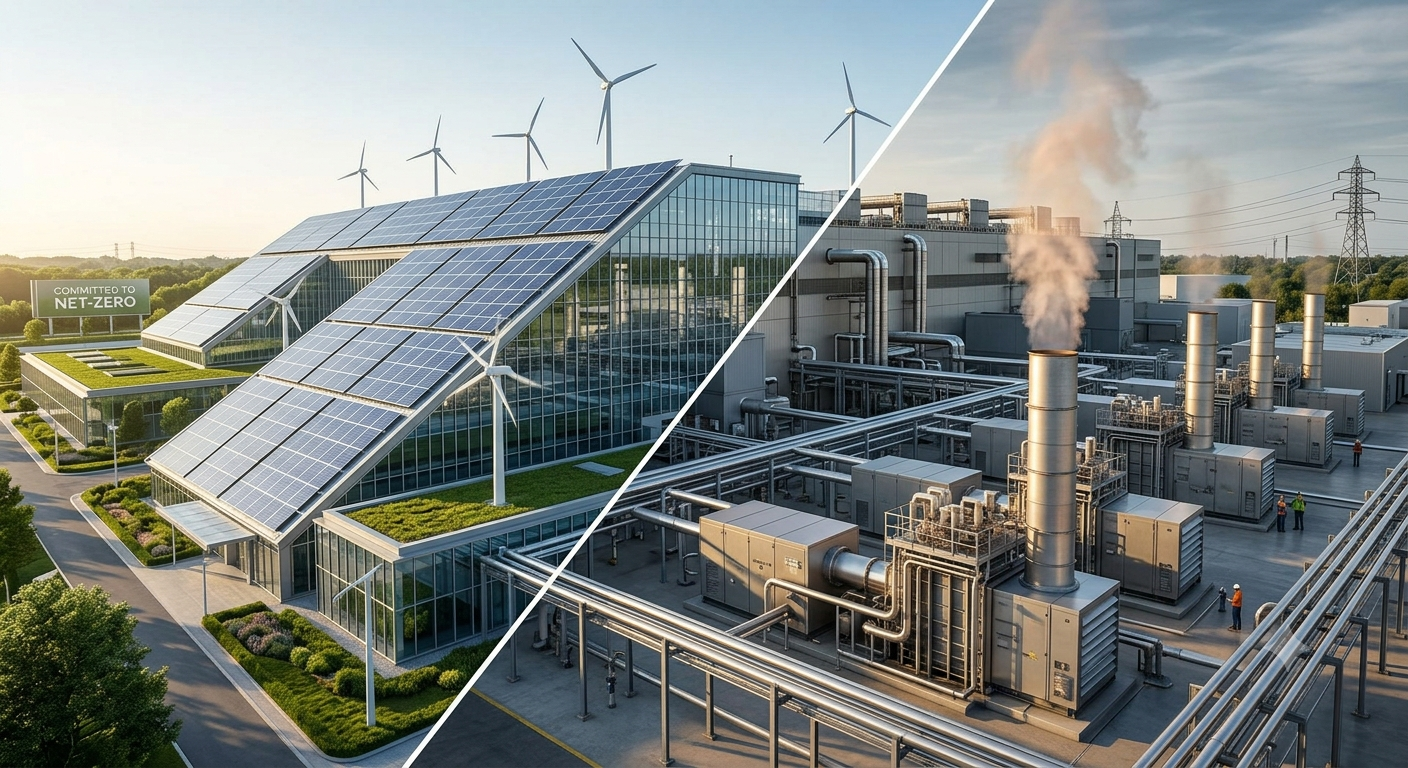
The global technology sector is undergoing a profound structural shift that threatens to destabilize federal and corporate climate mandates. For nearly a decade, hyperscalers led the corporate world in renewable energy procurement, utilizing virtual power purchase agreements to subsidize vast wind and solar farms. However, the explosive emergence of generative artificial intelligence has fundamentally altered the thermodynamic requirements of digital infrastructure. High-density AI clusters demand a continuous, uninterrupted baseload supply of electricity that intermittent renewable assets cannot reliably deliver.

Consequently, a growing rift has emerged between the public sustainability marketing of Silicon Valley and the physical execution of its engineering teams. To secure immediate access to power, developers are turning toward data center natural gas microgrids. This pivot represents a pragmatic response to an overburdened domestic energy grid, but it introduces an immediate surge in localized carbon emissions.

The primary driver behind this fossil fuel resurgence is the structural failure of the American electrical grid infrastructure. Interconnection queues across major regional transmission organizations now feature wait times stretching from seven to 12 years. For tech conglomerates locked in a hyper-competitive race for computational supremacy, waiting a decade for a utility connection is strategically unviable. Speed to market determines corporate valuation and market share in the cloud ecosystem. Therefore, operators are bypassing traditional utility infrastructure entirely. By developing behind-the-meter, on-site generation facilities, technology firms can deploy massive computational campuses in a fraction of the time required for traditional grid integration.

Behind-the-Meter Execution and Corporate Transactions

Recent transactional data highlights the scale of this infrastructure realignment. Microsoft has moved aggressively into alternative power structuring, securing an arrangement with Nscale in West Virginia to support an eight-gigawatt infrastructure cluster starting in 2027. This specific deployment heavily utilizes natural gas microgrid architecture to insulate the campus from local grid constraints. Furthermore, Microsoft has explored a separate 2.5-gigawatt proposal in Texas alongside Chevron and investment firm Engine No. 1. These transactions reflect a broader industry realization that achieving absolute uptime for training next-generation large language models requires substantial fossil-fuel infrastructure nearby.

Meanwhile, other technology firms are deploying similar stopgap measures to ensure operational readiness. In Memphis, Tennessee, xAI installed more than 30 natural gas turbines to provide daily operational power for its massive Colossus data center campus. Local environmental assessments and community disclosures reveal that these units operate continuously, rather than serving as emergency backup assets. While these companies continue to emphasize their long-term commitments to nuclear energy, geothermal power, and advanced battery configurations, the immediate capital expenditure clearly favors readily available gas turbines. The physical assembly lines for natural gas equipment can fulfill orders within months, whereas utility-scale clean energy projects remain bottlenecked by regulatory approvals and transmission line shortages.

The Thermodynamic Dilemma of Modern Compute Workloads

The structural engineering of an AI data center makes natural gas an ideal fuel source from a purely operational perspective. Traditional cloud computing workloads experience cyclical peaks and valleys, allowing operators to modulate power usage throughout the day. Conversely, AI training workloads run at maximum capacity continuously for weeks or months at a time. A single modern hyperscale facility can consume as much energy as 100,000 residential homes. When multiplied across hundreds of planned campuses, the cumulative demand threatens to outpace the total clean energy capacity added to the domestic grid over the last decade.

Faced with this consumption curve, developers face an engineering vacuum. Solar infrastructure operates at a limited capacity factor, and wind generation fluctuates based on atmospheric conditions. Grid-scale battery storage solutions can bridge short-term gaps, but they cannot sustain a multi-gigawatt computing cluster through multi-day weather anomalies. Alternative baseload options, such as small modular nuclear reactors, remain unproven at commercial scale and face protracted regulatory timelines that extend past 2030. Gas turbines offer superior power density, continuous baseload capability, and rapid ramping characteristics, enabling operators to protect delicate hardware from voltage fluctuations.

The environmental implications of this infrastructure pivot are drawing intense scrutiny from climate scientists and energy economists. Analytical data indicates that the ongoing data center buildout will inject millions of additional metric tons of greenhouse gases into the atmosphere annually. So far, Google stands out as the lone major cloud provider attempting to mitigate this trend by integrating carbon capture technology into its natural gas purchase frameworks. However, the vast majority of planned on-site gas installations across the United States lack carbon abatement mechanisms, threatening to reverse years of progress in power-sector decarbonization.

Fragmenting the Architecture of Corporate Accountability

This operational shift is fundamentally fracturing the established frameworks of corporate climate accounting. Historically, technology firms balanced their environmental ledgers by purchasing environmental attribute certificates and renewable energy certificates. These accounting mechanisms allowed companies to claim net-zero carbon status while consuming standard fossil-fuel energy from the public grid. However, the physical realities of on-site natural gas combustion cannot be mitigated through standard accounting maneuvers. Direct, behind-the-meter combustion produces scope 1 emissions that appear explicitly on local air quality registries and national carbon inventories.

This reality complicates the sustainability portfolios of enterprise customers who build applications on top of these cloud architectures. When a business utilizes an AI model hosted within a gas-powered facility, its own scope 3 supply chain emissions rise proportionally. Texas has emerged as the epicentre of this dilemma, accounting for a massive share of the planned natural gas power capacity currently in development nationwide. Estimates indicate that nearly 40 gigawatts of planned gas capacity in Texas will directly fuel digital infrastructure infrastructure, transforming the state into a haven for high-emission computing.

Ultimately, the infrastructure sector faces a critical contradiction between temporal necessity and ecological targets. The immediate financial rewards of AI deployment mandate rapid execution, which only natural gas can deliver under current grid conditions. Yet, every turbine anchored to a data center foundation pushes national net-zero goals further out of reach. Until federal regulators streamline transmission line permitting or clean baseload technologies achieve commercial scale, the physical backbone of the digital frontier will remain tethered to the carbon economy. Big Tech may project an automated, post-carbon future, but the current engine room of artificial intelligence runs on gas.


[simple-author-box]

More from AI Infrastructure

Ireland’s nuclear debate is no longer arriving as an abstract argument about reactor technology.

AI campuses increasingly support workloads with different compute and infrastructure needs. They no longer

India’s AI infrastructure debate is beginning to resemble a question of location more than

COMPUTE WEEKLY

The briefing that 40,000+ tech leaders read every Monday. Sharp, fast, essential.

Great! We’ve received your information.

Building an AI Startup Without Owning GPUs

Not owning GPUs has become the default, deliberate strategy for building an AI company — not a compromise founders accept reluctantly. H100 rental rates fell 64-75% in fifteen months, a dense ecosystem of neoclouds and inference-as-a-service providers now lets startups skip infrastructure entirely, and credit programs can fund a company’s first year before a founder writes a check
Most Read

AI infrastructure decisions for high-density deployments increasingly involve what happens after electricity enters the

Demand is broadening across enterprise workloads APAC’s infrastructure story is changing in ways that

AI infrastructure decisions increasingly influence what enterprises can build, test, and deliver. They also

Why Infrastructure Planning Now Starts With Availability A data center project can have a

A property can look enormous from the site entrance and still offer almost no

Disruptor Spotlight

Cerebras Systems

The chip that makes Nvidia nervous. Cerebras’ Wafer Scale Engine is rewriting the rules of AI inference at scale.
Faster
0 x
YoY Revenue
0 x
Transistors
0 T
Market Pulse
MSFT
+1.02%
NVDA
+0.66%
AMZN
-0.078%
AMD
-6.95%
TSMC
-2.98%
Indicative only · Not financial advice
Upcoming Events
SEP
The AI Infrastructure Race (India)
WEBINAR · ONLINE
The AI Infrastructure Race: Won on Power, Land and Trust — Not Capital
MAY
0
AI Infrastructure Summit
DUBAI · IN PERSON
MEA’s premier AI infrastructure event.
JUN
0 0
Compute Forecast Summit
SINGAPORE · IN PERSON
Our flagship APAC event. Early bird open.
Latest Moves
Live
ecolab
Ecolab Deepens Cooling Strategy With $4.75B CoolIT Acquisition
Ecolab is making one of its biggest moves yet into AI infrastructure after completing its $4.75 billion acquisition of liquid cooling specialist CoolIT Systems
Pure DC AVK Europe data center microgrid Dublin 110MW AI infrastructure Ireland 2026
Pure DC and AVK Deploy Europe’s First 110 MW Data Center Microgrid in Dublin
The Pure DC Dublin microgrid has made history as Europe’s first large-scale on-site data center microgrid, launched in partnership with power solutions provider AVK at Pure DC’s campus in Ireland.
Pace Digitek
Pace Digitek Partners With MEGMEET to Expand AI Data Center Power Business
India’s AI infrastructure ecosystem continues to mature as domestic technology manufacturers move beyond traditional telecommunications and industrial markets toward high-growth digital infrastructure opportunities
Follow Compute Forecast
11K followers
1200 followers
Companies to Watch
CW
CoreWeave
Neo Cloud · $19B · IPO Watch
CB
Cerebras Systems
AI Hardware · $4.25B · Pre-IPO
G42
G42
Sovereign AI · Abu Dhabi
H
Humain
Saudi AI · $40B Fund
Latest Podcast
AI Capex, Cloud Margins & the Nuclear Bet
48 MIN · 25 APR 2026

Big Tech Swaps Green Dreams For Natural Gas

The Reality of the AI Power Bottleneck The global technology sector is undergoing a profound structural shift that threatens to

Share
data center natural gas
29
847 SHARES

0
SHARES

[simple-author-box]

More from AI Infrastructure

AI infrastructure decisions for high-density deployments increasingly involve what happens after electricity enters the

Demand is broadening across enterprise workloads APAC’s infrastructure story is changing in ways that

AI infrastructure decisions increasingly influence what enterprises can build, test, and deliver. They also

Why Infrastructure Planning Now Starts With Availability A data center project can have a

COMPUTE WEEKLY

The briefing that 40,000+ tech leaders read every Monday. Sharp, fast, essential.

Great! We’ve received your information.

Global AI Infrastructure Outlook 2026

The briefing that 40,000+ tech leaders read every Monday. Sharp, fast, essential.
Download Free
Most Read

AI infrastructure decisions for high-density deployments increasingly involve what happens after electricity enters the

Demand is broadening across enterprise workloads APAC’s infrastructure story is changing in ways that

AI infrastructure decisions increasingly influence what enterprises can build, test, and deliver. They also

Why Infrastructure Planning Now Starts With Availability A data center project can have a

A property can look enormous from the site entrance and still offer almost no

Disruptor Spotlight

Cerebras Systems

The chip that makes Nvidia nervous. Cerebras’ Wafer Scale Engine is rewriting the rules of AI inference at scale.
Faster
0 x
YoY Revenue
0 x
Transistors
0 T
Market Pulse
NVDA
$924.60
+2.4%
MSFT
$421.30
+1.1%
AMZN
$192.80
-0.6%
NVDA
$924.60
+2.4%
NVDA
$924.60
+2.4%
Indicative only · Not financial advice
Upcoming Events
MAY
0 0
DCD Global — London
LONDON · IN PERSON
World’s largest DC event. CF is media partner.
MAY
0
AI Infrastructure Summit
DUBAI · IN PERSON
MEA’s premier AI infrastructure event.
JUN
0 0

Compute Forecast Summit

SINGAPORE · IN PERSON
Our flagship APAC event. Early bird open.
Latest Moves
  • Live
Sam Altman
OpenAI appoints new Chief Infrastructure Officer to lead $100B DC programme
27 APR · OPENAI
Sam Altman
OpenAI appoints new Chief Infrastructure Officer to lead $100B DC programme
27 APR · OPENAI
Sam Altman
OpenAI appoints new Chief Infrastructure Officer to lead $100B DC programme
27 APR · OPENAI
Follow Compute Forecast
18.4K followers
12.1K followers
9.3K subscribers
41 episodes
Companies to Watch
CW
CoreWeave
Neo Cloud · $19B · IPO Watch
CB
Cerebras Systems
AI Hardware · $4.25B · Pre-IPO
G42
G42
Sovereign AI · Abu Dhabi
CW
Humain
Saudi AI · $40B Fund
Latest Podcast
AI Capex, Cloud Margins & the Nuclear Bet
48 MIN · 25 APR 2026
Scroll to Top








