
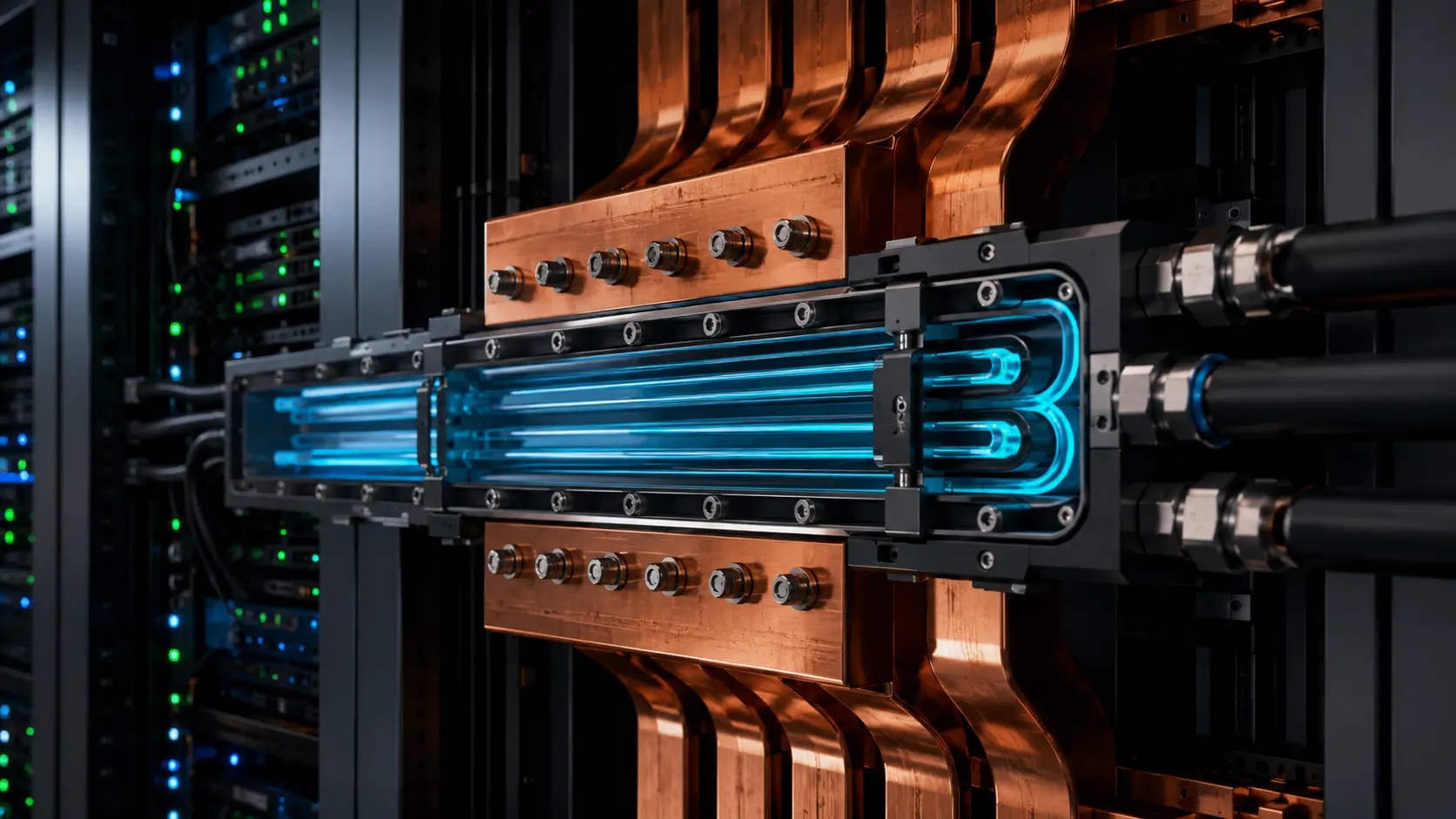
AI infrastructure decisions for high-density deployments increasingly involve what happens after electricity enters the rack, not simply the processors consuming it. Accelerators provide computational capacity, while power delivery, cooling, networking, and other infrastructure layers can influence whether that capacity operates within defined thermal and operational limits. As AI rack densities increase, conductors, connectors, distribution assemblies, and other power components must accommodate higher electrical loads within constrained physical spaces. Heat generated along this path can create localized thermal conditions that affect electrical design, cooling requirements, serviceability, and infrastructure planning. This creates a system-level engineering requirement in which compute, power, and thermal considerations must be evaluated together for dense AI deployments. Molex addresses one part of this challenge with a multi-channel architecture that integrates coolant paths directly into high-current busbar assemblies.

Why the Power Path Is Becoming a Thermal Constraint
Higher Rack Density Changes Where Heat Matters
Most discussions around AI cooling focus first on processors because GPUs and other accelerators create concentrated thermal loads at the compute layer. That perspective becomes incomplete when increasing rack power also raises the current moving through the electrical distribution infrastructure surrounding those processors. Busbars perform the essential task of carrying large amounts of electrical power, while resistance within any conductor converts part of that electrical energy into heat. Higher current requirements can therefore increase thermal pressure inside components that previously received less attention in cooling strategies. Operators must now evaluate the power path alongside servers because a thermally constrained distribution layer can limit the practical density of the overall rack. For end users, this means infrastructure planning increasingly requires coordinated decisions across compute, electrical distribution, and cooling rather than separate optimization of each domain.
Molex positions its new architecture around the thermal and electrical challenges associated with higher-density AI infrastructure. Its current design supports up to 15,000 amps, and the company has outlined a roadmap toward 25,000 amps for future development. Those figures should not be interpreted as a universal requirement for every AI deployment because rack designs, electrical architectures, and workload profiles differ substantially between facilities. They do, however, demonstrate the current range that Molex is targeting for high-current power distribution applications. A busbar that carries higher current within a defined mechanical footprint can provide system designers with additional flexibility when balancing electrical capacity and physical rack constraints. In dense rack environments, changes to conductor dimensions, component spacing, or cooling arrangements can also affect the space available for other infrastructure elements.
Extending Thermal Management Into Electrical Distribution
Cooling the Conductor Instead of Only the Compute
Molex’s approach moves thermal management closer to the electrical conductor by incorporating coolant channels within the power-distribution assembly. This differs from a design philosophy that concentrates liquid infrastructure primarily around CPUs and GPUs while managing other heat-producing components through separate thermal approaches. The company says its multi-channel architecture can incorporate as many as seven discrete coolant paths, allowing heat extraction across a broader internal structure. According to Molex, distributing coolant through multiple channels enables more uniform heat extraction and is designed to reduce thermal stress within the busbar assembly. For operators, this architecture provides an example of how power delivery can be integrated with a rack’s broader cooling strategy rather than treated as an entirely separate subsystem. However, the practical benefits of this integration will depend on the specific electrical, mechanical, and cooling architecture used in each deployment.
The technical case for this approach depends on how the design manages heat at sustained high current within its specified operating conditions. Molex reports a temperature rise of 15 degrees Celsius at 15,000 amps for its multi-channel design as a benchmark for the architecture’s thermal performance. The company also states that simulations show up to 20% greater cooling efficiency for the seven-channel configuration compared with a single-channel design. Because this comparison is based on Molex’s own simulation data, the result should be evaluated within the operating conditions and assumptions defined by the company. Production performance can vary according to the deployed configuration, operating conditions, and cooling-loop design. Therefore, the broader significance of the architecture is its integration of active cooling into the high-current power-distribution layer.
What Multi-Channel Designs Could Change for Rack Architecture
More Uniform Heat Removal Within Existing Space
Physical space is an important design consideration inside dense AI racks, where compute trays, networking hardware, power components, cooling connections, and service access must coexist. Molex says its multi-channel design is intended to maximize heat extraction within the same mechanical footprint, addressing the challenge of increasing electrical capacity without expanding the component’s physical space. That proposition can be relevant for operators because changes to infrastructure dimensions can affect rack layouts, enclosure design, and maintenance procedures. A power-distribution assembly designed to operate within a defined footprint can preserve physical space for other rack components. According to Molex, the multi-channel architecture also enables more uniform heat extraction and is designed to reduce thermal stress across the busbar. Meanwhile, the resulting thermal performance depends on the complete cooling system, including the conditions under which coolant is supplied and circulated through the assembly.

Multi-channel cooling illustrates how thermal performance in high-density infrastructure can depend on the interaction between several system components rather than on a single cooling device. A processor may use direct cooling while adjacent electrical infrastructure generates additional heat that requires separate thermal management. Integrating cooling into different heat-producing components can provide system designers with additional options for managing rack-level thermal conditions. The resulting architecture requires engineering consideration of fluid connections, pressure characteristics, materials compatibility, and service procedures within the overall system design. Molex states that its busbar designs support dielectric and non-dielectric liquids, allowing the architecture to accommodate different cooling approaches. For C-level decision makers, the central question is whether the complete system design delivers the required electrical and thermal performance within acceptable operational and economic constraints.
Integration Will Matter as Much as Thermal Performance
Avoiding a Complete Rack Redesign
New thermal technologies can offer practical value when their physical and operational characteristics align with deployable infrastructure requirements. Molex says its busbar design allows configuration of length, depth, and fluid inlet and outlet positions to accommodate different physical layouts. The company also describes a plug-and-play interface intended to support integration into compatible rack architectures. Such flexibility can be relevant for operators managing different equipment generations or planning infrastructure upgrades across large facilities. Integration remains an important consideration because liquid-cooled assemblies require appropriate installation, monitoring, and maintenance procedures within the broader infrastructure environment. Consequently, procurement teams can evaluate the technology as part of a complete infrastructure design rather than assessing the busbar solely on its current-carrying or cooling specifications.
Standards compatibility can influence how new power-distribution technologies integrate into broader infrastructure environments. Molex states that its architecture maintains footprint compatibility with Open Compute Project ORV3 and High Power Rack mechanical standards. This compatibility can be relevant to operators seeking to align power-distribution components with established rack specifications as equipment requirements evolve. Depending on the existing infrastructure and deployment plan, compatible mechanical interfaces may reduce the scope of physical redesign required during upgrades. The potential benefit will vary according to the equipment, rack architecture, and capacity requirements of each deployment. From an end-user perspective, interoperability and serviceability are relevant considerations alongside electrical and thermal specifications because they can affect deployment and lifecycle management.
The Infrastructure Opportunity Extends Beyond Accelerators
Power and Thermal Systems Become Strategic Assets
AI investment discussions often concentrate on processors, memory, and the companies producing computational hardware. Large-scale AI deployments also require physical infrastructure for power distribution, thermal management, connectivity, mechanical integration, and system operation. High-current busbars provide one example of infrastructure components designed to address the electrical and thermal requirements associated with dense computing environments. The engineering challenge involves delivering electrical power through components that must operate within their specified electrical and thermal limits. This creates a direct relationship between electrical design and thermal management in high-density rack architectures. As a result, power distribution, thermal interfaces, connectors, networking, and mechanical integration form part of the broader infrastructure required to support large-scale computing deployments.
For enterprise buyers and infrastructure leaders, this relationship supports a broader evaluation framework when planning AI capacity. Additional accelerator capacity requires corresponding infrastructure for electrical power delivery, cooling, networking, and physical integration. Constraints in any of these infrastructure layers can affect the deployment and operation of the overall system. Molex’s development provides one example of how suppliers are redesigning power-distribution components to address higher-current and thermal requirements. The long-term importance of such technologies will depend on demonstrated performance, integration economics, reliability, and compatibility with evolving rack standards. Still, the technology illustrates how power delivery and thermal management can be addressed together within a high-density infrastructure design.
What Data Center Leaders Should Evaluate Next
Designing for Capacity Without Creating New Constraints
Liquid-cooled power distribution provides one reason for infrastructure leaders to examine where thermal constraints may emerge as AI environments increase in density. That assessment can include current requirements, conductor temperatures, available rack space, coolant architecture, pumping requirements, service access, and compatibility with planned hardware generations. Molex specifies an operating flow range of approximately one to ten liters per minute and an end-to-end pressure drop below one bar under its stated operating conditions. These parameters are relevant inputs for cooling-loop integration and can influence hydraulic and pumping considerations. Operators should assess such specifications against their own thermal loads, cooling architecture, and facility requirements before applying them to a deployment. The appropriate design approach can differ between greenfield campuses and existing facilities because each environment may operate within different electrical, mechanical, and cooling constraints.
As AI infrastructure moves toward higher-density rack configurations, the associated electrical and thermal requirements become increasingly relevant to system design. Molex’s multi-channel busbar architecture provides one approach by integrating active cooling into the high-current power-distribution layer. Its currently stated support for up to 15,000 amps, roadmap toward 25,000 amps, and seven-channel configuration show the specifications Molex is targeting for this architecture. The broader infrastructure design requires coordination across compute, power, thermal, mechanical, and operational considerations. Organizations can assess these dependencies during planning to evaluate capacity expansion as an interconnected infrastructure system. For end users, the objective is to deploy the required AI capacity within the electrical, thermal, operational, and reliability requirements of the overall environment.











