 Skip to content
The Supercycle That Is Eating Its Own Infrastructure
The narrative of the AI infrastructure supercycle is one of relentless expansion: more chips, more data centres, more power, more capital. That narrative is accurate in the aggregate. It is misleading in the specific. Within the supercycle, a structural dynamic is playing out that the aggregate figures conceal entirely: the arrival of each successive GPU generation is not simply adding capacity to the existing fleet. It is displacing that fleet, evicting functional, three-year-old hardware from premium data centre floor space and grid allocations to make room for hardware that consumes power at densities the original facilities were never designed to support. The NVIDIA Hopper architecture, which represented the pinnacle of AI hardware as recently as 2023 and which anchored the first wave of serious enterprise AI deployment, is now being cascaded out of the primary data centre tier and into secondary markets at a pace that the depreciation schedules governing its acquisition did not anticipate.

This eviction is not driven by Hopper hardware failing. The chips work. The clusters run. The models they train and the inference they serve are commercially productive. The eviction is driven by something more prosaic and more financially consequential: premium data centre floor space and grid-connected megawatts are finite commodities, and the next generation of hardware demands so much more of both that continuing to occupy that space with Hopper is, from the perspective of any operator racing to deploy Blackwell and Rubin at scale, an economically irrational allocation of the scarcest resource in AI infrastructure.
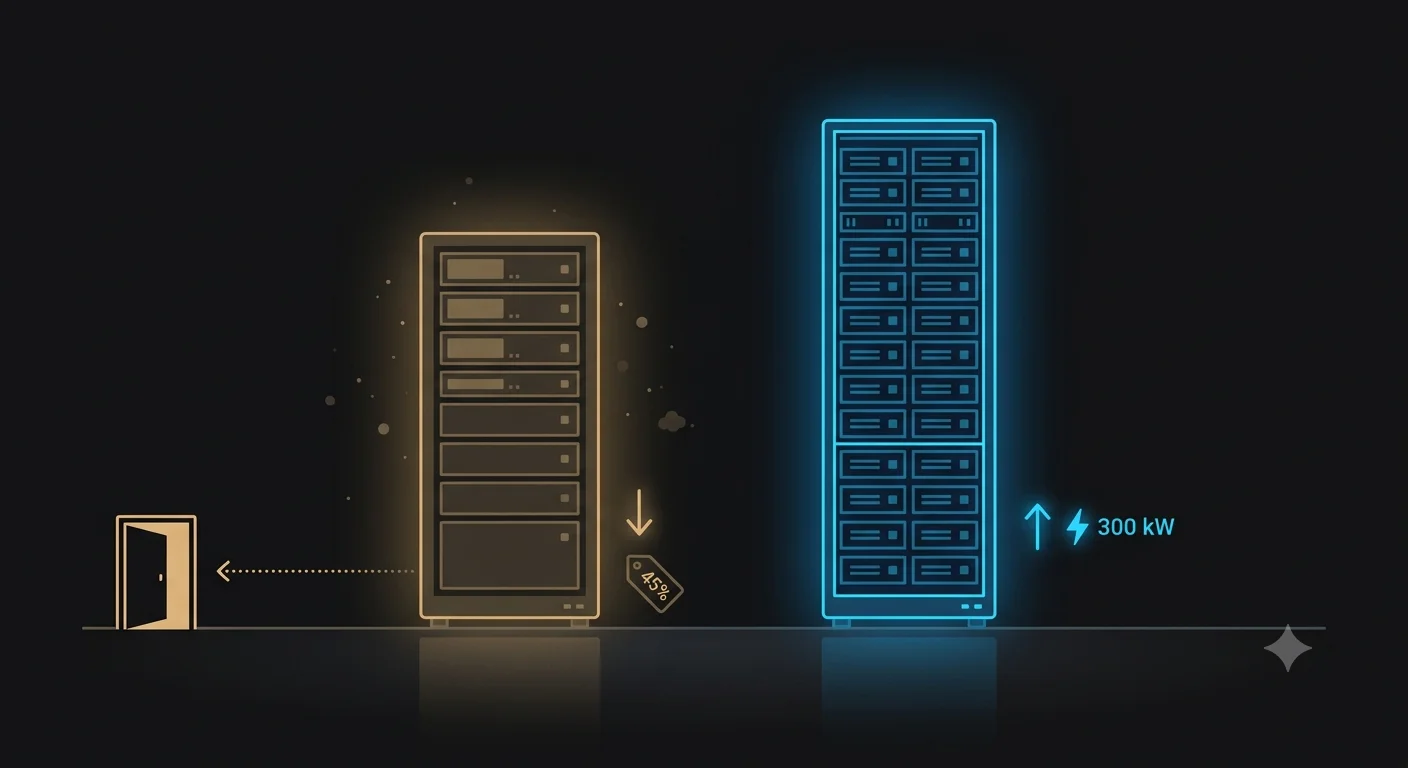
EdgeCore SVP Tom Traugott captured the progression with a precision that most vendor communications prefer to soften: what looked ambitious in 2023 is the desired specification for supporting AI leading edge workloads in 2025, and will become the minimum specification for even denser GPU servers in 2026. The rack power trajectory makes that statement concrete. A rack of eight Hopper H100 SXM5 GPUs at full load draws approximately fifty-six kilowatts. Nvidia’s Blackwell GB300 NVL72 configuration reaches one hundred and sixty-three kilowatts per rack. The Vera Rubin NVL144 systems arriving in the second half of 2026 require three hundred-plus kilowatts per rack. Rubin Ultra NVL576 racks are projected to exceed six hundred kilowatts per rack by 2027. Google’s Project Deschutes has already unveiled a one megawatt rack design. Within a four-year window, the rack power requirement for frontier AI hardware has increased from fifty-six kilowatts to a potential one thousand kilowatts, a nearly twenty-fold multiplication that the physical infrastructure of 2022-vintage data centres cannot accommodate by any amount of incremental modification.
The Physical Impossibility at the Heart of the Eviction
The specific mechanism driving Hopper evictions is worth examining precisely, because it is not the chip that creates the incompatibility. It is the building. A data centre designed to support Hopper-density workloads was typically built to accommodate rack loads in the range of fifteen to twenty-five kilowatts, with raised floor systems engineered for a specific weight bearing capacity, power distribution infrastructure sized to the aggregate draw of a Hopper-density deployment, and cooling architecture, almost universally air-cooled, rated for the thermal output that fifteen to twenty-five kilowatt racks generate. None of these parameters are adjustable in meaningful increments without structural intervention.

Liquid cooling is not optional for Blackwell at the GB200 NVL72 level, and it becomes physically mandatory as densities progress toward Vera Rubin. Air cooling cannot dissipate one hundred and forty kilowatts per rack at any fan speed that is commercially tolerable from a noise, energy consumption, and component reliability perspective. Installing direct-to-chip liquid cooling inside a facility built for air cooling requires floor penetrations for coolant supply and return lines, leak detection infrastructure integrated into raised floor systems that were engineered without it, structural modifications to support the weight of fully loaded liquid-cooled racks that can approach and exceed three thousand pounds, and heat rejection infrastructure connected to the facility’s chilled water or dry cooler plant at a capacity the original design never budgeted for. Introl’s analysis of legacy data centre retrofit costs placed floor reinforcement alone at approximately two hundred dollars per square foot, with total cooling retrofit costs for high-density AI workloads in the range of five hundred to one thousand five hundred dollars per kilowatt, translating to sixty thousand to one hundred and ninety-five thousand dollars per NVL72 rack before any hardware is installed.
For a neocloud or colocation operator sitting on a 2022-vintage facility financed around Hopper-density assumptions, this cost arithmetic produces an immediate strategic binary. Option one: invest the retrofit capital, evict the Hopper fleet to reclaim floor space and power budget, and redeploy those resources at the density that Blackwell and Rubin demand, accepting the capital expenditure of retrofit alongside the capital expenditure of new hardware. Option two: maintain the Hopper fleet in its existing facility without retrofit, accepting that this floor space and power budget will serve only Hopper-density workloads as a permanent ceiling, while watching the hardware’s commercial value erode as the customer base with genuine frontier AI workloads migrates to operators who have made the Blackwell transition. Neither option is comfortable. Together they define the great eviction’s economic logic.
The Depreciation Fiction That Michael Burry Named
The financial dimension of Hopper eviction is not limited to the capital expenditure of retrofit and replacement. It extends into the accounting treatment of the hardware being displaced, and the gap between how GPU assets are carried on balance sheets and how long they actually retain commercial relevance is, according to at least one prominent analyst, one of the largest unacknowledged financial risks in the AI infrastructure sector.
Most data centre operators and neoclouds depreciate their GPU hardware over five to six year useful lives. This accounting convention treats a rack of H100s purchased in 2023 as a productive asset through approximately 2028 or 2029. The hardware may, in a literal engineering sense, continue functioning until 2028. The question Michael Burry raised publicly in November 2025 is whether functional and commercially valuable are the same thing in a market where Blackwell has already arrived and Vera Rubin is six months away. Burry’s analysis placed the economic useful life of current-generation AI GPUs at two to three years rather than five to six, implying approximately one hundred and seventy-six billion dollars of understated depreciation across major AI spenders for the 2026 to 2028 period. That figure is not a rounding error. It is, if accurate, a systematic overstatement of asset values across every balance sheet in the sector that financed GPU clusters on five-year depreciation assumptions.
The ModulEdge analysis of neocloud economics in June 2026 frames the depreciation risk with operational specificity. Newer silicon holds a scarcity premium for a while, the analysis notes, and the playbook is to ride each generation’s premium before it erodes. B200 instances average approximately six dollars and fifty cents per GPU hour in 2026. GB200 rack-scale deployments reach seventeen dollars and eighty-five cents per hour. Over a typical five-year depreciation horizon, as McKinsey’s neocloud analysis documented, the price of a GPU hour declines by half or more, requiring operators to recover capital within the first four to five years after the GPU becomes active before the asset’s pricing power erodes to a level that cannot service the debt used to finance its acquisition. The math works when utilisation is high and the hardware remains relevant to the customer base. It stops working when the hardware is commercially cascaded to secondary use cases before the depreciation schedule has run its course.
The Utilisation Cliff That Precedes the Eviction
The eviction rarely arrives as a sudden decision. It arrives as a utilisation problem first, and operators who are watching the right metrics can see it coming months before the hardware is physically displaced. The utilisation dynamics of a Hopper cluster under commercial pressure from Blackwell availability follow a predictable deterioration curve that the neocloud economics literature has now documented with enough granularity to treat as a pattern rather than an anecdote.
A Hopper cluster at eighty-five percent utilisation is a profitable asset generating strong returns against its financing cost. The same cluster at sixty percent utilisation is consuming power, occupying floor space, and paying its depreciation clock, but generating insufficient revenue to service its debt adequately. The transition between these two states is not primarily driven by the cluster’s performance degrading. It is driven by customer migration: enterprise customers who committed to Hopper in 2023 and early 2024 for experimentation and initial production deployment are renewing contracts in late 2025 and 2026 with evaluation criteria that have shifted from access to compute to access to current-generation compute. The Vultr analysis of renewal dynamics was explicit on this point: initial commitments signed in 2024 and 2025 come up for renewal in late 2026 with evaluation criteria shifting from experimentation requirements to production-grade performance requirements.
The customer who ran proof-of-concept workloads on H100s and found them adequate for the exploration phase has spent that exploration phase learning what frontier production workloads actually require. When they return to sign a production-scale contract, they are asking whether Hopper is the right foundation for a three-year production commitment, not whether it was adequate for a six-month pilot. The answer, for any customer running the most demanding training and inference workloads, is increasingly no. The neocloud whose fleet is predominantly Hopper at this renewal juncture faces a specific and uncomfortable commercial decision: accept lower renewal rates to maintain utilisation, or lose the customer to a Blackwell-equipped competitor at a rate that reflects the hardware differential, compressing margins in either case.
The break-even analysis that makes this utilisation cliff financially dangerous is not abstract. American Compute’s 2026 modelling of a one-thousand-and-twenty-four GPU H100 cluster found the monthly swing between fifty-five percent and eighty-five percent utilisation to be six hundred and seventy thousand dollars, the difference between a three-hundred-and-thirty-thousand-dollar monthly loss and a three-hundred-and-forty-thousand-dollar monthly gain. On a cluster financed with hundreds of millions of dollars of debt, a sustained period at sixty percent or below is not a performance shortfall. It is a path to covenant breach. The operators who evict their Hopper fleets proactively, before the utilisation cliff arrives, are making a capital allocation decision that preserves optionality. The operators who wait until the cliff arrives are making a distressed disposal decision, and distressed disposals happen at prices that reflect the seller’s urgency rather than the asset’s residual value.
The Cascade and Its Commercial Consequences
The Hopper GPU being displaced from a premium hyperscale or neocloud deployment does not simply disappear from the market. It cascades down through successive tiers of use case and customer profile, in each case at a price that reflects its declining relevance to frontier AI workloads. The cascade follows a recognisable pattern that the history of semiconductor markets has produced across multiple prior technology generations, from gaming GPUs displaced by successive architecture generations to server processors pushed from enterprise tier to SMB tier to end-of-life support as newer generations arrive.
AWS’s mid-2025 decision to slash H100 instance prices by up to forty-five percent signalled the cascade’s arrival at the hyperscaler tier with unusual clarity. A forty-five percent price reduction on compute that cost the same two years earlier is not a routine pricing adjustment. It is a market signal that the commercial relevance of H100 for workloads willing to pay premium prices has declined materially, and that the hyperscaler is willing to compress margin significantly to maintain utilisation rather than accepting idle capacity on hardware whose depreciation clock is running regardless of whether any customer is using it. The ModulEdge analysis captures the utilisation mathematics with unambiguous precision. On a one-thousand-and-twenty-four GPU H100 cluster, the difference between fifty-five percent utilisation and eighty-five percent utilisation is the difference between a monthly loss of three hundred and thirty thousand dollars and a monthly gain of three hundred and forty thousand dollars. A debt-financed cluster breaks even around seventy percent utilisation. Bare-metal gross margins run fifty-five to sixty-five percent before depreciation, leaving almost no margin of safety for periods of underutilisation.
For neoclouds that built their initial fleet around Hopper and financed it on the assumption that five-to-six year useful lives would allow debt service from the revenue generated across that period, the cascade creates a direct financial stress. The Vultr analysis of neocloud consolidation risk, published in January 2026, identified faster obsolescence as among the most material risks facing the neocloud sector: AI hardware cycles are shortening, and new GPU generations can pull forward replacement decisions in ways that were not priced into the original financing structure. Initial enterprise commitments signed in 2024 and 2025 will come up for renewal in late 2026 with evaluation criteria that have shifted from experimentation requirements, where Hopper was adequate, to production-grade performance requirements, where the gap between Hopper and Blackwell is commercially meaningful.
The Neocloud Consolidation the Eviction Is Accelerating
McKinsey’s November 2025 analysis of neocloud evolution identified three economic realities that determine whether a neocloud operator survives the great eviction or becomes a casualty of it. The capital requirement overwhelms most players. The analysis projected three point one trillion dollars flowing into chips and computing hardware by 2030, with GPU capital costs running three point seven times higher than hosting costs in the current market. Even Microsoft, with effectively unlimited capital, has signed thirty-three billion dollars in external GPU deals with neoclouds rather than building all capacity internally, a fact that signals the capital intensity of the transition rather than any lack of hyperscaler commitment. The operators who can access Nvidia allocation at the Blackwell and Vera Rubin tier, finance that allocation through structured credit facilities or hyperscaler offtake agreements, and deploy at the physical density these hardware generations require are the operators who will capture the next phase of neocloud revenue growth. Those who cannot will be rationalised.
CoreWeave’s position illustrates the survivor profile. The company entered 2026 with a sixty-six-point-eight billion dollar contract backlog, deploying Blackwell GB300 GPUs at scale while hyperscalers were still integrating the same generation across their global footprints. Its Abilene Stargate campus, developed through its partnership with Crusoe, was targeting four hundred megawatts of total capacity by mid-2026, with a potential full build-out of one point two gigawatts. The capital structure supporting this deployment, including the offtake agreements from OpenAI and Microsoft that underwrite the revenue projections, reflects the model that McKinsey’s analysis described as viable: using large, lower-margin hyperscaler offtake agreements to finance fleet acquisition at scale, then extending asset economic life by renting at lower rates to enterprise customers who do not need frontier-generation hardware once the primary contracts wind down.
The operators without this capital structure and without Nvidia allocation at the next-generation tier face the eviction problem from both sides simultaneously. Their Hopper fleet is being cascaded in commercial relevance and repriced downward by hyperscaler price cuts. Their ability to replace it with Blackwell or Rubin hardware is constrained by allocation scarcity and by the capital requirements of the retrofit or new-build infrastructure those hardware generations demand. The consolidation wave the Vultr analysis described is, at its root, the market’s mechanism for distributing the finite supply of next-generation GPU allocation and premium AI-ready floor space to the operators who can use it most efficiently, while rationalising the operators who cannot.
The Power Constraint That Makes Eviction Irreversible
The eviction story would be complex enough if data centre floor space were the only finite commodity creating the displacement pressure. The grid megawatt adds a second, less negotiable layer of scarcity that makes the eviction dynamic structurally irreversible at the speed the AI hardware cycle is moving. A data centre operator who evicts a Hopper cluster to make room for Blackwell is not simply swapping hardware in an otherwise unchanged facility. They are reallocating a grid allocation, a secured power commitment from a grid operator that may have taken years to obtain and that cannot be duplicated on a short timeline, from a workload drawing fifty-six kilowatts per rack to one drawing one hundred and sixty-three kilowatts per rack.
The power constraint that has been documented across European, American, and Asian data centre markets confirms that the grid allocation itself, not the floor space and not the GPU hardware, is in many markets the binding resource. New high-capacity grid connections in Northern Virginia, Dublin, Singapore, and Amsterdam face four to seven year wait times. Interconnection queues in the United States alone exceeded one thousand five hundred gigawatts as of 2025 according to Lawrence Berkeley Lab data. High-capacity transformers now carry lead times of up to four years. In this environment, the operator who holds a secured power connection for one hundred megawatts at an AI-ready facility holds an asset whose replacement cost, measured in years of grid queue time, substantially exceeds the cost of any individual hardware generation. That asset becomes dramatically more productive when deployed at Blackwell density rather than Hopper density, because the same one hundred megawatts of secured power supports roughly three times as much AI compute throughput at Blackwell’s performance-per-watt metrics.
The implication for Hopper hardware sitting on secured power in a premium facility is that the opportunity cost of maintaining it there, rather than evicting it and deploying denser hardware on the same power budget, compounds with each passing quarter as the performance-per-watt gap between generations widens. An operator who chose not to evict Hopper in 2025 while Blackwell was available will face a larger performance-per-watt penalty for the same choice in 2026 as Vera Rubin arrives, and a larger one again in 2027 as Rubin Ultra pushes toward six hundred kilowatts per rack. The eviction is not a one-time event. It is a continuous pressure applied by the hardware roadmap against the finite supply of premium AI-ready power, and that pressure does not diminish over time. It accelerates.
The Floor Space Arithmetic That Forces the Hand
The grid megawatt constraint operates at the facility level. The floor space constraint operates at the rack level, and the arithmetic of competing rack deployments inside a finite data hall explains why the eviction pressure is not merely a long-run trend but an immediate, quarter-by-quarter operational decision for any operator attempting to deploy Blackwell or Rubin hardware inside an existing facility.
A single GB200 NVL72 rack at one hundred and sixty-three kilowatts occupies the same physical floor footprint as a rack of eight H100 SXM5 GPUs drawing fifty-six kilowatts. The floor footprint per rack is approximately the same. The compute performance per rack is dramatically different. At the same floor footprint, a Blackwell NVL72 rack delivers AI training throughput that the Introl analysis placed at approximately three to four times the Hopper equivalent for large language model workloads, reflecting both the raw GPU performance uplift and the NVLink interconnect improvements that enable larger effective batch sizes. A data hall with two hundred racks of available floor space can host two hundred Hopper racks or two hundred Blackwell NVL72 racks. The data hall generating three to four times the AI compute throughput from the same floor footprint is generating three to four times the potential revenue per square metre at equivalent utilisation, and the pricing premium that current-generation hardware commands at Blackwell over Hopper suggests the actual revenue differential per square metre is even larger than the throughput multiple alone implies.
The power budget constraint sharpens this arithmetic into a genuine floor space eviction calculation. A one-hundred-megawatt facility deploying Hopper-density hardware can accommodate approximately one thousand seven hundred racks at fifty-six kilowatts each, with overhead for cooling and distribution infrastructure. The same one hundred megawatts deployed at Blackwell NVL72 density accommodates approximately five hundred racks at one hundred and sixty-three kilowatts each, after accounting for the same overhead. The choice is not between Hopper racks and Blackwell racks occupying the same number of positions. It is between one thousand seven hundred Hopper racks drawing fifty-six kilowatts each and five hundred Blackwell racks drawing one hundred and sixty-three kilowatts each from the same power budget. The revenue case for the five-hundred-rack Blackwell deployment, at six dollars and fifty cents per GPU-hour for B200s versus the cascaded H100 rate after AWS’s forty-five percent price cut, is substantially stronger per megawatt of committed power even with fewer total racks. The premium real estate of a secured power allocation is more productive at Blackwell density, and that productivity calculation is what forces the floor space eviction whether the operator wants it or not.
Structural weight constraints add a further dimension that most high-level analyses of the eviction dynamic omit. The Eaton Heavy-Duty SmartRack specification for AI workloads supports five thousand pounds of static weight. A fully populated GB200 NVL72 rack with liquid cooling infrastructure approaches and can exceed three thousand pounds. Legacy raised floor systems in facilities built before 2020 were typically specified to support between one hundred and fifty and two hundred and fifty pounds per square foot, a load capacity rating calibrated for air-cooled server racks rather than liquid-cooled AI clusters. Installing Blackwell hardware at full density in a facility with a standard raised floor load rating without structural reinforcement is not a configuration choice. It is a structural engineering violation that creates both safety and insurance liability that no operator can accept. The floor reinforcement cost of two hundred dollars per square foot documented in the Introl retrofit analysis applies not just to the individual rack footprint but to the distributed load paths that run beneath the entire data hall, making the structural modification scope substantially larger than the physical rack footprint alone would suggest.
What Cascaded Hopper Finds at the Bottom
The eviction narrative has a coda that McKinsey’s neocloud analysis is careful not to omit, because the cascade dynamic does not necessarily end in total asset value destruction. Depreciated compute fleets have sustainable long-tail value. Even after primary contracts with hyperscalers wind down, GPU fleets can retain meaningful residual value if repurposed for enterprise and mid-market clients who do not need frontier generation hardware for the specific use cases they are deploying. The inference workloads that represent the fastest-growing share of total AI compute demand, as established in analyses of the inference buildout’s infrastructure implications, do not universally require Blackwell or Vera Rubin performance. An enterprise running a retrieval-augmented generation application for internal knowledge management, a regulated financial institution deploying a compliance document review tool, or a mid-market company running a customer service AI assistant is often well served by Hopper-tier hardware at a price point that the cascade makes available.
IREN’s operator strategy illustrates this long-tail model in practice. The company combined existing Hopper GPU inventory with new Blackwell deployments at its Prince George campus, treating the architectures as serving different market segments within the same physical facility rather than as one replacing the other entirely. The fifty megawatts of dedicated power at Prince George was capacity-planned to ultimately host more than twenty thousand Blackwell GPUs, but the interim phase maintained existing Hopper inventory as it ramped Blackwell deployment, extracting residual commercial value from the earlier generation rather than writing it off immediately. This approach reflects the McKinsey observation that neoclouds can use large, low-margin hyperscaler offtake agreements to finance fleet acquisition, then extend the assets’ economic life by renting to enterprises that do not need the most current generation, provided the depreciation schedule has been managed to reflect actual useful life rather than accounting convention.
The question the sector cannot yet answer with confidence is whether the enterprise mid-market inference demand that cascaded Hopper will serve is large enough, and willing enough to pay at rates that cover operational costs and residual debt service, to sustain viable businesses built around second-tier hardware rather than frontier hardware. Structure Research’s projection of the neocloud market growing from under ten billion dollars in 2025 to one hundred and eighty-six billion dollars by 2030 implies that the total addressable market expands far beyond what frontier hardware alone can serve, which would support the long-tail hypothesis. The consolidation that is already visible in 2026 will separate the operators who correctly sized their Hopper fleet’s long-tail value and managed its depreciation accordingly from those who financed it on assumptions that the cascade has already invalidated.
Why Nvidia Access Has Become More Important Than Capital Access
The great eviction’s final and perhaps most consequential dimension operates not inside any individual data centre but upstream, in the supply chain relationship between GPU manufacturers and the operators who need hardware to replace the fleets being evicted. Surviving the eviction cycle, transitioning from a Hopper-dominant fleet to a Blackwell-dominant fleet in time to retain the enterprise customers whose renewal cycles are arriving in late 2026, requires Nvidia allocation at the Blackwell and Vera Rubin tier. That allocation is not available on demand. It is rationed, negotiated, and distributed through commercial relationships that reflect Nvidia’s own strategic priorities as much as any individual operator’s purchasing power.
The CoreWeave model illustrates the specific mechanism through which allocation access and capital access interact in this market. CoreWeave’s sixty-six-point-eight billion dollar contract backlog is not merely a revenue signal. It is an allocation guarantee: the hyperscaler and AI lab customers who have signed those contracts at the backlog value have implicitly validated CoreWeave as the kind of counterparty that Nvidia has commercial incentive to prioritise in allocation decisions, because CoreWeave’s contract backlog demonstrates that the hardware will be deployed at high utilisation into creditworthy, long-term customers rather than sitting in speculative inventory waiting for demand that may not arrive. The allocation advantages flow to operators whose deployment economics Nvidia can observe as predictable, and the financial strength signalled by a multi-billion-dollar backlog is exactly the signal that makes those economics predictable from Nvidia’s perspective.
For operators without this kind of contract backlog to present as allocation evidence, securing Blackwell access at the scale required to execute a meaningful fleet transition involves a more speculative capital commitment. Purchasing hardware ahead of secured customer demand, on the bet that demand will arrive before the depreciation clock or the debt service requirement becomes problematic, is the same trade that financed the original Hopper fleet build-out in 2022 and 2023. Operators who made that trade successfully are now managing the Hopper eviction problem. Operators who make the equivalent trade for Blackwell are betting that the pattern will not repeat, or at least not repeat within a time horizon that their financing structure cannot accommodate. The hardware roadmap suggests that Vera Rubin’s arrival in the second half of 2026, with three-hundred-plus kilowatts per rack, will create the same eviction pressure on Blackwell-era facilities that Blackwell is currently creating on Hopper-era facilities, with a two-to-three year lag between deployment and displacement. The operators who factor that lag into their depreciation assumptions and their facility planning today are the ones for whom the next eviction cycle will be managed rather than imposed.
Not a Supercycle. A Replacement Cycle Running at Supercycle Speed.
The analytical error embedded in describing the AI infrastructure buildout as an open-ended land grab for any available silicon is not a minor framing inaccuracy. It shapes capital allocation decisions, depreciation accounting choices, and neocloud business models in ways that are producing the financial stress visible in the sector’s consolidation dynamics as of mid-2026. The supercycle framing implies that all hardware is additive, that each GPU generation sits alongside the prior one in an expanding total fleet. The replacement cycle reality is that each GPU generation competes with the prior one for a finite pool of premium, grid-connected, liquid-cooling-capable data centre capacity, and the competition is not symmetrical. A three-hundred-kilowatt Vera Rubin rack does not coexist peacefully with a fifty-six-kilowatt Hopper rack on the same power budget. It evicts it.
The operators who understood this dynamic earliest have built around it rather than against it: securing Blackwell and Rubin allocations through Nvidia’s supply chain, building or retrofitting facilities specifically for the density requirements of current and next-generation hardware, structuring contracts around hyperscaler offtake at the frontier tier while managing Hopper fleet wind-down explicitly rather than implicitly. The operators who did not are managing the cascade under financial pressure that five-to-six year depreciation schedules did not anticipate and that forty-five percent price cuts from AWS are making structurally more acute with each passing quarter.
The hardware roadmap that Nvidia has published, from Blackwell to Vera Rubin to Rubin Ultra to the one-megawatt rack designs that Google’s Project Deschutes has already prototyped, is a schedule of evictions written in kilowatts. Every data centre operator and neocloud in the AI infrastructure sector is living inside that schedule whether they have chosen to engage with it analytically or not. The ones who have engaged with it are repositioning. The ones who have not are being repositioned by it.










