
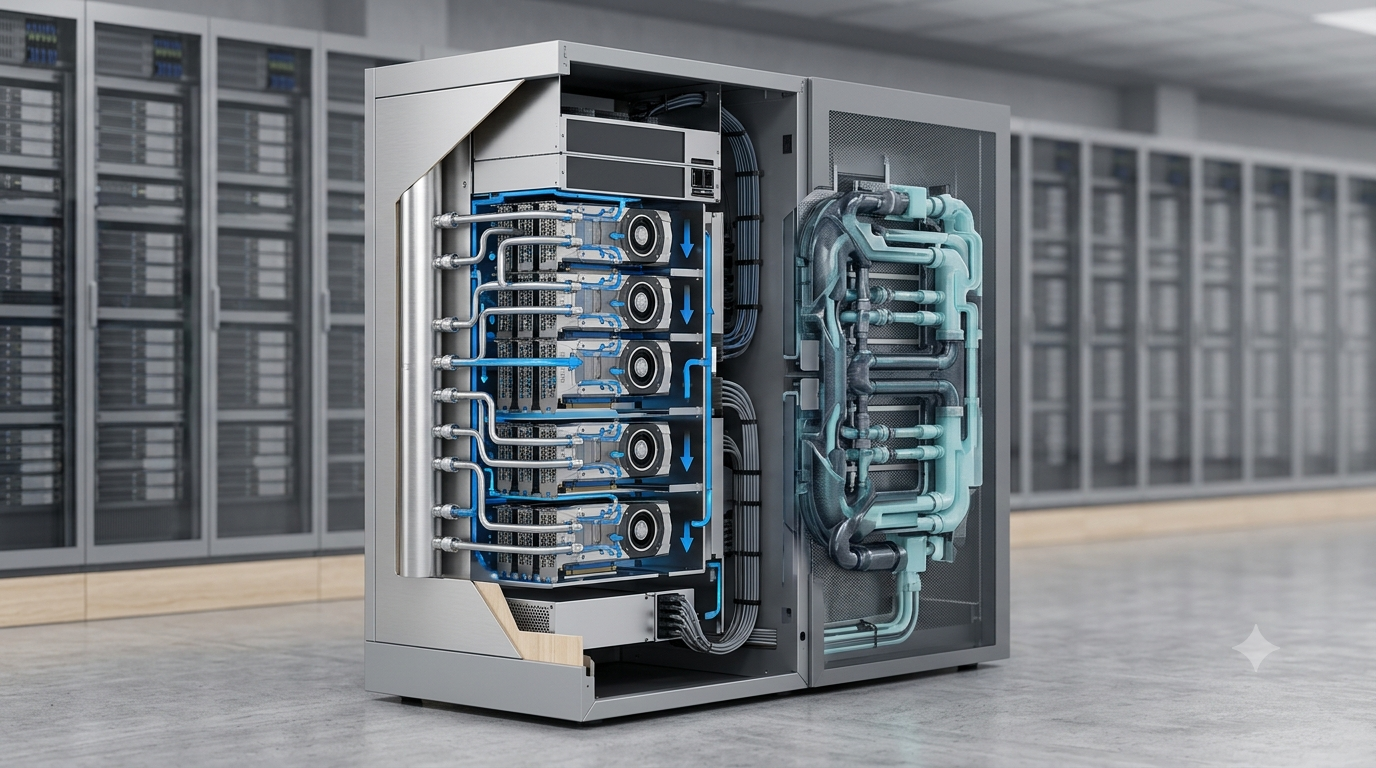
Artificial intelligence is changing nearly every layer of data center design, from power distribution and rack density to networking and thermal management. Among these shifts, liquid cooling has emerged as one of the most important infrastructure upgrades supporting high-performance AI workloads. As processors continue to generate more heat, traditional air cooling can no longer deliver the efficiency required by modern GPU clusters. Yet deploying liquid cooling involves much more than circulating coolant through a server. Every component within the cooling loop, including manifolds, connectors, piping, and valves, directly influences reliability, operational efficiency, and long-term maintenance. Material selection has therefore become an engineering decision that extends beyond procurement and into the overall resilience of AI infrastructure.

Why Liquid Cooling Has Become Essential for AI Infrastructure
Graphics processing units have increased dramatically in thermal design power over the past few years. AI accelerators now routinely consume several hundred watts per chip, while next-generation systems continue pushing toward kilowatt-scale rack densities. Removing that heat efficiently requires cooling methods capable of transferring thermal energy far more effectively than air alone. Liquid cooling addresses this challenge by circulating coolant directly to the hottest server components, significantly improving heat transfer while lowering overall facility power consumption. Operators adopting direct-to-chip and immersion cooling architectures are not simply improving cooling performance; they are enabling compute densities that would otherwise be impractical in conventional facilities. As AI deployments continue expanding, liquid cooling is increasingly becoming standard infrastructure rather than a specialized deployment option.
The Overlooked Role of Material Engineering
Many discussions surrounding liquid cooling focus on pumps, coolant chemistry, or heat exchangers. Far less attention is given to the materials that carry coolant throughout the system. Components such as manifolds perform a deceptively simple function by distributing coolant evenly across multiple servers. However, they must also withstand internal pressure, resist corrosion, tolerate chemical exposure, and maintain dimensional stability over years of continuous operation. Any failure within these components can disrupt cooling performance and introduce unnecessary operational risk. Consequently, selecting appropriate materials is becoming just as important as choosing the cooling architecture itself. Material engineering now influences system reliability, installation complexity, maintenance schedules, and total cost of ownership.
Stainless Steel: Proven Performance with Structural Strength
Stainless steel has long been the preferred material for industrial fluid systems because of its mechanical strength and durability. Within liquid-cooled data centers, stainless steel manifolds offer excellent pressure resistance while maintaining structural integrity under demanding operating conditions. They also provide strong compatibility with many coolant formulations and demonstrate excellent resistance to physical wear throughout extended deployment cycles. These characteristics make stainless steel particularly attractive for environments requiring maximum durability and long operational lifespans. Large hyperscale facilities often prioritize predictable performance over many years, making the robustness of stainless steel an important advantage. Furthermore, the material performs consistently across varying temperatures and operating pressures, reducing the likelihood of mechanical failure during continuous AI workloads. However, these benefits come with trade-offs. Stainless steel components are generally heavier than engineered polymer alternatives and often require more complex manufacturing and installation processes. Higher material and fabrication costs may also increase initial capital expenditure, especially for large-scale deployments involving thousands of cooling connections.

Engineered Plastics Offer Flexibility and Manufacturing Advantages
Advances in engineering polymers have expanded the role of plastics within liquid cooling systems. Modern high-performance polymers provide impressive chemical resistance while reducing component weight and simplifying manufacturing. Injection molding also enables highly customized manifold designs that integrate complex internal flow paths without requiring multiple welded assemblies. Weight reduction delivers practical operational benefits. Lighter manifolds simplify installation, reduce handling requirements, and decrease mechanical loads on supporting infrastructure. Engineers can also incorporate intricate geometries that improve coolant distribution and optimize hydraulic performance.
Plastic components frequently offer lower production costs for high-volume manufacturing as well. This advantage becomes increasingly significant as hyperscale operators deploy liquid cooling across multiple facilities simultaneously. Customization can also occur more rapidly, allowing suppliers to adapt designs for different rack architectures and evolving AI hardware platforms. Nevertheless, material selection requires careful engineering validation. Different polymer formulations vary in temperature tolerance, long-term creep behavior, pressure ratings, and compatibility with specific coolant chemistries. Selecting engineered plastics therefore involves evaluating the complete operating environment rather than relying solely on cost or weight advantages.
Reliability Depends on More Than Material Choice Alone
Selecting between stainless steel and engineered plastics is rarely a simple comparison of one material outperforming another. Overall reliability depends on how each component integrates into the complete cooling system. Pressure cycles, vibration, coolant composition, maintenance practices, and manufacturing quality all influence long-term performance. A well-designed polymer manifold may outperform an improperly manufactured stainless steel assembly under certain operating conditions. Likewise, premium stainless steel may remain the preferred option for facilities prioritizing maximum mechanical durability and extended service life. Engineers increasingly evaluate complete lifecycle performance rather than individual material specifications. Manufacturing precision also plays an essential role. Tight dimensional tolerances ensure consistent coolant flow while minimizing leakage risks at connection points. Quality control throughout fabrication therefore contributes as much to reliability as the base material itself.
Material Decisions Influence Total Cost of Ownership
Initial procurement cost represents only one portion of infrastructure economics. Data center operators increasingly evaluate material choices through the lens of total cost of ownership, considering installation efficiency, maintenance requirements, operational reliability, replacement intervals, and energy performance. Lighter components may reduce installation labor and transportation expenses. Durable materials can lower maintenance frequency and extend replacement cycles. Improved hydraulic efficiency may reduce pump energy consumption over many years of operation. Even small improvements become significant when replicated across thousands of racks within hyperscale AI facilities. Material selection therefore affects both capital expenditure and operational expenditure. Infrastructure teams must balance upfront investment with lifecycle economics, recognizing that lower purchase prices do not always produce lower long-term operating costs.
AI Infrastructure Is Driving New Cooling Standards
The rapid expansion of AI infrastructure is accelerating innovation throughout the liquid cooling supply chain. Server manufacturers, cooling vendors, and component suppliers are collaborating more closely to develop standardized interfaces, improved manifold designs, and materials capable of supporting future generations of AI hardware. Industry organizations such as the Open Compute Project continue advancing standards that promote interoperability across liquid-cooled systems. Standardization reduces deployment complexity while encouraging broader adoption of advanced cooling technologies across hyperscale, enterprise, and colocation environments. As rack power densities continue increasing, material innovation will remain an active area of research. Future developments may include advanced composites, hybrid metal-polymer assemblies, and new manufacturing techniques designed specifically for AI infrastructure.
The Future of Liquid Cooling Will Be Built on Smart Engineering Choices
Liquid cooling has moved beyond experimental deployments to become a cornerstone of modern AI infrastructure. While discussions often focus on GPUs, pumps, and coolant technologies, the materials supporting those systems deserve equal attention. Manifolds, piping, connectors, and structural components determine how reliably cooling systems perform throughout years of continuous operation. The choice between stainless steel and engineered plastics is not about identifying a universal winner. Instead, operators must evaluate each deployment according to workload density, operating environment, maintenance strategy, scalability requirements, and long-term economics. Material engineering is increasingly becoming a strategic infrastructure decision rather than a purely mechanical one. As AI data centers continue scaling toward higher power densities and larger deployments, seemingly small design decisions will shape overall operational resilience. In that environment, selecting the right material is no longer simply an engineering preference. It has become a critical factor in building efficient, reliable, and future-ready AI infrastructure.











