
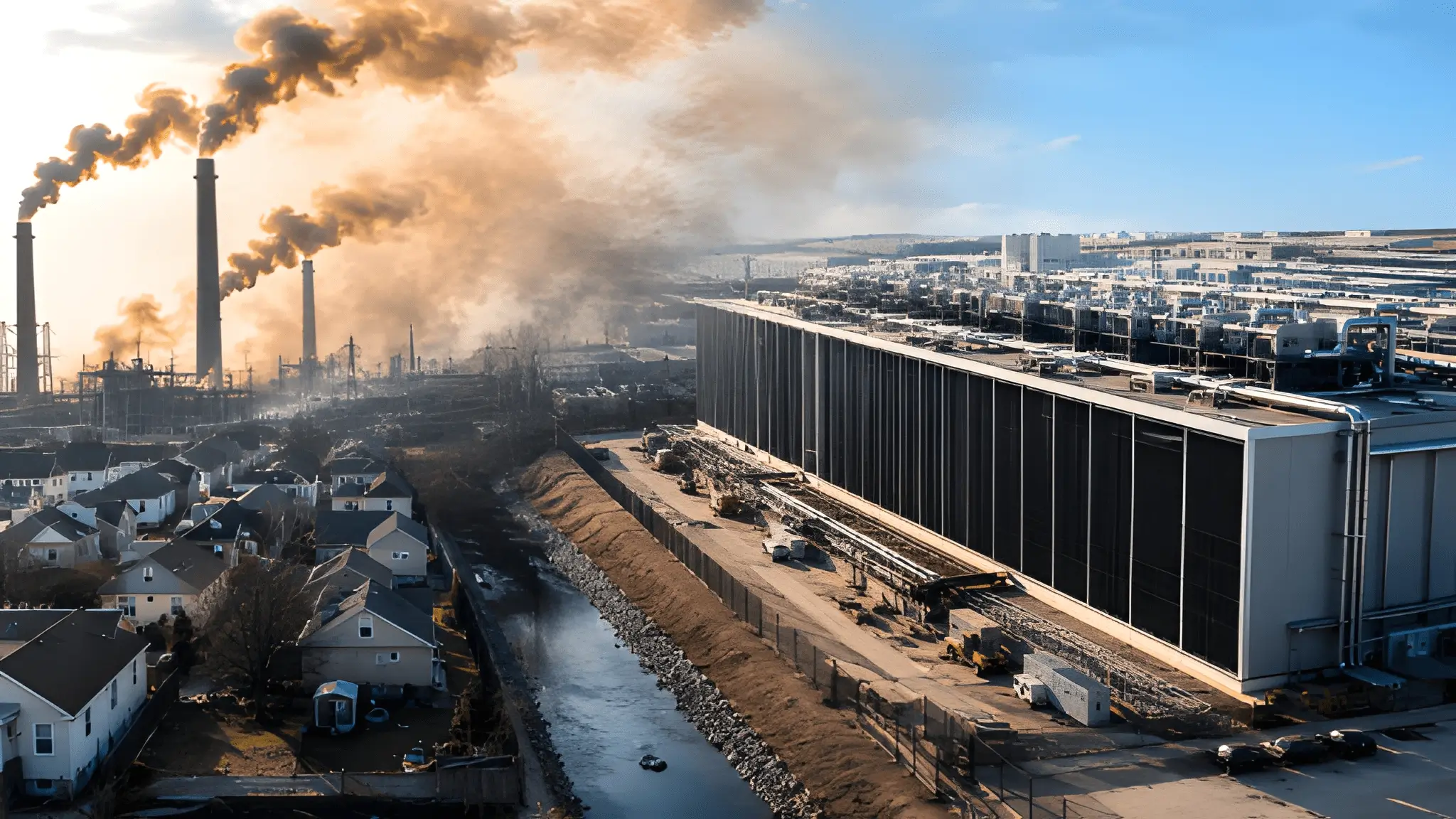
The global race to build advanced artificial intelligence systems has moved beyond software innovation and into a much larger infrastructure challenge. The next phase of AI growth depends on enormous computing capacity, where thousands of specialised chips operate together inside increasingly powerful data centers. These facilities have become the physical foundation behind the rapid expansion of generative AI models, automation platforms, and enterprise intelligence systems. However, the scale required to support this technological acceleration is creating a difficult strategic question for governments, technology companies, and communities hosting these facilities. The debate is no longer limited to how quickly AI can evolve, but whether the supporting infrastructure can expand without creating long-term environmental consequences. As the industry pushes toward larger models and faster processing, the resources required to sustain this growth are becoming one of the defining issues of the AI era.

The current AI infrastructure landscape depends heavily on advanced GPU systems that allow research organizations and technology companies to train increasingly complex models. These computing architectures require massive clusters of hardware distributed across large-scale data centers, creating unprecedented demand for electricity and supporting resources. The expansion reflects a historic shift in digital infrastructure, where computing capacity has become closely tied to physical resource consumption. Unlike previous technology cycles that focused primarily on software adoption, the AI boom requires extensive real-world infrastructure investment. Every new generation of AI capability brings additional requirements for energy availability, cooling systems, and land development. Therefore, the industry faces a balancing challenge between technological ambition and responsible infrastructure planning.
The hidden environmental cost behind AI expansion
Deep within this infrastructure race, companies operating some of the world’s most ambitious AI systems are facing growing scrutiny over their environmental footprint. xAI, the artificial intelligence company behind Grok, operates large computing facilities known as Colossus 1 and Colossus 2. These sites represent the scale required to support modern AI development, where massive computing power must operate continuously to train and deploy advanced models. At the same time, concerns around energy sourcing and environmental impact have become part of a wider discussion about how AI infrastructure should be built. Communities, regulators, and environmental organisations are increasingly examining whether rapid deployment is considering local consequences. The challenge is creating AI infrastructure that supports innovation while maintaining responsible relationships with surrounding regions.
What makes the discussion more complex is that the demand for computing power itself is not the only factor under examination. The broader concern involves how infrastructure decisions affect local environments, public resources, and community health over decades of operation. The NAACP has taken xAI in the spotlight, alleging that the company installed and operated gas turbines in Mississippi without required permits and that emissions from the turbines could expose nearby communities to harmful pollutants. The situation highlights a larger industry challenge: whether emergency approaches to meeting AI energy requirements could create long-term risks. The question facing the sector is not whether additional power capacity is necessary, but how companies choose to secure that capacity. As AI infrastructure becomes more widespread, environmental responsibility is becoming a core element of technology strategy rather than a secondary consideration.
Rising rack densities reshape the power equation
The first pressure point in the AI infrastructure ecosystem is computing intensity itself. Modern GPU systems continue to become more efficient, but their increasing density means each generation can demand significantly higher power levels. Traditional server environments once operated at much lower energy levels, while AI-focused racks now require substantially greater electricity capacity to support accelerated computing workloads. The shift has transformed data centres from predictable infrastructure assets into high-density industrial facilities. Companies planning future AI campuses must now consider electrical availability, grid stability, and long-term operational costs. The physical limits of infrastructure are becoming just as important as the performance limits of computing hardware.
Nvidia has outlined future Kyber rack architectures targeting power levels around 600 kW per rack as AI workloads continue increasing in density. Nvidia itself has proclaimed that its Kyber systems will draw an unheard-of 600 kW per rack by 2027. The broader industry trend indicates that power requirements and hardware density are increasing as AI systems become more advanced, although the exact pace of this transition will depend on future technology development and deployment strategies. This trajectory suggests that future AI campuses may require infrastructure planning closer to industrial energy projects than traditional technology facilities. The industry must prepare for a future where computing demand grows faster than existing power systems can adapt.

AI efficiency could accelerate resource consumption
The second challenge comes from an economic effect known as Jevon’s paradox, where efficiency improvements can increase total consumption rather than reduce it. As AI systems become cheaper, faster, and easier to deploy, businesses may expand their usage across more applications. Lower costs can encourage broader adoption, which ultimately increases demand for computing resources. This creates a complicated dynamic where technological efficiency does not automatically translate into lower environmental impact. The AI sector could experience rising resource consumption if efficiency improvements encourage broader adoption and increased deployment of AI systems.
The third pressure point comes from financial momentum behind AI infrastructure expansion. Major technology companies are directing significant capital toward computing facilities, semiconductor capacity, and supporting infrastructure. Current investment patterns show that AI infrastructure has become one of the most significant technology spending cycles of the current decade. These investments are accelerating construction timelines as companies compete to secure computing capacity ahead of future demand. However, the scale of spending also raises questions about how quickly infrastructure can expand without creating economic and environmental strain. The industry’s financial commitment demonstrates confidence in AI growth, but it also increases the urgency for responsible deployment.
The policy gap surrounding AI infrastructure growth
The rapid expansion of AI data centers has exposed a significant gap in public policy. Many regions are still developing frameworks for managing energy demand, water usage, emissions, and community impact linked to large computing facilities. Governments face pressure to attract investment while ensuring that infrastructure growth aligns with long-term sustainability goals. The speed of AI development has created a situation where regulation often struggles to keep pace with technological change. Without clear standards, companies may face inconsistent expectations across different markets.
The absence of coordinated planning creates uncertainty for both communities and infrastructure developers. A single data center may appear manageable when evaluated independently, especially if it uses advanced cooling systems or efficient designs. However, the cumulative impact of multiple facilities across campuses and regions could create a much larger resource challenge. The long-term impact depends not only on individual buildings but also on the combined footprint of future AI infrastructure networks. Strategic planning must therefore consider total environmental load rather than isolated facility performance.
Building sustainable AI infrastructure before the crisis arrives
The AI industry still has an opportunity to address these challenges before they become irreversible. Companies can incorporate sustainability planning into infrastructure decisions by evaluating energy sources, water systems, emissions controls, and community impact before construction begins. Proactive strategies could reduce future regulatory pressure while creating stronger relationships between technology providers and local communities. The next generation of data centrers will likely operate for decades, making early decisions critical to their long-term impact. Sustainable design is becoming a competitive advantage as businesses, investors, and governments increasingly evaluate environmental responsibility.
Thoughtful infrastructure planning could allow data centres to become responsible contributors to the regions where they operate. Rather than treating communities as locations for expansion, technology companies can build partnerships that support economic growth while protecting local resources. Closed-loop water systems, renewable energy integration, and advanced cooling technologies are among the approaches being explored by the data center industry to improve resource efficiency and reduce environmental pressure. However, these solutions require planning beyond individual facilities and must account for broader regional development.
The future of AI will depend not only on the intelligence of the models being created but also on the responsibility behind the infrastructure supporting them. Data centers are expected to remain operational for decades, meaning decisions made today will influence environmental outcomes for generations. The technology sector now faces a defining choice: accelerate without limits or build a foundation that allows innovation and sustainability to coexist. The AI revolution does not need to become an environmental burden, but achieving that outcome requires action before the pressure points become failures.











