AI data center infrastructure has entered territory the industry has never navigated before. Demand is rising faster than power grids can respond. Meanwhile, cooling systems, construction timelines, and financing models are all under strain. Consequently, operators face decisions that will define the next decade of digital infrastructure. This shift is not incremental. Instead, it represents a structural break from how data centers scaled in the past. Understanding this inflection point requires looking closely at power, cooling, geography, and risk together.
Power Demand Has Outpaced Grid Capacity
US data center power demand could climb from 31 gigawatts in 2025 to 66 gigawatts by 2027. Goldman Sachs Research produced this projection. That growth trajectory has few historical parallels. However, grid interconnection queues often stretch past four years in major markets. As a result, many projects sit ready for construction while waiting on transmission access. Meanwhile, utilities struggle to plan generation additions against uncertain long-term demand curves. Therefore, power availability has replaced capital as the primary constraint on new development. Global data center electricity consumption could reach roughly 945 terawatt-hours by 2030, according to the International Energy Agency. That figure would represent nearly double 2024 levels. Accelerated servers, driven mainly by AI adoption, account for almost half of that projected increase. In contrast, conventional server demand contributes a much smaller share of overall growth.
Hyperscalers Are Building Their Own Power Supply
Grid connection delays have pushed hyperscalers toward on-site generation. Some interconnection timelines now stretch past seven years in constrained regions. Consequently, companies are pursuing Bring-Your-Own-Power arrangements to bypass public grid bottlenecks entirely. In April 2026, Chevron entered negotiations to build a natural gas facility powering a Microsoft data center in Texas. This deal reflects a broader pattern across the industry. Instead of waiting for utility upgrades, technology firms now partner directly with energy producers. These arrangements carry real complexity, though. Gas transmission siting and air emission permitting create significant execution risk. Moreover, pairing a data center project with a power generation project doubles the points of potential failure. Nevertheless, operators view this trade-off as preferable to years of grid queue uncertainty. Natural gas is expected to dominate incremental data center power supply over the next five years.
Rack Density Has Crossed a New Threshold
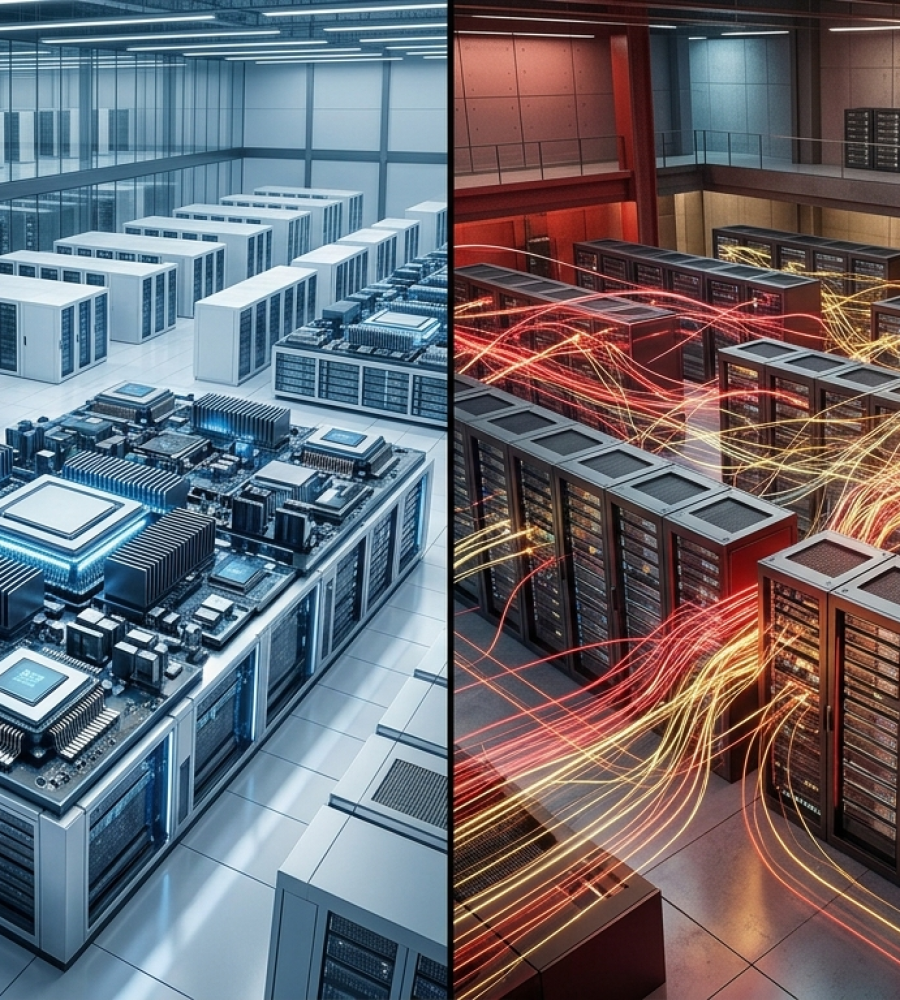
Rack density has moved well past the standards that defined the previous decade. Engineering leaders from Oracle, Nvidia, and Google now describe densities approaching the megawatt range. Racks that once carried 30 to 40 kilowatts now run in the hundreds. This shift is forcing a redesign of power delivery inside facilities. Higher-voltage distribution models are now under active exploration across the industry. Meanwhile, traditional compute and AI systems must coexist within the same physical footprint. Training workloads also behave differently than conventional IT loads. These clusters create sharp, dynamic power swings that ripple back through the grid. Generation must ramp quickly to match unpredictable workload behavior. Therefore, energy storage has become essential for smoothing these fluctuations. Operators now treat storage as necessary infrastructure rather than an optional upgrade. Voltage ride-through requirements are also becoming standard across new grid interconnection agreements.
Inference Has Changed the Shape of Demand
Training runs once defined how the industry thought about AI power use. However, inference has since overtaken training as the dominant compute driver. Inference now accounts for roughly 80 to 90 percent of total AI compute load. Unlike training, inference workloads run continuously rather than in short bursts. As a result, facilities must sustain constant high-wattage draw around the clock. This shift changes how operators plan capacity and manage utilization. Agentic workloads are adding further complexity to this picture. Multi-step reasoning and task orchestration are driving substantial CPU demand alongside GPU demand. Amazon highlighted this trend during its first-quarter 2026 earnings discussion. Its Trainium2 chips reportedly deliver around 30 percent better price performance than comparable GPUs. Consequently, hardware efficiency gains are becoming a competitive differentiator rather than a background factor.
Grid Reliability and Cost Pressures Are Mounting
Analysis presented to PJM Interconnection governors warns of a 49-gigawatt US generation shortfall by 2028. That gap stems from rising demand, aging plant retirements, and lengthy interconnection delays. Meanwhile, retail power prices rose 2.3 percent year-over-year nationally in 2026. Data center demand growth is cited as a primary driver behind that increase. Goldman Sachs projects data center-driven electricity demand will add 0.1 percent to core inflation in 2026 and 2027. The impact will be sharpest across PJM-region states, including Virginia and Ohio. In response, several states now require operators to fund infrastructure proportional to their consumption. This marks a shift away from broadly shared utility investment models. Therefore, cost allocation has become a central policy debate shaping future site selection.
Geography Is Being Redrawn by Power Access
Site selection once prioritized latency and proximity to population centers. Instead, power availability now determines where new campuses get built. Development is shifting away from traditionally dense markets like Northern Virginia. New regions with energy surpluses are attracting hyperscale investment instead. This energy-first approach is reshaping the global map of digital infrastructure. NTT Global Data Centers announced plans in March 2026 to double its global capacity to 4 gigawatts. This move signals that the power-driven shift extends well beyond the United States. However, announcements do not always translate into operational capacity. Sightline Climate reports that up to 11 gigawatts of planned 2026 capacity remains stuck in the announcement phase. Roughly half of global projects face delays tied to power constraints.
A Structural Redesign, Not a Temporary Surge
The current moment differs fundamentally from past data center growth cycles. Efficiency gains from cloud migration and virtualization have already been captured. Future progress must instead come from better accelerators and smarter scheduling. Meanwhile, power procurement has become as strategically important as chip supply. Operators who secure reliable, scalable power will hold a lasting advantage. Those who cannot may face delays regardless of available capital. This is, therefore, a systemic redesign rather than incremental improvement. Power, cooling, geography, and financing are now deeply interconnected decisions. As the Data Center World 2026 panel noted, assumptions built for the last decade no longer hold. The organizations that question those assumptions early will shape the next phase of AI infrastructure.