 Skip to content
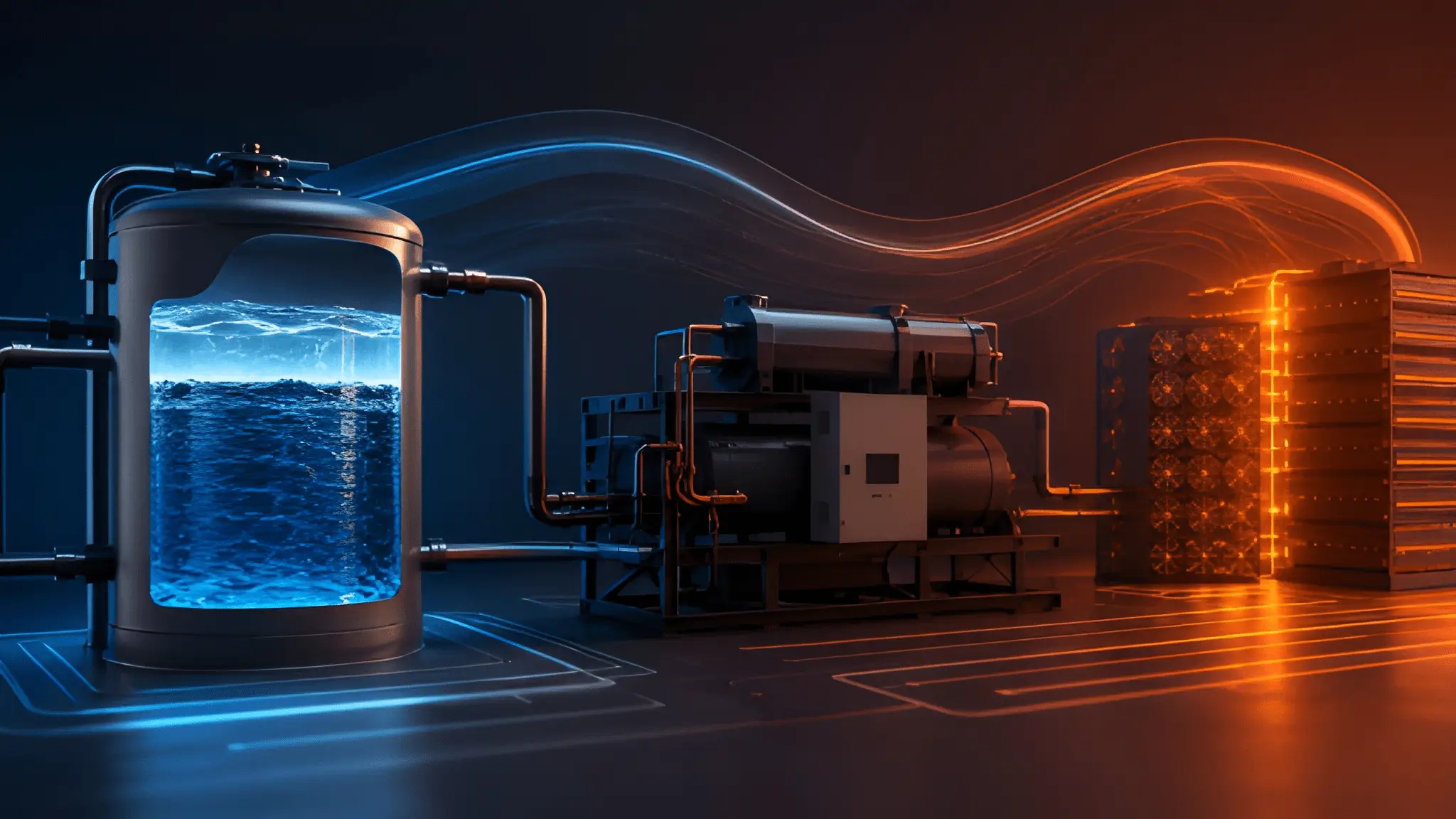
AI infrastructure has changed the shape of electrical demand more aggressively than it has changed annual energy consumption, which means operators increasingly pay for the highest interval rather than the largest monthly total. Traditional efficiency metrics still matter, yet they no longer explain why two mechanically similar cooling plants can produce very different operating costs under the same utility tariff. Thermal storage introduces another dimension because it allows cooling capacity to move through time instead of remaining tied to the exact moment when servers generate heat. That distinction changes the conversation from producing colder water to producing flexibility that the electrical system can monetize without interrupting computational availability. Modern cooling strategies therefore need to connect thermal physics, electrical pricing, and workload orchestration into one continuously optimized operating model rather than treating them as isolated engineering disciplines.

Most discussions around energy storage still begin with batteries because electrical storage naturally dominates conversations about resilience and grid participation. Cooling systems, however, already contain large quantities of recoverable thermal capacity that operators can dispatch without adding another high-power electrical asset beside the UPS plant. Chilled-water tanks, ice storage systems, and phase-change materials all convert inexpensive off-peak electricity into usable cooling that becomes available during expensive demand intervals. Their financial value depends less on the storage vessel itself than on the intelligence controlling when charging begins, how quickly discharge occurs, and which computational workloads remain active during each interval. AI clusters create short-duration power excursions that align surprisingly well with thermal storage response when supervisory controls coordinate cooling and scheduling together. Thermal arbitrage therefore represents a control strategy instead of a mechanical product because every economic gain depends on synchronized decisions across electrical, thermal, and computational infrastructure.
Demand Charges Are the New PUE: Why kWh Stopped Mattering
Cooling engineers traditionally optimized systems around annual energy efficiency because electrical consumption formed the largest controllable operating expense across most commercial buildings. AI computing has shifted that assumption because thousands of accelerators can transition between moderate utilization and near-maximum electrical demand within operationally meaningful timeframes. Utilities generally determine demand charges from averaged demand intervals rather than instantaneous electrical peaks, making the highest billing interval disproportionately influential in monthly operating costs. ASHRAE guidance emphasizes that supervisory optimization for chilled-water and ice storage must evaluate the entire billing period because demand charges, time-of-use pricing, and ratchet provisions interact across weeks instead of individual hours. That observation changes cooling optimization from a thermodynamic exercise into an operational scheduling problem where every chiller decision influences future billing outcomes instead of only present electrical efficiency.
Understanding Why Peak Demand Now Dominates Cooling Economics
Conventional power management assumes batteries should absorb every electrical disturbance because they directly store electrical energy for later discharge. Thermal systems follow a different operational philosophy because cooling demand can shift through stored latent or sensible heat without drawing equivalent electrical power during expensive intervals. Phase-change materials absorb substantial quantities of thermal energy while changing physical state, whereas chilled-water systems rely primarily on sensible heat stored within water volume. Both approaches reduce chiller loading during predefined operating windows instead of replacing server power consumption itself. Operators therefore reshape facility electrical demand indirectly by lowering compressor activity precisely when utility billing calculations become economically significant. Successful demand reduction consequently depends on predictive cooling rather than emergency cooling because the opportunity disappears once the billing interval has already captured the electrical peak.
AI clusters also introduce computational behavior that differs fundamentally from traditional enterprise workloads because synchronized model training often creates steep electrical ramps instead of relatively smooth utilization curves. Those transient events place mechanical systems under pressure to respond rapidly without forcing chillers into inefficient operating regions or unnecessary compressor starts. Thermal storage buffers these events by supplying previously stored cooling while supervisory controls evaluate whether the electrical excursion will persist long enough to justify additional mechanical capacity. That buffering capability allows cooling infrastructure to operate with greater stability even while computational demand fluctuates aggressively across short operational periods. Utility tariffs reward this operational stability because the billing meter measures electrical demand rather than computational throughput delivered during each interval. Thermal arbitrage therefore transforms cooling infrastructure into an active participant in financial optimization rather than leaving it as a passive consumer of electrical energy.
Cooling Flexibility Creates More Economic Value Than Cooling Capacity Alone
Plant sequencing also becomes considerably more sophisticated when thermal storage participates in cooling operations because supervisory controls must determine which assets should remain idle, which should operate efficiently, and which should reserve capacity for later demand intervals. Intelligent dispatch algorithms evaluate storage state, weather forecasts, expected computational activity, condenser water conditions, and utility schedules before selecting the lowest-cost operating sequence. That decision process differs substantially from conventional lead-lag chiller rotation because economic optimization extends beyond equipment runtime into tariff-aware orchestration. Thermal storage therefore becomes an operational reserve that protects compressors from unnecessary cycling while preserving cooling capacity for intervals with greater financial significance. Stable compressor operation often improves equipment longevity because unnecessary starts, abrupt loading changes, and repeated ramp events decline under coordinated supervisory control. Financial optimization consequently emerges from disciplined system coordination instead of isolated mechanical performance improvements.

Ultimately, demand charges redefine how operators evaluate cooling infrastructure because the most valuable ton of cooling may be the one produced several hours before it is actually required. Thermal storage encourages engineers to think in terms of dispatchable cooling inventory rather than instantaneous refrigeration output because stored thermal capacity carries economic value across time. AI infrastructure reinforces this perspective because workload orchestration already treats computational resources as schedulable assets instead of permanently fixed operating loads. Cooling systems now benefit from the same operational philosophy when predictive control aligns stored thermal energy with anticipated electrical demand intervals. Operators who integrate workload forecasts with thermal dispatch gain additional flexibility that conventional automation cannot deliver through temperature control alone. Facility economics therefore become increasingly dependent on coordinated temporal optimization rather than isolated improvements in mechanical efficiency.
The Melt Window: Timing Phase-Change Discharge to Price Signals
Phase-change materials attract attention because they store large amounts of thermal energy within a relatively compact volume, yet their practical value depends far more on discharge timing than on storage density alone. During charging, these materials absorb cooling energy while changing physical state, and they later release that stored capacity as the material reverses the phase transition under controlled operating conditions. Operators therefore manage a finite thermal inventory whose usefulness depends on matching discharge behavior with utility demand intervals instead of simply maximizing storage duration. A poorly timed discharge can leave valuable cooling unavailable during the most expensive electrical window even though the storage system still contains usable thermal capacity. Effective supervisory controls consequently forecast both computational activity and tariff timing before initiating discharge because premature cooling release reduces later operational flexibility. Thermal arbitrage succeeds only when latent heat behaves as a scheduled resource rather than an emergency cooling reserve.
Latent Heat Becomes Valuable Only When Its Release Matches Utility Timing
Unlike conventional chilled-water storage, phase-change systems exhibit discharge characteristics that depend on material properties, heat exchanger performance, and thermal gradients throughout the storage medium. These physical behaviors influence how rapidly cooling becomes available and how consistently thermal output remains during extended discharge periods. Engineers therefore model melt progression alongside hydraulic performance because uneven thermal release may reduce available cooling before the billing interval concludes. Predictive algorithms increasingly estimate remaining thermal capacity using measured heat transfer rates instead of relying solely on temperature measurements. That analytical approach improves dispatch accuracy because latent storage systems do not reveal their remaining usable capacity through temperature alone while the phase transition continues. Operational confidence therefore grows when physics-based models complement real-time instrumentation across the complete thermal storage cycle.
The interaction between utility tariffs and thermal storage also extends beyond simple time-of-use pricing because many electrical contracts include billing structures that penalize sustained peaks across defined averaging intervals. Supervisory controls must therefore evaluate how rapidly thermal discharge should occur instead of assuming that maximum cooling output always produces the greatest financial benefit. Excessively aggressive discharge can exhaust stored capacity before the interval concludes, while conservative operation may fail to suppress compressor demand sufficiently during the billing window. Successful strategies continuously adjust discharge rates according to measured thermal inventory, evolving workload demand, and predicted electrical consumption throughout the interval. Dynamic control consequently replaces fixed operating schedules because every billing event unfolds differently under changing computational and environmental conditions. Melt timing therefore becomes an optimization exercise rooted equally in thermodynamics, forecasting, and tariff interpretation.
Designing Melt Profiles Around Cooling Plant Dynamics Instead of Tank Capacity
Thermal storage delivers consistent economic value only when its discharge profile complements the operating characteristics of the entire cooling plant rather than maximizing the instantaneous output of the storage medium itself. Chillers, pumps, cooling towers, control valves, and heat exchangers all respond at different rates, which means abrupt thermal discharge can create hydraulic instability even while electrical demand temporarily declines. Engineers therefore develop melt profiles that account for equipment ramp rates, minimum compressor loading thresholds, and flow stability before determining how quickly stored cooling should enter the distribution network. That coordinated approach prevents supervisory controls from replacing one operational constraint with another because compressor cycling and unstable flow conditions can offset the financial benefit gained through demand reduction. Thermal storage consequently behaves as an integrated component of the plant instead of functioning as an isolated cooling asset with its own independent control philosophy.
Hydraulic behavior deserves equal attention because distribution networks determine whether stored cooling actually reaches the loads that create the highest electrical demand during critical operating intervals. Flow balancing, pressure stability, and return-water temperature all influence how efficiently stored thermal capacity offsets active refrigeration equipment. Control systems therefore evaluate valve positions, differential pressure, and branch flow continuously instead of relying exclusively on supply temperature as the primary operating indicator. Advanced building automation platforms increasingly coordinate these variables through predictive optimization models that anticipate cooling demand before the thermal imbalance develops across the network. That forecasting capability allows storage systems to discharge smoothly without forcing rapid mechanical adjustments elsewhere in the plant. Cooling infrastructure therefore maintains operational continuity while electrical demand remains below the thresholds that drive higher billing exposure.
Stranded Tons, Found Dollars: Right-Sizing Tanks for Three Gen Ahead
Thermal storage projects often become constrained by assumptions that reflect present-day cooling requirements rather than the operating characteristics expected over the next several hardware generations. AI accelerators continue to evolve toward higher rack power densities, changing cooling distribution methods and heat rejection profiles without necessarily increasing average annual energy consumption proportionally. Engineers therefore gain greater long-term value by sizing storage according to projected thermal dynamics instead of matching today’s installed refrigeration capacity alone. That planning philosophy recognizes that cooling flexibility often remains useful even after chillers, distribution equipment, or computational hardware undergo significant modernization. Storage infrastructure typically operates across much longer asset lifecycles than compute platforms, making future adaptability an important component of the original engineering decision. Proper sizing consequently depends on anticipated operational flexibility instead of merely satisfying current design-day cooling calculations.
Storage Capacity Should Follow Thermal Behavior Rather Than Installed Cooling Equipment
Future rack architectures also influence storage requirements because liquid-assisted cooling, direct-to-chip systems, and hybrid thermal management approaches redistribute heat throughout the cooling network differently than legacy air-cooled environments. Those architectural changes alter return-water temperatures, flow characteristics, and transient thermal behavior, all of which affect how efficiently stored cooling can offset active refrigeration during demand-sensitive intervals. Engineers therefore evaluate thermal storage performance using dynamic operational models that represent evolving cooling topologies instead of relying solely on steady-state design assumptions. That modeling approach provides greater confidence that installed storage remains economically relevant even as computational infrastructure transitions through multiple technology refresh cycles. Design flexibility ultimately protects long-lived thermal assets from becoming oversized, undersized, or operationally mismatched with future cooling requirements. Storage therefore retains financial relevance beyond the first generation of AI hardware deployed inside the cooling envelope.
Storage sizing also benefits from evaluating workload characteristics because computational scheduling influences cooling demand as strongly as hardware specifications under many AI operating conditions. Large synchronized training jobs create concentrated thermal events, whereas diversified inference activity often distributes cooling requirements more evenly throughout the operating period. Thermal storage therefore performs differently depending on the temporal distribution of computational demand rather than simply the maximum cooling capacity installed within the plant. Predictive operational modeling captures these interactions more accurately by combining workload forecasts with thermal simulations instead of evaluating mechanical systems independently. Engineering teams consequently make sizing decisions that preserve operational flexibility across changing computational strategies rather than optimizing exclusively for today’s processing behavior.
Engineering Thermal Storage for Transient GPU Step-Loads Instead of Static Design Conditions
Thermal storage design increasingly depends on understanding transient GPU behavior because modern accelerator clusters generate rapid changes in cooling demand that conventional steady-state calculations do not adequately represent. Mechanical engineers have traditionally sized chilled-water systems around sustained peak conditions, yet AI workloads often produce repetitive bursts that stress cooling response more than continuous operation. Those transient events influence compressor loading, pump sequencing, heat exchanger performance, and distribution stability across much shorter operational windows than legacy enterprise computing environments. Thermal storage introduces a buffering mechanism that absorbs these fluctuations without requiring every mechanical asset to respond immediately to each computational event. Engineers therefore evaluate storage performance using time-series simulations that reflect realistic workload transitions instead of relying exclusively on design-day capacity calculations.
Hydraulic response also becomes a decisive factor because rapid thermal changes propagate through chilled-water networks differently than electrical demand propagates through power distribution systems. Distribution piping, control valves, variable-speed pumps, and heat exchangers each introduce response delays that influence how quickly stored cooling reaches high-density cooling loops. Designers therefore evaluate the complete thermal pathway instead of treating storage tanks as isolated energy reservoirs disconnected from downstream hydraulic performance. Computational fluid models and operational simulations help identify locations where pressure instability, uneven flow distribution, or delayed heat removal could reduce the practical value of stored thermal capacity during demand-sensitive periods. That engineering process improves operational predictability because every major hydraulic component contributes to the effectiveness of thermal arbitrage once discharge begins.
Telemetry Over Temperature: What You Must Measure to Monetize Cold
Traditional cooling plants relied heavily on supply and return temperature measurements because those values provided sufficient visibility into refrigeration performance under relatively stable operating conditions. Thermal storage introduces an entirely different operational requirement because stored cooling represents a finite dispatchable resource whose remaining value cannot be inferred accurately from temperature alone. Operators therefore require continuous visibility into flow rates, heat transfer, energy movement, and storage conditions before supervisory systems can make economically informed dispatch decisions. A storage vessel may exhibit acceptable temperatures while simultaneously containing insufficient usable thermal capacity to suppress compressor demand during a future billing interval. Engineering teams consequently treat thermal storage as an energy inventory that must be quantified through multiple operating variables rather than monitored through isolated temperature measurements. Dispatch accuracy improves substantially when control platforms evaluate thermal state using integrated thermodynamic measurements instead of conventional refrigeration indicators alone.
Temperature Alone Cannot Describe the Economic State of Thermal Storage
Flow measurement becomes particularly important because thermal energy reaches computational equipment only when hydraulic transport remains stable throughout the distribution network. Variations in pump performance, valve position, branch balancing, or pressure differential can reduce effective cooling delivery even while stored thermal capacity remains available inside the tank. Supervisory platforms therefore combine flow instrumentation with temperature measurements to calculate actual thermal energy transfer rather than estimating cooling performance indirectly. This analytical approach enables operators to distinguish between storage limitations and distribution inefficiencies before unnecessary refrigeration equipment starts operating to compensate for perceived cooling shortfalls. Greater measurement fidelity also improves predictive optimization because future dispatch decisions depend on understanding how efficiently stored cooling moves through the network under varying operating conditions. Thermal arbitrage consequently relies on hydraulic intelligence as much as refrigeration performance because energy transport determines whether stored cooling becomes economically useful.
Enthalpy provides an even more valuable operational indicator because it captures the total heat content carried by the circulating fluid rather than describing temperature in isolation. Operators use enthalpy calculations to determine how much usable cooling actually enters and leaves the storage system during each charging and discharging sequence. That measurement supports more accurate estimation of remaining thermal inventory because energy accounting reflects real heat transfer instead of assuming constant operating conditions throughout the hydraulic circuit. Predictive control systems increasingly combine enthalpy calculations with historical operating data to estimate future storage availability before demand-sensitive intervals begin. Engineering decisions therefore become increasingly data-driven because thermal dispatch depends on quantified energy movement rather than simplified assumptions about cooling performance. Accurate thermal accounting ultimately allows stored cooling to function as a measurable operational resource capable of supporting sophisticated economic optimization strategies.
Predictive Telemetry Turns Stored Cooling into a Dispatchable Operational Resource
Thermal storage achieves its greatest operational value when instrumentation evolves from passive monitoring into predictive decision support that continuously estimates future cooling availability. Conventional building automation platforms often report historical operating values, yet thermal arbitrage requires forecasts that indicate how much usable cooling will remain available after anticipated workload changes occur. Engineers therefore combine state-of-charge estimation, enthalpy calculations, hydraulic measurements, weather forecasts, and workload scheduling information to produce forward-looking dispatch recommendations. That analytical framework allows supervisory controls to determine whether charging should begin earlier, whether discharge should accelerate, or whether mechanical refrigeration should temporarily assume additional load before billing exposure increases. Operational confidence improves because control decisions rely on quantified thermal inventory rather than conservative assumptions intended to protect cooling reliability. Predictive telemetry consequently transforms thermal storage from a static mechanical asset into an actively managed operational resource with measurable economic value.
State-of-charge estimation deserves particular attention because latent and sensible thermal storage systems do not reveal remaining usable energy through visual inspection or temperature measurements alone. Supervisory algorithms therefore estimate available cooling by integrating historical charging behavior, present operating conditions, measured heat transfer, and expected discharge characteristics throughout the storage cycle. Those predictive calculations become increasingly accurate as machine learning models incorporate larger operational datasets describing seasonal performance, hydraulic response, and equipment behavior under varying computational loads. Engineers gain better visibility into dispatch confidence because predicted storage availability includes uncertainty estimates instead of presenting a single deterministic operating value. That additional context supports more disciplined operational decisions whenever cooling demand approaches utility billing thresholds that carry significant financial consequences. Thermal storage therefore behaves more like a managed energy portfolio than a conventional chilled-water asset because its remaining value becomes continuously measurable and forecastable.
Risk in a Tank: Failure Modes Utilities Don’t Tell You About
Thermal storage systems generally fail gradually rather than catastrophically, which makes early operational degradation difficult to recognize through conventional maintenance inspections alone. Cooling capacity may decline incrementally while temperatures remain within acceptable operating limits, allowing hidden performance losses to accumulate until demand charges unexpectedly increase during peak operating periods. Engineers therefore benefit from evaluating financial anomalies alongside mechanical telemetry because unusual billing behavior frequently indicates deteriorating storage performance before physical inspection reveals obvious defects. Thermal arbitrage depends on predictable discharge capability, meaning even modest reductions in usable storage can force compressors to start earlier than planned during critical billing intervals. Electrical demand subsequently rises despite apparently healthy refrigeration equipment because the storage system no longer supplies the expected thermal support. Operational reliability therefore requires continuous verification of storage performance instead of assuming that acceptable temperatures indicate acceptable economic performance.
Hidden Thermal Storage Failures Often Appear First as Electrical Cost Problems
Thermal stratification illustrates this challenge because chilled-water storage relies on maintaining distinct temperature layers that preserve usable cooling throughout the discharge cycle. Excessive mixing inside the storage vessel reduces thermal separation, causing outlet temperatures to deteriorate earlier than predictive control algorithms anticipate. Engineers therefore monitor stratification behavior using distributed temperature measurements, hydraulic balancing analysis, and operational trend evaluation rather than relying solely on inlet and outlet instrumentation. Mechanical modifications, improper flow sequencing, or unexpected operating conditions can all disrupt stratification even though individual equipment components continue functioning normally. Reduced storage effectiveness then forces chillers to compensate during demand-sensitive intervals, increasing electrical consumption precisely when utility tariffs impose greater financial penalties. Thermal stratification consequently represents an operational risk that directly influences economic performance rather than remaining merely a hydraulic design consideration.
Biological growth and water quality also influence long-term storage performance because thermal reservoirs contain significant water volumes that require disciplined treatment throughout their operational life. Biofouling gradually reduces heat transfer efficiency, alters hydraulic resistance, and increases maintenance requirements across connected cooling equipment. Engineers therefore integrate water chemistry management with predictive operational monitoring to identify subtle performance changes before they evolve into economically significant cooling deficiencies. Routine inspection of storage vessels, filtration systems, and treatment programs protects both refrigeration efficiency and the reliability of thermal dispatch during utility demand events. Mechanical reliability ultimately depends on preserving thermal transfer characteristics as carefully as preserving compressor performance or pumping efficiency. Thermal storage consequently requires comprehensive operational stewardship because water quality directly affects the financial outcomes expected from cooling arbitrage strategies.
Cycling Fatigue, Control Drift, and Operational Blind Spots Can Erase Arbitrage Value
Repeated charging and discharging place every thermal storage system under operational stress because valves, pumps, actuators, heat exchangers, and control sequences experience continuous transitions rather than steady-state operation. Although storage tanks themselves often exhibit long service lives, supporting mechanical equipment gradually develops performance deviations that reduce dispatch accuracy across successive operating cycles. Engineers therefore monitor actuator response, valve authority, pump efficiency, sensor calibration, and controller stability alongside refrigeration performance because each subsystem influences how effectively stored cooling offsets electrical demand. Minor calibration drift can alter discharge timing sufficiently to require premature chiller operation during demand-sensitive intervals, thereby reducing the financial benefit expected from thermal arbitrage. Preventive maintenance consequently shifts from equipment preservation toward operational precision because dispatch timing matters as much as mechanical availability.
Control drift presents another operational challenge because predictive optimization gradually loses effectiveness when instrumentation accuracy declines across months or years of continuous operation. Temperature sensors, differential pressure transmitters, flow meters, and energy meters each contribute to supervisory calculations that determine when charging or discharging should begin. Small measurement errors may appear operationally insignificant in isolation, yet their combined influence can shift dispatch decisions enough to increase electrical demand during utility billing intervals. Engineering teams therefore establish regular calibration schedules supported by analytical validation using historical operating trends instead of relying solely on manufacturer maintenance recommendations. Automated fault detection also strengthens operational resilience because software can identify deviations between expected and measured system behavior before mechanical failures become apparent.
The System Pays, Not the Tank: Why Arbitrage Is a Platform Play
Thermal storage does not create financial value simply because a tank stores chilled water or a phase-change material retains latent cooling capacity between operating periods. The economic outcome emerges only when electrical infrastructure, cooling systems, workload orchestration, and supervisory software exchange operational information before utility billing intervals begin. Each infrastructure layer contributes a different form of flexibility, yet none can independently optimize demand charges without understanding the operating state of the others. Engineers therefore design thermal arbitrage around coordinated decision-making instead of isolated equipment optimization because dispatch timing depends on multiple interacting variables throughout the facility. Predictive cooling loses effectiveness if workload schedulers unexpectedly increase computational intensity, while workload optimization delivers less value if refrigeration equipment responds without awareness of upcoming tariff exposure.
Thermal Arbitrage Begins Where Infrastructure Layers Exchange Operational Intelligence
Electrical infrastructure contributes to the operational boundary conditions that define when thermal storage becomes economically useful because tariff structures establish the financial consequences associated with peak demand events. Cooling systems provide temporal flexibility by shifting refrigeration production away from those intervals, while computational schedulers influence how aggressively thermal demand develops across the operating period. Supervisory control platforms therefore function as integration layers that evaluate all three information streams before determining the most advantageous dispatch strategy. This coordinated approach enables operators to preserve thermal inventory for periods where electrical demand reduction carries greater financial significance without compromising cooling reliability. Economic optimization consequently becomes an outcome of synchronized operational intelligence rather than an isolated characteristic of any single mechanical technology.
Long-term competitiveness increasingly depends on how effectively organizations integrate operational data across mechanical, electrical, and computational systems instead of how much individual equipment capacity they install. Storage tanks, phase-change materials, chillers, pumps, and automation platforms each remain important engineering assets, yet their combined operational intelligence determines whether stored cooling becomes measurable financial value. Future cooling strategies will likely continue emphasizing predictive coordination because AI computing introduces increasingly dynamic thermal behavior that static control sequences cannot manage efficiently. That perspective aligns infrastructure investment with the realities of modern electrical pricing, dynamic computational scheduling, and evolving cooling technologies without depending on any single equipment category for economic success. The greatest advantage ultimately belongs to integrated systems that continuously coordinate Power → Thermal → Network → Compute → Economics as one operational value chain rather than optimizing each discipline independently.












