 Skip to content
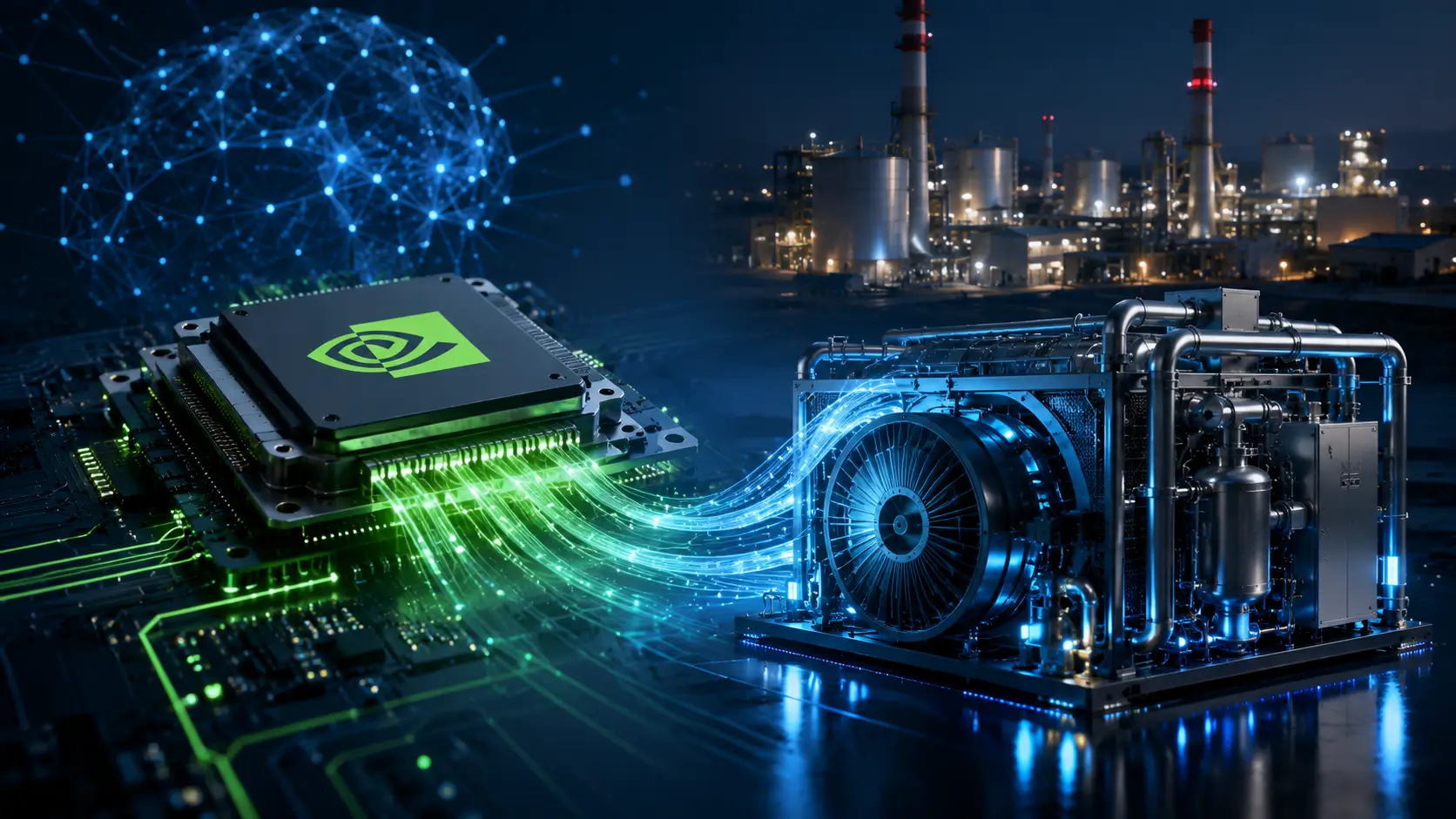
Nvidia is exploring a partnership with Mitsubishi Heavy Industries (MHI) that could reshape the next phase of AI infrastructure by combining advanced semiconductor platforms with industrial-scale cooling and power management technologies. The discussions center on equipping Nvidia’s next-generation AI facilities described as AI factories with thermal and energy systems capable of supporting increasingly dense GPU deployments. The potential collaboration reflects a broader shift taking place across the AI infrastructure market. While graphics processors remain the primary engine behind generative AI, the supporting ecosystem surrounding power delivery, cooling, and facility engineering is emerging as an equally important competitive advantage. As compute density rises, infrastructure performance increasingly depends on how efficiently operators manage heat rather than simply how many accelerators they deploy. Nvidia’s AI factory strategy envisions hyperscale environments housing thousands of high-performance GPUs operating continuously for AI training and inference. Those deployments introduce unprecedented thermal loads, requiring cooling architectures that extend well beyond conventional air-based systems.

Liquid Cooling Is Becoming Central to Next-Generation AI Factories
The industry’s transition toward liquid cooling continues accelerating as processor power consumption climbs. Modern AI accelerators can consume roughly 1 kilowatt per GPU, placing enormous pressure on facility operators seeking to balance performance, operating costs, and sustainability objectives. Nvidia has already positioned liquid cooling at the center of its future infrastructure roadmap through its Rubin platform, which supports 100% liquid cooling while operating at temperatures reaching 45°C. The architecture aims to reduce both energy consumption and water usage compared with conventional cooling methods. “The NVIDIA DSX reference design for AI factories has zero water consumption we have eliminated massive amounts of power usage and pretty much all water usage. With dry-cooler-based designs, it’s a closed-loop system with no evaporative water cooling, outside of maybe 1% of the year when we might need chillers in some climates.” — Ali Heydari, Director of Data Center Cooling
Mitsubishi Heavy Brings Industrial Cooling Expertise to AI Infrastructure
Mitsubishi Heavy enters the discussions with decades of experience designing industrial thermal management and energy systems. Its portfolio includes direct-to-chip liquid cooling, two-phase cooling technologies, high-efficiency chillers, and integrated energy management platforms designed for mission-critical operations. Those capabilities complement Nvidia’s growing emphasis on infrastructure optimization rather than silicon performance alone. As AI deployments expand, cooling systems increasingly influence rack density, power efficiency, operating expenditure, and facility scalability. Rather than functioning as standalone mechanical systems, cooling technologies are becoming integrated components of AI infrastructure design, influencing everything from data center architecture to electricity procurement strategies.
Japan Could Strengthen Its Position in the Global AI Infrastructure Market
Should the partnership advance, Japan could strengthen its position as a strategic location for next-generation AI infrastructure by combining semiconductor innovation with advanced industrial engineering capabilities. The collaboration would also reflect a broader convergence between traditional heavy industry and digital infrastructure. Companies that historically specialized in power generation, industrial equipment, and thermal engineering are becoming increasingly important participants in AI deployment as compute facilities demand larger and more sophisticated mechanical systems. This evolution expands the definition of AI infrastructure beyond chips and servers to include integrated power distribution, thermal management, and energy optimization.

Cooling Efficiency Is Emerging as the Next AI Battleground
The discussions also highlight how infrastructure priorities are evolving across the AI sector. Previous investment cycles focused primarily on semiconductor performance, networking bandwidth, and accelerator availability. Today, thermal efficiency has become another defining constraint on hyperscale expansion. Closed-loop liquid cooling architectures offer operators opportunities to reduce operational costs while minimizing water consumption, improving sustainability metrics, and supporting increasingly dense compute clusters. Whether Nvidia ultimately partners with Mitsubishi Heavy or pursues alternative collaborators, the industry’s direction appears increasingly clear. Cooling systems and energy management are becoming strategic technologies rather than supporting infrastructure. As AI factories continue expanding worldwide, future competitive advantage will likely depend not only on faster processors but also on the ability to deliver resilient, energy-efficient, and thermally optimized computing environments capable of sustaining the next generation of artificial intelligence workloads.












