 Skip to content
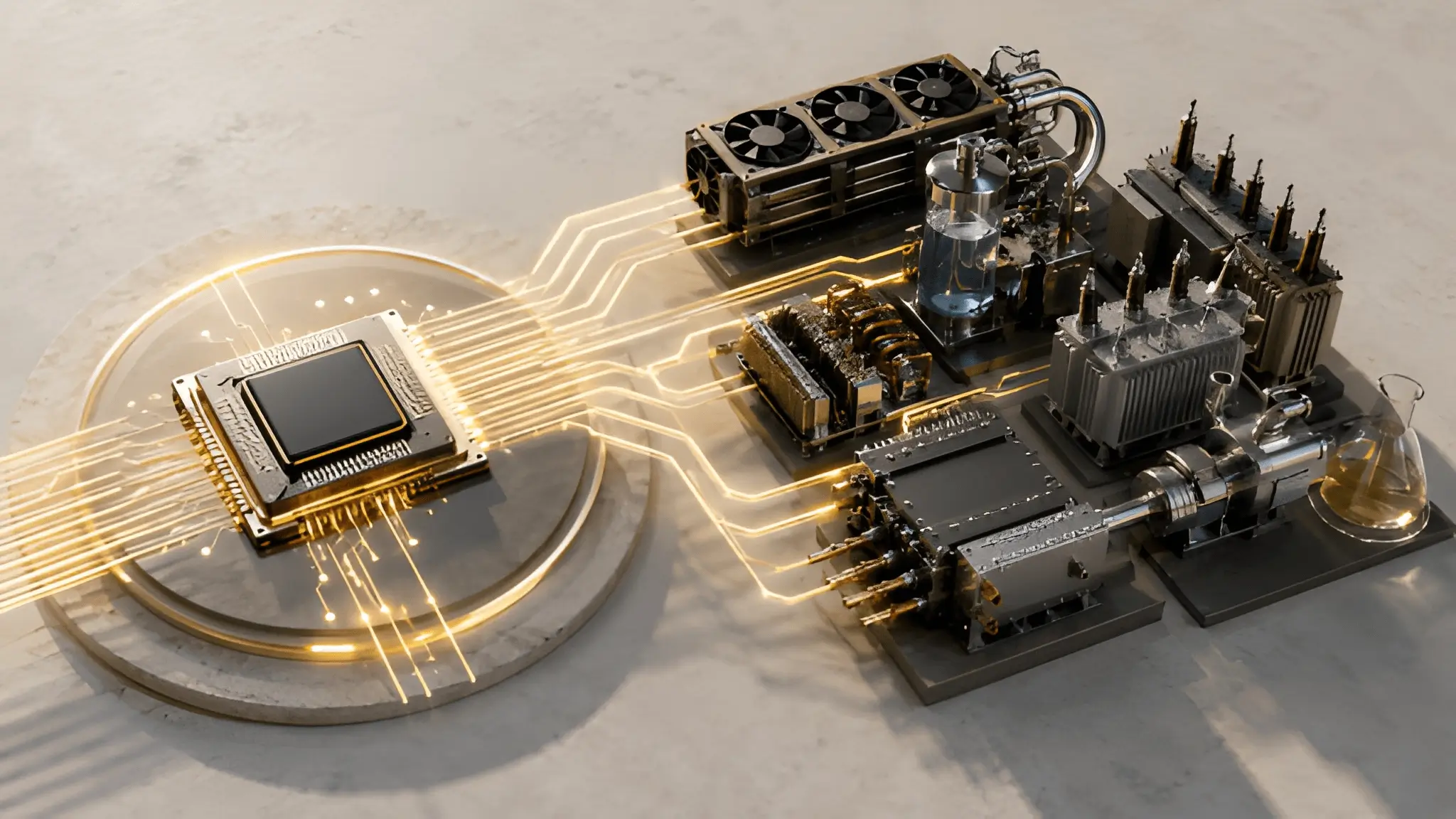
The most consequential upgrade in an AI system may not arrive inside the accelerator package. It may arrive beside it, underneath it or somewhere farther down the infrastructure chain. That shift matters because AI performance increasingly depends on whether surrounding systems can sustain the operating conditions that modern accelerators demand. More compute per rack means more electrical capacity, faster heat removal, tighter thermal tolerances and increasingly sophisticated packaging. The accelerator still sits at the center of the system, but the economic perimeter around it is expanding.

The industry is already providing evidence of that change. SK hynix is pursuing the same problem from another direction. Its iHBM solution integrates cooling elements directly into the HBM package, with the company reporting a 30% reduction in thermal resistance. Its HBM4E samples also use packaging technology aimed at reducing heat resistance. Those developments reveal an important change in semiconductor engineering. Memory can no longer be treated simply as a component that supplies data to a processor. Thermal behavior has become part of the performance equation.
The more interesting development is happening outside the semiconductor industry. AI’s density requirements are creating a common engineering problem across businesses that historically operated in very different markets. A memory manufacturer worries about heat moving through stacked packages. A cooling company worries about extracting heat from increasingly dense racks. A power-infrastructure supplier worries about delivering and managing volatile electrical loads. A chemicals or energy company can now find a commercial opportunity in the fluid circulating around the hardware.
Heat Is Becoming a Design Constraint, Not an Operating Detail
The traditional mental model of computing separates the processor from the facility around it. The chip performs computation, while the data center provides power and cooling as supporting services. High-density AI weakens that distinction. A GPU cannot deliver its theoretical performance if thermal constraints force it to reduce operating intensity. A memory stack cannot maintain its intended behavior if heat accumulates faster than the package can dissipate it. A rack cannot scale simply because more accelerators fit inside it if the power distribution and cooling architecture cannot handle the resulting load.

That makes thermal engineering increasingly inseparable from compute architecture. Research published in 2026 reflects the same direction. One study examining direct-to-chip liquid cooling for the NVIDIA GB200 Grace Blackwell platform found that redesigned cooling-channel geometries could materially reduce both average and peak temperatures compared with a baseline design. The implication extends beyond any single cooling technology. AI infrastructure is becoming a tightly coupled thermal, electrical and computational system.
Even Oil and Chemicals Have Found a Place in the AI Stack
Few developments illustrate this physical turn better than the emergence of specialized cooling fluids. Castrol, through its Castrol ON business, now markets dielectric fluids for direct-to-chip and immersion cooling in data centers. Its portfolio includes single-phase immersion fluids designed to transfer heat while providing electrical insulation. In May 2026, the company also announced Open Compute Project recognition for one of its direct-liquid-cooling fluids. The significance is larger than the product itself.
A technology industry that once treated software, processors and networking as the primary sources of competitive differentiation now increasingly depends on fluid properties, material compatibility, pumping characteristics, heat exchangers and thermal stability. That does not mean oil companies or chemical businesses will suddenly become AI companies. It means AI has created enough physical demand for capabilities from those industries to become strategically relevant to computing. The supply chain is therefore becoming more interdisciplinary because the underlying engineering problem has become more interdisciplinary.
The Next AI Bottleneck May Not Look Like a Chip
This creates a different way to think about AI infrastructure economics. The obvious question remains how quickly the industry can produce more advanced accelerators. The less obvious question is whether the surrounding industrial system can evolve at the same pace. Memory has to move data efficiently without creating unacceptable thermal penalties. Packages have to move heat. Power systems have to respond to increasingly dynamic loads. Cooling systems have to remove that heat without consuming excessive energy or introducing new operational constraints. Fluids have to remain stable and compatible with increasingly complex hardware environments.
Each layer can become a bottleneck. That changes where investors, operators and infrastructure planners should look for the next constraint. A shortage of accelerators is visible because the product has a recognizable name and a measurable specification. A thermal bottleneck can emerge through dozens of interacting components, from cold plates and pumps to electrical distribution and heat rejection. The most expensive upgrade, in other words, may not be the one that increases compute. It may be the one that allows the compute already being purchased to operate at full capacity.
AI Is Making Computing More Physical Again
The irony is difficult to miss. AI has accelerated the industry’s pursuit of abstraction. Models increasingly generate software, automate decisions and turn complex tasks into computational services. Yet the infrastructure required to run those systems at scale is moving in the opposite direction. More advanced AI requires more physical coordination among silicon, memory, packaging, electricity, cooling equipment, materials and industrial fluids. That does not make AI less technological. It makes the technology harder to separate from the industrial systems that sustain it. The next phase of AI competition may therefore belong not only to whoever builds the fastest accelerator, but also to whoever solves the physical conditions that let thousands of those accelerators operate together. The chip remains the engine. But the infrastructure around it is becoming a machine.










