 Skip to content
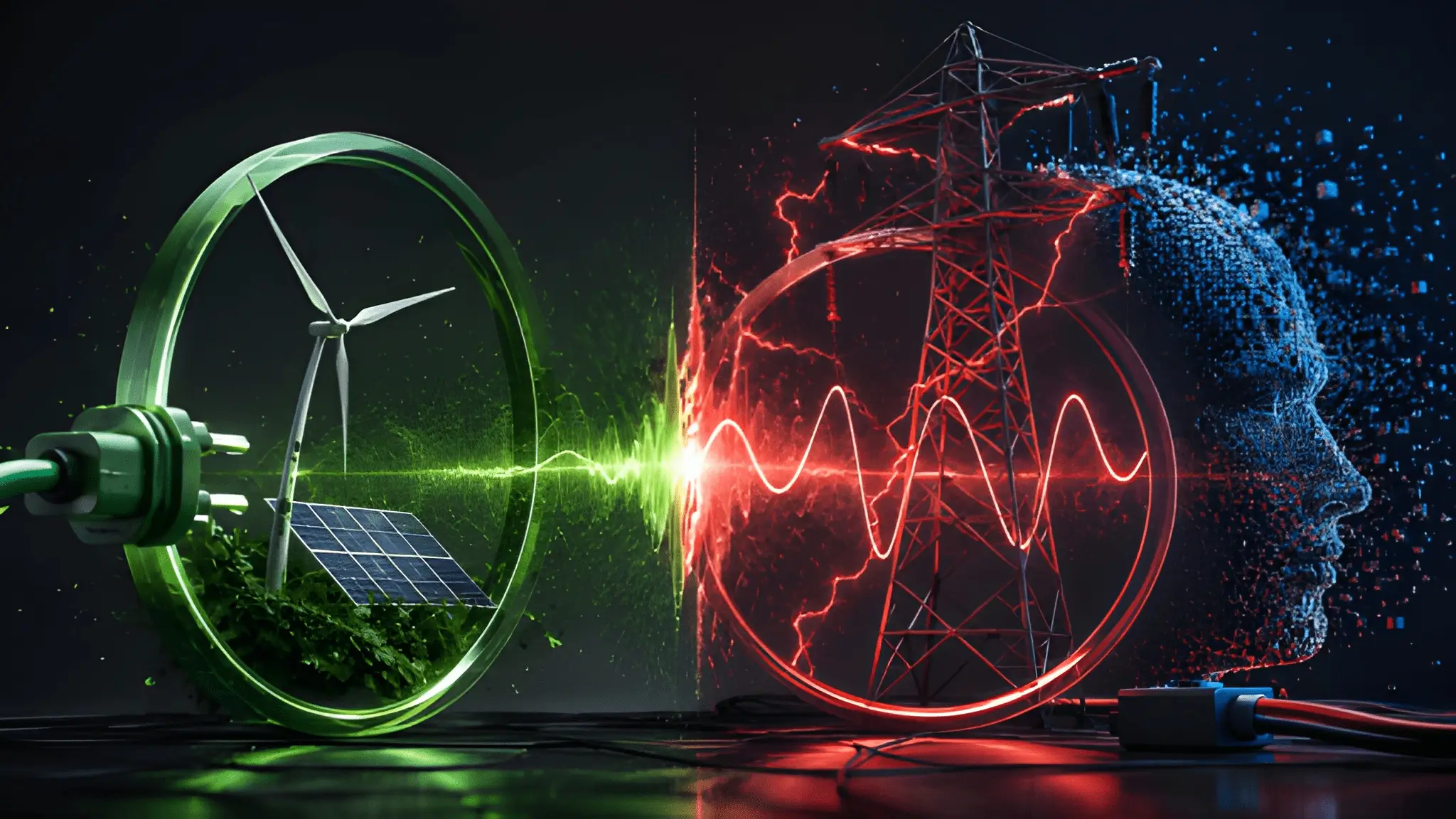
A renewable-energy contract does not tell you what an electrical load does to the system around it. It tells you what someone bought, what someone generated, and, depending on the structure, which environmental attributes can be assigned to consumption. The harder question begins after the clean-energy certificate has done its accounting work: what happened to the grid while the load actually operated? That question becomes uncomfortable when artificial intelligence workloads change the electrical behavior of a large computing load faster than conventional power planning assumptions can capture. A modern AI computing environment does not simply consume a steady quantity of electricity throughout the day, because accelerator-heavy workloads, power-conversion equipment, cooling systems, and control systems can interact with the grid through fast changes in active and reactive power.
The emerging sustainability question therefore is not simply whether an AI load consumes clean electricity. It is whether that load can consume clean electricity without making the physical system around it harder to operate. That distinction matters because a renewable-heavy grid needs flexible demand, controllable resources, transmission capacity, storage, and stable operating conditions to work together rather than treating clean generation and electricity consumption as independent accounting objects. Research into AI data-center loads and sub-synchronous resonance is beginning to address precisely that interaction, although the field remains young and engineers still need site-specific studies before attributing particular disturbance events to a particular load.
When Clean Electrons Create a Dirty Side Effect
The central paradox is simple enough to understand without an engineering degree. Imagine a computing operation that contracts for renewable electricity, retires the relevant environmental attributes, and reports its purchased electricity through an accepted market-based Scope 2 methodology. The procurement can satisfy the accounting framework while the physical load still produces electrical behavior that the procurement contract never describes, because the contract generally answers a question about energy attributes rather than the dynamic response of power-electronic equipment to disturbances on the interconnected system.
The Physical Load Behind the Clean Claim
Electricity does not move through the grid as a stack of individually identifiable renewable electrons that follow a contractual certificate from generator to server. The physical system balances generation and demand continuously, while contractual instruments assign attributes according to defined accounting rules. That distinction has always existed, but AI computing makes it more consequential because the electrical behavior of a large power-electronic load can depend on controls, converters, workload patterns, cooling systems, voltage conditions, and the strength of the grid at the point of interconnection. Recent technical research has specifically modeled AI data-center loads alongside inverter-based resources when examining sub-synchronous oscillations, while other research has investigated how workload-dependent impedance characteristics can affect resonance risk.
The practical implication is that sustainability teams need to separate energy provenance from load behavior when they evaluate a clean-energy claim. Energy provenance asks where the environmental attributes came from, how the contractual instrument was structured, whether the generation can be matched to consumption, and whether the claim satisfies the applicable accounting criteria. Load behavior asks a different set of questions about ramp rates, power-factor behavior, harmonic characteristics, control responses, voltage sensitivity, and the way large computing loads respond when grid conditions change. The second category does not invalidate the first, but ignoring it leaves a material part of the physical sustainability story outside the claim.
Why Matching Does Not Describe Behavior
The limits of the traditional matching model become clearer when the accounting clock and the electrical clock are placed side by side. A market-based Scope 2 calculation can operate through contractual instruments that establish an emission factor for purchased electricity, while physical grid dynamics can unfold through control interactions and disturbances far faster than an annual accounting record can represent. The GHG Protocol’s proposed revisions explicitly include temporal matching and deliverability for market-based reporting, which would make procurement claims more specific to when and where electricity is consumed, but even such accounting would not determine whether the consuming load behaves constructively during a grid disturbance.
The sustainability consequence is subtle but important. A clean-energy claim can remain technically valid under the rules that govern the claim while still failing to communicate the complete physical relationship between the load and the electricity system. That does not mean every renewable-powered AI operation destabilizes its surrounding grid, nor does it establish that a particular appliance failure or household disturbance came from a nearby computing load. Bloomberg’s investigation into power-quality conditions near data-center activity reported an association between proximity to data-center activity and worsening harmonic distortion, while the underlying physical relationship requires careful engineering analysis rather than a blanket causal conclusion.
The Clean Receipt That Hides a Messy Reality
A renewable-energy receipt can remain accurate while telling an incomplete story about what happened on the electrical system. Market-based Scope 2 accounting attributes emissions to contractual instruments according to defined rules, while the physical grid continuously balances generation and consumption through electrical flows that no certificate can directly represent. The GHG Protocol has proposed hourly matching and deliverability requirements for market-based reporting because greater temporal and geographic specificity could make reported clean-energy procurement more closely aligned with the time and place electricity is consumed, although those proposals have not yet become final Scope 2 requirements. That change improves the connection between procurement and physical reality, but it still does not measure the electrical quality of the demand itself. Sustainability teams therefore need to understand that a cleaner accounting relationship does not automatically become a cleaner physical relationship.
What the Accounting Receipt Can Prove
The strongest way to understand the clean-energy receipt is to treat it as evidence for a specific proposition rather than as proof of overall electrical cleanliness. A qualifying contractual instrument can establish an emissions factor or environmental attribute for purchased electricity under the market-based method, subject to the accounting rules that apply to that instrument and reporting period. It cannot establish that the load maintained a particular power factor, stayed within a particular harmonic profile, avoided oscillatory behavior, or responded smoothly to voltage and frequency disturbances. Those characteristics belong to power-system engineering, where operators examine quantities such as voltage distortion, current distortion, reactive-power behavior, frequency response, impedance interactions, and dynamic stability. The GHG Protocol’s proposed revisions explicitly state that market-based accounting remains an inventory tool and that broader impact claims sit outside the market-based inventory method, which makes the distinction especially important for sustainability communications.
Why the Electrical Clock Changes the Story
An AI load can create a reporting blind spot because conventional sustainability records tend to aggregate electricity consumption while electrical engineers examine system behavior at much finer temporal and electrical resolution. Recent research has modeled data-center loads as dynamic power-electronic loads and examined how their impedance characteristics can change with computing workloads, creating possible interactions with sub-synchronous oscillations in systems containing inverter-based resources. Other recent research has examined persistent sub-synchronous active-power oscillations associated with large AI data-center loads and their potential effect on generator shaft dynamics, while stressing that actual risk depends on the characteristics of the network, machines, controls, and point of interconnection. That distinction prevents a common analytical mistake: treating every rapid AI load change as proof of instability rather than treating it as a condition that deserves engineering assessment.
When How You Use Clean Energy Matters More Than How Much You Buy
The next sustainability differentiator will increasingly concern the behavior of electricity demand rather than the volume of renewable procurement attached to it. Two computing sites can hold comparable contractual renewable-energy arrangements while presenting very different engineering challenges to the systems that serve them. One load can respond gradually to workload changes and coordinate its computing schedule with storage, cooling, and grid conditions, while another can synchronize large groups of power-conversion systems around abrupt changes in computational activity. The distinction does not require either site to consume more or less renewable electricity for the physical consequence to differ. It instead depends on how the electrical equipment converts computational demand into active and reactive power at the point of interconnection. That makes load temperament a legitimate engineering concept for sustainability teams even if it does not yet have the same standardized vocabulary as renewable procurement or carbon accounting.
The New Meaning of a Well-Behaved Load
A well-behaved AI load does not mean a load that never changes its electricity demand, because computational workloads naturally change and operators cannot treat computing demand as an industrial process with no variability. It means a load whose changes remain within known electrical characteristics, whose controls respond predictably to disturbances, and whose interaction with the network does not create avoidable resonance or power-quality problems. That requires engineers to understand the relationship between server power supplies, rack-level power distribution, converters, cooling equipment, UPS systems, transformers, and the upstream network rather than examining only the site’s aggregate meter. Workload orchestration can become relevant because software decisions about when and where computation occurs can influence the electrical profile presented to the grid. The strongest programs will eventually describe renewable procurement, flexibility, power-quality performance, and grid-support behavior as connected elements rather than separate technical topics owned by unrelated teams.
Why Identical PPAs Can Produce Different Outcomes
A power purchase agreement describes a contractual relationship around electricity and associated environmental attributes, but it does not prescribe the electrical behavior of the buyer’s computing equipment. One site might use the contracted renewable supply while operating a highly controllable computing schedule, whereas another site might consume the same contractual product while its computing equipment responds sharply to workload changes. The difference can become more important on a grid with high penetration of inverter-based generation, because system strength, control interactions, fault behavior, and oscillatory characteristics can differ materially from conditions on a network dominated by conventional synchronous machines. Recent research into weak grids with high renewable penetration reinforces the importance of voltage support, system strength, frequency control, and related stability services when power-electronic resources dominate system behavior. AI loads also rely heavily on power electronics, which means the conversation cannot stop at the generation side of the inverter-based resource equation.
What Community Trust Costs When Green Marketing Meets Flickering Lights
The sustainability conversation changes character when electricity quality becomes something people can experience rather than something they encounter in a report. A resident does not experience a renewable certificate, a market-based emissions factor, or an hourly matching methodology when an appliance behaves erratically or an electrical service becomes unreliable. That person experiences the physical result through equipment performance, power interruptions, voltage disturbances, or concern about whether the local electrical system can support growing demand. Bloomberg’s investigation brought this issue into public view by examining power-quality measurements and their geographic relationship with data-center activity, but the findings should not become a shortcut for assigning every local electrical problem to AI computing. Power-quality conditions can arise from many sources, including industrial loads, distributed energy resources, utility equipment, network configuration, and other power-electronic devices.
When Technical Disturbance Becomes a Human Issue
Power quality has always mattered to electricity users, yet the rapid expansion of large computing loads changes the visibility and political sensitivity of the issue. Harmonic distortion, voltage variation, resonance, and other electrical phenomena normally remain inside engineering studies until someone experiences a consequence that makes the technical condition visible. A sustainability claim can then become part of the community conversation because residents naturally compare the language of environmental responsibility with the physical experience associated with new electrical demand. Bloomberg’s reporting examined measurements of distorted power near areas with significant data-center activity and connected the issue to potential effects on electrical equipment, while independent technical discussion has emphasized that the presence of distortion does not automatically establish that a particular data center caused a particular appliance failure. That nuance matters because responsible sustainability communication should neither dismiss the concern nor claim certainty where the evidence does not support it.
Why Trust Can Move Faster Than Carbon Accounting
Carbon reporting operates through methodologies, boundaries, emission factors, contractual instruments, verification processes, and disclosure cycles, while community confidence develops through direct experience and visible evidence. A company can spend years improving its carbon accounting while losing credibility quickly if people believe its electricity demand contributes to local power-quality problems and the organization responds only with renewable procurement figures. It means that sustainability communication must distinguish between climate impact and electrical-system impact instead of allowing a successful carbon claim to imply a broader environmental guarantee. An end user deciding whether to trust an operator ultimately needs a clear answer to a practical question: does the organization know how its electricity demand affects the system, and does it take corrective action when evidence identifies a problem? The answer becomes more credible when the company publishes engineering evidence, explains uncertainty honestly, and avoids using renewable procurement as a substitute for physical accountability.
The Carbon Math That Forgot Physics
The carbon consequences of unstable electricity demand do not stop at the boundary of the power meter. AI computing depends on a physical chain of equipment that includes batteries, UPS systems, generators, transformers, cooling equipment, power converters, and other components whose service life depends partly on operating conditions. If unusual workload behavior increases cycling, thermal stress, vibration, or electrical stress, premature replacement can create an environmental burden that a conventional operational Scope 2 calculation does not automatically capture. Recent reporting has described volatile AI power demand and reported premature wear or malfunction in some data-center power equipment, while technical research has separately modeled how persistent oscillatory loading could affect generator mechanical systems under specified operating conditions. Those findings do not justify assuming that every AI installation will experience premature equipment failure, but they do justify treating equipment duty cycle as part of the sustainability discussion.
Replacement Carbon is Still Carbon
The cleanest way to frame replacement carbon is not as an argument against electrification or AI computing, but as a reminder that infrastructure has a material life cycle. A battery that requires unusually frequent replacement necessarily brings forward the material, manufacturing, transportation, installation, and end-of-life impacts associated with replacing that equipment rather than distributing those impacts across its originally expected service period. A turbine or generator subjected to unfavorable cycling can face a similar problem because mechanical components respond to stress cycles rather than simply to the total amount of electricity produced. Recent modeling research examining AI data-center load oscillations and hydro-generator shaft behavior has investigated how electrical oscillations could interact with mechanical modes under specified system conditions, providing a risk-assessment basis rather than evidence that such damage occurs at every affected generator.
Designing the Carbon Model Around Operating Reality
A stronger sustainability model would connect electricity procurement with operational records that show how the equipment actually behaved. That model could combine electricity consumption data with power-quality monitoring, workload profiles, battery operating conditions, generator duty cycles, maintenance records, and replacement histories without pretending that every observed change has a single cause. Such an approach would allow sustainability teams to distinguish ordinary equipment turnover from replacement that follows unusual operating stress and to investigate whether changes in computing behavior correlate with changes in infrastructure maintenance. It would also make carbon reporting more useful because the organization could identify where operational decisions create environmental consequences that conventional electricity accounting does not capture. The exercise requires cooperation between sustainability professionals, electrical engineers, reliability teams, procurement specialists, and operators, but it does not require turning the sustainability report into an engineering manual.
Rethinking Additionality for Loads That Shake What They Join
In many corporate clean-energy strategies, additionality is used to ask whether procurement supports new clean-generation capacity or investment rather than simply allocating existing environmental attributes to a buyer. That question remains important, but large AI loads introduce another engineering consideration because the reliability value of adding generation also depends on whether the surrounding power system can accommodate changing generation and demand without creating avoidable operating problems. A renewable project can add low-carbon electricity while a rapidly changing computing load simultaneously creates control interactions that complicate the network’s ability to maintain stable operation. That does not make the clean generation ineffective, and it does not mean that a demanding load automatically cancels the environmental value of procurement. It means sustainability teams need a broader definition of compatibility alongside additionality when they evaluate whether a clean-energy strategy supports the physical transition they describe.
Additionality Needs a Compatibility Test
A more useful additionality framework would retain the question of whether procurement supports new clean generation while adding a second question about the electrical environment created by the associated demand. The first question concerns investment, contractual structure, project development, and the conditions under which clean generation enters the electricity system. The second concerns whether the consuming load operates within a range that allows the grid to use generation, transmission, storage, and other resources without avoidable instability or power-quality stress. This second question does not require sustainability teams to invent a new carbon-accounting category because the GHG Protocol already distinguishes inventory accounting from broader impact reporting and has proposed separate treatment for consequential electricity-sector impacts. Instead, it requires organizations to place technical compatibility evidence beside procurement evidence when they make broader sustainability claims.
Proving Compatibility Alongside Procurement
Compatibility should become an evidence category rather than a marketing adjective. A company could document the renewable resources supporting its electricity strategy, the contractual instruments used for Scope 2 accounting, the geographical relationship between generation and consumption, and the temporal relationship between clean supply and load. It could then maintain a separate technical record covering interconnection studies, power-quality measurements, disturbance investigations, control-system validation, and mitigation measures. That record would not need to enter the Scope 2 inventory itself because the GHG Protocol’s proposed framework keeps the inventory focused on attributional accounting while developing complementary approaches for actions and impacts outside the inventory boundary. The separation actually improves credibility because it prevents an organization from forcing a physical-grid claim into a carbon-accounting number that was never designed to measure it.
How Sustainability Teams Can Talk About Impact Without Greenwashing
The communications challenge begins when a technically correct statement creates an impression that extends beyond what the evidence supports. Saying that electricity consumption carries renewable-energy attributes can be accurate under the applicable accounting framework, while saying that the associated load is therefore harmless to the electricity system would require a different body of evidence. Sustainability teams need language that preserves the value of clean-energy procurement without allowing the procurement claim to become a proxy for reliability, power quality, or grid compatibility. This distinction matters more as electricity-system operators, engineers, regulators, communities, and customers pay closer attention to the behavior of large flexible and power-electronic loads. The safest communications strategy does not retreat from environmental ambition, because that would confuse uncertainty about one physical effect with uncertainty about the value of decarbonization itself.
Replace Clean-Energy Shorthand With Evidence
The phrase “powered by renewable energy” compresses several distinct claims into a single sentence, which makes it attractive for communications but difficult to defend when stakeholders ask what the statement actually means. A stronger formulation can identify the procurement structure, explain whether the claim uses market-based Scope 2 accounting, describe the relationship between the contracted resources and consumption, and separately state how the load’s electrical behavior is monitored. The organization can then explain that renewable procurement addresses the emissions characteristics of purchased electricity while engineering controls address power quality, stability, and reliability at the point of interconnection. That language does not weaken the sustainability story because it gives each claim the evidence appropriate to it. The approach also prevents an organization from presenting a clean-energy certificate as evidence that its computing demand has no effect on neighboring electrical equipment or on broader grid behavior.
Build the Claim Around What the User Can Verify
A useful communications framework should begin with the experience of the person receiving the claim rather than the internal structure of the sustainability report. An electricity customer, investor, community member, or procurement decision-maker needs to understand what the company has actually demonstrated and what remains outside the evidence. That means replacing broad phrases such as “zero-impact clean power” with more specific statements about renewable procurement, temporal and geographic matching, electrical monitoring, interconnection compliance, and corrective action. The organization should also explain material uncertainty without turning every disclosure into a technical disclaimer, because transparency works best when the audience can understand why a particular uncertainty exists and what the company is doing about it. When a disturbance occurs, the communications process should preserve the distinction between an event that coincides with computing activity and an event that engineering analysis has demonstrated the computing load caused or amplified.
From Claiming Clean to Proving Compatible
The next phase of AI sustainability will require a more complete understanding of what electricity means after it leaves the procurement spreadsheet. Renewable procurement remains essential because the electricity system cannot decarbonize without investment in cleaner generation, stronger transmission, storage, flexibility, and demand-side participation. Scope 2 accounting remains essential because organizations need a consistent way to measure emissions associated with purchased energy and communicate progress against climate objectives. The emerging issue is that a large AI load operates within the same physical electricity system that sustainability accounting seeks to describe, while NERC and recent technical research have identified conditions under which computational-load behavior can influence system dynamics. Recent research into data-center loads, UPS controls, oscillatory behavior, generator stress, and grid interaction shows that the engineering community has started to investigate these questions with greater specificity.
The New Standard is Clean and Compatible
Compatibility should become the practical bridge between carbon ambition and electrical responsibility. A compatible AI load would not simply demonstrate that it procures clean electricity, because procurement answers only part of the sustainability question. It would demonstrate that its electrical equipment operates predictably within the characteristics of the grid, that engineers understand the behavior of its converters and controls, that the site can respond appropriately to disturbances, and that flexible resources can support the system where technically feasible. Such an approach could include renewable procurement evidence, hourly consumption and generation information where available, deliverability information, power-quality monitoring, disturbance records, control-system validation, and engineering studies appropriate to the network. The proposed Scope 2 revisions have explored greater temporal and geographic specificity through hourly matching and deliverability, while separate GHG Protocol work is considering methods for reporting electricity-sector impacts outside corporate inventories, with both areas still part of the standards-development process.
The Invitation to Return is the Real Test
The strongest measure of responsible AI infrastructure may ultimately have little to do with the most impressive renewable-energy headline. A site earns confidence when utilities, grid operators, communities, customers, and other electricity users can see that its demand remains technically manageable as conditions change. That confidence comes from evidence rather than branding, including credible interconnection studies, transparent monitoring, appropriate controls, responsive operating practices, and a willingness to investigate disturbances without deciding the conclusion in advance. The same principle applies to carbon claims because an organization should be able to explain precisely what its renewable procurement proves, what its Scope 2 inventory measures, and what separate engineering evidence demonstrates about its physical behavior. The distinction protects sustainability teams from greenwashing while also protecting them from an equally unhelpful form of skepticism that treats every AI load as inherently incompatible with clean electricity.
The clean-energy transition was never only a procurement exercise because electricity becomes useful through a physical network whose behavior matters at every point between generation and consumption. AI makes that reality harder to ignore because concentrated computing demand combines large electrical loads with sophisticated power electronics, fast workload changes, extensive UPS infrastructure, and increasingly complex relationships with renewable generation and storage. Sustainability reporting can respond without abandoning its existing foundations by keeping Scope 2 accounting precise, treating broader physical impacts as complementary evidence, and making compatibility part of the operating story rather than an implied consequence of buying renewable energy. The most defensible future claim will not say that a facility is clean simply because its electricity contract is clean, because the contract and the load answer different questions.












