 Skip to content
When Digital Infrastructure Becomes an Urban Heat Source
Data centres have become major electricity consumers as digital workloads expand across cloud, enterprise and artificial intelligence systems. Servers, memory, storage and networking equipment all consume electricity during normal operation. Much of that electricity eventually appears as heat inside the facility. Cooling systems move that heat away from sensitive equipment through air, water or other cooling mediums. Conventional facilities can reject the thermal energy into the surrounding environment without another useful application. A data centre does not automatically create a measurable citywide heat-island effect. Its thermal influence depends on facility scale, cooling design, local weather and surrounding development. The more useful question is whether nearby energy users can capture and use that rejected heat.

Heat Becomes an Energy Resource
The thermal stream from computing equipment can remain available for long operating periods. That pattern gives data centres a different profile from many intermittent heat sources. Nearby buildings can sometimes use the heat when their demand matches the available supply. District heating networks can provide another route for moving heat between facilities and customers. The IEA identifies data centres as potential sources of low-temperature excess heat. It also highlights proximity to heat demand as an important factor in practical recovery. A useful project must connect the thermal source with a suitable customer. The value comes from integrating digital infrastructure with an existing energy requirement.
The Thermal Energy Hidden Inside Computing
A modern data centre converts electrical energy into computing activity and heat during normal operation. Processors execute workloads while memory systems handle active information and storage systems maintain data. Networking equipment consumes electricity while moving traffic through the facility. Much of this electrical input eventually becomes heat that engineers must manage continuously. Cooling systems capture the resulting thermal load and move it toward rejection or recovery equipment. Air systems use airflow and heat-transfer equipment to carry heat away from servers. Liquid systems can capture heat closer to high-density computing components. The cooling architecture therefore influences both heat temperature and recovery options.
Temperature Determines Reuse Potential
The temperature of recovered heat depends on equipment, cooling design and operating conditions. A low-temperature stream may not meet the direct requirements of a district heating network. Heat pumps can raise that temperature by adding electrical energy to the thermal process. Their performance depends on the temperature difference between the source and delivery system. Smaller temperature lifts can support more efficient heat pump operation. Lower-temperature heating networks can therefore improve conditions for some recovery projects. The electricity used by the heat pump must remain within the system assessment. Carbon benefits depend on both the electricity source and the heating source being displaced.
Why City Location Matters
The location of a data centre can strongly influence the value of its excess heat. A remote facility may require additional transmission and connection infrastructure to reach customers. Pumping equipment and heat exchangers can add further project requirements. Dense residential areas can provide concentrated heating demand near a suitable data centre. Commercial buildings and industrial facilities can create other potential heat destinations. District heating networks can distribute heat from concentrated sources to many connected buildings. Existing networks still require suitable temperature levels and sufficient thermal capacity. Site selection can therefore include heat demand alongside power, fibre, land and cooling requirements.
District Heating Creates the Connection
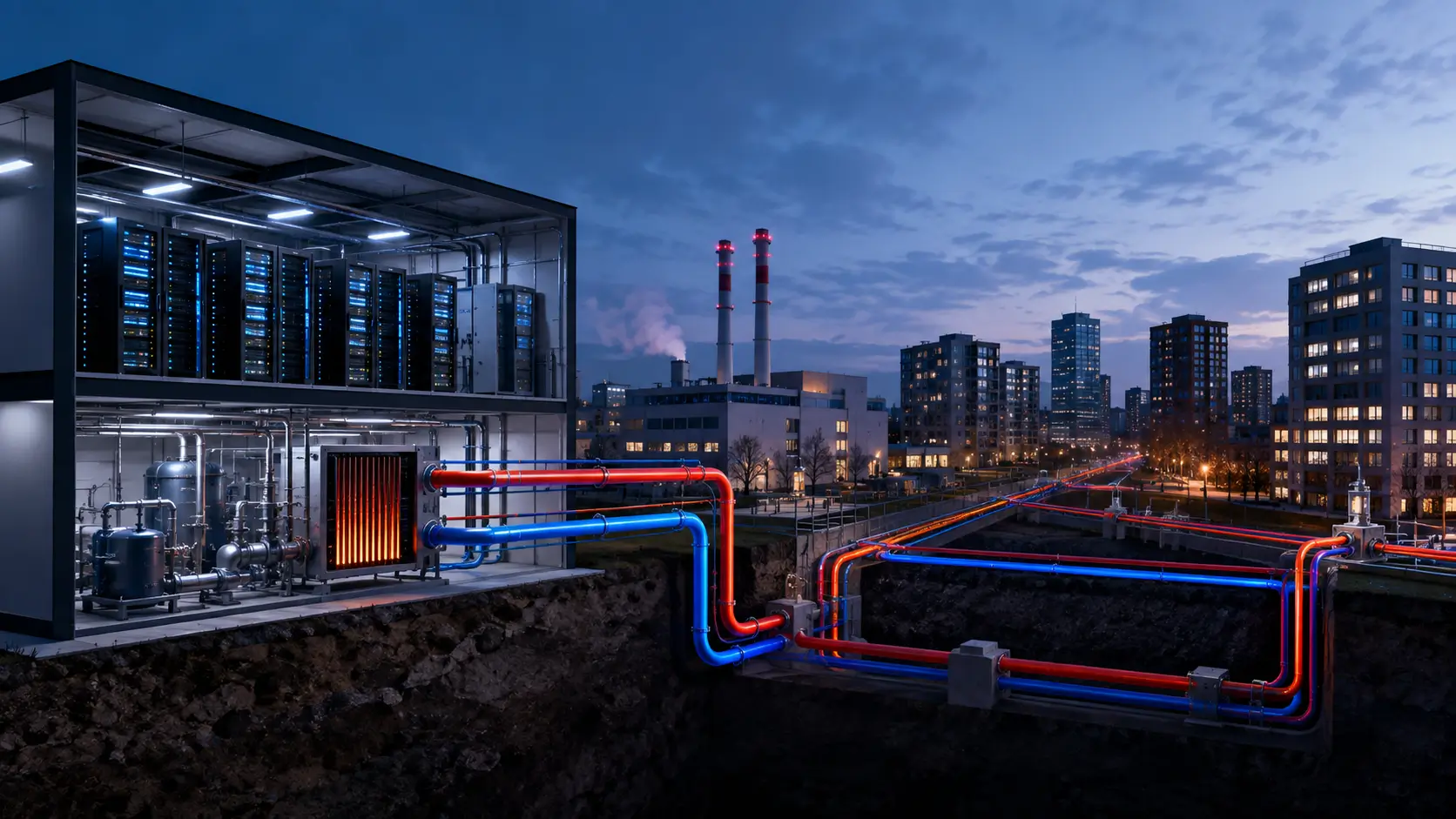
District heating creates a practical pathway between a concentrated heat source and multiple users. Networks can combine several thermal sources within one broader supply system. Data centres can contribute alongside heat pumps, industrial processes and energy-from-waste facilities. A heat exchanger can separate the data centre cooling circuit from the heating network. This arrangement transfers thermal energy without directly combining the two water circuits. Heat pumps can provide additional temperature upgrading when the source remains too cool. Network operators can then distribute the upgraded heat according to customer demand. The model requires technical coordination between data centre owners and heating operators.

Stockholm Shows What Integration Can Look Like
Stockholm provides a documented example of this type of thermal integration. Its Open District Heating model allows organisations to supply excess heat to the local network. Data centres participate alongside other businesses that produce suitable recoverable heat. The IEA reports more than 20 Stockholm data centres supplying about 1.5% of city district heating needs. One documented installation transfers heat from a data centre cooling loop through a heat exchanger. Large heat pumps then upgrade the recovered heat before distribution through the network. The installation demonstrates how cooling output can enter an established thermal system. Other cities cannot assume identical results because local network conditions differ.
Local Conditions Still Matter
Stockholm’s model depends on physical infrastructure and commercial arrangements. The surrounding heat market provides another important part of the system. Network temperature can influence how much upgrading the recovered heat requires. Available capacity can determine whether the network can accept additional thermal supply. Customer demand can change the value of recovered heat during different periods. Data centre operators must maintain safe cooling when external heat demand falls. The network must retain reliable supply when the data centre becomes unavailable. These conditions make the Stockholm example useful without turning it into a universal template.
Cooling Architecture Shapes the Opportunity
Cooling architecture can determine how easily a facility can capture useful thermal energy. Conventional air-cooled systems may produce heat that needs additional upgrading before network use. Liquid cooling can capture heat closer to high-density computing components. Rear-door heat exchangers provide another option for capturing heat from selected server environments. Peer-reviewed research has examined the energy and economic performance of these configurations. One study found stronger economic feasibility for rear-door cooling under its specific conditions. That result does not establish a universal advantage across all data centre designs. Operators should therefore evaluate recovery during the initial cooling design process.
Heat Recovery Starts With System Design
Heat recovery becomes easier when engineers consider it during facility planning. Cooling systems can then include suitable interfaces for external thermal transfer. Heat exchangers, pumps and controls can receive appropriate space within the facility design. Designers can evaluate source temperatures before selecting the heat pump arrangement. They can compare expected heat availability with nearby demand profiles. Operators can then assess whether direct use or temperature upgrading offers better value. Retrofitting recovery equipment can create additional engineering constraints after commissioning. Early planning can reduce those constraints without changing the primary reliability requirements.
Urban Heat Requires More Precise Language
The relationship between data centres and urban temperature requires careful interpretation. Thermal discharge from one facility does not automatically establish a citywide urban heat-island effect. Local weather, building density and facility scale can influence the surrounding thermal environment. A 2024 Italian study examined data centre heat within an integrated district heating scenario. The researchers modelled a 100-kilowatt data centre and estimated 926 megawatt-hours of annual waste heat. The model redirected part of that heat into district heating through high-temperature heat pumps. The analysis found that recovered heat could replace some gas consumption in the studied network. The result demonstrates technical potential without proving a universal urban climate effect.
Measuring the Wider Effect
Urban thermal analysis requires more than measuring heat released from one building. Researchers need to consider local weather patterns and surrounding building conditions. The physical characteristics of the facility can influence how heat enters the environment. Cooling architecture can change the temperature and location of the discharged thermal stream. Nearby infrastructure can alter airflow and heat dispersion around the site. Heat recovery can reduce the amount of thermal energy released directly into the environment. District heating integration can therefore change the local energy pathway. Site-specific measurement remains necessary before broader urban temperature conclusions are drawn.
The Timing Problem Cannot Be Ignored
Heating demand does not remain constant throughout the year. Data centres can generate heat continuously while buildings require different amounts across seasons. Winter demand can be much higher than summer demand in many heating networks. This mismatch can limit the amount of recovered heat that customers can absorb. Thermal storage can help manage differences between heat availability and network demand. Short-duration storage can address daily changes in thermal consumption. Longer-duration systems can shift heat across wider periods when conditions permit. Storage design must consider capacity, losses, charging rates and discharge requirements.
Storage Adds Flexibility
Thermal storage does not remove the need for suitable heat demand. Stored energy still requires a useful destination within a practical timeframe. Storage can instead change when recovered heat becomes available to the network. This flexibility can improve utilisation when supply and demand occur at different times. Water-based systems can serve shorter storage periods in suitable applications. Longer-duration approaches can address wider timing differences between supply and demand. Research continues to examine storage methods for data centre thermal integration. Each project requires separate evaluation of cost, capacity and operating conditions.
New Research Points Toward Thermal Storage
Recent research is combining data centre heat recovery with advanced thermal storage. A 2026 study examined a proposed system in Varna, Bulgaria. The model included a 500-kilowatt data centre and a third-generation district heating network. Average district heating demand in the study reached 9.3 megawatts. The system combined vapour-compression heat pumps with thermochemical energy storage. Recovered heat could supply up to 3% of annual heating demand under the studied conditions. The model also found that recovered heat could exceed 20% of instantaneous heating load.
Annual and Instantaneous Value
Annual and instantaneous contributions measure different aspects of system value. A modest annual contribution can still become significant during periods when demand aligns with supply. Thermochemical storage can help separate heat availability from network demand. Its commercial value still depends on system costs and operating conditions. The Varna study represents a specific modelled configuration rather than an industry-wide benchmark. Its findings show how storage can change the timing of recovered heat delivery. They do not establish identical performance for other data centres. Local demand, cooling design and network conditions will influence each outcome.
Economics Will Determine Scale
Technical feasibility does not automatically establish commercial feasibility for heat recovery. Heat exchangers, heat pumps, pipelines, controls and storage can require significant capital investment. Electricity prices influence operating costs because heat pumps consume power during temperature upgrading. The value of recovered heat depends on the energy source that it can replace. Customer demand also influences the price that a network can support for delivered heat. Longer distances can increase connection costs and pumping requirements. Research in Espoo found potential reductions in district heating operating costs from waste heat use. Project-level financial modelling remains necessary because economic outcomes vary between locations.
Distance and Demand
A data centre can produce substantial heat without having a nearby customer for that energy. Long transmission distances can increase infrastructure requirements and reduce economic attractiveness. Dense heating demand can improve the utilisation of available thermal output. Existing district heating networks can reduce some connection challenges where suitable capacity exists. Network temperature can still determine whether heat pumps are necessary. Electricity prices can influence the cost of that temperature upgrading. Contracts can determine how the data centre receives value from supplied heat. These factors must be assessed together before investment decisions are made.
Frankfurt Illustrates the Scale Question
Frankfurt provides another case for examining the scale of urban heat integration. A 2024 feasibility study considered two districts with annual heat demand of 144 gigawatt-hours. The researchers modelled high-capacity heat pumps, gas boilers and thermal storage. Their proposed configuration indicated that waste heat could cover 97.5% of studied heat demand. The analysis also estimated a 78% average carbon dioxide reduction within the studied network. These figures describe a specific feasibility scenario rather than a universal performance benchmark. Large urban districts may offer concentrated demand for extensive recovery infrastructure. Economic viability still depends on network characteristics, infrastructure costs and available heat.
Backup Capacity Remains Important
A district heating system cannot assume uninterrupted output from one thermal source. Data centre workloads can change, and cooling systems can require maintenance. External networks can also experience periods when additional heat cannot be accepted. Backup generation can maintain service when recovered heat becomes unavailable. Thermal storage can provide another layer of operational flexibility. The Frankfurt study included gas boilers and storage within its proposed configuration. That design illustrates the importance of maintaining supply resilience. Heat recovery can support a network without becoming its only source of thermal energy.
Data Centre Operators Need a Different Design Mindset
Data centre operators must preserve reliability when adding external heat recovery systems. Cooling equipment protects computing hardware and remains the primary operational requirement. Heat recovery should function as an additional thermal pathway rather than a dependency for safe operation. Heat exchangers can separate recovery equipment from critical cooling circuits. Redundant pumps can provide resilience for thermal transfer equipment. Bypass arrangements can maintain heat rejection when external demand changes. Controls must respond to IT loads, cooling conditions and network requirements. Operators should define maintenance, outage and availability responsibilities before commercial operation begins.
Designing the Interface
The connection between a data centre and a heating network requires controlled thermal interfaces. Heat exchangers can prevent direct mixing between separate cooling and heating circuits. Pumps can maintain the required flow through recovery equipment. Control systems can respond to changing temperatures and thermal loads. Isolation systems can support maintenance without affecting core cooling functions. The recovery pathway should remain independent of critical heat rejection where necessary. External network failures should not create unsafe conditions inside the data centre. This approach keeps reliability at the centre of the recovery design.
District Heating Operators Face Their Own Constraints
District heating operators face a separate set of technical and commercial constraints. Existing networks may already use boilers, heat pumps or combined heat and power facilities. A new heat source can change the operating pattern of those assets. Recovered heat temperature also determines whether additional upgrading will be necessary. Commercial contracts must define payment arrangements and delivery conditions. Heat quality rules can specify temperature, flow and reliability requirements. Contracts should address periods when data centre output falls or network demand changes. The IEA identifies business models and tariff structures as barriers to wider waste heat integration.
Building a Reliable Heat Market
A heat recovery project needs a customer that can accept the thermal supply. The customer also needs confidence in heat availability and delivery conditions. Data centre operators must understand how much heat they can provide consistently. Heating companies must understand how that supply fits within their existing generation portfolio. Contracts can establish responsibilities during outages and periods of reduced demand. Tariff structures can influence whether recovered heat creates sufficient commercial value. Regulatory rules can shape the conditions for connecting external heat sources. A successful project therefore requires both physical infrastructure and a functioning commercial relationship.
The Grid and Heat Networks Are Becoming Connected
Artificial intelligence is changing the relationship between digital infrastructure and energy systems. High-density computing can increase electricity demand and create additional cooling requirements. The IEA expects data centre electricity consumption to grow significantly as AI services expand. Every unit of electricity consumed by computing creates a thermal management requirement. Heat pumps can connect electrical consumption with useful thermal delivery. District heating networks can provide an external destination for recovered heat. The IEA estimates that data centres represented about 1.5% of global electricity consumption in 2025. Grid planners and heating operators therefore have reasons to examine these systems together.
Linking Electrical and Thermal Systems
A data centre can participate in several energy flows at the same time. It consumes electricity for computing and produces heat as part of that process. Cooling systems then move that heat toward rejection or recovery equipment. Heat pumps can upgrade suitable thermal streams for external use. District heating networks can distribute the upgraded energy to connected customers. The electricity used for temperature upgrading remains part of the overall energy balance. The environmental value depends on the electricity source and displaced heating source. This creates a closer relationship between digital infrastructure and wider energy planning.
Planning Cities Around Digital and Thermal Infrastructure
Urban planners can include thermal demand when evaluating locations for future data centres. Digital infrastructure planning already considers power availability, fibre access, land and cooling conditions. District heating networks can add another important location variable. Geographic information systems can map thermal sources against nearby demand centres. Temperature mapping can indicate whether direct heat exchange is practical. Heat pumps may become necessary when source temperatures remain below network requirements. Network capacity must also accommodate additional thermal input. Planning authorities can consider future connection corridors where digital and thermal infrastructure may eventually intersect.
Coordinating Urban Infrastructure
Data centre planning can become more effective when digital and thermal systems are considered together. Electricity networks already influence where large computing facilities can operate. Fibre networks determine whether those facilities can connect to digital services and customers. Heat networks can add another infrastructure consideration for suitable urban locations. Industrial demand can provide another potential destination for recovered heat. Building density can influence the availability of nearby thermal customers. Such planning does not guarantee successful recovery at every site. It can instead identify locations where the technical conditions deserve detailed evaluation.
Regulation Can Accelerate Practical Deployment
Regulation can influence how data centres connect with local energy systems. Planning rules can affect where facilities are developed and what infrastructure they can access. Energy efficiency policies can influence decisions around cooling and waste heat. Clear frameworks can reduce uncertainty when developers and utilities share infrastructure investment. Tariff structures can influence the commercial value of recovered heat. Heat quality standards can establish temperature, flow and reliability conditions. Contracts can address periods when heat output falls or network demand changes. The IEA identifies policy coordination, business models and tariffs among barriers to wider integration.
Recognising Site Differences
Not every data centre can provide the same thermal resource to a heating network. Cooling systems produce different temperatures and operating conditions. Facilities can also differ in size, workload and heat availability. Network temperature can determine how much heat upgrading is required. Distance can influence connection costs and infrastructure requirements. Regulatory frameworks should account for these differences when setting requirements. Developers need practical rules that distinguish technical potential from guaranteed recovery. Policy can support deployment when it reflects the physical limits of individual projects.
The Next Efficiency Frontier Is Integration
The next efficiency question concerns how data centres interact with surrounding energy systems. Heat recovery provides one pathway for using thermal energy outside the facility. Heat pumps can manage temperature differences between sources and heating networks. Storage can manage timing differences between heat production and demand. District heating can connect recovered heat with multiple customers. Each component introduces costs and operational dependencies that require site-specific evaluation. Financial analysis must include capital costs, electricity consumption and network connections. Environmental analysis must include heat pump electricity and the energy source being displaced.
Measuring the Whole System
A successful project must demonstrate reliable heat delivery without weakening computing resilience. The data centre must retain safe cooling during external network disruptions. Financial performance must reflect the complete investment and operating structure. Environmental performance must consider all additional electricity and displaced energy sources. Heat recovery should therefore be assessed across its entire operating chain. Engineers can compare source temperature, network demand and available infrastructure. Operators can then determine whether the proposed system creates measurable value. This system-level approach provides a stronger basis for long-term infrastructure decisions.
From Heat Rejection to Energy Partnership
Data centre heat can become part of an urban energy system when technical conditions align. District heating can provide a route for moving recovered heat to multiple buildings. Industrial facilities can provide alternative destinations for suitable thermal streams. Heat pumps can raise source temperatures when direct integration is not possible. Thermal storage can help manage differences between supply and demand. Research from Stockholm, Frankfurt, Italy, Finland and Bulgaria shows several possible configurations. Each example depends on its own cooling architecture, network conditions and economic assumptions. The broader opportunity lies in treating computing, cooling, electricity and thermal demand as connected infrastructure.












