
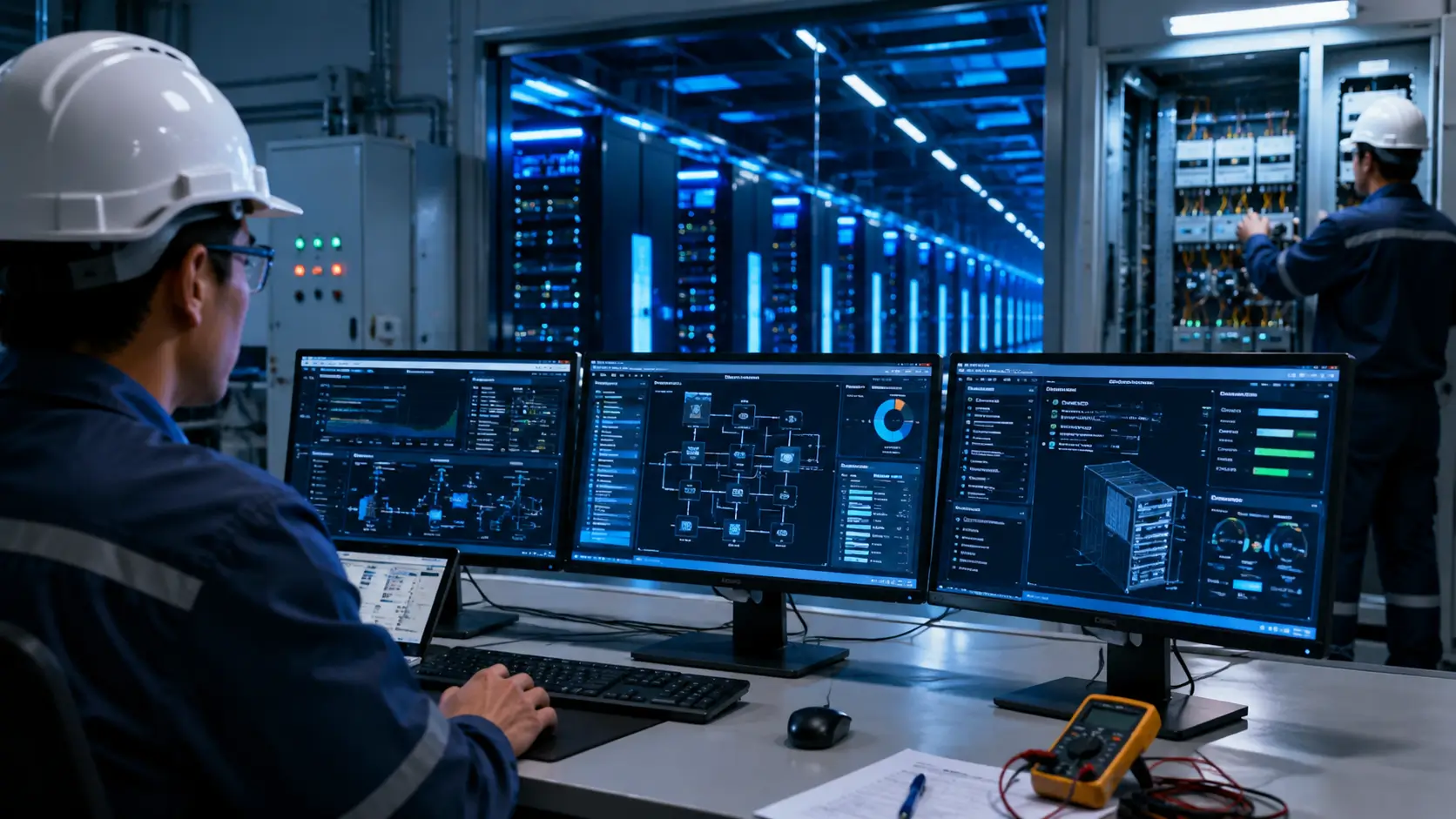
A completed AI facility can look ready while remaining weeks away from useful compute. The difference lies in what happens after construction crews leave. End users need reliable compute, not simply finished buildings. They also need power, cooling, networking and hardware to work together. That requires more than equipment installation and visual inspections. It requires structured testing across the entire infrastructure stack. ASHRAE’s AI data center framework places commissioning at the center of this process. The framework covers AI hardware, cooling, power systems and network infrastructure. This changes how enterprises should evaluate infrastructure readiness. Physical completion is becoming only one milestone on the path to production compute.

Physical Completion Does Not Equal Production Readiness
Construction completion and production readiness measure different outcomes. A completed building does not automatically deliver usable AI capacity. Equipment can remain in testing after installation work ends. Individual systems can also pass checks without proving integrated performance. Commissioning addresses that gap through staged testing and validation. These stages can include equipment checks, functional testing and integrated systems testing. Each stage answers a different operational question. The final objective is to establish whether the facility can support its intended critical load. For an AI customer, that distinction can affect deployment schedules, capacity planning and operational risk.
Integrated Testing Becomes the Operational Gate
Integrated systems testing brings separate infrastructure systems into one testing environment. It examines how those systems respond during defined operating conditions. It can also test selected maintenance and failure scenarios. Power, cooling, controls and other systems must respond in the correct sequence. Individual equipment tests cannot establish that level of coordination. AI workloads make this coordination more important as power and thermal demands increase. Load banks can simulate IT demand without placing production hardware at unnecessary risk. Thermal testing can also expose weaknesses before live workloads arrive. The result is stronger evidence that the infrastructure can operate as designed.
Power Validation Must Follow the Compute
Power capacity alone does not establish AI infrastructure readiness. High-density accelerator deployments can create substantial electrical demand within compact rack footprints. That demand places greater importance on power distribution and system response. Enterprises therefore need more than a confirmed utility connection. They need evidence that the electrical chain behaves correctly under defined conditions. Commissioning can test generators, UPS systems, switchgear and distribution equipment together. It can also examine transfers, alarms and recovery sequences. These tests help reveal weaknesses that static inspections may not detect. For end users, validated power performance can reduce uncertainty around production deployment.
Cooling Commissioning Moves From Comfort to Compute Protection
Cooling has become a direct constraint on high-density AI deployment. More accelerator power produces more heat inside the same physical space. The cooling system must remove that heat continuously and reliably. Liquid cooling adds further equipment and control dependencies. Pumps, heat exchangers and coolant distribution systems must operate together. Commissioning can validate flow, pressure and temperature performance. It can also test control sequences and selected failure conditions. ASHRAE identifies cleanliness and hydronic preparation as important commissioning considerations for liquid-cooled environments. For AI deployments, cooling performance therefore needs to match the compute load the facility must support.
Network Readiness Can Leave Finished Compute Stranded
Network infrastructure can create another gap between installation and production readiness. A data hall may contain servers, power equipment and cooling systems while network validation remains incomplete. Configuration and integration still need to meet the intended operating requirements. Network testing should therefore form part of the wider commissioning process. The objective is to establish that the intended network environment performs as designed. This matters because AI clusters depend on communication between compute, storage and supporting systems. Hardware integration adds another layer of coordination. Accelerator servers, racks, cooling interfaces and management platforms must operate as one environment. A finished room therefore does not necessarily represent a finished compute platform.

Commissioning Capability Could Become a Competitive Differentiator
Construction capacity remains essential to AI infrastructure expansion. Yet commissioning capability can influence the path from completion to operational readiness. AI projects now involve more complex power and cooling requirements. They also require closer coordination between facility and IT systems. Traditional commissioning approaches can face pressure when project timelines accelerate. A rigorous program can identify integration problems before production begins. It can also create documented evidence of system performance. That evidence can help customers assess whether infrastructure meets defined requirements. The advantage is not simply about finishing construction faster. It is about reducing uncertainty before expensive AI workloads depend on the facility.
The Handoff Becomes Part of the Product
The final handoff should prove more than physical completion. It should show that critical systems have passed defined tests. Those tests should cover the infrastructure that directly supports production workloads. Power validation should establish expected electrical behavior. Cooling validation should demonstrate thermal performance under representative conditions. Network validation should confirm the intended operating environment. Hardware integration should establish that the installed compute platform works with supporting systems. Documentation should record test results and unresolved issues. This creates a clearer bridge between construction delivery and operational use. For customers, that bridge can matter as much as the physical facility itself.
The End User Should Redefine What “Ready” Means
Enterprise buyers can respond by making production readiness a clear requirement. They can define technical gates before accepting capacity for production workloads. Those gates can cover power, cooling, networking and hardware integration. They can also include integrated systems testing and operational documentation. Customers should know which tests have run before committing critical workloads. They should also understand the conditions used during those tests. Failure scenarios deserve attention because normal operation alone cannot prove resilience. This approach changes readiness from a construction milestone into an operational decision. It also gives customers stronger evidence when comparing infrastructure providers.
The Real Value Is Validated Compute
The AI infrastructure market often measures progress through buildings, megawatts and installed hardware. Those measures remain important, but they do not tell the entire story. The customer ultimately needs compute that can support real workloads. That requires infrastructure to perform as an integrated system. Commissioning provides the process for testing that integration before production begins. It can expose gaps between design assumptions and operational behavior. It can also reduce uncertainty around the point of handover. This makes commissioning increasingly relevant to the economics of AI infrastructure delivery. Operators that demonstrate reliable readiness could strengthen customer confidence. The defining question is no longer whether the facility is finished. It is whether the compute can actually run when the customer needs it.











