
NVIDIA H200 shipments delayed to Q3  · BREAKING: Microsoft confirms 3GW data centre expansion in Asia-Pacific ·  AWS announces new sovereign cloud regions in India and UAE  · Arm-based servers now 24% of hyperscale deployments ·  EU AI Act enforcement enters phase two  · Global data centre investment hits $612B in 2026 ·  TSMC Arizona yields improve to 68% on 3nm process  · OpenAI valuation reaches $400B after latest funding round ·  NVIDIA H200 shipments delayed to Q3  · BREAKING: Microsoft confirms 3GW data centre expansion in Asia-Pacific ·  AWS announces new sovereign cloud regions in India and UAE  · Arm-based servers now 24% of hyperscale deployments ·  EU AI Act enforcement enters phase two  · Global data centre investment hits $612B in 2026

Can Immersion Cooling Solve the AI Data Center Heat Problem?

The heat problem is becoming an infrastructure problem AI data centers now face a thermal challenge tied directly to compute

Share
immersion cooling for AI data centers

The heat problem is becoming an infrastructure problem

AI data centers now face a thermal challenge tied directly to compute density. High-performance GPUs place substantial electrical loads inside increasingly compact rack designs. As rack power rises, conventional air cooling becomes harder to scale economically. Uptime Institute identifies rack density and processor heat loads as leading drivers of direct liquid cooling adoption. Its broader research also shows that air cooling remains dominant across much of the data center sector. That creates an important choice for operators planning new AI capacity. Immersion cooling changes the thermal equation by placing compatible hardware inside a dielectric fluid. The question for end users is whether that thermal advantage justifies the operational changes that follow.

Immersion cooling changes where the heat goes

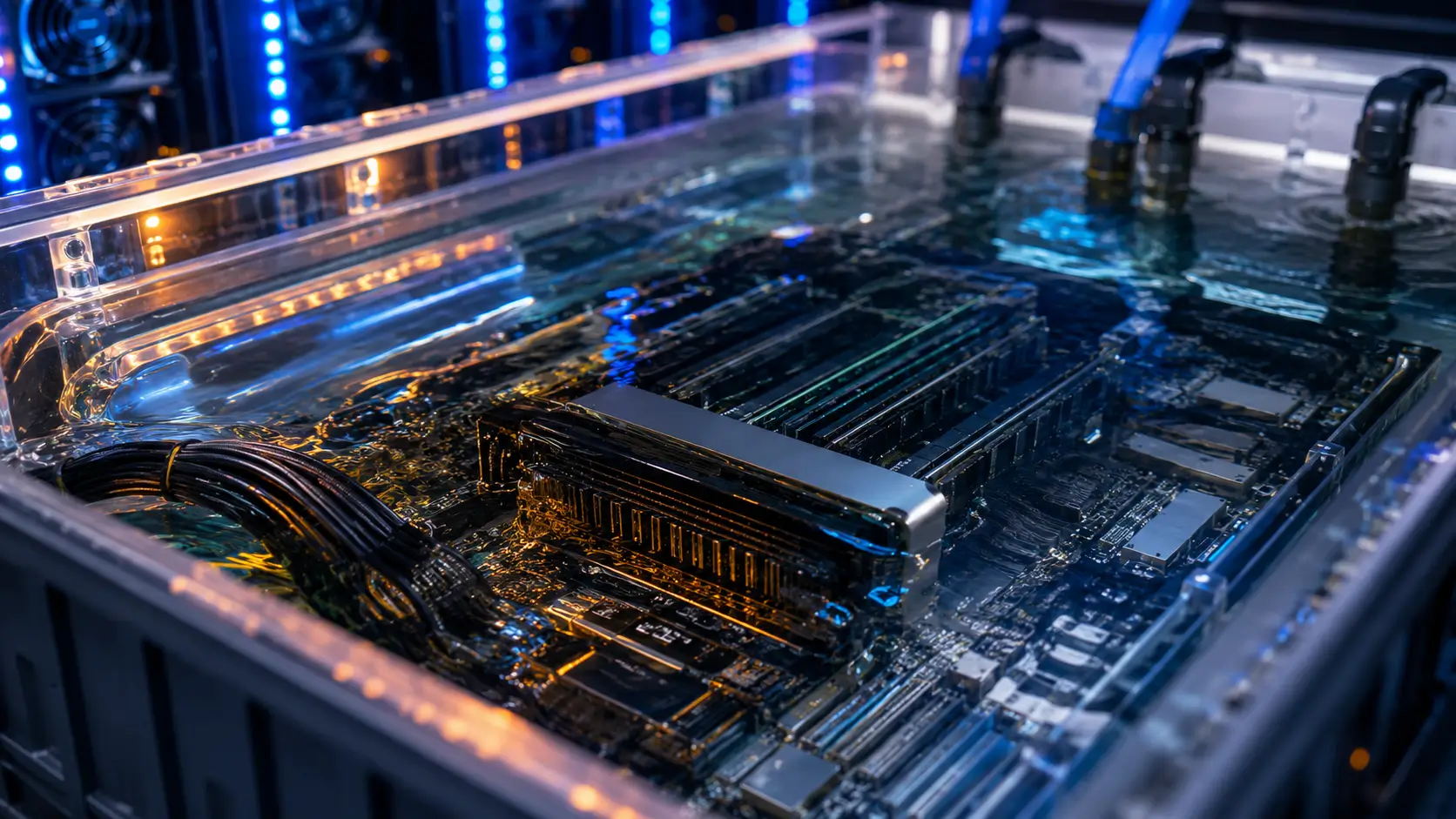
Immersion cooling moves heat away from components through direct contact with a dielectric liquid. Single-phase systems circulate liquid through pumps and heat exchangers during normal operation. Two-phase systems instead use evaporation and condensation to transfer heat. Both approaches can handle thermal loads that challenge conventional air-based systems. Immersion can also reduce dependence on IT airflow management inside high-density environments. Uptime Institute says immersion systems can support vat loads above 150 kW without air-cooling support. Newer industry activity also shows growing interest in immersion for AI infrastructure. For an end user, the main attraction is greater thermal headroom during sustained compute workloads.

The efficiency argument needs more precision

The efficiency case for immersion cooling needs more than a simple comparison between air and liquid. Liquids transfer heat more effectively than air under comparable engineering conditions. That advantage can reduce some energy requirements within the cooling system. However, the complete efficiency result depends on the surrounding infrastructure. Pumps, cooling distribution units and heat exchangers all consume energy. Heat rejection equipment also influences the final power requirement of the facility. Higher coolant temperatures can create opportunities for free cooling or heat reuse in suitable designs. End users should therefore assess cooling performance alongside total facility power rather than one component alone.

Density is where immersion becomes more compelling

The strongest case for immersion appears when AI workloads create extreme rack power. Uptime Institute places liquid cooling among technologies typically used above 50 kW per rack. It also expects more complete liquid cooling at rack powers approaching 150 kW or higher. These figures should not become universal engineering limits for every facility. They instead illustrate how cooling choices increasingly follow workload density. High-power accelerator racks create different thermal requirements from conventional enterprise CPU deployments. Immersion can become attractive when air-cooling capacity becomes a major deployment constraint. That makes the technology particularly relevant where power or space limits further expansion of high-density compute.

The operational trade-off is harder to ignore

Thermal performance represents only one part of the immersion cooling decision. Hardware compatibility becomes important because not every system can operate with every dielectric coolant. Uptime Institute notes that operators must confirm immersion support for each hardware type. Liquid cooling can also narrow equipment choices compared with conventional air-cooled environments. Service procedures change when technicians work around tanks, coolant and submerged equipment. Those changes can affect maintenance processes and responsibilities between IT and facilities teams. Mixed environments may also create more complex support requirements when only some systems use immersion. Operators should therefore treat immersion as an infrastructure redesign rather than a simple cooling replacement.

The fluid itself becomes part of the infrastructure equation

Coolant selection creates another long-term consideration for operators evaluating immersion architectures. Single-phase systems keep dielectric fluid in a liquid state during normal operation. Two-phase systems depend on evaporation and condensation to move heat through the system. That difference creates distinct requirements for fluid management and equipment design. Fluid availability also matters when operators plan infrastructure for long service lives. Uptime Institute has highlighted the impact of 3M’s PFAS production withdrawal on Novec fluids. Those fluids have been used in some two-phase immersion applications. End users should therefore evaluate availability, compatibility, service requirements and environmental considerations before deployment.

Immersion should not become the default answer

The industry evidence does not support immersion cooling as a universal answer for AI infrastructure. Uptime Institute’s research shows that liquid cooling adoption remains gradual across the wider data center market. Traditional air cooling still serves a large share of existing data center environments. Liquid cooling remains especially relevant where air cooling becomes difficult to scale. That distinction matters because AI workloads do not all create identical thermal requirements. Smaller inference systems may have less economic justification for full immersion. Direct-to-chip cooling and rear-door heat exchangers can address some high-density requirements. The right architecture should therefore depend on workload density, hardware and facility constraints.

The end-user decision should begin with workload economics

End users should begin their cooling evaluation with the workload rather than the technology. Operators should establish expected rack power before selecting a thermal architecture. Accelerator utilization also matters because sustained workloads create different cooling requirements. Deployment duration and future capacity growth should enter the same assessment. High-density AI training can present a stronger case for advanced liquid cooling approaches. Enterprise inference workloads can have different utilization patterns and thermal requirements. Financial analysis should include facility upgrades, coolant distribution, maintenance and hardware compatibility. The objective should remain reliable compute delivery at the lowest sustainable total cost.

Immersion can solve the heat problem, but not the whole infrastructure problem

Immersion cooling has a credible role in high-density AI infrastructure. The technology directly addresses the thermal challenge created by concentrated compute power. It can transfer heat efficiently while supporting very high equipment densities. It can also reduce dependence on IT air cooling in suitable deployments. Uptime Institute’s recent research suggests liquid cooling will remain concentrated in high-density applications. That makes immersion a targeted infrastructure choice rather than an automatic replacement for air cooling. End users should judge the technology by the constraints it removes and the complexity it introduces. The strongest solution will create thermal headroom without replacing one infrastructure bottleneck with another.


[simple-author-box]

More from AI Infrastructure

AI cooling infrastructure costs are becoming harder to separate from computing economics. The industry

A data center’s carbon footprint is usually discussed as if it begins when a

An AI server usually carries an implicit assumption that someone will eventually be able

COMPUTE WEEKLY

The briefing that 40,000+ tech leaders read every Monday. Sharp, fast, essential.

Great! We’ve received your information.

Building an AI Startup Without Owning GPUs

Not owning GPUs has become the default, deliberate strategy for building an AI company — not a compromise founders accept reluctantly. H100 rental rates fell 64-75% in fifteen months, a dense ecosystem of neoclouds and inference-as-a-service providers now lets startups skip infrastructure entirely, and credit programs can fund a company’s first year before a founder writes a check
Most Read

Demand is broadening across enterprise workloads APAC’s infrastructure story is changing in ways that

AI infrastructure decisions increasingly influence what enterprises can build, test, and deliver. They also

Why Infrastructure Planning Now Starts With Availability A data center project can have a

A property can look enormous from the site entrance and still offer almost no

As rack power rises toward the megawatt range, the physical footprint of power-delivery equipment

Disruptor Spotlight

Cerebras Systems

The chip that makes Nvidia nervous. Cerebras’ Wafer Scale Engine is rewriting the rules of AI inference at scale.
Faster
0 x
YoY Revenue
0 x
Transistors
0 T
Market Pulse
MSFT
+1.02%
NVDA
+0.66%
AMZN
-0.078%
AMD
-6.95%
TSMC
-2.98%
Indicative only · Not financial advice
Upcoming Events
SEP
The AI Infrastructure Race (India)
WEBINAR · ONLINE
The AI Infrastructure Race: Won on Power, Land and Trust — Not Capital
MAY
0
AI Infrastructure Summit
DUBAI · IN PERSON
MEA’s premier AI infrastructure event.
JUN
0 0
Compute Forecast Summit
SINGAPORE · IN PERSON
Our flagship APAC event. Early bird open.
Latest Moves
Live
ecolab
Ecolab Deepens Cooling Strategy With $4.75B CoolIT Acquisition
Ecolab is making one of its biggest moves yet into AI infrastructure after completing its $4.75 billion acquisition of liquid cooling specialist CoolIT Systems
Pure DC AVK Europe data center microgrid Dublin 110MW AI infrastructure Ireland 2026
Pure DC and AVK Deploy Europe’s First 110 MW Data Center Microgrid in Dublin
The Pure DC Dublin microgrid has made history as Europe’s first large-scale on-site data center microgrid, launched in partnership with power solutions provider AVK at Pure DC’s campus in Ireland.
Pace Digitek
Pace Digitek Partners With MEGMEET to Expand AI Data Center Power Business
India’s AI infrastructure ecosystem continues to mature as domestic technology manufacturers move beyond traditional telecommunications and industrial markets toward high-growth digital infrastructure opportunities
Follow Compute Forecast
11K followers
1200 followers
Companies to Watch
CW
CoreWeave
Neo Cloud · $19B · IPO Watch
CB
Cerebras Systems
AI Hardware · $4.25B · Pre-IPO
G42
G42
Sovereign AI · Abu Dhabi
H
Humain
Saudi AI · $40B Fund
Latest Podcast
AI Capex, Cloud Margins & the Nuclear Bet
48 MIN · 25 APR 2026

Can Immersion Cooling Solve the AI Data Center Heat Problem?

The heat problem is becoming an infrastructure problem AI data centers now face a thermal challenge tied directly to compute

Share
immersion cooling for AI data centers
3
847 SHARES

0
SHARES

[simple-author-box]

More from AI Infrastructure

Demand is broadening across enterprise workloads APAC’s infrastructure story is changing in ways that

AI infrastructure decisions increasingly influence what enterprises can build, test, and deliver. They also

Why Infrastructure Planning Now Starts With Availability A data center project can have a

A property can look enormous from the site entrance and still offer almost no

COMPUTE WEEKLY

The briefing that 40,000+ tech leaders read every Monday. Sharp, fast, essential.

Great! We’ve received your information.

Global AI Infrastructure Outlook 2026

The briefing that 40,000+ tech leaders read every Monday. Sharp, fast, essential.
Download Free
Most Read

Demand is broadening across enterprise workloads APAC’s infrastructure story is changing in ways that

AI infrastructure decisions increasingly influence what enterprises can build, test, and deliver. They also

Why Infrastructure Planning Now Starts With Availability A data center project can have a

A property can look enormous from the site entrance and still offer almost no

As rack power rises toward the megawatt range, the physical footprint of power-delivery equipment

Disruptor Spotlight

Cerebras Systems

The chip that makes Nvidia nervous. Cerebras’ Wafer Scale Engine is rewriting the rules of AI inference at scale.
Faster
0 x
YoY Revenue
0 x
Transistors
0 T
Market Pulse
NVDA
$924.60
+2.4%
MSFT
$421.30
+1.1%
AMZN
$192.80
-0.6%
NVDA
$924.60
+2.4%
NVDA
$924.60
+2.4%
Indicative only · Not financial advice
Upcoming Events
MAY
0 0
DCD Global — London
LONDON · IN PERSON
World’s largest DC event. CF is media partner.
MAY
0
AI Infrastructure Summit
DUBAI · IN PERSON
MEA’s premier AI infrastructure event.
JUN
0 0

Compute Forecast Summit

SINGAPORE · IN PERSON
Our flagship APAC event. Early bird open.
Latest Moves
  • Live
Sam Altman
OpenAI appoints new Chief Infrastructure Officer to lead $100B DC programme
27 APR · OPENAI
Sam Altman
OpenAI appoints new Chief Infrastructure Officer to lead $100B DC programme
27 APR · OPENAI
Sam Altman
OpenAI appoints new Chief Infrastructure Officer to lead $100B DC programme
27 APR · OPENAI
Follow Compute Forecast
18.4K followers
12.1K followers
9.3K subscribers
41 episodes
Companies to Watch
CW
CoreWeave
Neo Cloud · $19B · IPO Watch
CB
Cerebras Systems
AI Hardware · $4.25B · Pre-IPO
G42
G42
Sovereign AI · Abu Dhabi
CW
Humain
Saudi AI · $40B Fund
Latest Podcast
AI Capex, Cloud Margins & the Nuclear Bet
48 MIN · 25 APR 2026
Scroll to Top








