
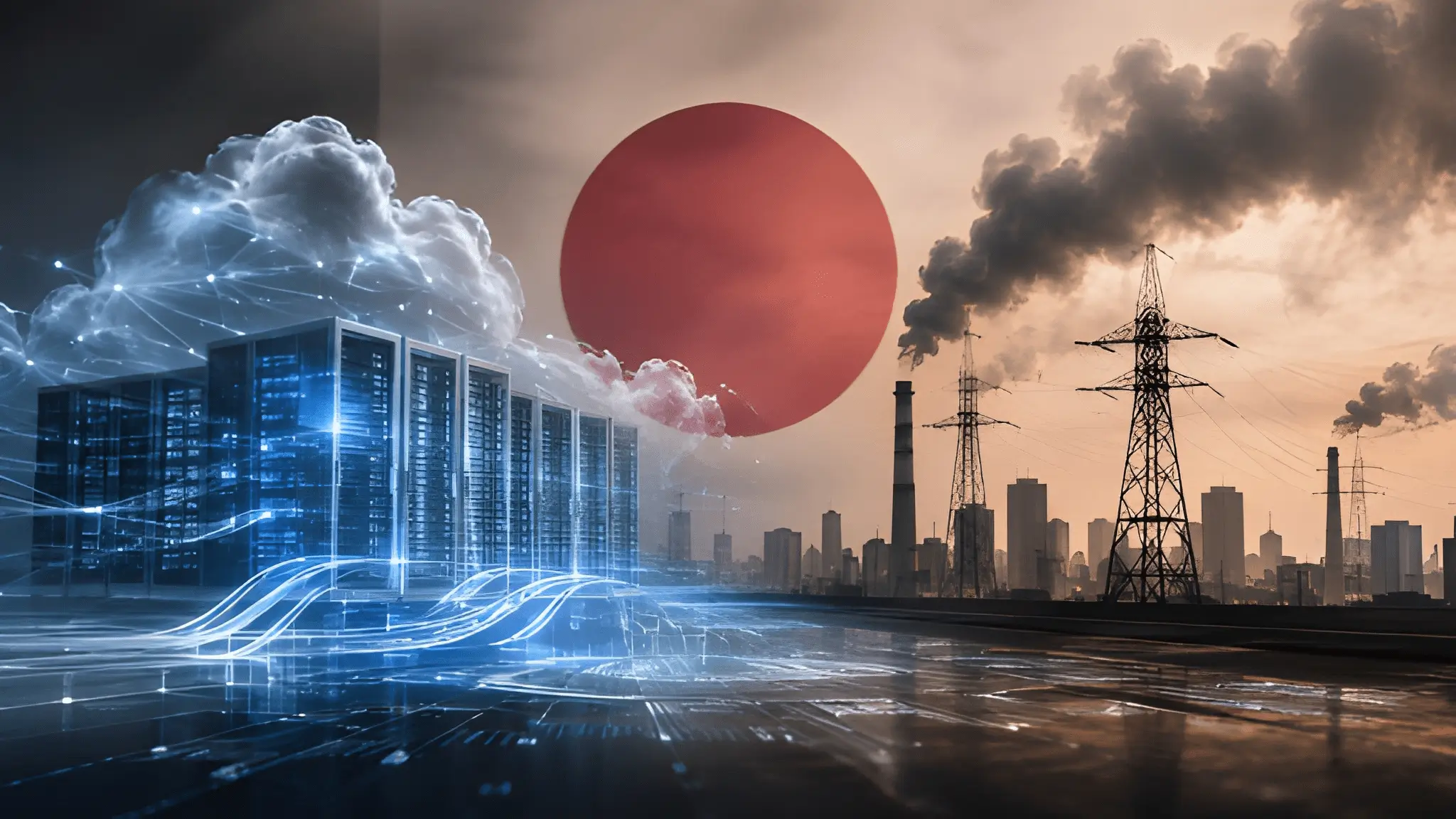
Japan is entering a new phase of digital infrastructure growth as artificial intelligence drives demand for computing capacity across the country. Large data centers now form a critical layer of the digital economy, processing enormous volumes of information for AI services, cloud platforms and other high-demand applications. Japan’s data-center market is expanding rapidly as AI and digital services increase demand for computing capacity, with about 90% of the country’s data centers concentrated in Greater Tokyo and Greater Osaka, according to JLL. The expansion reflects a strategic need for greater capacity, but it is creating a parallel challenge for communities that must live alongside facilities built to operate continuously. Japan’s data centers require far more than server halls, because operators must install cooling systems, backup power equipment, batteries and fuel storage to maintain operations during disruptions.

The geography of this expansion makes the issue more immediate for local communities. Developers have concentrated facilities around the Tokyo metropolitan area and the Kinki region of western Japan because those markets sit close to major sources of digital demand. Proximity can reduce communication delays and support applications that depend on fast data transmission, giving operators a strong commercial reason to locate near population and business centers. Cooling systems can generate persistent noise, large backup generators can produce exhaust emissions, and waste heat can add another layer of concern for nearby residents. Large-capacity batteries and fuel tanks introduce additional questions around fire safety, emergency response and the handling of stored energy. The closer these facilities move toward dense communities, the harder it becomes for developers and governments to treat their impacts as an issue confined to private industrial sites.
Cooling, Generators and Batteries Raise Local Concerns
A modern data center operates as an energy-intensive industrial system even when its outward appearance resembles an ordinary commercial building. Servers produce substantial heat, forcing operators to deploy powerful air-conditioning and cooling equipment around the clock. Backup generators provide another layer of infrastructure because operators need to keep computing systems running when the electricity supply fails. Fuel tanks support those generators, while large batteries provide additional backup capacity and introduce their own safety considerations. Residents therefore encounter a combination of mechanical noise, generator exhaust, waste heat and potential fire hazards rather than a single source of disruption. Those concerns can become particularly contentious when developers place facilities close to homes, businesses and public transportation hubs.
The pushback has already moved beyond neighborhood complaints into formal political and legal action. In Inzai, Chiba Prefecture, residents have filed a lawsuit seeking cancellation of a data-center construction plan. The dispute demonstrates how quickly opposition can escalate when communities believe the planning process does not adequately account for the characteristics of large computing facilities. In Seika, Kyoto Prefecture, the municipal assembly has addressed concerns involving generator noise and exhaust emissions. The town has announced a policy of, in principle, no longer seeking to attract new data-center projects. Such decisions can alter the economics of development because location remains one of the most important variables in data-center construction. A facility can secure power and connectivity yet still encounter a serious obstacle if local governments and residents reject its environmental footprint.
Japan’s Rules Have Not Kept Pace With Data Centers
The regulatory problem reaches deeper than individual construction disputes because Japan has not established a framework that fully reflects the physical nature of modern data centers. Building confirmation applications submitted to local governments can classify their use as an “office” alongside other facility descriptions. That classification may satisfy existing administrative requirements, but it does not capture the scale or operational profile of a site packed with servers, cooling equipment, batteries, generators and fuel systems. A conventional office building and a high-density computing facility can occupy similar structures while creating very different demands on electricity, emergency systems, cooling infrastructure and surrounding communities. This mismatch creates uncertainty for local authorities that must evaluate proposals without a category designed around the risks associated with data centers. It can likewise leave residents struggling to understand what developers intend to build in their neighborhoods.
Japan’s national environmental impact assessment framework presents another gap. Data centers do not fall under the national system in the same way as certain other large infrastructure projects, limiting the role of a standardized environmental review. Concerns have also emerged over the amount of operational information available to nearby residents, including details relevant to the facilities’ power use, backup generation and fuel storage. Residents can reasonably find that explanation difficult to reconcile with the need to evaluate noise, emissions, fire exposure and resource demand. However, withholding basic information can deepen mistrust even when operators have legitimate security requirements that prevent the disclosure of sensitive technical details. A more structured disclosure system could separate genuinely sensitive information from operational data that communities need to understand local impacts. Without that distinction, each project risks becoming a new confrontation over information rather than a predictable planning exercise.

Industry Faces Pressure to Earn Local Trust
The data-center industry has begun responding to the backlash, recognizing that technical performance alone will not determine whether new projects can move forward. Industry groups have developed guidelines that encourage operators to communicate with local residents from the site-selection stage rather than waiting until construction plans generate opposition. The approach shifts community engagement from a late-stage public-relations exercise toward a component of project development. Early dialogue can give residents greater visibility into expected noise levels, emergency systems, cooling requirements, power demand and other characteristics that shape a facility’s local footprint. Developers can use that process to identify concerns before they become political disputes or legal challenges. Moreover, meaningful disclosure can give communities a clearer basis for distinguishing legitimate security restrictions from information that operators can safely provide.
The stakes extend beyond individual projects because Japan needs substantial computing infrastructure to support its digital economy. Artificial intelligence applications require expanding processing capacity, and cloud services depend on facilities that can deliver reliable power, cooling and network connectivity. Developers therefore face pressure to build quickly, while municipalities face pressure to protect residents and preserve confidence in local planning decisions. A regulatory system that moves too slowly could constrain digital infrastructure investment, yet a system that moves too loosely could create environmental conflicts that delay projects anyway. The most durable approach would connect data-center permitting with clear standards for noise, exhaust emissions, cooling systems, energy use, fire safety and fuel storage. Meanwhile, transparent communication can help operators demonstrate that the physical consequences of digital infrastructure receive the same level of scrutiny as its economic benefits.
Overseas Rules Offer Japan a Warning
Other jurisdictions are confronting similar pressures as data centers consume an increasing share of electricity and resources. Ireland provides one of the clearest examples of how rapid data-center growth can become a national infrastructure concern, with data centers accounting for 23% of the country’s metered electricity consumption in 2025. The scale has already prompted restrictions in Dublin, where authorities imposed a freeze on new data-center grid connections in 2021 before later lifting it and replacing it with requirements for new facilities to provide their own power. The Irish experience shows that the central question can quickly shift from whether a country wants more computing capacity to whether its electricity system, planning framework and communities can absorb the demand. Japan faces a different energy and geographic landscape, but the underlying tension remains relevant as AI accelerates the need for high-density computing.
New York has taken another approach by directly targeting the environmental footprint of large computing projects. In July, New York imposed a one-year moratorium on new hyperscale data centers with power requirements of 50 megawatts or more, pausing state permitting while regulators develop environmental-impact standards. The move came with a policy direction toward developing standards for environmental impacts and other concerns associated with these facilities. That intervention reflects a broader shift in how governments view data centers: not simply as buildings that host technology companies, but as major infrastructure assets with measurable effects on energy, water and local environments. Japan can use such international developments as reference points while designing rules that reflect its own electricity system, urban density and industrial geography. Therefore, the country has an opportunity to establish clearer requirements before data-center disputes become a larger constraint on digital infrastructure investment.
Japan Needs a Clearer Model for Data Center Growth
The central challenge for Japan is no longer whether it should expand computing capacity, but how it can expand that capacity without creating a new category of avoidable pollution and community conflict. Data centers will remain essential to the growth of artificial intelligence, cloud computing and Japan’s wider digital economy, making a halt to development unrealistic. The more practical objective is to make the physical footprint of each project visible before construction begins and to establish predictable standards that developers and communities can understand. National and local authorities can clarify how data centers should be classified, what environmental information operators must disclose and which safety requirements should apply to batteries, generators, fuel storage and cooling equipment. Operators can strengthen projects by treating community engagement as part of site selection and risk management rather than as an obligation that begins after opposition emerges.
Japan’s data-center expansion will test whether the country can reconcile digital ambition with physical limits. The industry’s growth reflects genuine demand, but every new computing facility brings electricity requirements, cooling loads, backup systems, emissions risks and safety considerations into the surrounding community. Residents should not have to rely on lawsuits or political pressure to obtain basic information about infrastructure planned near their homes. Developers, for their part, need rules that define expectations before they commit capital to sites that may later face opposition. Policymakers can reduce that uncertainty by treating data centers as a distinct infrastructure category with standards that match their operational reality. The outcome will shape more than the next wave of AI capacity because it will determine whether Japan can build a durable digital infrastructure market without turning rapid technological expansion into a new source of pollution and public distrust.











