 Skip to content
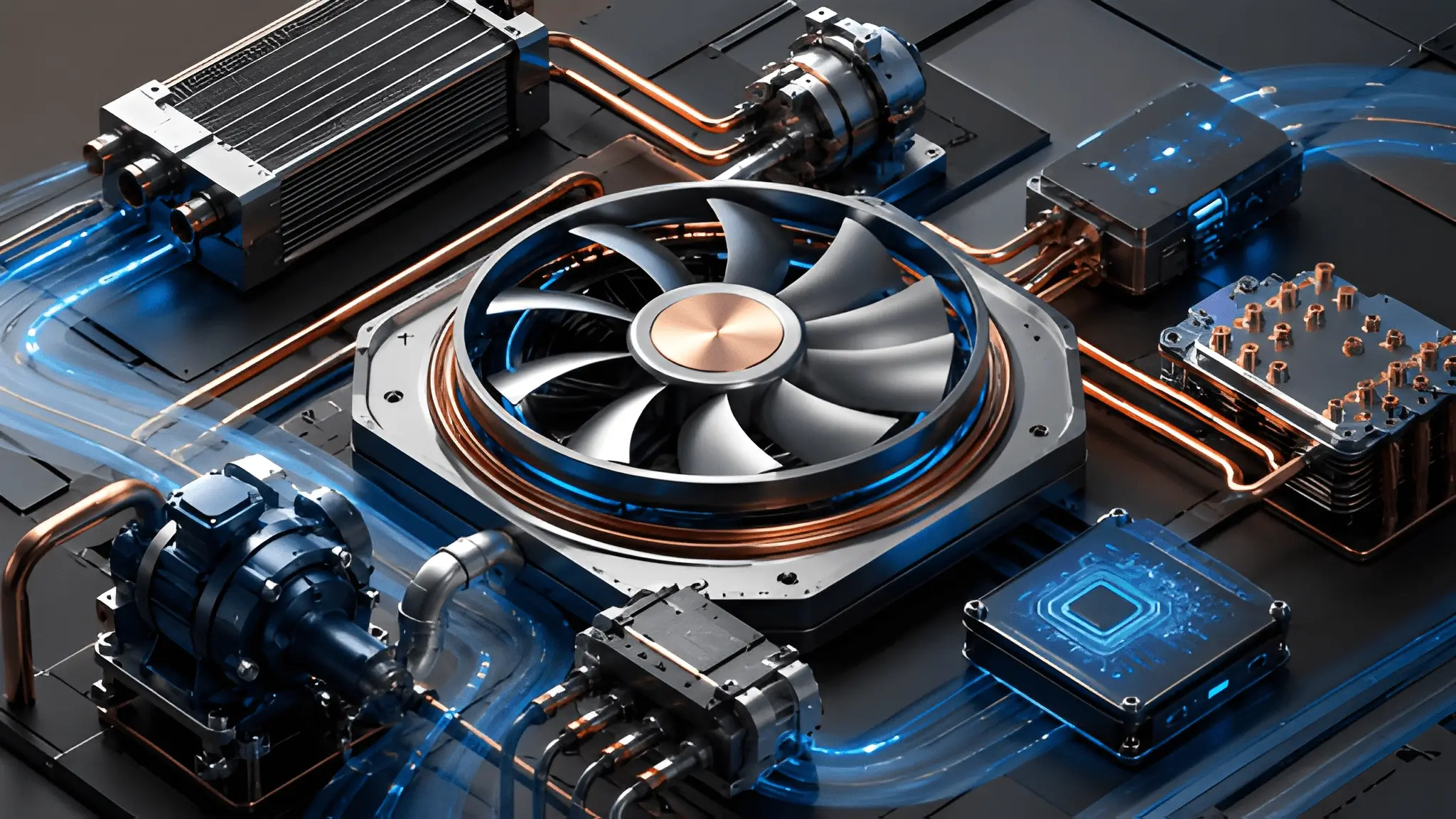
There is a point in every industrial transition when the most important opportunity stops looking like the headline product. For artificial intelligence, that point is becoming visible in the machinery that removes heat rather than the silicon that creates intelligence. A processor can deliver extraordinary computational performance, but its usefulness still depends on a physical system that can move heat away from the electronics, control fluid, manage pressure, maintain airflow and keep those functions stable over years of operation. That reality places fans, pumps, heat exchangers, cooling distribution units, controls and their supporting components much closer to the center of AI infrastructure than their traditionally quiet position in the industrial supply chain suggests. India already has a manufacturing base capable of producing several adjacent thermal components, while its policy architecture has explicitly sought to move air-conditioning manufacturing toward deeper component localization rather than simple finished-product assembly.

The global thermal industry is also seeing significant corporate consolidation across airflow and liquid-cooling technologies. Madison Air announced an agreement in August 2026 to acquire ebm-papst, a supplier of high-performance airflow technology and electronically commutated fan and motor systems, with the transaction expected to close around year-end subject to regulatory approvals and customary closing conditions. Eaton completed its acquisition of Boyd Thermal in March 2026, adding a thermal-components and liquid-cooling business serving data centers and other markets to its portfolio. Schneider Electric completed its acquisition of a controlling interest in Motivair in February 2025, adding a company specializing in liquid cooling and advanced thermal-management solutions for high-performance computing systems. These transactions demonstrate that established industrial companies are placing greater strategic emphasis on airflow and thermal-management capabilities within broader infrastructure portfolios.
The Acquisition Window India Cannot Afford to Miss
The recent consolidation of thermal businesses provides a current reference point for Indian industrial companies evaluating cooling technology and engineering capabilities. Madison Air’s announced acquisition of ebm-papst would add high-performance airflow technology, EC fan and motor systems and associated engineering capabilities to Madison Air’s portfolio once the transaction closes. Eaton’s completed acquisition of Boyd Thermal adds thermal components, systems and liquid-cooling expertise for data centers and other demanding applications, while Schneider Electric’s completed acquisition of a controlling interest in Motivair adds specialized liquid-cooling and advanced thermal-management capabilities for high-performance computing.
The transactions involve different corporate structures and are not evidence that the same assets are available for purchase by Indian companies. They do, however, demonstrate that major industrial groups are integrating thermal capabilities into broader technology portfolios. Indian companies seeking to accelerate domestic cooling capability can therefore examine acquisitions, licensing, technical partnerships and internal engineering development as separate routes toward building comparable capabilities. The relevant acquisition target should be judged by the engineering knowledge, product qualification, testing capability and technical workforce it can contribute rather than by manufacturing capacity alone.

Thermal IP Is Becoming an Industrial Asset
The value of an acquisition in this field would therefore sit deeper than the machinery inside a factory. A mature thermal company carries accumulated knowledge about fan curves, motor efficiency, heat transfer surfaces, pressure losses, pump selection, fluid compatibility, sealing methods, control logic and failure modes that cannot be recreated simply by purchasing production equipment. The same principle applies to customer qualification because data-center operators and equipment manufacturers need confidence that a thermal system will behave predictably under changing loads, maintenance conditions and environmental conditions. A company that acquires this knowledge can enter the market with an engineering foundation, while a company that acquires only assembly capacity may remain dependent on imported designs and critical components. India’s opportunity therefore lies in identifying specialist thermal businesses whose intellectual property and engineering teams can become the nucleus of a domestic design organization rather than treating acquisitions as conventional capacity purchases.
India’s existing policy experience provides a useful foundation for this strategy because the Production Linked Incentive framework for white goods was explicitly designed around component and sub assembly manufacturing rather than merely rewarding the assembly of finished air conditioners. The government’s published framework identifies heat exchangers, motors, control assemblies and other components within the air conditioning value chain, and later selections under the scheme have continued to include component manufacturing. The transition will require a deliberate change in how industrial companies evaluate technology, because the target should be process knowledge and design competence as much as production volume. A manufacturer that combines domestic component sourcing with acquired thermal IP could develop products around local materials, local machining and local electronics while retaining internationally proven engineering principles.
The Acquisition Case Is About Capability, Not Capacity
A credible acquisition strategy would begin with the capabilities that remain difficult to build organically. Indian industrial companies can establish sheet-metal lines, machining operations, electronics assembly and fabrication relatively quickly, but those assets do not automatically provide the expertise required to design a high performance fan, optimize a heat exchanger or qualify a liquid cooling loop. The acquisition of a specialist engineering company can compress that learning curve by bringing experienced engineers, design databases, test procedures, supplier relationships and application specific knowledge into the organization. The strategic value becomes especially strong when the acquired business has experience working with demanding customers that specify thermal behavior rather than simply buying equipment from a catalog. This matters for AI infrastructure because cooling systems increasingly interact directly with server architecture, rack configuration, facility water conditions and control systems, making equipment design inseparable from the environment in which it operates.
The recent transactions also show that thermal technology spans several complementary layers rather than one isolated product category. Madison Air’s announced transaction with ebm-papst is centered on high-performance airflow technology and EC fan and motor systems, while Eaton’s Boyd Thermal acquisition covers thermal components and liquid-cooling systems for data-center applications. Schneider Electric’s Motivair transaction similarly adds liquid cooling and advanced thermal-management capabilities for high-performance computing. These examples do not establish a fixed list of future winning technologies or determine where competition will ultimately concentrate. They do show that airflow, liquid cooling and associated thermal engineering can form strategically important parts of broader infrastructure portfolios. Indian manufacturers can use that product structure to identify adjacent capabilities that complement their existing mechanical, electrical and manufacturing expertise.
Fans, Pumps and Exchangers Are the New Strategic Layer
The thermal system inside an AI data center is not a single machine, and its complexity becomes clearer when the stack is examined from the point where heat leaves the processor to the point where it reaches the final heat-rejection system. Fans control airflow and pressure relationships, pumps establish liquid circulation, heat exchangers transfer energy between fluids, air handlers manage conditioned air, cooling distribution units connect facility-side and technology-side loops, while sensors and control systems coordinate the behavior of the entire arrangement. Each component has a distinct engineering function, yet the performance of one component can influence the operating envelope of another. This makes thermal manufacturing fundamentally different from producing interchangeable mechanical parts because the finished equipment must meet a defined thermal, hydraulic and control response.
The Thermal Stack Starts With Precision
Fans illustrate the point particularly well because their function depends on the relationship between airflow, static pressure, motor behavior, acoustic performance and control strategy. An industrial fan manufacturer can fabricate an impeller and housing, but a high-performance airflow supplier must also understand aerodynamic geometry, motor integration, electronic control, vibration behavior and the operating envelope of the equipment into which the fan will be installed. The same principle applies to pumps, where flow, head, efficiency, fluid compatibility, bearing behavior, seals and control response must work together under real operating conditions. Heat exchangers introduce another layer because surface geometry, material selection, fluid velocities, pressure drop, fouling behavior, brazing quality and thermal approach all influence the final result. India’s existing air-conditioning component manufacturing base gives domestic industry experience in several of these areas, but AI infrastructure will require that experience to move toward more tightly integrated and application-specific thermal engineering.
The strategic importance of these components comes from their position between the digital workload and the physical environment. A processor generates heat locally, but the thermal chain must capture that heat, transport it and ultimately reject it without allowing temperatures, pressure conditions or fluid quality to move outside acceptable limits. ASHRAE’s AI data-center framework links cooling architecture directly with high-density AI workloads and identifies direct liquid cooling as a major approach for managing those conditions. That technical shift increases the importance of components that historically received less attention than servers, networking equipment or electrical infrastructure. Indian manufacturers that develop expertise across fans, pumps, heat exchangers and controls can therefore occupy a part of the AI infrastructure stack where mechanical engineering remains decisive even as computing becomes increasingly software-defined.
Integration Will Separate Suppliers From Thermal Specialists
A thermal manufacturer becomes strategically valuable when its products work predictably as part of a larger system. A pump cannot be evaluated only by whether it moves liquid, because its pressure behavior affects the heat exchanger, the piping network and the cooling distribution unit connected to it. A heat exchanger cannot be judged solely by nominal heat-transfer capability because its pressure drop, material compatibility, brazed joints and contamination tolerance can influence the reliability of the entire loop. Fans face similar constraints because airflow must match the resistance of filters, coils, containment arrangements and other equipment rather than simply delivering a stated volume under ideal conditions. This is why advanced thermal manufacturing requires a systems-engineering culture that connects design calculations with physical testing and field performance. India’s opportunity will depend on whether manufacturers can move beyond individual component specifications and develop a shared engineering language across the thermal stack.
Controls make that integration even more important because thermal systems increasingly respond dynamically to changes in computing demand and environmental conditions. Sensors can measure temperatures, pressures, flow and other operating variables, while control systems adjust pumps, fans, valves and cooling equipment to maintain the required operating state. The hardware therefore needs to communicate with the control architecture through predictable responses rather than functioning as isolated mechanical assemblies. A manufacturer that understands only fabrication may struggle when a customer asks for a coordinated system in which thermal equipment responds to changes in workload or facility conditions. A manufacturer that understands mechanical design, electronics and controls can instead treat the thermal system as an engineered platform whose individual components contribute to a common operating objective.
Assembly Is Not Manufacturing When It Comes to Heat
An imported cooling kit can make a domestic production line look capable long before the underlying engineering capability exists. The distinction becomes important when the manufacturer must change an impeller geometry, redesign a heat exchanger, alter a pump curve, adapt a control sequence or qualify a material for a different operating environment. True manufacturing begins when engineers can define the thermal requirement, model the system, select materials, develop tooling, validate the design and control the production process without waiting for an overseas design owner to provide the answer. That capability depends on engineering methods that connect computational fluid dynamics, heat-transfer analysis, structural analysis, manufacturing tolerances and physical testing rather than treating each activity as an isolated task.
Engineering Depth Starts Where the Imported Kit Ends
The difference becomes particularly visible in heat exchangers because small changes in geometry can alter both thermal performance and hydraulic resistance. A manufacturer must understand fin geometry, tube configuration, material selection, brazing quality, surface condition, fluid velocity and pressure behavior before it can reliably modify a design for a new application. Similar requirements apply to fans, where blade geometry, motor selection, bearing behavior, vibration characteristics and system impedance determine whether the finished assembly performs as intended. Pump manufacturing introduces another set of engineering relationships involving flow, head, efficiency, seals, fluid compatibility and control behavior.
India’s existing policy framework already points toward deeper component manufacturing rather than dependence on finished imports. The government’s Production-Linked Incentive scheme for white goods specifically identifies components such as heat exchangers, motors, copper tubes and control assemblies as part of the domestic air-conditioning manufacturing ecosystem. That policy direction creates useful industrial foundations, but the same logic needs to extend into the more demanding thermal requirements associated with high-density computing. A manufacturer moving from conventional air-conditioning components into data-center cooling would need to develop its own design verification procedures, tolerance controls, test protocols and engineering documentation rather than simply repurposing an existing production line. The commercial value would come from being able to modify and qualify products quickly while retaining control over the underlying design process.
CFD, Materials and Testing Become the Manufacturing Moat
CFD becomes valuable in this environment because thermal equipment operates through fluid behavior that is often difficult to observe directly after assembly. Engineers can use simulation to examine airflow distribution, pressure losses, recirculation, velocity profiles and heat-transfer behavior before committing to tooling or production changes. Physical testing remains essential because simulations depend on assumptions about material properties, surface conditions, manufacturing tolerances and boundary conditions that may differ from actual production equipment. A credible manufacturer therefore needs a feedback loop in which simulation informs prototypes, prototype results refine the model and validated models guide subsequent product development.
Materials science adds another layer because thermal systems operate through repeated exposure to temperature changes, pressure variations, moisture, vibration and chemical interactions with fluids. Copper, aluminum, stainless steel, engineered polymers, elastomers and brazing materials each behave differently under those conditions, and the selection of one material can influence corrosion resistance, thermal conductivity, manufacturability and service life. Seals provide an especially important example because a small compatibility problem can become a fluid leak or loss of pressure after prolonged operation. Brazed joints and mechanical connections also require controlled production processes because their quality affects the integrity of the entire thermal circuit. A domestic thermal manufacturer therefore needs materials qualification and process-control capabilities alongside machining and fabrication, particularly when its products will operate continuously inside critical computing environments.
Where Is the Thermal Talent Stack Going to Come From
India already has established engineering and research capabilities relevant to thermal management, including work spanning mechanical, thermal and electronics engineering. Its documented capabilities include thermal simulation, airflow evaluation, infrared thermal imaging and thermocouple-based temperature measurement. These capabilities illustrate that thermal engineering expertise already exists within India’s technical ecosystem rather than being absent from the country. The challenge for AI cooling is to connect such expertise with manufacturing organizations, product development teams, liquid cooling specialists and field service operations. High density computing combines thermal, mechanical, electrical and controls requirements, which makes cross-disciplinary engineering particularly relevant to product development. India’s opportunity therefore lies in expanding and connecting existing thermal expertise with the manufacturing and deployment requirements of AI infrastructure rather than treating the country as starting without a technical talent base.
The talent requirement also extends beyond design offices because thermal manufacturing depends on engineers and technicians who understand production processes at the point where theoretical performance meets physical tolerances. A heat exchanger designer needs manufacturing feedback to understand how brazing, forming and material variation affect the final product. A pump engineer needs production knowledge to understand how machining accuracy, balancing, sealing and assembly influence hydraulic performance. A controls engineer needs field experience to understand how sensors behave in real installations and how control logic responds when operating conditions depart from laboratory assumptions. Building this capability requires close interaction between engineering teams, manufacturing lines, testing laboratories and field-service organizations rather than treating workforce development as classroom training alone.
The Missing Skill Is System Thinking
Thermal talent becomes more valuable when engineers understand the relationship between individual components and the complete cooling architecture. A pump engineer who understands only pump curves may struggle to diagnose a pressure imbalance created by the wider distribution loop. A controls engineer who understands only software may miss a mechanical limitation caused by valve behavior, sensor placement or fluid conditions. A mechanical designer who understands only component geometry may overlook how maintenance procedures or contamination affect long-term thermal performance. AI infrastructure therefore requires engineers who can move between component specifications, system behavior and operating conditions without losing sight of the underlying thermal objective.
That system perspective can be developed through projects that expose engineers to the full thermal lifecycle. Design teams should work alongside manufacturing engineers during prototyping, while testing teams should feed measured results back into simulation and product development. Field engineers should then document commissioning problems and operating behavior so that the next product generation incorporates lessons from real installations. India’s existing technical institutions and industry partnerships can support this model when training programs include practical exposure to thermal management rather than focusing exclusively on digital skills. The collaboration between IIT Madras, Vertiv and IIT Madras Pravartak Technologies Foundation provides one example of industry and academia working together around data-center operations, thermal management and critical infrastructure skills.
The Hidden Component Ecosystem No One Has Mapped
A cooling system can contain highly visible equipment such as a CDU, pump or heat exchanger while depending on a much larger group of components that receive little strategic attention. Quick disconnects determine whether liquid circuits can be connected and serviced without compromising the system, while seals determine whether those connections remain reliable under repeated thermal and pressure conditions. Sensors provide the measurements that allow controls to respond to temperature, pressure and flow changes, while drives regulate motors and therefore influence the behavior of pumps and fans. Brazed joints, valves, tubing, fittings and microchannel structures connect the thermal path into a continuous system. The localization of these components may therefore determine whether India can build complete thermal systems domestically or remains dependent on imported items hidden inside locally assembled equipment.
The Small Parts Can Determine the Reliability of the Large System
Microchannel heat exchangers demonstrate why component depth matters. Their performance depends on small passages, material properties, manufacturing consistency, joining methods and controlled fluid distribution, which makes production quality inseparable from thermal performance. Quick-disconnects face a different engineering challenge because they must combine mechanical strength, sealing performance, low pressure loss and serviceability while maintaining compatibility with the chosen coolant. Sensors introduce another dependency because inaccurate or poorly positioned measurements can cause a control system to respond incorrectly even when the mechanical equipment itself works as designed. These components therefore belong to the engineering architecture rather than merely the purchasing list, and their suppliers need qualification processes that match the requirements of the larger thermal system.
India’s PLI White Goods program provides direct evidence that component manufacturing is being treated as a deliberate part of domestic industrial development. The January 2026 fourth-round selections include companies producing heat exchangers, motors, copper tubes, control assemblies, cross-flow fans, valves, brass components and sheet-metal components for the air-conditioning value chain. The government describes the scheme’s objective as creating a domestic component ecosystem and positioning India within global supply chains. Schneider Electric’s current account of liquid-cooling sourcing in India separately states that the country’s liquid-cooling supply chain has historically depended on imported equipment while domestic production is beginning to expand. These sources establish both a broader domestic component-development policy and an emerging move toward localized liquid-cooling production. They do not establish that every specialized AI-cooling component is already manufactured domestically or that all categories have the same level of import dependence.
Tier Two and Tier Three Suppliers Need a Thermal Road Map
The next stage for Indian thermal manufacturers is to identify the component dependencies that remain important to complete cooling systems. Schneider Electric states that India’s liquid-cooling supply chain has historically relied on imported equipment and that domestic production is beginning to expand, while its Bengaluru operation now manufactures CDUs, direct-to-chip hardware and rear-door heat-exchanger solutions. The evidence therefore supports a transition from import-dependent sourcing toward greater domestic production, but it does not establish a comprehensive import-dependence profile for every component category used in liquid cooling. Manufacturers can nevertheless use this transition to examine which pumps, valves, sensors, connectors, seals, drives, heat-transfer components and other specialized parts require domestic supplier development for their particular products.
Supplier development also needs to account for the manufacturing processes that sit between raw material and finished components. Brazing, forming, precision machining, surface treatment, molding, balancing, winding and electronic assembly each require process controls that can affect thermal behavior even when the final component appears mechanically simple. A domestic supplier cannot become strategically useful merely by meeting a drawing because thermal equipment requires repeatable performance across production batches and operating conditions. Qualification should therefore examine material traceability, process stability, dimensional control, leak performance and relevant thermal or hydraulic behavior according to the component involved. This is where a thermal ecosystem becomes more demanding than a conventional fabrication network, because every supplier must understand how its process variation can propagate into system performance.
Design for Export From Day One, Not Just for Indian Data Centers
India’s thermal manufacturing opportunity becomes considerably larger when manufacturers design for international qualification from the beginning rather than treating exports as a later extension of domestic sales. A product developed exclusively around one local installation can accumulate design assumptions that limit its usefulness in other climates, electrical environments, fluid conditions and data-center architectures. Global thermal equipment instead needs a documented design basis that defines operating envelopes, materials, interfaces, controls, safety requirements and performance under the conditions for which the product will be sold. Designing against recognized technical requirements gives Indian manufacturers a stronger foundation for qualification with international customers because the product development process begins with requirements that can travel across markets.
Global Qualification Must Shape the Product Before Production
Export-oriented thermal products need to account for the environmental and infrastructure conditions of the markets in which they will operate. Southeast Asian and Middle Eastern locations can present different ambient, humidity and infrastructure conditions, so manufacturers need to define the operating envelope of each product rather than assume that one configuration suits every deployment. ASHRAE provides data-center environmental and thermal guidance that can serve as a technical reference when manufacturers establish those operating conditions. International certification frameworks such as Eurovent also provide established performance-evaluation structures for relevant cooling equipment categories. The engineering requirement is therefore to design products with clearly documented operating limits and configurable characteristics that can accommodate the conditions specified for each market. Indian manufacturers can use domestic deployments as development references while avoiding product architectures that depend exclusively on assumptions specific to one location.
Qualification by large data-center operators and infrastructure customers can introduce requirements that extend beyond general industry standards. Those requirements can include product documentation, reliability evidence, integration specifications, testing records, service arrangements and compatibility with the customer’s infrastructure architecture. The precise requirements vary by customer and product category, so there is no single universal hyperscaler qualification process that applies to every thermal product. Indian manufacturers seeking international customers therefore need to establish their own documented design, testing and quality systems while preparing to meet customer-specific qualification requirements. Building those processes into product development from the beginning can reduce the need to redesign equipment when a customer introduces additional technical or documentation requirements. Export readiness consequently depends not only on the physical product but also on the manufacturer’s ability to provide credible engineering evidence and lifecycle support.
Southeast Asia and the Middle East Offer Natural Test Markets
Southeast Asia represents a relevant export market for Indian thermal manufacturers because the region contains growing data-center activity and operating environments that require careful thermal-system design. Products entering these markets need to be evaluated against the ambient and infrastructure conditions specified for each deployment rather than being treated as interchangeable with domestic installations. The same principle applies to Middle Eastern markets, where manufacturers must establish equipment operating envelopes appropriate to the environmental conditions of each project. These requirements favor manufacturers that can document how their products perform across defined operating conditions rather than relying only on nominal equipment specifications. India can therefore use export development to strengthen the engineering discipline of its thermal products while building market-specific configurations around established technical requirements.
A practical export strategy can connect standards, qualification and service throughout the product-development process. Engineers can establish operating requirements using recognized technical standards, testing teams can generate evidence against those requirements, and service organizations can translate the resulting design assumptions into installation and maintenance procedures. This approach gives manufacturers a consistent technical record that can support customer qualification in different markets. It also allows field-service experience to feed back into product development when installation or operating conditions reveal requirements that were not apparent during laboratory testing. India’s emerging liquid-cooling manufacturing activity provides a domestic environment in which manufacturers can develop these processes before expanding into international markets. The result is a product-development model in which export readiness is incorporated into engineering and service practices rather than treated solely as a later sales objective.
What Is Actually Stopping India From Owning This Stack
India already has thermal-design and validation capabilities, but the expansion of advanced cooling manufacturing will require those capabilities to connect more closely with commercial product development and production. The existence of these capabilities means India cannot accurately be described as lacking thermal-validation infrastructure altogether. The more defensible manufacturing question is whether specialized testing and validation resources can expand in breadth and commercial accessibility as domestic production of advanced cooling systems grows. Liquid-cooling manufacturers also need validation processes that cover pumps, heat exchangers, CDUs, controls, fluid systems and their integration with computing infrastructure. India’s task is therefore to build on existing thermal-validation capabilities and connect them with the manufacturing, qualification and field-service ecosystem required for advanced AI cooling.
The Bottleneck Is Validation, Not the Ability to Fabricate
Prototyping speed matters because thermal design rarely reaches maturity through a single development cycle. Engineers may discover excessive pressure loss in one iteration, uneven airflow in another, or an unexpected temperature gradient during physical testing. Each discovery can require changes to geometry, materials, controls or manufacturing processes before the design becomes suitable for production. A manufacturer that must send every prototype overseas for specialized testing can lose valuable development time and create additional dependence on external engineering organizations. Domestic thermal laboratories, pilot production lines and shared testing centers could shorten that cycle by allowing companies to move from simulation to prototype to validation without breaking the engineering feedback loop.
Reliability testing presents an even deeper challenge because a thermal product must maintain its performance beyond the conditions of a controlled demonstration. Fans, pumps, valves, seals, heat exchangers and control systems experience repeated thermal cycling, vibration, pressure changes and environmental exposure during service. Manufacturers therefore need accelerated testing methods and long-duration evaluation programs that can identify weaknesses before commercial deployment. The absence of such validation does not necessarily mean a product will fail, but it makes qualification more difficult because customers must accept greater uncertainty about long-term behavior. A domestic thermal industry can reduce that uncertainty by investing in common testing capabilities that smaller manufacturers could access without having to build every laboratory independently.
After-Sales Thermal Engineering Must Become Part of Manufacturing
Cooling equipment cannot be treated like a conventional mechanical product that leaves the factory and then operates independently of its manufacturer. Thermal performance depends on installation conditions, piping arrangements, control configuration, water quality, airflow paths and interaction with other equipment. A correctly designed component can therefore perform poorly if commissioning changes the assumptions under which the original design was validated. Liquid cooling makes this relationship particularly visible because commissioning can involve flushing, cleaning, pressure testing, leak checks, flow verification and integration with facility controls. Manufacturers that remain involved throughout this process can capture operational information that improves future designs, while manufacturers that treat service as an external responsibility lose an important source of engineering feedback.
India can strengthen advanced cooling manufacturing by connecting existing thermal-engineering capabilities with manufacturers, testing organizations, engineering centers and field-service networks. IIT Madras has also worked with Vertiv on data-center operations, maintenance and thermal-management skills, providing another example of industry and technical education working together around critical infrastructure requirements. These capabilities do not constitute a single integrated national ecosystem, but they provide building blocks that manufacturers can connect through supplier qualification, joint development, technical training and shared testing requirements. A more connected development pathway would allow companies to move from simulation and prototype work toward production qualification and field deployment while retaining access to specialist expertise. The objective should therefore be to expand the connections between India’s existing capabilities rather than claim that the country must first create thermal engineering and validation infrastructure from scratch.
The Next Industrial Champion Will Move Heat, Not Build Models
The most durable industrial opportunity created by AI may sit outside the software and semiconductor businesses that receive most of the attention. Every high-density computing system still creates heat, and that heat must travel through a physical chain of materials, fluids, mechanical components, sensors and control systems before it can leave the computing environment. The sophistication of that chain is increasing as liquid cooling becomes more relevant to high-density AI infrastructure, creating demand for specialized equipment that combines thermal engineering with manufacturing precision. ASHRAE’s work on AI data-center thermal efficiency reflects this transition by treating thermal architecture as an integral part of high-density computing design rather than as a secondary mechanical concern. India’s manufacturing base gives it a credible starting point, but the opportunity will depend on turning component capability into independent thermal engineering.
India’s AI Opportunity Extends Into the Machinery Behind Compute
The path toward that position is becoming clearer when the required capabilities are considered together. Fans need aerodynamic and motor expertise, pumps require hydraulic and mechanical competence, heat exchangers demand materials and heat-transfer engineering, CDUs require system integration, and controls connect those physical systems to changing operating conditions. Beneath them sits a supplier network covering sensors, valves, seals, drives, quick disconnects, tubing, joining technologies and specialized heat-transfer components. A manufacturer that controls only the final assembly of these products will remain exposed to external design decisions and supply dependencies. A manufacturer that owns the engineering relationships between these components can instead adapt its products as computing architectures change.
Policy can support that transition, but policy alone cannot manufacture thermal expertise. India’s PLI framework demonstrates that government support can encourage domestic component production and deepen supply chains, yet the move into advanced AI cooling requires additional capabilities in design validation, reliability testing, specialized talent and field engineering. The acquisition of thermal businesses by larger global industrial groups also shows that established engineering knowledge carries strategic value, which makes technology acquisition and structured partnerships relevant tools for Indian companies seeking to accelerate their learning curves. The strongest domestic strategy would therefore combine policy support with selective technology acquisition, local engineering development and supplier qualification rather than treating incentives as a substitute for technical capability.
The Thermal Factory to the World Must Be Engineered in India
The phrase “Make in India” has greater significance when manufacturing means owning the design decisions that determine how a product performs. For AI cooling, that means an Indian company should be able to define a thermal requirement, model the design, select materials, build a prototype, test the system, qualify suppliers, control production and support the equipment after installation. It should also be able to modify the design when a customer changes its rack architecture, coolant conditions or environmental requirements without waiting for an overseas engineering organization to authorize the change. That capability transforms localization from a procurement exercise into an engineering strategy. It creates a domestic industrial asset that can continue generating value even as individual cooling technologies evolve.
The next Indian industrial champion in AI infrastructure therefore does not necessarily need to build an AI model, operate a cloud platform or manufacture a processor. It could build the equipment that allows those technologies to operate reliably by controlling the movement of heat through increasingly dense computing environments. That position requires India to acquire specialized knowledge where it makes sense, develop thermal engineering talent, map the Tier Two and Tier Three supplier ecosystem, build accessible validation capacity and design products for international qualification from the outset. The country’s opportunity is not to claim ownership of every part of the cooling stack at once, but to establish enough engineering depth that domestic companies can progressively control more of it.










