
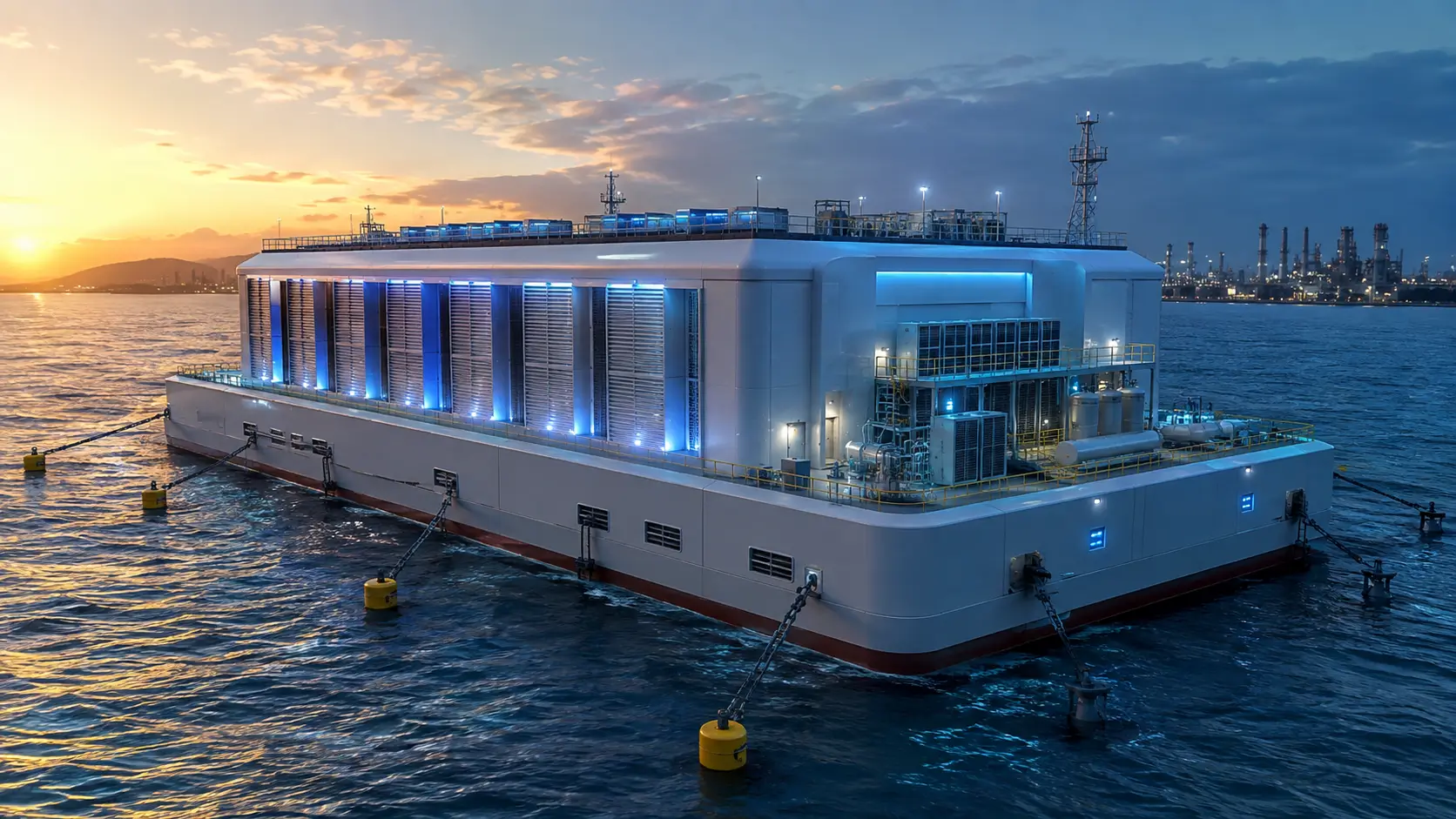
Why Samsung Is Taking AI Infrastructure Offshore
AI infrastructure now faces a practical challenge beyond processor availability. Suitable sites also need land, electricity, cooling, connectivity, and dependable operating conditions. Samsung Heavy Industries is developing a floating data center platform for this challenge. In August 2026, Samsung signed an engineering contract with Mousterian Corporation for its first U.S. deployment. Each planned facility is designed for 50MW of critical IT capacity. The project gives enterprises another infrastructure model to consider when conventional sites face physical or utility constraints.

Samsung has moved beyond an early design concept with its 50MW-class platform. The design received Approval in Principle from the American Bureau of Shipping and Lloyd’s Register. That approval validates the design framework, but it does not prove long-term commercial performance. Samsung is also working with Capital Clean Energy Carriers and Lloyd’s Register on project development. A separate partnership with Supermicro covers AI server validation in river and offshore environments. These partnerships combine marine engineering, data-center systems, certification, power, and AI-server expertise.
How the Architecture Addresses Site Constraints
A conventional data center needs suitable land with enough electrical and cooling infrastructure. Site selection also requires construction access and room for future expansion. Samsung’s design shifts part of this requirement from land to a floating platform. The company has described a dedicated newbuild barge for its floating data center architecture. The platform includes data halls, mechanical systems, electrical systems, and supporting power equipment. Its nearshore configuration can also use shore-based electricity instead of relying entirely on onboard generation.
Cooling becomes another important consideration for high-density AI infrastructure. Samsung’s proposed architecture uses seawater as part of its cooling approach. This design brings the surrounding marine environment into the thermal management system. The architecture also incorporates onboard power-generation options for suitable deployments. Such generation could reduce reliance on shore-based electricity where project conditions support self-generation. Operators must still manage heat exchange, corrosion, redundancy, environmental protection, and maintenance requirements. The key question for users is whether the cooling system can maintain stable performance under marine operating conditions.
What AI Operators Need to Consider
AI workloads place heavy demands on power delivery, thermal management, networking, and hardware density. A new facility design must therefore prove performance across the complete infrastructure stack. Samsung’s 50MW design provides a defined capacity target for future deployments. Capacity alone does not establish workload reliability or operational performance. Marine environments introduce vibration, inclination, salt exposure, and humidity changes. Samsung and Supermicro are working to verify AI server operation under river and marine conditions.
Connectivity also becomes important when computing capacity moves away from traditional terrestrial campuses. AI environments require strong links between compute, storage, applications, cloud systems, and users. Physical distance from terrestrial infrastructure can influence network architecture and operating costs. A nearshore facility can remain closer to terrestrial infrastructure than a remote offshore installation. Samsung’s first planned U.S. deployment follows this nearshore approach. Enterprise buyers should assess carrier diversity, cable routes, latency, redundancy, and recovery procedures before committing workloads.

The Commercial Model Will Matter as Much as the Technology
Commercializing floating infrastructure requires more than constructing the physical platform. Samsung has established partnerships across project sourcing, investment, technical development, certification, power, and AI-server validation. Capital Clean Energy Carriers is involved in project sourcing and investment considerations. Lloyd’s Register contributes technical and regulatory expertise to the development process. Samsung Heavy Industries handles technology development and construction for its platform. This structure gives customers several areas to examine before selecting the model for production infrastructure.
The economics will determine whether floating infrastructure becomes a repeatable deployment category. Samsung has highlighted standardized shipbuilding processes for design and equipment integration. A repeatable process could support consistent deployment across suitable future projects. Customers must still compare construction costs with land, grid connection, cooling, insurance, maintenance, and connectivity. Lifecycle cost remains more important than the physical novelty of the platform. A strong commercial case requires project-level evidence showing where the model delivers measurable value.
What Could Determine Adoption After 2028
Regulation will remain important because floating facilities involve both data-center and maritime requirements. American Bureau of Shipping and Lloyd’s Register are already involved in Samsung’s design process. Their involvement provides technical assessment for the proposed architecture. Individual deployments will still need to address applicable local requirements. These may include maritime, environmental, electrical, coastal, port, and infrastructure permissions. Operators also need clear procedures for emergency response, fire protection, evacuation, maintenance, and recovery.
Environmental performance also requires detailed project-level evaluation. Seawater cooling does not automatically make a facility environmentally preferable. Operators must examine heat discharge, marine impacts, fuel choices, emissions, and corrosion management. Construction and maintenance can also contribute to the facility’s environmental footprint. Samsung’s architecture incorporates onboard generation options, while nearshore facilities can use shore-based electricity. Those choices will influence how individual projects align with customer sustainability requirements.
What End Users Should Watch Before Adoption
Enterprises planning AI capacity should treat Samsung’s platform as an additional infrastructure option. It should not yet be viewed as a replacement for established land-based data centers. Potential use cases are most relevant where land, power, cooling, or development constraints limit expansion. A floating platform could provide another location for compute capacity without requiring equivalent permanent land. Customers should demand evidence covering availability, reliability, cooling, networking, maintenance, security, insurance, and recovery. These factors remain critical when infrastructure supports business applications that require dependable service.
Samsung’s 2028 commercialization target will test the transition from engineering validation to enterprise infrastructure. The company already has partners covering shipbuilding, certification, investment, power, and AI-server technology. The next stage will require project execution and real-world equipment validation. It will also require repeatable maintenance processes and predictable operating performance. Enterprises should watch deployment evidence instead of relying on announcements alone. If performance meets enterprise requirements, floating infrastructure could offer another option for constrained AI deployment locations.











