...
NVIDIA H200 shipments delayed to Q3  · BREAKING: Microsoft confirms 3GW data centre expansion in Asia-Pacific ·  AWS announces new sovereign cloud regions in India and UAE  · Arm-based servers now 24% of hyperscale deployments ·  EU AI Act enforcement enters phase two  · Global data centre investment hits $612B in 2026 ·  TSMC Arizona yields improve to 68% on 3nm process  · OpenAI valuation reaches $400B after latest funding round ·  NVIDIA H200 shipments delayed to Q3  · BREAKING: Microsoft confirms 3GW data centre expansion in Asia-Pacific ·  AWS announces new sovereign cloud regions in India and UAE  · Arm-based servers now 24% of hyperscale deployments ·  EU AI Act enforcement enters phase two  · Global data centre investment hits $612B in 2026

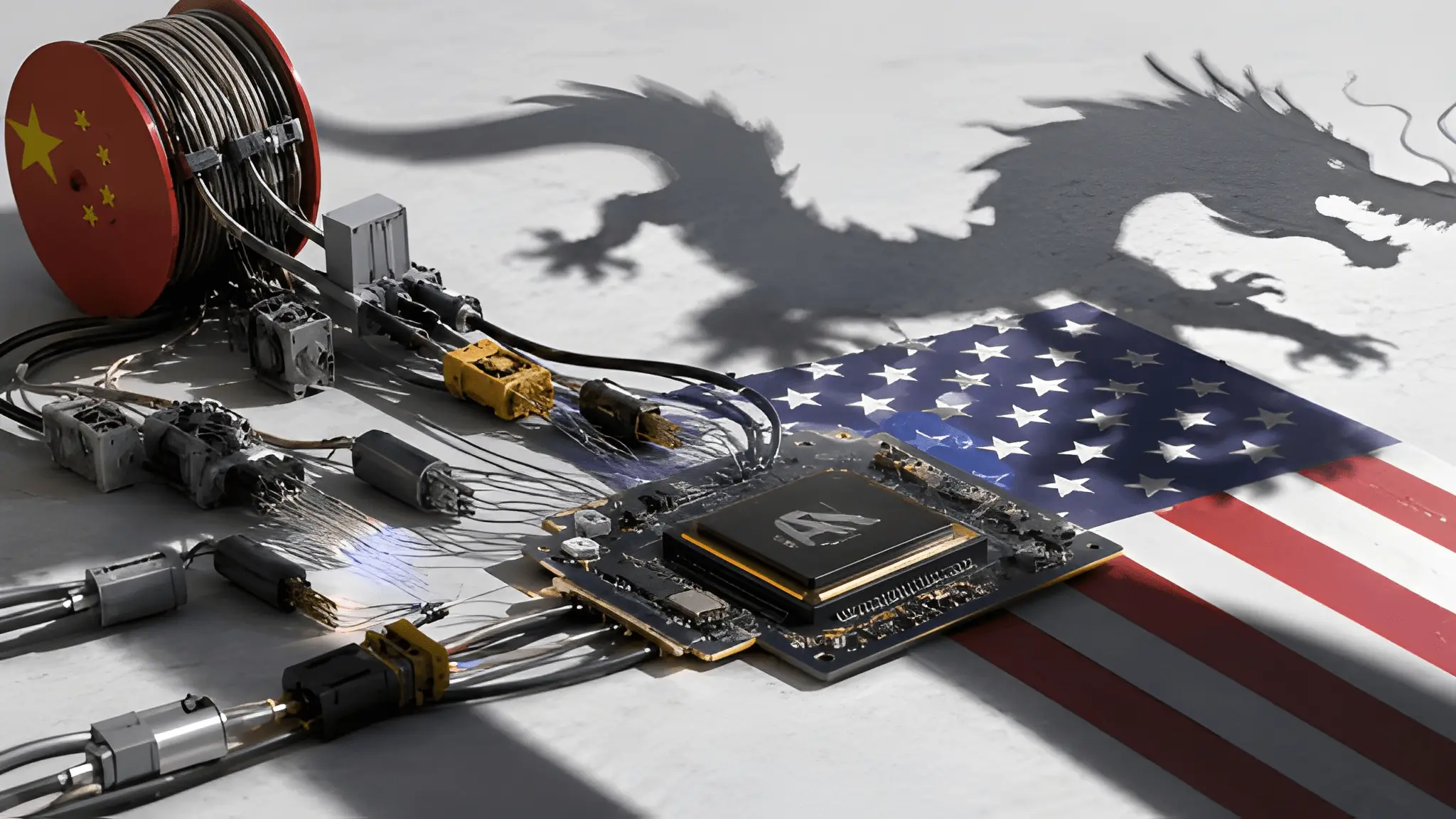
China’s Supply Chain Shadow Looms Over America’s AI Boom

A strange thing happens when an AI data center moves from a financial model to a construction site: the GPU

Share
China supply chain

A strange thing happens when an AI data center moves from a financial model to a construction site: the GPU stops looking like the whole story. The AI infrastructure industry increasingly discusses capacity in terms of accelerators, racks, power availability and computing clusters. Yet those machines cannot operate without a dense physical system that sits underneath them. Transformers move electricity into the right voltage range. Switchgear distributes and protects it. Batteries provide backup. Optical modules and fiber infrastructure move data between computing systems. Cooling equipment keeps the resulting heat under control.

These components rarely dominate AI headlines, but shortages and long procurement timelines for critical infrastructure can materially affect when new computing capacity comes online. That creates a more uncomfortable supply-chain question for the U.S. AI buildout. America can expand domestic semiconductor manufacturing, assemble servers onshore and spend heavily on new power capacity while still relying on globally distributed manufacturing networks for the less glamorous equipment that connects those pieces. The vulnerability, in other words, may not sit inside the GPU rack. It may sit several layers upstream.

China’s Role Is Bigger Than the Hardware Americans Usually Associate With China

China’s relevance to the AI infrastructure supply chain does not depend on Chinese companies supplying frontier GPUs to U.S. data centers. The exposure can appear through equipment categories that receive considerably less attention. Transformer manufacturing provides one example. Chinese manufacturers are part of the global transformer supply chain, while U.S. authorities continue to identify limited domestic production capacity, foreign supply dependence and extended procurement timelines as challenges for critical transformer equipment. DOE’s current supply-chain program specifically targets transformers, components and materials while acknowledging dependence on imported inputs.

Optical infrastructure presents another layer. High-performance AI clusters increasingly depend on optical connectivity to move enormous volumes of data between servers and across networking systems. Industry reporting from China indicates that Chinese companies hold significant positions in optical-module manufacturing, with several Chinese vendors ranking among the world’s largest suppliers. That does not mean every U.S. AI facility depends directly on Chinese-made optical equipment.

It does mean that the global manufacturing base behind high-speed AI networking remains geographically concentrated in ways that the U.S. semiconductor narrative can obscure. Supply-chain exposure is not the same thing as dependence on a single Chinese supplier. Modern infrastructure rarely follows such a clean line. A component can involve Chinese manufacturing, non-Chinese intellectual property, materials from another country, final assembly somewhere else and a U.S. integrator before it reaches a data center. That complexity makes the vulnerability harder to see, not necessarily smaller.

The Real Question Is Whether America Is Building or Assembling

Washington’s industrial push increasingly focuses on bringing strategic production closer to home. NVIDIA, for example, now highlights U.S. expansion across parts of its AI manufacturing ecosystem, including chips, packaging, optics and systems. But an independent AI industrial base requires more than domestic production of the components that receive the most attention. It requires depth. That means the ability to manufacture transformers at scale, produce specialized electrical equipment, secure critical materials, build optical systems, fabricate cooling equipment and replace foreign inputs without sending project schedules into another planning cycle.

The distinction between building and assembling therefore becomes important. America could assemble an enormous amount of AI capacity domestically while remaining exposed to overseas industrial ecosystems for some of the equipment and materials that support that capacity. The resulting infrastructure would look American at the site level but remain international at the component level. That is not automatically a failure. Global specialization exists because it can deliver lower costs, greater scale and faster production. The problem emerges when geopolitical friction or sudden demand exposes how few alternative suppliers exist.

The Most Important AI Supply Chain May Be the Least Photogenic

There is an irony in the industry’s obsession with increasingly sophisticated silicon. The more powerful the accelerator becomes, the more demanding the surrounding infrastructure becomes. A next-generation AI cluster does not merely need more computing. It needs more electrical capacity, more sophisticated power distribution, higher-bandwidth networking, more cooling and increasingly complex supporting systems. The physical requirements compound as compute density rises. That creates a supply-chain hierarchy in which a comparatively mundane component can become strategically important simply because there are not enough of them.

DOE’s recent assessment makes the point without relying on AI hype: critical grid equipment can face lead times of two years or more, while the department is pursuing programs to increase domestic manufacturing and reduce reliance on foreign suppliers. The implication for AI developers is straightforward. The fastest path to more compute may not always involve buying more accelerators. It may involve securing the equipment that allows those accelerators to receive power, communicate and operate continuously. That is a much less glamorous industrial problem, but it may become the more consequential one.

America’s AI Independence Will Be Tested Outside the Server Rack

The U.S. does not need to eliminate every foreign supplier to create a resilient AI infrastructure base. That would be commercially unrealistic and would confuse self-sufficiency with resilience. The more useful test is whether a disruption involving one major manufacturing region can stop a large portion of the AI construction pipeline. If the answer is yes, then domestic AI capacity remains vulnerable even when the most visible technology sits inside U.S. facilities. That is why China’s supply-chain shadow matters. It is not primarily a story about Chinese GPUs appearing inside American data centers. It is about how deeply manufacturing specialization has become embedded in the physical machinery surrounding advanced computing, including components and systems supplied through international production networks.

The next phase of America’s AI buildout will therefore reveal something the GPU race cannot show on its own: whether the country is developing an industrial ecosystem capable of supporting frontier compute, while reducing its exposure to bottlenecks that depend on overseas manufacturing capacity. The uncomfortable part is that those bottlenecks may look almost boring. They may be copper, steel, fiber, transformers, switchgear and power electronics. And if those components can materially affect how quickly AI capacity comes online, they deserve to be treated as part of the AI race itself.

[simple-author-box]

More from AI Infrastructure

The Data Center Is Becoming an Energy System The most important change in AI

A 330-megawatt compute facility is difficult to describe as merely a building with servers

A 500-megawatt AI facility can represent a substantial engineering undertaking, but its resilience depends

COMPUTE WEEKLY

The briefing that 40,000+ tech leaders read every Monday. Sharp, fast, essential.

Great! We’ve received your information.

Building an AI Startup Without Owning GPUs

Not owning GPUs has become the default, deliberate strategy for building an AI company — not a compromise founders accept reluctantly. H100 rental rates fell 64-75% in fifteen months, a dense ecosystem of neoclouds and inference-as-a-service providers now lets startups skip infrastructure entirely, and credit programs can fund a company’s first year before a founder writes a check
Most Read

A data center master plan can establish a defined technical basis before all future

A transformer can leave a refurbishment shop looking almost indistinguishable from a new unit,

Why Samsung Is Taking AI Infrastructure Offshore AI infrastructure now faces a practical challenge

AI infrastructure decisions for high-density deployments increasingly involve what happens after electricity enters the

Demand is broadening across enterprise workloads APAC’s infrastructure story is changing in ways that

Disruptor Spotlight

Cerebras Systems

The chip that makes Nvidia nervous. Cerebras’ Wafer Scale Engine is rewriting the rules of AI inference at scale.
Faster
0 x
YoY Revenue
0 x
Transistors
0 T
Market Pulse
MSFT
+1.02%
NVDA
+0.66%
AMZN
-0.078%
AMD
-6.95%
TSMC
-2.98%
Indicative only · Not financial advice
Upcoming Events
SEP
The AI Infrastructure Race (India)
WEBINAR · ONLINE
The AI Infrastructure Race: Won on Power, Land and Trust — Not Capital
MAY
0
AI Infrastructure Summit
DUBAI · IN PERSON
MEA’s premier AI infrastructure event.
JUN
0 0
Compute Forecast Summit
SINGAPORE · IN PERSON
Our flagship APAC event. Early bird open.
Latest Moves
Live
ecolab
Ecolab Deepens Cooling Strategy With $4.75B CoolIT Acquisition
Ecolab is making one of its biggest moves yet into AI infrastructure after completing its $4.75 billion acquisition of liquid cooling specialist CoolIT Systems
Pure DC AVK Europe data center microgrid Dublin 110MW AI infrastructure Ireland 2026
Pure DC and AVK Deploy Europe’s First 110 MW Data Center Microgrid in Dublin
The Pure DC Dublin microgrid has made history as Europe’s first large-scale on-site data center microgrid, launched in partnership with power solutions provider AVK at Pure DC’s campus in Ireland.
Pace Digitek
Pace Digitek Partners With MEGMEET to Expand AI Data Center Power Business
India’s AI infrastructure ecosystem continues to mature as domestic technology manufacturers move beyond traditional telecommunications and industrial markets toward high-growth digital infrastructure opportunities
Follow Compute Forecast
11K followers
1200 followers
Companies to Watch
CW
CoreWeave
Neo Cloud · $19B · IPO Watch
CB
Cerebras Systems
AI Hardware · $4.25B · Pre-IPO
G42
G42
Sovereign AI · Abu Dhabi
H
Humain
Saudi AI · $40B Fund
Latest Podcast
AI Capex, Cloud Margins & the Nuclear Bet
48 MIN · 25 APR 2026

China’s Supply Chain Shadow Looms Over America’s AI Boom

A strange thing happens when an AI data center moves from a financial model to a construction site: the GPU

Share
China supply chain
0
847 SHARES

0
SHARES

[simple-author-box]

More from AI Infrastructure

A data center master plan can establish a defined technical basis before all future

A transformer can leave a refurbishment shop looking almost indistinguishable from a new unit,

Why Samsung Is Taking AI Infrastructure Offshore AI infrastructure now faces a practical challenge

AI infrastructure decisions for high-density deployments increasingly involve what happens after electricity enters the

COMPUTE WEEKLY

The briefing that 40,000+ tech leaders read every Monday. Sharp, fast, essential.

Great! We’ve received your information.

Global AI Infrastructure Outlook 2026

The briefing that 40,000+ tech leaders read every Monday. Sharp, fast, essential.
Download Free
Most Read

A data center master plan can establish a defined technical basis before all future

A transformer can leave a refurbishment shop looking almost indistinguishable from a new unit,

Why Samsung Is Taking AI Infrastructure Offshore AI infrastructure now faces a practical challenge

AI infrastructure decisions for high-density deployments increasingly involve what happens after electricity enters the

Demand is broadening across enterprise workloads APAC’s infrastructure story is changing in ways that

Disruptor Spotlight

Cerebras Systems

The chip that makes Nvidia nervous. Cerebras’ Wafer Scale Engine is rewriting the rules of AI inference at scale.
Faster
0 x
YoY Revenue
0 x
Transistors
0 T
Market Pulse
NVDA
$924.60
+2.4%
MSFT
$421.30
+1.1%
AMZN
$192.80
-0.6%
NVDA
$924.60
+2.4%
NVDA
$924.60
+2.4%
Indicative only · Not financial advice
Upcoming Events
MAY
0 0
DCD Global — London
LONDON · IN PERSON
World’s largest DC event. CF is media partner.
MAY
0
AI Infrastructure Summit
DUBAI · IN PERSON
MEA’s premier AI infrastructure event.
JUN
0 0

Compute Forecast Summit

SINGAPORE · IN PERSON
Our flagship APAC event. Early bird open.
Latest Moves
  • Live
Sam Altman
OpenAI appoints new Chief Infrastructure Officer to lead $100B DC programme
27 APR · OPENAI
Sam Altman
OpenAI appoints new Chief Infrastructure Officer to lead $100B DC programme
27 APR · OPENAI
Sam Altman
OpenAI appoints new Chief Infrastructure Officer to lead $100B DC programme
27 APR · OPENAI
Follow Compute Forecast
18.4K followers
12.1K followers
9.3K subscribers
41 episodes
Companies to Watch
CW
CoreWeave
Neo Cloud · $19B · IPO Watch
CB
Cerebras Systems
AI Hardware · $4.25B · Pre-IPO
G42
G42
Sovereign AI · Abu Dhabi
CW
Humain
Saudi AI · $40B Fund
Latest Podcast
AI Capex, Cloud Margins & the Nuclear Bet
48 MIN · 25 APR 2026
Scroll to Top
Seraphinite AcceleratorOptimized by Seraphinite Accelerator
Turns on site high speed to be attractive for people and search engines.