
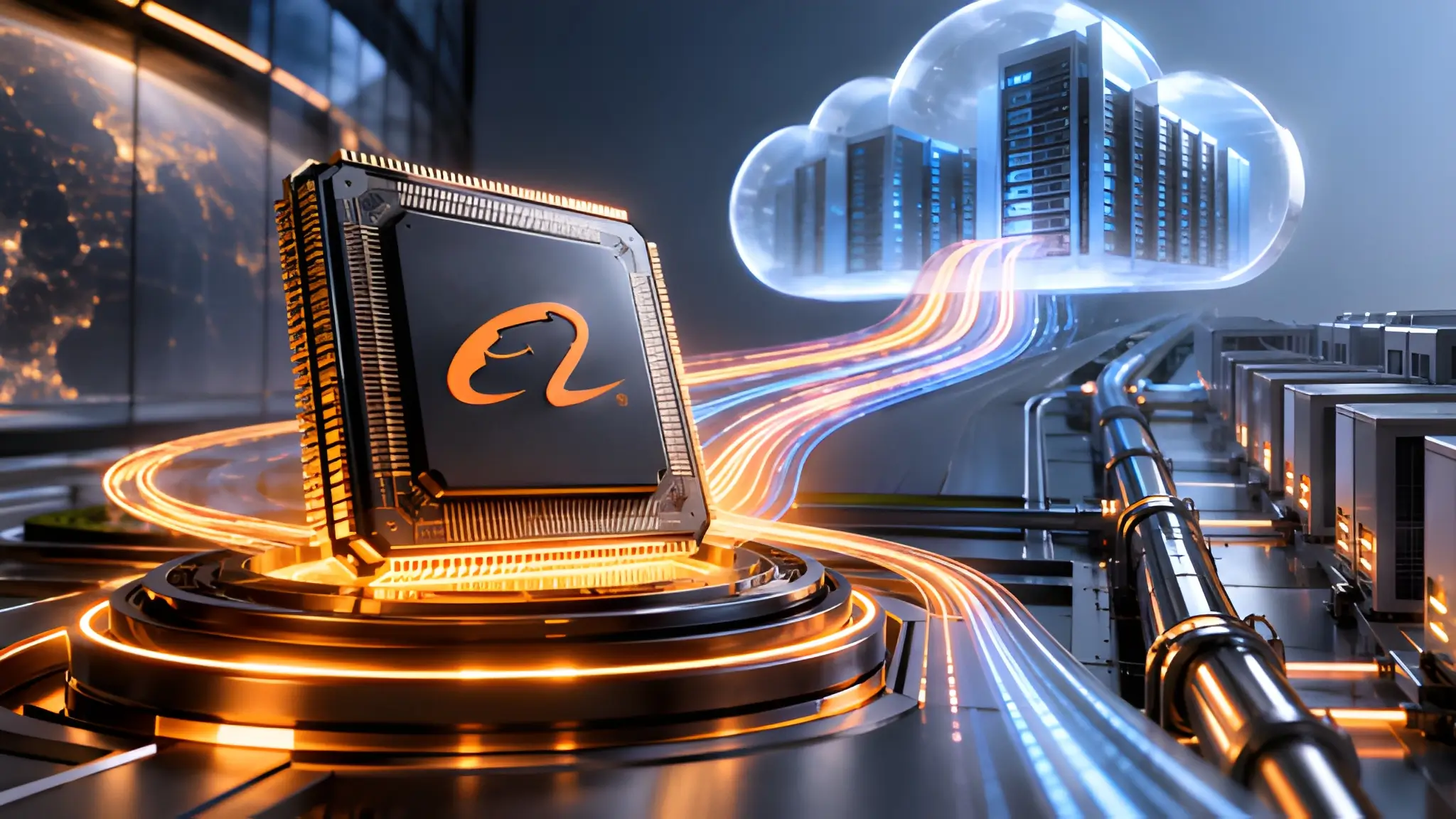
Alibaba Group Holding Ltd. is tying its next phase of AI expansion to a new generation of in-house computing hardware, placing the Zhenwu V900 accelerator at the center of a broader infrastructure strategy. The company introduced the chip Tuesday at Alibaba Cloud’s annual Apsara Conference in Hangzhou and described it as China’s most powerful AI accelerator. Alibaba’s T-Head semiconductor division developed the V900, which delivers three times the performance of its predecessor and can operate across clusters of as many as 500,000 chips.

The hardware announcement carries a much larger infrastructure ambition behind it. Chief Executive Officer Eddie Wu said Alibaba Cloud intends to push its global data center capacity beyond 20 gigawatts by 2032, responding to what he described as “exponentially rising demand for AI.” That target places computing capacity alongside chips and models as interconnected pieces of Alibaba’s long-term AI strategy. The company expects the V900 to support frontier-model training and large-scale inference as its cloud footprint expands.
Zhenwu V900 Anchors Alibaba’s AI Stack
Alibaba’s semiconductor push reflects a broader attempt to control more of the infrastructure required to develop increasingly large AI systems. The company has committed more than $53 billion over three years toward AI capabilities, covering areas that include computing infrastructure, chips and model development. It raised about $10.2 billion through a Hong Kong share offering in August, with the proceeds supporting its AI investment program.
The V900 matters because Alibaba is not treating accelerator development as a standalone hardware project. The company wants its chip architecture, cloud capacity and AI models to scale together, reducing dependence on external computing infrastructure as demand rises. Alibaba has further outlined plans for an AI model containing between 5 trillion and 10 trillion parameters, a scale designed to handle more complex and longer-running tasks than today’s leading systems. Industry reports said the proposed model could reach up to four times the size of Alibaba’s current Qwen 3.8 Max model.

Alibaba Pushes Toward Larger AI Models
The model roadmap gives the 20GW target a clearer strategic context. Training systems with trillions of parameters requires sustained access to accelerators, high-bandwidth networking, storage and power, making data center capacity a core component of model development rather than merely a cloud-service resource. Alibaba’s approach therefore links semiconductor design directly with the physical infrastructure needed to operate increasingly demanding AI workloads. Meanwhile, the company is preparing to scale the V900 into mass production, with reports indicating that production could begin in early 2027.
Alibaba’s strategy comes as Chinese technology companies continue building domestic alternatives to advanced US-designed AI hardware. Restrictions affecting access to leading Nvidia processors have increased the importance of locally developed accelerators, encouraging Chinese companies to improve performance, efficiency and software compatibility. Alibaba’s T-Head division is expected to play a larger role in that effort, with the company planning to list the chip-design business and tap investor interest in the expanding AI accelerator market. The move could give Alibaba another financing channel as semiconductor development becomes increasingly capital intensive.
Alibaba’s 20GW Bet Reshapes Cloud Strategy
The 20GW target signals that Alibaba expects AI demand to reshape the economics and physical architecture of cloud computing through the end of the decade. Its strategy combines proprietary accelerators, enormous model ambitions and a planned expansion of power-intensive data center infrastructure into one integrated AI stack. For infrastructure operators, the scale highlights how chip availability, power procurement and data center construction are becoming increasingly inseparable from model-development strategies. Alibaba’s latest announcements therefore position its cloud business for a future in which control over computing capacity becomes as important as access to AI software.











