
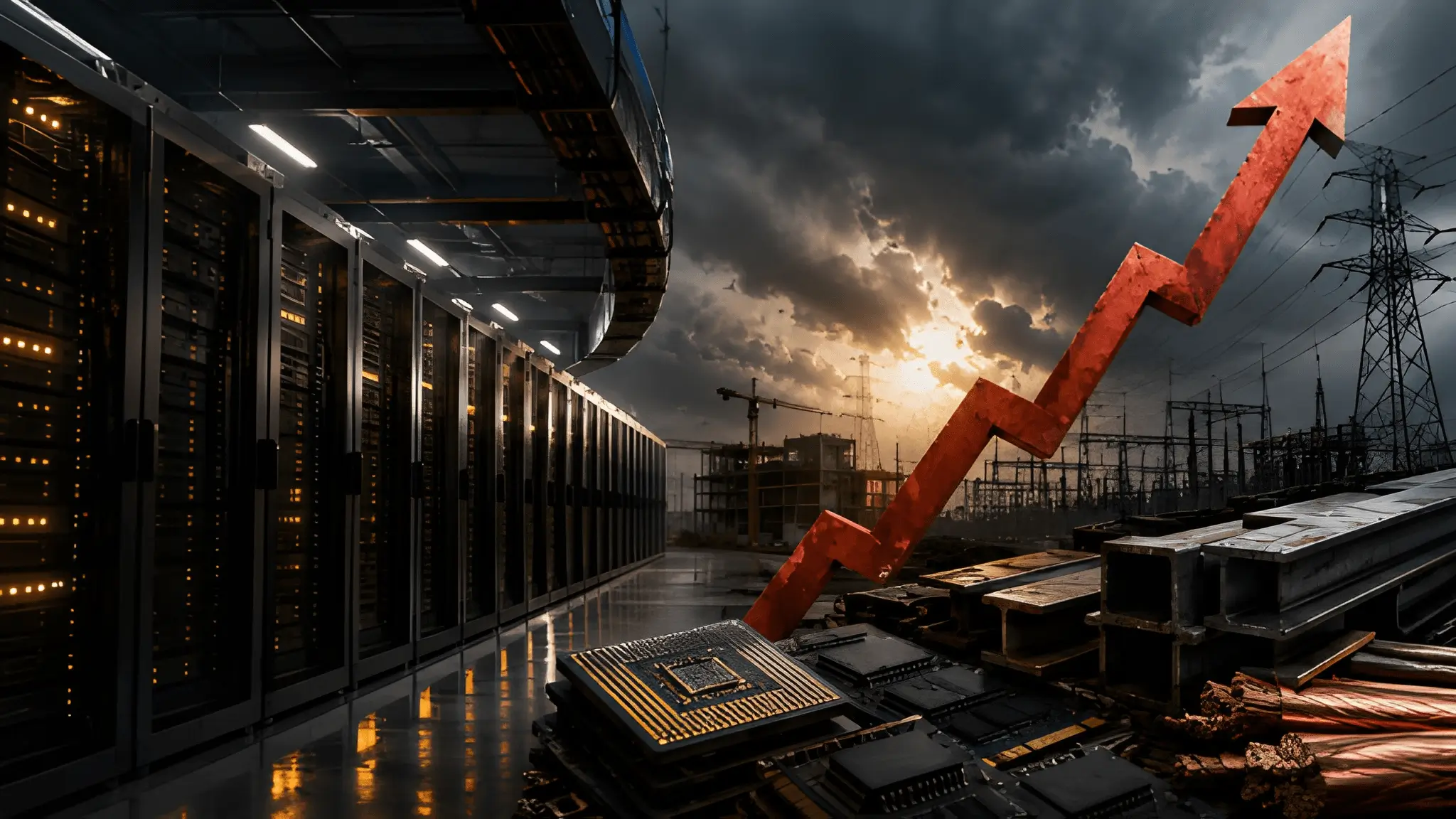
Inflation discussions usually begin with consumer demand, labor shortages, interest rates, or geopolitical disruption. Artificial intelligence rarely enters that conversation as an inflationary force. Instead, AI is commonly positioned as the technology that will eventually suppress costs through automation, productivity, and operational efficiency. That assumption deserves closer scrutiny because the physical systems supporting AI have already begun reshaping the economics of industries far removed from software. Every breakthrough model depends on a supply chain measured in transformers, switchgear, high-bandwidth memory, GPUs, liquid cooling equipment, electrical steel, copper, concrete, and gigawatts of reliable electricity. Those inputs remain finite.

As investment in AI infrastructure accelerates, demand for each component rises alongside it, creating pressure that reaches manufacturers, utilities, construction firms, and industrial buyers competing for the same resources. That shift reframes the conversation. Data centers no longer represent only digital infrastructure. They increasingly function as large-scale industrial consumers whose purchasing power influences pricing across multiple sectors. Their economic footprint extends well beyond cloud computing, introducing competitive pressure into markets that once operated with more balanced demand.
AI’s physical economy is becoming impossible to ignore
The modern AI discussion often emphasizes algorithms while overlooking the industrial ecosystem that enables them. Every large-scale model begins with physical assets that require years to build, secure, and connect to electrical infrastructure. Those assets compete directly with other sectors seeking the same materials and engineering capacity. Manufacturers of electrical equipment already face expanding order books as utilities modernize aging grids while hyperscale operators pursue increasingly larger campuses. Similar dynamics appear across cooling technologies, power distribution systems, specialized semiconductors, networking equipment, and industrial construction. None of these markets operate independently anymore. AI infrastructure increasingly links them together. That interconnected demand matters because supply expansion rarely keeps pace with investment cycles.
Building additional transformer manufacturing capacity or expanding semiconductor packaging facilities requires significant capital, specialized labor, regulatory approvals, and time. Demand, however, can accelerate much faster than production. The result resembles a familiar economic pattern. Scarcity raises prices long before additional capacity arrives. Many businesses outside the technology sector are beginning to encounter higher project costs even when they have little direct connection to AI. Manufacturers replacing electrical equipment may face longer procurement timelines. Renewable energy developers can encounter greater competition for transformers and grid connections. Some commercial construction projects may absorb higher material costs as engineering resources increasingly shift toward larger, better-funded developments. None of these outcomes necessarily indicate market failure. They demonstrate what can happen when one rapidly expanding industry becomes one of the fastest-growing sources of demand for critical industrial inputs.
The productivity narrative skips today’s invoice
Silicon Valley continues to promote AI through its long-term productivity potential. The argument remains economically credible. Automation could reduce operating expenses, accelerate research, improve logistics, and increase workforce efficiency across numerous industries. The timeline, however, deserves equal attention. Many of AI’s projected economic gains remain future expectations. Infrastructure spending represents today’s reality. Capital expenditures for AI campuses already require enormous investments in power delivery, substations, cooling systems, networking hardware, and specialized computing equipment before productivity improvements appear in broader economic data. Those investments ripple through supply chains immediately. Utilities expand transmission networks. Equipment manufacturers increase production. Construction firms may redirect labor toward large-scale AI infrastructure projects. Some industrial suppliers may prioritize higher-value contracts when manufacturing capacity remains constrained.
Each adjustment influences prices throughout the broader economy before businesses or consumers experience measurable efficiency gains from AI applications. That sequencing creates an uncomfortable question for policymakers and economists. If infrastructure costs rise faster than productivity improvements materialize, who absorbs the difference during the transition? Households may encounter higher utility investments reflected over time through regulated rate structures where approved infrastructure costs are recoverable. Businesses may face more expensive expansion projects because electrical equipment becomes harder to procure. Public infrastructure initiatives may compete against private AI developments for engineering talent and industrial materials. The technology industry rarely describes those outcomes as AI-related inflation. Yet they reflect the economic consequences of concentrating unprecedented investment into physical infrastructure within a compressed timeframe.












