
The Shortcut That Created a Different Problem
Developers can construct data centers within 12 to 18 months. Connecting them to the grid, however, currently takes five to seven years. That mismatch did not stay theoretical for long. Faced with a utility queue stretching past the end of the decade, hyperscalers and developers made a pragmatic decision: build the power yourself, behind the meter, and skip the line entirely. Data center developers have announced approximately 101 gigawatts of on-site natural gas generation to bypass interconnection bottlenecks and secure reliable baseload power. The numbers reflect a genuine infrastructure crisis, not corporate recklessness.

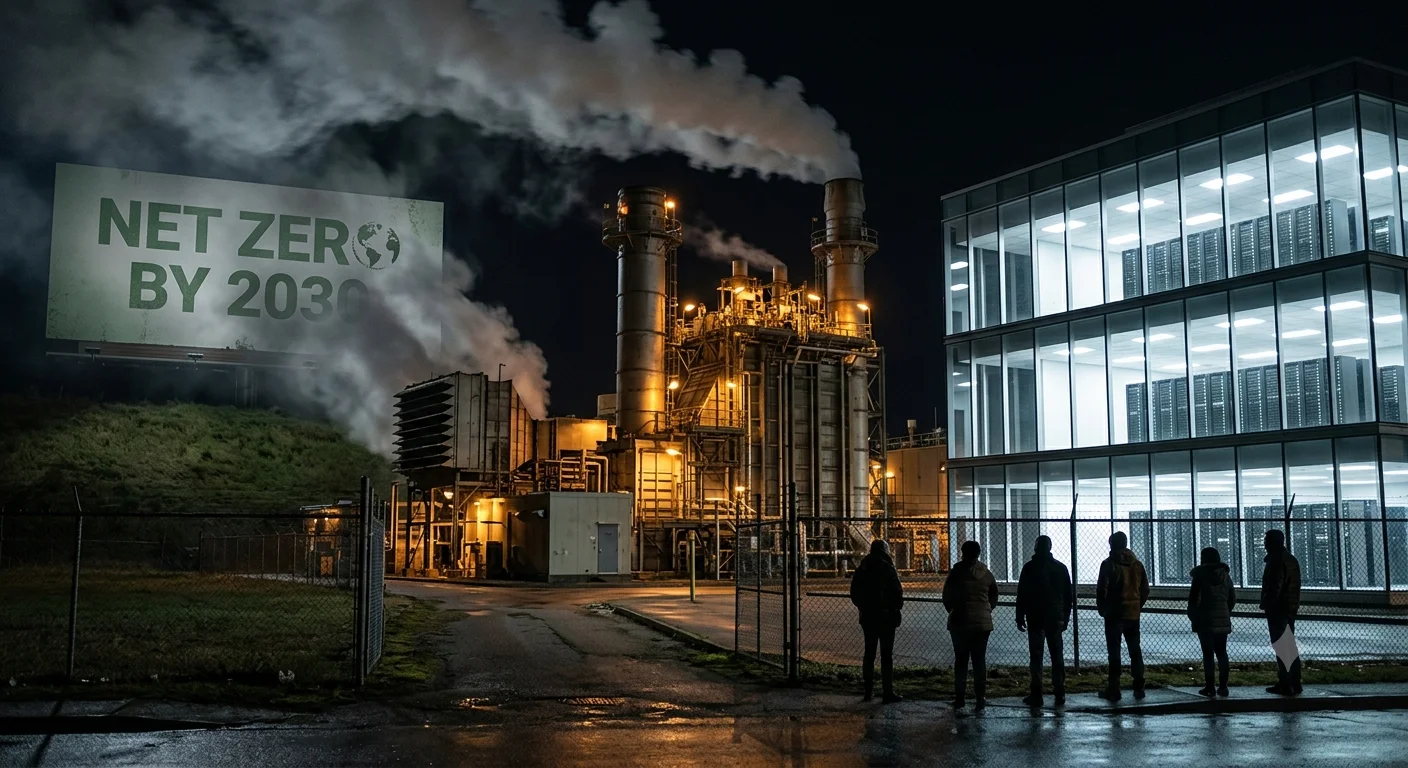
However, the BYOP strategy solved one problem while constructing another. Companies announced approximately 57 gigawatts of behind-the-meter natural gas generation projects in 2025 alone. That volume of on-site fossil fuel generation is now colliding simultaneously with federal environmental regulations, local community air quality standards, and the corporate sustainability pledges that the same companies issued to their investors. Meanwhile, community opposition has already blocked or delayed approximately $98 billion in projects in Q2 2025. The shortcut is becoming expensive faster than anyone expected.
What Memphis Revealed About the Loophole
For a period, BYOP worked partly because of a regulatory gap. Temporary natural gas turbines deployed behind the meter occupied an ambiguous category under Clean Air Act permitting rules. Some operators treated modular turbines as non-road engines, a classification that carried substantially lighter emissions review requirements. xAI’s Memphis facility, which began operations in 2024, powered its Grok AI models through exactly this approach, deploying gas turbines without traditional air permitting.
Consequently, the EPA closed the loophole on January 16, 2026. The revised guidance clearly states that operators cannot classify natural gas turbines used in this manner as non-road engines. Companies must now obtain Clean Air Act permits before installing and operating turbines, particularly when combined emissions exceed major source thresholds. Moreover, the EPA revised its New Source Performance Standards in January 2026, adding Subpart KKKKa specifically for turbines constructed after December 2024. Temporary turbines now face a strict 24-month operational limit before permanent facility rules apply retroactively from day one of installation. Therefore, operators who planned to run “temporary” gas generation indefinitely discovered they had been building a compliance liability from the first day of operation.

The Air Quality Numbers Communities Are Reading
The permitting change arrived because the underlying emissions data made the status quo indefensible. Developers plan to build at least 74 natural gas-fired power plants across the United States to supply electricity to the rapidly expanding data center industry. These plants could emit nearly 662 million tons of greenhouse gases annually—equivalent to the yearly emissions of 140 million cars and trucks. Furthermore, the plants could release 159,142 tons per year of health-damaging air pollutants, including 44,281 tons of nitrogen oxides and 32,684 tons of fine particulate matter.
These numbers do not stay abstract in host communities. In Sterling, Virginia, the Vantage VA2 data center runs eight natural gas turbines around the clock to power its facility. In Memphis, residents of Boxtown in South Memphis organized against xAI’s facility, citing the emissions burden on a community already carrying disproportionate industrial air quality exposure. Most U.S. voters now oppose data centers because they worry about higher household electricity costs, environmental damage, and reduced quality of life for nearby residents, who often endure constant noise and pollution from gas turbines.Public support for data center development has reached an all-time low. That political reality is now showing up in permitting timelines.
The Net-Zero Contradiction Nobody Wants to Name
The emissions compliance problem is acute. However, the corporate credibility problem may ultimately prove more consequential. The same hyperscalers running on-site gas turbines have issued net-zero commitments, detailed sustainability reports, and carbon neutrality pledges to their institutional investors, ESG rating agencies, and government regulators simultaneously. Hyperscalers have committed to running on renewable energy and matching their electricity use to renewable energy certificates. Operating gas-fired turbines around the clock at their own facilities creates an obvious gap between that commitment and physical reality.
Moreover, natural gas demand from data centers in the U.S. may reach 6.1 billion cubic feet per day by 2030, potentially a nearly 20 percent increase to annual average power burn. That trajectory does not describe a sector transitioning toward its stated sustainability commitments. Instead, it describes a sector moving in the opposite direction while the sustainability reports continue to signal progress. The EU’s Corporate Sustainability Reporting Directive and California’s climate disclosure laws are creating reporting obligations that will make this gap a matter of legal record rather than voluntary narrative. Scope 1 emissions from on-site gas turbines are among the most directly attributable emissions in any company’s portfolio. Therefore, operators who treated BYOP as a temporary bridge solution will discover their emissions disclosures require permanent accounting of a fossil fuel commitment they described as transitional.
The Supply Constraint Inside the Supply Crisis
There is a further industrial constraint that the BYOP strategy has generated almost as a side effect. Natural gas turbines purpose-built for data center deployment have become the next scarce component in an infrastructure stack already defined by scarcity. New turbine orders are commanding price premiums of 10 to 20 percent above existing backlogs. That premium reflects a manufacturing base that was not designed to produce at the volumes the AI data center buildout now demands.
Transformer demand increased 119 percent from 2019 to 2025, with lead times stretching to five years from roughly one year pre-COVID. Gas turbines are now experiencing comparable pressure. Consequently, the strategy that operators adopted specifically to avoid grid interconnection delays is generating its own queue — this time for the generation equipment required to make the BYOP model operational. Meanwhile, community opposition is extending permitting timelines for the facilities that do manage to secure turbines. The combined effect is a supply crisis that the industry created by attempting to bypass the original one.
Why BYOP Cannot Be the Long-Term Answer
The BYOP model was never designed as a permanent infrastructure strategy. It emerged from a genuine and urgent constraint: a utility interconnection system that moves on decade-long timelines while AI infrastructure demands move on 12-month ones. That mismatch is real, and the operators who adopted BYOP were responding rationally to a structural problem they did not create. However, the regulatory environment that allowed BYOP to operate in a compliance gray zone has now changed. The EPA closed the permitting loophole in January 2026.
State-level air quality regulators are scrutinizing cumulative emissions across data center campuses rather than evaluating each turbine in isolation. Community opposition has demonstrated it can block nearly $100 billion in projects. Furthermore, EU regulators are moving to require granular, time-stamped energy source disclosure that annual renewable energy certificates will not satisfy at the level of specificity now demanded. The industrial supply crisis AI infrastructure has triggered is ultimately a governance failure dressed up as an engineering problem. The utility interconnection queue is genuinely broken and needs structural reform. However, the answer to a broken grid process is not a fossil fuel bypass that creates air quality violations, blows up sustainability pledges, strains turbine supply chains, and turns host communities into opponents.











