
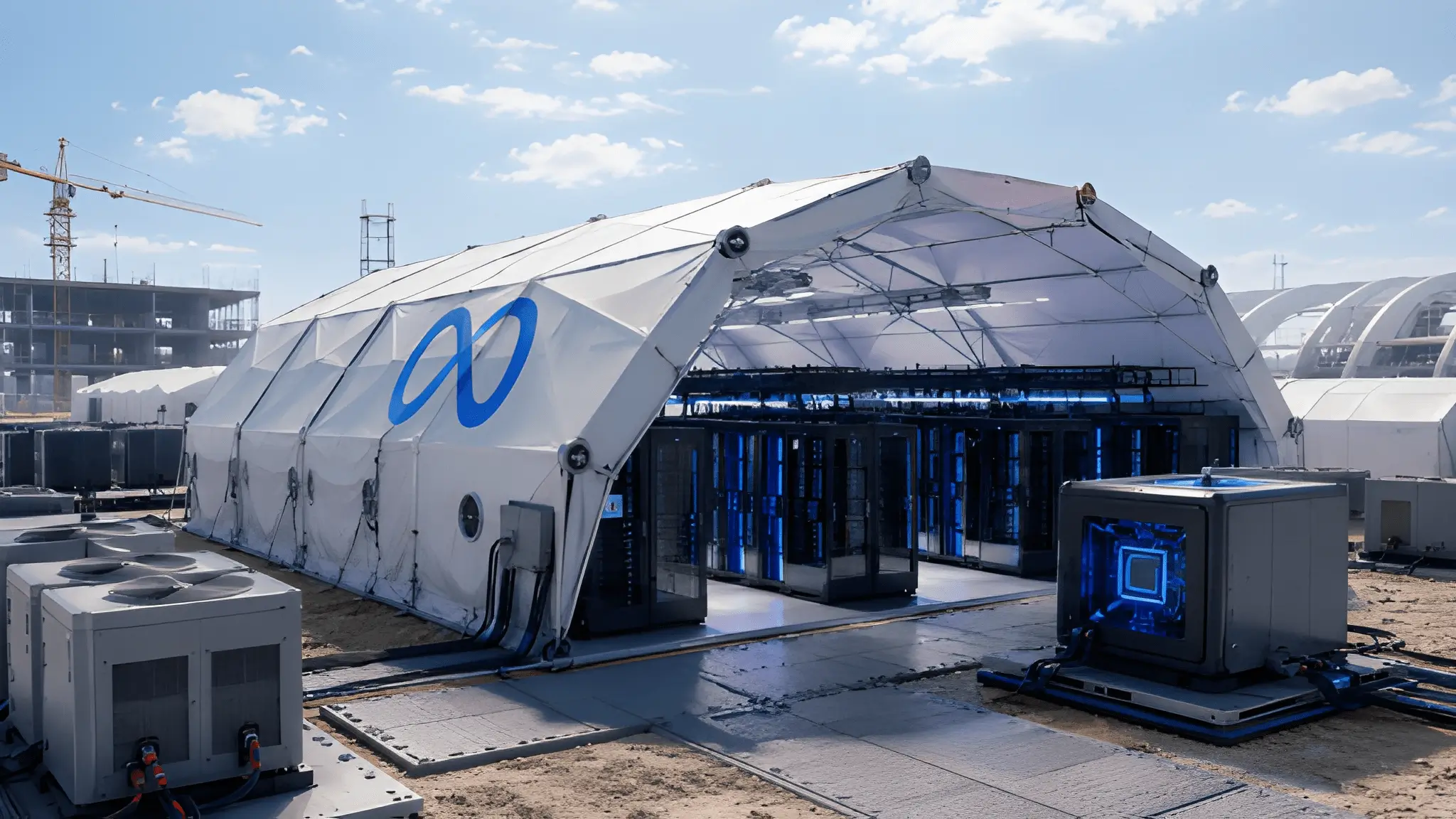
A row of temporary structures housing advanced computing equipment would once have appeared out of place in the world’s most sophisticated technology projects. Today, however, the image serves as a useful indicator of how rapidly the artificial intelligence market is changing the economics of digital infrastructure. Meta‘s reported decision to deploy temporary tent structures while permanent facilities remain under construction should not be viewed primarily as a construction story. The tents themselves are not the development. The more important signal is the urgency that produced them. The move mirrors an emerging infrastructure philosophy in which operational readiness takes precedence over architectural completion.

Infrastructure planning traditionally followed a predictable sequence. Companies acquired land, secured permits, completed engineering work, constructed facilities, installed equipment, and then brought capacity online. The process often stretched across several years. Such timelines reflected a period when demand forecasts remained relatively stable and organizations could afford to wait for optimal completion before deployment. Artificial intelligence has altered that equation.
The rapid expansion of large-scale model training and inference workloads has transformed computing capacity into a strategic resource. Access to GPUs, power, networking, and physical space now carries competitive implications that extend beyond operational efficiency. In many cases, infrastructure availability directly influences a company’s ability to develop, train, and deploy AI systems. Against that backdrop, Meta’s use of temporary structures appears less unconventional than practical. The company is effectively acknowledging a broader reality facing hyperscalers: waiting for perfect infrastructure may carry greater costs than deploying functional infrastructure immediately. The tents are therefore symbolic. They represent a market where speed increasingly determines value.
Compute Availability Has Become A Competitive Asset
The AI industry frequently discusses model performance, algorithmic improvements, and semiconductor innovation. Yet infrastructure has emerged as an equally important battleground. Organizations can only deploy AI capabilities at scale if sufficient computing resources exist behind them. Every new model launch, enterprise AI deployment, and inference workload ultimately depends on physical infrastructure. As demand accelerates, traditional construction cycles are struggling to keep pace. Data centers remain among the most complex facilities built by modern industry. They require extensive power planning, cooling systems, network architecture, environmental controls, and regulatory approvals. None of those requirements have become simpler because AI arrived. Demand, however, has become significantly faster.
The resulting mismatch is creating new behavior across the sector. Companies increasingly seek ways to shorten deployment schedules, accelerate capacity additions, and bring infrastructure online before every element of a broader campus reaches completion. Meta’s temporary deployment strategy reflects this shift. Rather than treating infrastructure as a finished product, companies are beginning to treat it as an evolving platform that can expand in stages. That mindset resembles practices often observed in software development. Products launch in functional form and improve over time. Infrastructure historically operated differently. Facilities typically reached completion before production workloads arrived. AI is narrowing that distinction. The priority now centers on obtaining usable capacity as quickly as possible. If temporary facilities can support critical workloads while permanent assets continue construction, many organizations appear willing to accept that tradeoff.
The Infrastructure Playbook Is Being Rewritten
The significance of Meta’s reported approach extends beyond one company or one project. The broader implication is that AI demand is forcing infrastructure operators to reconsider assumptions that guided data center development for decades. Traditional optimization focused on long-term efficiency, reliability, and facility design. Those priorities remain essential, but deployment speed has moved significantly higher on the list. This does not suggest companies are abandoning engineering standards. Reliability remains non-negotiable for large-scale computing operations. Instead, the market appears to be searching for ways to accelerate deployment without compromising core operational requirements.

Temporary structures offer one example. Modular systems, prefabricated infrastructure, and phased construction models represent others. Each reflects the same objective: reducing the time between infrastructure investment and infrastructure availability. The strategy mirrors a broader pattern visible throughout the AI ecosystem. Semiconductor manufacturers are expanding production. Utilities are evaluating new approaches to power delivery. Cloud providers continue pursuing larger campuses and denser computing environments. Across the value chain, participants are searching for methods to compress timelines. The underlying driver remains straightforward. AI demand is arriving faster than conventional infrastructure can be delivered. That reality creates pressure not only for technology companies but also for construction firms, power providers, equipment vendors, and policymakers. Every stakeholder connected to digital infrastructure now faces expectations shaped by AI’s growth trajectory.
The Tent Is The Story Because It Should Not Be
The most revealing aspect of Meta’s reported deployment strategy may be the reaction it generated. Temporary structures attract attention because they contrast sharply with public expectations of hyperscale infrastructure. Data centers are commonly associated with highly engineered buildings, extensive security systems, and long-term permanence. Tents represent the opposite image. Yet that contrast is precisely what makes the development noteworthy. The industry is entering a period where visible signs of urgency are becoming increasingly difficult to ignore. Infrastructure decisions that might have seemed unusual a few years ago now appear logical within the context of AI-driven demand. The tents are therefore less important than the circumstances that made them acceptable. They highlight a market where computing capacity has become scarce enough, valuable enough, and strategically important enough to justify unconventional deployment methods. They also illustrate how infrastructure operators increasingly measure success not only by facility quality but by how quickly resources become available.
That shift may prove more consequential than any individual construction technique. If AI continues expanding at its current pace, infrastructure planning could become defined by speed as much as scale. Future projects may prioritize deployment flexibility, modularity, and rapid activation alongside traditional considerations such as efficiency and resilience. Meta’s reported use of temporary structures does not signal the end of conventional data centers. Permanent facilities will remain the foundation of large-scale digital infrastructure. What it does signal is a changing hierarchy of priorities. The AI infrastructure race is creating an environment where months matter, capacity matters, and timing matters. In that environment, the question is no longer whether infrastructure looks complete. The question is whether it is available. That distinction explains why a tent can become one of the most telling symbols of the current AI era. The structure itself may be temporary. The pressure driving it appears anything but temporary











