
.Nscale Locks $3.5 Billion Figure Robotics Compute Deal  ·Qatar’s Meeza Lands Major Hyperscaler Deal for 8MW ·Qualcomm Strikes Amazon AI Chip Deal, Opens Door to $4 Billion Stock ·Hitachi Energy Bets $300M on China Grid Manufacturing Corvex Builds Toward 8MW Cloud Infrastructure Footprint LITEON Bets $176 Million on DCX Liquid Cooling EdgeConneX Backs Singapore’s AI-Ready Tropical Data Center Testbed

AI Investment Is Outpacing the Talent Pipeline and Nobody Is Talking About It

The announcements come in waves now. Another hyperscaler commits tens of billions to data center expansion. Another sovereign wealth fund

Share
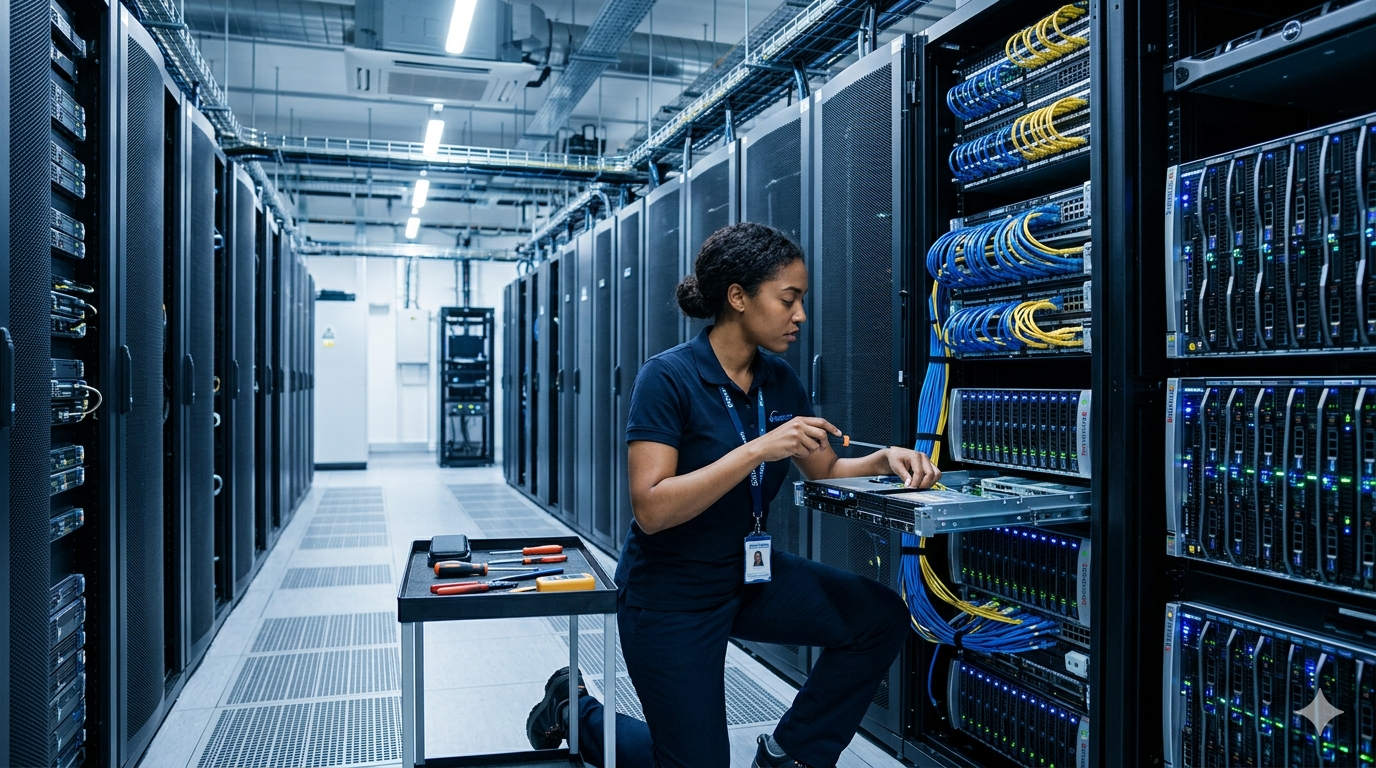
AI infrastructure talent pipeline data center engineer technical workforce

The announcements come in waves now. Another hyperscaler commits tens of billions to data center expansion. Another sovereign wealth fund backs an AI infrastructure platform. Governments keep declaring national AI strategies anchored by gigawatt-scale compute capacity. The capital formation happening around AI infrastructure is genuinely unprecedented, and the coverage it receives treats it primarily as a financial story. How much money, from whom, at what valuation, toward what capacity target. What that coverage consistently skips is the question of who actually builds and operates all of this infrastructure once the capital commitment clears.

The talent pipeline that AI infrastructure development depends on has not scaled anywhere near proportionally to the capital flowing into the sector. The engineers who design high-density power systems, the technicians who commission liquid cooling infrastructure, the architects who plan AI-optimized network topologies, and the operators who manage facilities running at sustained power densities that the industry had no experience with five years ago represent a workforce whose development takes years. The assumption embedded in most AI infrastructure investment narratives is that the money will attract the talent. That assumption deserves far more scrutiny than it currently receives.

The Compounding Scarcity Problem

The talent scarcity in AI infrastructure is not a single problem. It is several overlapping scarcities that compound each other in ways that make the aggregate gap larger than any individual shortage suggests. Power systems engineers with experience in high-voltage infrastructure at data center scale are scarce because demand for their expertise across data center development, renewable energy construction, grid modernization, and electrification of industrial processes all competes for the same underlying workforce. Liquid cooling specialists are scarce because the technology itself is relatively new at commercial scale and the base of practitioners who have designed, installed, and operated these systems through full lifecycle cycles remains small.

AI infrastructure architects who understand the interaction between hardware, network topology, and workload requirements well enough to design facilities that actually perform as modeled are perhaps the scarcest of all. Their expertise sits at the intersection of disciplines that have historically trained and hired separately, and no single educational pathway reliably produces them. Each of these scarcities would be manageable in isolation. Together they create a situation where major infrastructure programs compete for the same limited pool of expertise simultaneously, driving compensation to levels that smaller operators cannot match and leaving mid-market infrastructure development chronically understaffed.

The operators who recognized this dynamic early and invested in building internal training programs, retaining experienced practitioners at above-market compensation, and developing talent pipelines through university partnerships hold advantages that capital alone cannot buy. Those who are discovering the talent gap after committing capital to major programs are finding that money solves the financing problem but not the execution problem.

What the Industry Gets Wrong About Training

The standard industry response to talent scarcity involves some combination of hiring from adjacent fields, accelerating training programs, and importing expertise from international markets. Each of these approaches has genuine merit and each has limits that public discussion tends to understate. Hiring from adjacent fields, particularly from the power generation and industrial automation sectors that share some technical foundations with data center infrastructure, brings relevant engineering knowledge but requires substantial domain-specific development before practitioners can contribute effectively. The learning curve involved is real and the time it consumes is time that urgent development programs cannot treat as negligible.

Accelerated training programs can develop specific technical competencies faster than traditional educational pathways, but they cannot substitute for the judgment that comes from working through unexpected problems that real infrastructure programs generate. A technician who has completed a liquid cooling certification program knows the procedures. One who has decommissioned a failed immersion cooling system at two in the morning under production pressure knows something that no training program teaches. The industry’s tendency to conflate credentialed knowledge with operational capability consistently understates how much of the expertise that infrastructure programs need resides in experienced practitioners rather than in curricula.

Why This Matters More Than the Capital Headlines

The financial consequences of talent scarcity in AI infrastructure are real and growing, but they flow through mechanisms that earnings reports and investment announcements do not capture well. Project delays attributable to workforce constraints do not usually appear in press releases describing ambitious capacity expansion programs. Cost overruns driven by premium compensation required to attract scarce expertise rarely feature in investment narratives that frame AI infrastructure as a straightforward bet on secular demand growth. The gap between announced capacity and delivered capacity accumulates quietly, visible only in earnings calls that reference execution challenges and in timelines that major programs consistently miss.

The operators and developers who treat talent as a strategic input requiring the same rigorous planning that capital and land receive will execute their programs more reliably than those who treat it as a procurement problem to solve after the financial structure closes. That distinction will matter more as programs grow larger and as the talent market tightens further. The capital story around AI infrastructure is compelling and the coverage it receives reflects that. The talent story is less glamorous and harder to quantify, which is precisely why it receives less attention than its strategic importance warrants. That imbalance will eventually show up in execution outcomes, and the operators who recognized it early will be the ones still on schedule when others are explaining delays.


[simple-author-box]

More from AI Infrastructure

The hardest part of scaling AI may no longer sit entirely inside the processor.

AI capacity can look available long before the surrounding infrastructure is ready A customer

The compute contract may be moving faster than the electricity system AI infrastructure procurement

COMPUTE WEEKLY

The briefing that 40,000+ tech leaders read every Monday. Sharp, fast, essential.

Building an AI Startup Without Owning GPUs

Not owning GPUs has become the default, deliberate strategy for building an AI company — not a compromise founders accept reluctantly. H100 rental rates fell 64-75% in fifteen months, a dense ecosystem of neoclouds and inference-as-a-service providers now lets startups skip infrastructure entirely, and credit programs can fund a company’s first year before a founder writes a check
Most Read

A compute node sitting behind a garage door can perform the same basic computational

A project can leave a site without leaving behind the conditions that made the

A commercial operation date can look precise long before the underlying project is capable

A 5 GW AI infrastructure plan can satisfy every conventional site-selection requirement and still

A fire strategy becomes expensive when the building has already decided where walls, equipment,

Disruptor Spotlight

Cerebras Systems

The chip that makes Nvidia nervous. Cerebras’ Wafer Scale Engine is rewriting the rules of AI inference at scale.
Faster
0 x
YoY Revenue
0 x
Transistors
0 T
Market Pulse
MSFT
+1.02%
NVDA
+0.66%
AMZN
-0.078%
AMD
-6.95%
TSMC
-2.98%
Indicative only · Not financial advice
Upcoming Events
SEP
The AI Infrastructure Race (India)
WEBINAR · ONLINE
The AI Infrastructure Race: Won on Power, Land and Trust — Not Capital
MAY
0
AI Infrastructure Summit
DUBAI · IN PERSON
MEA’s premier AI infrastructure event.
JUN
0 0
Compute Forecast Summit
SINGAPORE · IN PERSON
Our flagship APAC event. Early bird open.
Latest Moves
Live
ecolab
Ecolab Deepens Cooling Strategy With $4.75B CoolIT Acquisition
Ecolab is making one of its biggest moves yet into AI infrastructure after completing its $4.75 billion acquisition of liquid cooling specialist CoolIT Systems
Pure DC AVK Europe data center microgrid Dublin 110MW AI infrastructure Ireland 2026
Pure DC and AVK Deploy Europe’s First 110 MW Data Center Microgrid in Dublin
The Pure DC Dublin microgrid has made history as Europe’s first large-scale on-site data center microgrid, launched in partnership with power solutions provider AVK at Pure DC’s campus in Ireland.
Pace Digitek
Pace Digitek Partners With MEGMEET to Expand AI Data Center Power Business
India’s AI infrastructure ecosystem continues to mature as domestic technology manufacturers move beyond traditional telecommunications and industrial markets toward high-growth digital infrastructure opportunities
Follow Compute Forecast
11K followers
1200 followers
Companies to Watch
CW
CoreWeave
Neo Cloud · $19B · IPO Watch
CB
Cerebras Systems
AI Hardware · $4.25B · Pre-IPO
G42
G42
Sovereign AI · Abu Dhabi
H
Humain
Saudi AI · $40B Fund
Latest Podcast
AI Capex, Cloud Margins & the Nuclear Bet
48 MIN · 25 APR 2026

AI Investment Is Outpacing the Talent Pipeline and Nobody Is Talking About It

The announcements come in waves now. Another hyperscaler commits tens of billions to data center expansion. Another sovereign wealth fund

Share
AI infrastructure talent pipeline data center engineer technical workforce
24
847 SHARES

0
SHARES

[simple-author-box]

More from AI Infrastructure

A compute node sitting behind a garage door can perform the same basic computational

A project can leave a site without leaving behind the conditions that made the

A commercial operation date can look precise long before the underlying project is capable

A 5 GW AI infrastructure plan can satisfy every conventional site-selection requirement and still

COMPUTE WEEKLY

The briefing that 40,000+ tech leaders read every Monday. Sharp, fast, essential.

Great! We’ve received your information.

Global AI Infrastructure Outlook 2026

The briefing that 40,000+ tech leaders read every Monday. Sharp, fast, essential.
Download Free
Most Read

A compute node sitting behind a garage door can perform the same basic computational

A project can leave a site without leaving behind the conditions that made the

A commercial operation date can look precise long before the underlying project is capable

A 5 GW AI infrastructure plan can satisfy every conventional site-selection requirement and still

A fire strategy becomes expensive when the building has already decided where walls, equipment,

Disruptor Spotlight

Cerebras Systems

The chip that makes Nvidia nervous. Cerebras’ Wafer Scale Engine is rewriting the rules of AI inference at scale.
Faster
0 x
YoY Revenue
0 x
Transistors
0 T
Market Pulse
NVDA
$924.60
+2.4%
MSFT
$421.30
+1.1%
AMZN
$192.80
-0.6%
NVDA
$924.60
+2.4%
NVDA
$924.60
+2.4%
Indicative only · Not financial advice
Upcoming Events
MAY
0 0
DCD Global — London
LONDON · IN PERSON
World’s largest DC event. CF is media partner.
MAY
0
AI Infrastructure Summit
DUBAI · IN PERSON
MEA’s premier AI infrastructure event.
JUN
0 0

Compute Forecast Summit

SINGAPORE · IN PERSON
Our flagship APAC event. Early bird open.
Latest Moves
  • Live
Sam Altman
OpenAI appoints new Chief Infrastructure Officer to lead $100B DC programme
27 APR · OPENAI
Sam Altman
OpenAI appoints new Chief Infrastructure Officer to lead $100B DC programme
27 APR · OPENAI
Sam Altman
OpenAI appoints new Chief Infrastructure Officer to lead $100B DC programme
27 APR · OPENAI
Follow Compute Forecast
18.4K followers
12.1K followers
9.3K subscribers
41 episodes
Companies to Watch
CW
CoreWeave
Neo Cloud · $19B · IPO Watch
CB
Cerebras Systems
AI Hardware · $4.25B · Pre-IPO
G42
G42
Sovereign AI · Abu Dhabi
CW
Humain
Saudi AI · $40B Fund
Latest Podcast
AI Capex, Cloud Margins & the Nuclear Bet
48 MIN · 25 APR 2026
Scroll to Top








