
Artificial intelligence has become one of the defining infrastructure races of the decade. Yet beneath the excitement surrounding AI models, cloud platforms, and accelerated computing lies a more fundamental constraint: electricity. The explosive growth of AI workloads has pushed data centers toward unprecedented levels of energy consumption, forcing governments, utilities, and technology companies to confront a question that cannot be solved by software alone, where will the power come from?

Across major digital infrastructure markets, the electrical grid has emerged as the bottleneck. Grid connections for new facilities can take years due to permitting delays, aging infrastructure, and rising competition for power. For companies building AI infrastructure at hyperscale, waiting for traditional grid expansion has become increasingly impractical.
This pressure is beginning to reshape how digital infrastructure is powered. Rather than relying solely on centralized utilities, some operators are experimenting with localized energy systems that allow facilities to generate and manage electricity independently. Among these approaches, microgrids are emerging as one of the most discussed solutions to the industry’s growing power challenge.
Europe’s grid bottlenecks collide with AI demand
The urgency of the problem is especially visible in Europe, where grid capacity limitations have persisted for decades. While the region wants to capture economic opportunities created by AI infrastructure, the electricity system must expand significantly to support it.

The European Commission has warned that hundreds of billions of euros in electricity grid investments will be required across Europe by 2040 to modernize aging infrastructure and support rising electrification. Until those upgrades materialize, data center developers often encounter lengthy delays when applying for power connections.
In some markets, authorities have responded by restricting development. Ireland, one of Europe’s largest data center hubs, temporarily imposed a moratorium on new projects because the facilities were placing intense pressure on the national grid. In 2024, data centers consumed 22% of Ireland’s total electricity, a striking figure for a relatively small energy system.
That policy has since softened as governments recognize the economic importance of digital infrastructure and AI computing. However, the episode illustrated a broader reality: the expansion of AI infrastructure now depends as much on energy availability as on technological innovation.
Microgrids enter the data center conversation
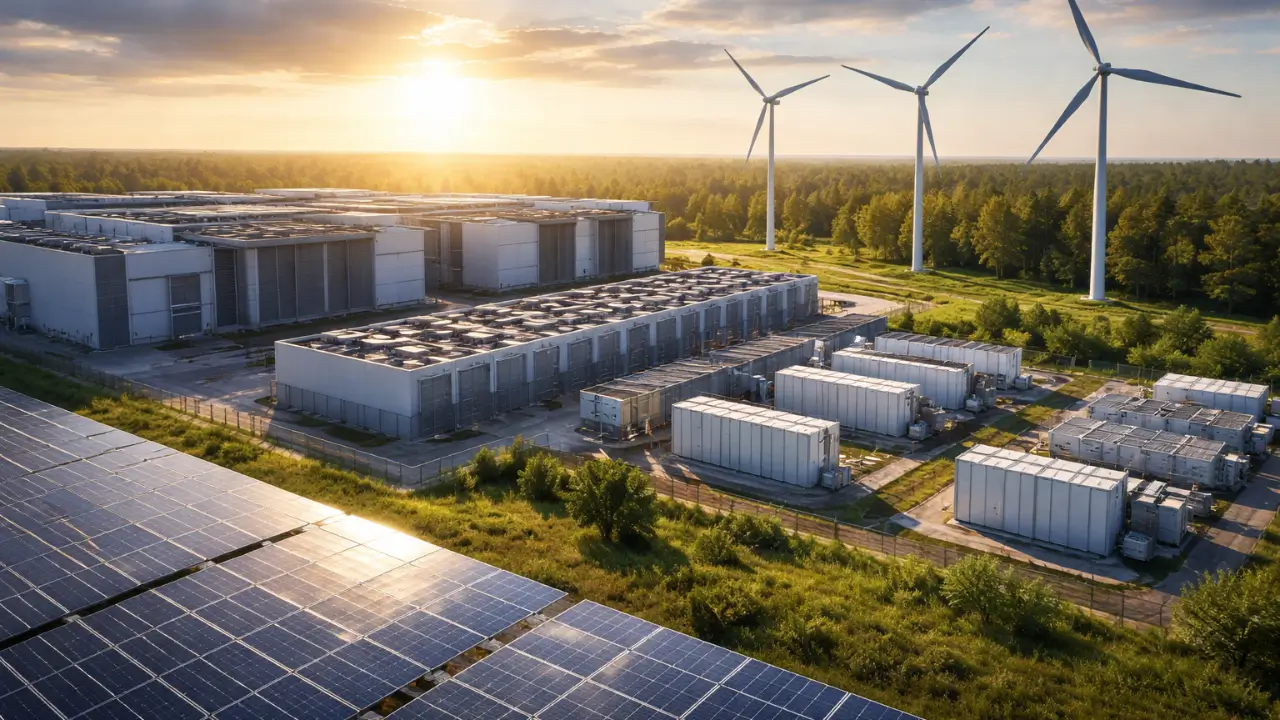
One emerging workaround is the use of microgrids, localized energy networks capable of generating, storing, and distributing electricity independently from the main grid. These systems can operate alongside traditional utilities or function entirely on their own in an “islanded” mode.
In the United States, where AI infrastructure growth has been particularly rapid, microgrids and other behind-the-meter energy systems have already gained traction. Technology clusters in regions such as Texas and Virginia have seen data center operators explore alternatives including fuel cells, gas turbines, and on-site generation to avoid grid congestion.
Industry analysts say a growing share of U.S. data centers are exploring microgrids and other behind-the-meter energy systems as operators seek alternatives to grid congestion.In Europe, adoption has historically lagged behind the United States, but interest in microgrids and other localized energy solutions is rising rapidly as power constraints intensify.
The global microgrid market itself is expanding alongside these trends, with multiple industry studies estimating the sector to be worth tens of billions of dollars and growing steadily as industries seek localized energy resilience.
A new infrastructure model for digital power
Microgrids represent more than a technical fix. They may signal the beginning of a new infrastructure model in which power generation becomes a parallel investment layer alongside computing facilities.
Traditionally, data centers have relied on utilities for continuous electricity while installing generators only for emergency backup. But AI infrastructure is changing that equation. When facilities require hundreds of megawatts of capacity and operate continuously, energy planning becomes a central strategic decision rather than a secondary operational consideration.
In this context, specialized investors are beginning to view microgrids themselves as an infrastructure asset class. Infrastructure funds and energy investors are exploring opportunities to build and operate localized power systems that supply electricity directly to digital infrastructure.
If that trend continues, future AI campuses could resemble hybrid ecosystems in which computing clusters and dedicated power networks evolve together. Such arrangements could reduce dependence on overstretched national grids while enabling faster deployment of new capacity.
Regulation remains the critical barrier
Despite the enthusiasm surrounding microgrids, their widespread adoption remains far from guaranteed. Technical feasibility is only one part of the equation. Regulatory frameworks and energy market rules will play an equally decisive role.
In many countries, electricity systems were designed around centralized utilities and large transmission networks. Introducing independent microgrids into that framework raises complex questions about grid participation, energy markets, and regulatory oversight. Experts often highlight the difference between building a microgrid and integrating it into a broader electricity system. Grid operators may require flexibility from such systems, for example, the ability to supply power during periods of stress or store electricity when demand falls.
In the United States, grid operators are increasingly exploring ways distributed energy systems can provide limited flexibility to help stabilize electricity networks during periods of peak demand.
Without clear rules, the deployment of microgrids could remain uneven despite strong market interest.
Sustainability pressures complicate the equation
Another challenge lies in ensuring that these systems align with climate and sustainability goals. Much of the current microgrid discussion involves gas-powered turbines, fuel cells, or other dispatchable generation technologies capable of providing reliable electricity at scale.
However, reliance on fossil fuels could conflict with national decarbonization strategies and corporate climate commitments. Policymakers therefore face the difficult task of balancing three competing priorities: reliability, sustainability, and rapid infrastructure expansion.
Some regulatory frameworks attempt to address this tension directly. New data centers connecting to Ireland’s grid, for example, must provide dispatchable power or energy storage and source at least 80% of their annual electricity from renewable energy, according to national guidelines. These types of requirements illustrate how governments are attempting to accommodate digital infrastructure growth while maintaining environmental targets.
The power question shaping AI’s future
The expansion of AI infrastructure has often been framed as a race for chips, algorithms, and computing scale. Yet energy availability may ultimately determine how quickly that expansion unfolds.
Building larger AI clusters without securing sufficient power capacity risks creating a mismatch between computational ambition and physical reality. For many operators, waiting years for grid upgrades is no longer an option.
Microgrids therefore represent a pragmatic response to an immediate constraint. They allow projects to move forward even when grid access remains uncertain, while potentially offering long-term resilience and flexibility.
Whether microgrids become a standard component of AI infrastructure will depend on how regulators, utilities, and investors adapt to this new landscape. What is clear, however, is that the AI revolution is no longer purely a software story.
It is increasingly an energy story, and the solution to the AI power problem may begin not in the cloud, but in the power systems built beneath it.











