Image Credit: Google
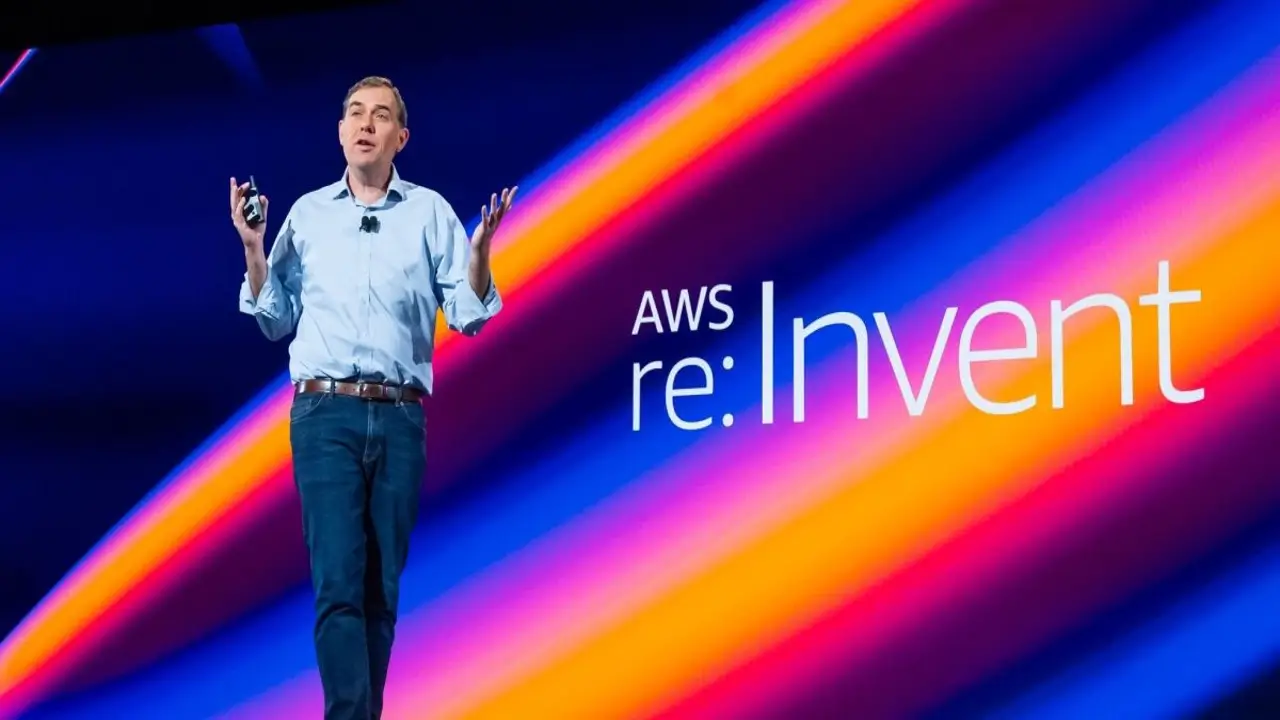
AWS re:Invent 2025 offered a clear view into the future of enterprise AI, and we observed several developments that carry global significance. For us, AWS re:Invent 2025 highlighted how frontier agents, Trainium3 UltraServers, Graviton5, and the expanded Nova model family are reshaping expectations for AI-driven infrastructure. The event reflected a shift toward scalable, autonomous, and sovereignty-aware systems that enterprises now require.
Frontier Agents Mark a Change in Enterprise Automation
A New Class of Long-Running Autonomous Agents
One of the most impactful announcements at AWS re:Invent 2025 was the debut of frontier agents. These agents can operate for hours or days without intervention. AWS introduced three versions: the Kiro autonomous agent, AWS Security Agent, and AWS DevOps Agent. Each one extends software development, security workflows, or operations through continuous AI-driven assistance.
Adoption Indicates a Larger Global Trend
We noted early adoption from organizations such as Commonwealth Bank of Australia and Western Governors University. Their results show that long-running agents are already influencing team productivity and delivery cycles. This shift suggests that enterprises are moving toward deeper AI support across everyday engineering tasks.
Custom Silicon at AWS re:Invent 2025 Enables High-Performance AI
Graviton5 Introduces Better Performance and Efficiency
AWS introduced Graviton5, its most advanced CPU so far. It offers 192 cores and a larger cache for improved speed across general workloads. These gains meet a growing need for faster and more efficient compute resources. Many enterprises now run diverse workloads that demand strong performance without higher energy use.
Trainium3 UltraServers Bring Scalable AI Training
Another highlight was the new Trainium3 UltraServer. It supports up to 144 Trainium3 chips in one integrated system. These servers offer up to 4.4× the compute performance of the previous generation. They also help reduce energy usage, which is important as model sizes continue to grow. Early users, including Anthropic and Ricoh, report faster training cycles and up to 50% lower costs.
Nova Models and Open Training Expand Enterprise Flexibility
New Nova Models Strengthen Reasoning and Multimodal Tasks
AWS expanded the Nova model family with new versions focused on reasoning, multimodal input, automation, and code generation. These models aim to support more predictable and domain-specific results. This is key for enterprises building AI systems that require higher reliability.
Nova Forge Introduces an “Open Training” Approach
Nova Forge offers pre-trained checkpoints that enterprises can blend with their proprietary data. This gives organizations more control while maintaining data privacy. Early adopters like Reddit and Hertz are using Nova Act to replace multiple specialized models with one solution for browser-based workflows.
AWS Hardware and Services Inside Customer Data Centers
AWS AI Factories stand out as an important development for hybrid and sovereign AI environments. These systems bring AWS-grade infrastructure NVIDIA GPUs, Trainium chips, and Bedrock/SageMaker services into existing enterprise data centers. This helps organizations run high-performance AI workloads without migrating sensitive datasets.
Supporting Data Residency and Regulatory Requirements
Many global enterprises face strict data constraints. AI Factories offer a controlled environment that still supports modern AI development. One large example is HUMAIN’s planned AI Zone in Saudi Arabia. The project will deploy up to 150,000 AI chips in a dedicated facility.
Model Customization Becomes Faster and More Accessible
Reinforcement Fine-Tuning Improves Model Accuracy
Amazon Bedrock now supports Reinforcement Fine-Tuning (RFT). RFT improves average accuracy by 66% over base models. Companies such as Salesforce have reported even higher gains. These improvements highlight how essential fine-tuning has become for enterprise AI.
Serverless Customization Reduces Development Time
Amazon SageMaker now offers serverless customization. This feature reduces the time required to build and test AI models. Many teams can now complete weeks of experimentation in a few days. Faster turnaround helps organizations deliver AI features earlier in their development cycles.
Core Infrastructure Enhancements Strengthen AI Foundations
Scaling Data and Storage Systems for AI
Several upgrades support the growing demands of AI workloads. These include:
- Amazon S3 Vectors, which now stores billions of vectors per index
- S3 Tables, adding Intelligent-Tiering for lower storage costs
- S3 Batch Operations, now running large jobs up to 10× faster
Together, these improvements simplify the management of large datasets.
Better Networking and Observability Across Clouds
Beyond core compute, AWS re:Invent 2025 highlighted innovations across storage, networking, observability, and security. Enhancements to Amazon S3 Vectors, S3 Tables, CloudWatch unified data storage, and Database Savings Plans reflect the foundational role that data infrastructure plays in modern AI ecosystems. Meanwhile, the announcement of AWS Interconnect multicloud, beginning with Google Cloud, may change how enterprises approach cross-cloud networking.
Lambda Managed Instances Add Flexibility
AWS also launched Lambda Managed Instances, blending serverless simplicity with EC2 control. This helps teams that need predictable performance while keeping the familiar Lambda programming model.
Looking Ahead: The Future of Enterprise AI After AWS re:Invent 2025
AWS re:Invent 2025 made clear that the era of agentic, AI-first infrastructure is accelerating. Frontier agents, Trainium3 UltraServers, AI Factories, and Nova Forge all point toward a future built on automation, performance efficiency, and hybrid deployments. As enterprises modernize, scalable architectures and sovereignty-ready systems will guide how AI is adopted worldwide.
For us, the announcements at AWS re:Invent 2025 reinforced the importance of preparing for this new phase. Organizations that invest in flexible compute, automated workflows, and reliable agentic systems will be better positioned to lead in the years ahead.