
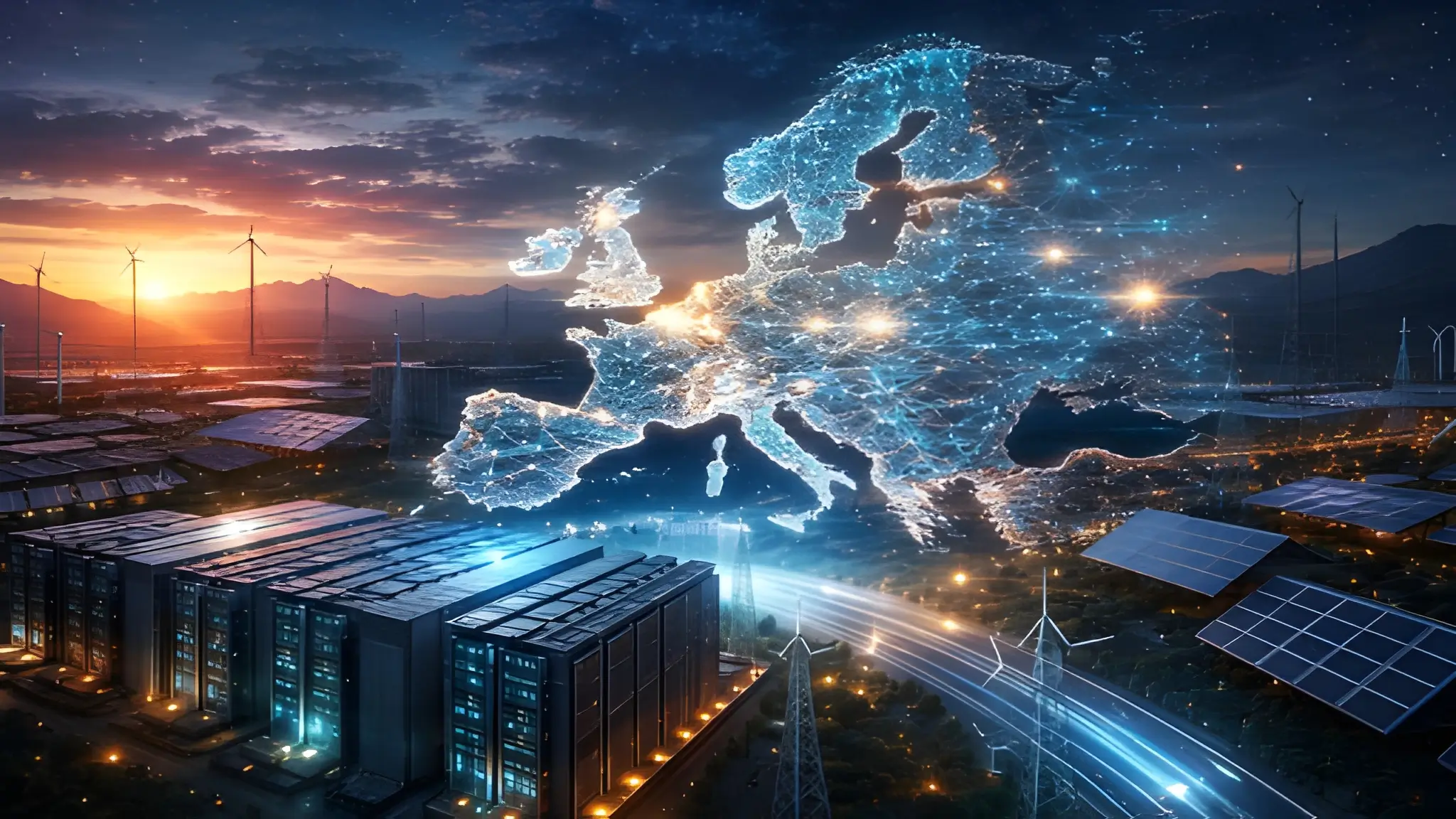
Europe’s digital infrastructure is entering a decisive phase, one where the urgency to build is no longer matched by the ease of doing so. Artificial intelligence has not just accelerated demand for data centers. It has fundamentally altered how, where, and why they are built.

A once predictable expansion across established hubs has become fragmented. Energy realities, regulatory divergence, and geopolitics now drive this high-stakes recalibration.
For years, Europe’s data center narrative revolved around a handful of dominant cities, Frankfurt, London, Amsterdam, Paris, and Dublin. These locations became synonymous with connectivity, financial ecosystems, and hyperscale expansion. The AI era is forcing a departure from that model. Capacity constraints, power bottlenecks, and sustainability pressures are pushing operators beyond traditional strongholds. This shift is triggering a geographic redistribution that reveals deeper structural tensions across the continent.
Energy as the new currency of digital infrastructure
At the heart of Europe’s data center dilemma lies a simple truth: AI workloads are power-hungry, and Europe’s energy landscape is anything but uniform. The growing computational intensity of AI training models, coupled with the proliferation of high-density racks, is redefining energy as the primary determinant of infrastructure viability.

Northern Europe, particularly Scandinavia, has emerged as a natural beneficiary of this shift. The region offers a rare combination of abundant renewable energy, lower electricity costs, and favorable climatic conditions that enable efficient cooling. In an industry where thermal management is becoming as critical as compute itself, natural cooling is no longer a bonus, it is a competitive advantage.
Meanwhile, Southern Europe, especially Spain and Portugal is carving out its own role in this evolving ecosystem. Unlike the North, its appeal lies not in temperature but in surplus. Excess wind and solar generation, at times so abundant that production must be curtailed, creates a compelling case for energy-intensive facilities like data centers. Here, the narrative flips: instead of struggling to secure power, operators can anchor infrastructure where energy is underutilized.
Yet, this redistribution introduces new complexities. Building in remote or energy-rich regions may suit AI training workloads, but inference, the phase where models interact with users demands proximity.
Latency constraints ensure that not all workloads can migrate freely. Europe is therefore beginning to reflect a more function-driven distribution of infrastructure, where compute is geographically decoupled based on workload requirements rather than convenience.
The sovereignty paradox shaping infrastructure decisions
Overlaying the energy equation is a second, equally influential force: data sovereignty. Across Europe, governments are increasingly asserting control over digital infrastructure, driven by concerns over data privacy, strategic autonomy, and dependence on foreign providers.
However, sovereignty in Europe is not a unified concept, it is a mosaic of interpretations. Each country approaches it differently, influenced by its regulatory philosophy, political priorities, and economic interests. This lack of alignment creates friction in a market already strained by fragmentation.
In practical terms, sovereignty introduces a non-negotiable constraint: certain data must remain within national borders. This requirement can override otherwise logical decisions about energy efficiency or cost optimization. A data center that would ideally be built in a renewable-rich region may instead be anchored in a less optimal location simply to comply with local data residency laws.
This tension highlights a broader paradox. Europe seeks to lead in both sustainability and digital independence, yet the policies driving these goals can sometimes pull infrastructure development in opposing directions. While greater harmonization is often discussed at a continental level, operators today must navigate a landscape where regulatory alignment remains limited and inconsistent across markets.
Building for an unpredictable future
If energy and sovereignty define the external pressures on Europe’s data center market, technological acceleration defines its internal challenge. The pace of innovation, particularly in AI hardware is increasingly challenging traditional development timelines and forcing infrastructure providers to rethink long-term planning assumptions.
The evolution of power architectures within data centers illustrates this vividly. As GPU capabilities advance at unprecedented speed, supporting infrastructure must adapt just as quickly.
Decisions that once followed incremental roadmaps are now being leapfrogged in response to sudden shifts in hardware requirements. Voltage standards, cooling systems, and power distribution models are all being reengineered in real time.
This unpredictability places a premium on anticipation. Infrastructure providers are no longer simply building for current demand; they are building for what demand might look like several years ahead. That requires deep integration across the supply chain from chip manufacturers to system integrators ensuring visibility into future technological trajectories.
At the same time, the human dimension cannot be overlooked. The complexity of modern data centers demands a workforce equipped with specialized skills, yet talent shortages persist. Automation and digitization are increasingly positioned as solutions, enabling facilities to operate efficiently with fewer personnel. But even as systems become more autonomous, the need for expertise does not disappear; it evolves.
A fragmented market with no single path forward
Europe’s defining characteristic, its diversity is both its strength and its challenge. Unlike more centralized markets, the continent operates as a collection of interconnected yet distinct ecosystems. Each country brings its own regulatory framework, energy profile, and market dynamics, creating a patchwork that defies one-size-fits-all strategies.
For data center operators, this means adopting a highly localized approach. Success in one market does not guarantee success in another. Infrastructure must be tailored not only to technical requirements but also to policy environments and cultural expectations.
This fragmentation can complicate scaling compared to more centralized markets. While the demand for AI infrastructure is pan-European, the pathways to meeting that demand are inherently regional. The result is a market where growth is robust but uneven, driven by localized opportunities rather than uniform expansion.
The race Europe cannot afford to lose
The stakes for Europe are high. As AI becomes a cornerstone of economic competitiveness, the ability to support its infrastructure demands will shape the continent’s position in the global digital economy. Falling behind is not simply a matter of slower growth, it risks ceding strategic influence to regions that can deploy infrastructure more rapidly and at greater scale.
Yet, Europe’s challenge is not a lack of capability; it is the complexity of its operating environment. Balancing sustainability goals with energy availability, aligning sovereignty policies with market realities, and keeping pace with technological change all while navigating a fragmented regulatory landscape requires a level of coordination that is difficult to achieve.
The path forward will likely involve a combination of strategic compromise and targeted investment. Energy infrastructure must be expanded and modernized. Policy frameworks need greater alignment. Collaboration across the supply chain must deepen. Above all, decision-making must become more agile, reflecting the speed at which the industry itself is evolving.
Building under constraint, innovating under pressure
Europe’s data center dilemma is not defined by a single challenge but by the convergence of many. Energy constraints, policy fragmentation, and technological acceleration are colliding at a moment when demand is surging faster than ever before.
And yet, within this complexity lies pressure for adaptation, pushing the industry to rethink how infrastructure is designed, powered, and deployed. To build faster and power harder is not merely an operational imperative; it is a strategic necessity. Europe’s ability to adapt will determine whether it remains a central player in the AI age, or becomes a region defined by constraints it could not overcome.











