 Skip to content
There is a version of India’s AI story that reads like an unambiguous triumph, and it is the version that got told at the India AI Impact Summit in February 2026. Reliance committing $110 billion. Adani scaling toward 5 GW of data centre capacity. Google, Microsoft, and Amazon each deploying between $15 billion and $35 billion. The IndiaAI Mission targeting 100,000 public GPUs by the end of 2026. Yotta’s 20,736 Nvidia Blackwell Ultra GPU cluster one of the largest sovereign AI compute deployments outside the United States and China confirmed and scheduled for commissioning by August 2026. On the numbers, India’s AI infrastructure story looks like a country that has figured out what it needs and is moving to get it.

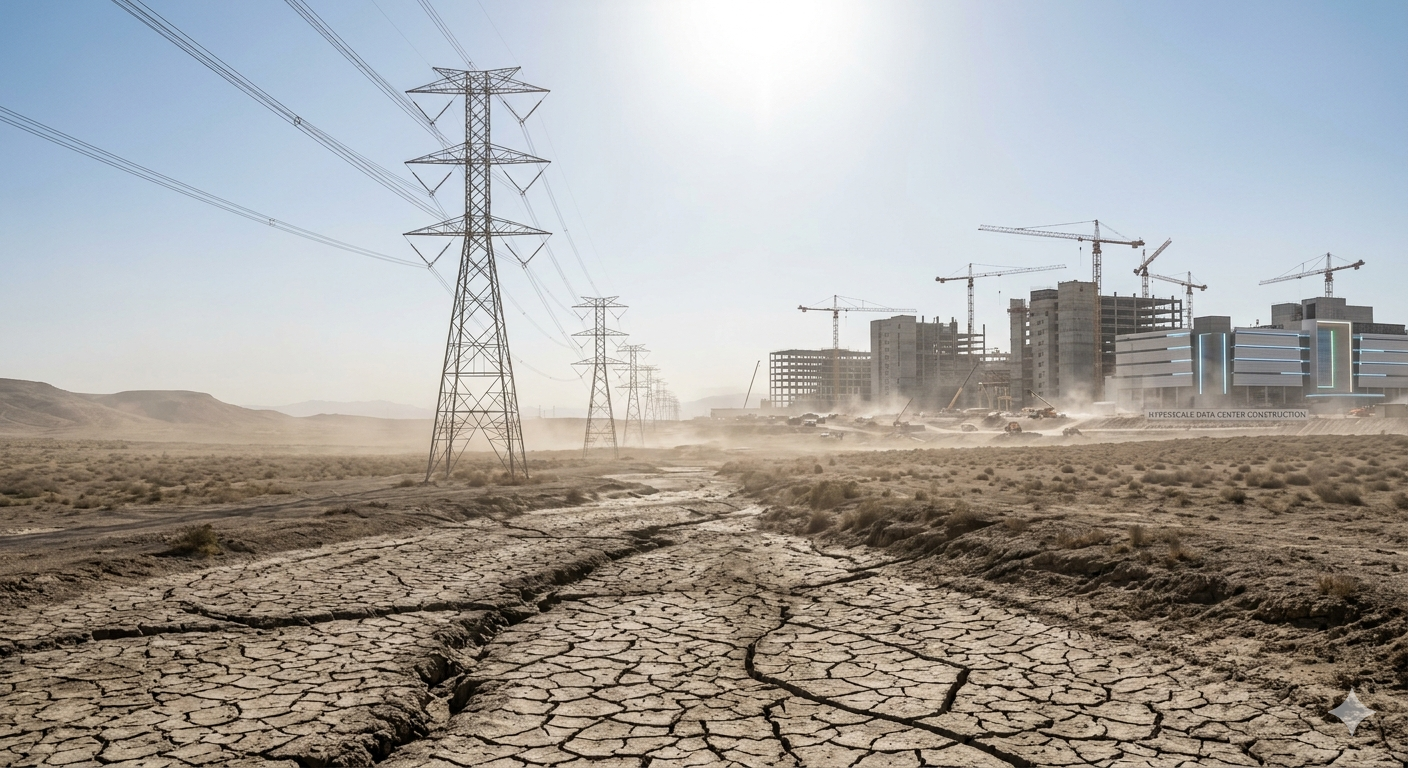
The problem with that version is what sits beneath it. India generates nearly one fifth of the world’s data and holds less than five percent of global data centre capacity. The incoming capacity pipeline is more than double what currently exists, concentrated in Maharashtra, Tamil Nadu, and Telangana states that are themselves water-stressed, sitting on grid infrastructure that was not designed for the load profile that AI-era data centres impose. India’s own Economic Survey, published in January 2026, put the structural tension plainly: power, finance, and especially water remain limited, and building large-scale compute capacity creates trade-offs because the resources consumed by AI infrastructure compete directly with the needs of households and industries. That is not a fringe concern buried in a footnote. That is the government’s own assessment of its own ambition, published weeks before the summit at which the same government announced it was doubling down on that ambition.
The Grid Cannot Be Announced Into Existence
The distinction that India’s AI moment requires everyone to make and that summit rhetoric consistently papers over is the difference between capital commitment and physical delivery. A billion-dollar investment announcement is not a data centre. A data centre is not a connected data centre. A connected data centre running at capacity is not a connected data centre running at capacity on a grid that can absorb its load without destabilising surrounding infrastructure. Each step in that chain takes time, requires physical construction, and depends on underlying systems substations, transmission lines, water treatment capacity, renewable generation that do not materialise faster because the press release was ambitious.
India added a record volume of renewable generation capacity recently, and that achievement is real and significant. What has not kept pace is the grid integration and transmission infrastructure required to move that generation to where AI workloads need it. Substation upgrades and transmission line extensions, as analysts covering India’s data centre buildout have consistently noted, take years often longer than the construction timelines for the data centre facilities they are meant to serve. The result is a widening gap between announced capacity and powered capacity that no summit declaration can close. India’s data centre boom is hitting what one April 2026 analysis described as an invisible ceiling a power infrastructure constraint that is structural, physical, and entirely indifferent to the enthusiasm of the investment cycle running into it.
The geographic concentration of the pipeline makes this constraint more acute rather than less. Maharashtra alone hosts nearly half of India’s upcoming data centre power capacity, with Mumbai as the primary hub. Tamil Nadu and Telangana carry a large share of the rest. These are not states with abundant spare grid headroom sitting ready for industrial-scale AI demand. They are states where the existing grid serves dense populations and established industrial loads, and where the addition of hyperscale AI facilities represents a qualitatively different demand profile continuous, high-density, thermally intense that the grid was not sized to absorb at the pace the pipeline implies.
Water Is the Constraint Nobody at the Summit Addressed
Grid stress is a solvable problem on a long enough timeline, and India’s commitment to renewable energy integration, along with partnerships like CtrlS Datacenters’ MoU with NTPC Green Energy for a 2 GW renewable project, signals that credible private and public capital is being directed at the power side of the equation. Water is a different kind of constraint, because it does not respond to capital deployment in the same way. India holds 18% of the world’s population and 4% of its freshwater resources. Across the country, more than 330 million people live under conditions of water scarcity, with roughly half the nation’s land facing drought-like conditions at various points in the year. The AI infrastructure now being announced in Maharashtra, Andhra Pradesh, and Telangana will land in this context.

A single 20 MW data centre facility can consume the equivalent of the daily water needs of thousands of households, and that figure scales directly with facility size. The incoming pipeline of hyperscale AI facilities targeting multi-hundred-megawatt deployments carries water consumption implications that India’s data centre policy conversation has not confronted with anything approaching the same energy it has devoted to GPU counts and investment totals. The BBC’s reporting on India’s data centre water challenge, drawing on JLL’s market analysis, confirmed that the sector is poised for explosive growth while the resource implications of that growth remain profoundly underexamined. Training equivalent AI models in Asian data centres which operate at lower efficiency than their US counterparts carries a water footprint that multiplies the per-query consumption that research institutions have already documented for Western deployments.
India does not have a choice about whether to build AI infrastructure. The competitive and economic arguments for doing so are overwhelming, and the IndiaAI Mission’s instinct to democratise compute access making GPU hours available to startups, researchers, and universities at subsidised rates is directionally correct. What India has a choice about is whether to build that infrastructure with its eyes open to the resource constraints that govern its physical deployment, or to let the announcement cycle run ahead of the grid and water planning that determines whether the announced facilities actually operate at the scale and reliability that AI workloads require.
The Invisible Ceiling Has a Name
India’s Economic Survey described the core tension accurately: investment in AI infrastructure competes directly with other sources of demand. That competition is not abstract. It is a daily operational reality in Bengaluru and Hyderabad, where data centre hubs face intensifying water stress and where the grid serving AI campuses is the same grid serving hospitals, residential neighbourhoods, and manufacturing facilities whose load growth was already straining supply before the AI capital wave arrived. The CEEW’s February 2026 analysis of India’s data centre infrastructure concluded that sustainability and resilience must be integrated from the outset, given India’s already critical resource constraints and its large population a recommendation that carries significantly more weight when read against a pipeline of new capacity that is more than double the existing base.
The summit announced the ambition. The grid will decide whether it delivers. India has the structural ingredients for a genuine AI infrastructure leadership position in the global south the data generation scale, the engineering talent base, the software development culture, and increasingly the sovereign compute access that the IndiaAI Mission is building toward. None of those advantages converts into delivered AI capacity without power that is reliable, abundant, and properly integrated into the facilities being built to consume it, and without water resources that can sustain cooling loads at hyperscale without competing directly with the households and communities that surround the campuses. The announcements made in February 2026 will not expire immediately capital at that scale moves slowly enough that the pipeline will continue building regardless of grid readiness. What expires is the window in which India can address its physical infrastructure gaps proactively rather than reactively, before the first wave of facilities arrives at capacity and finds the grid cannot hold them.
The countries that are winning the global AI infrastructure race in 2026 are those that made unglamorous decisions about substations, transmission corridors, and water infrastructure years before the AI capital wave made those decisions consequential. India is at the precise moment in its infrastructure cycle where those decisions are still ahead of it expensive, politically complicated, and entirely necessary. The summit was the easy part.












