 Skip to content
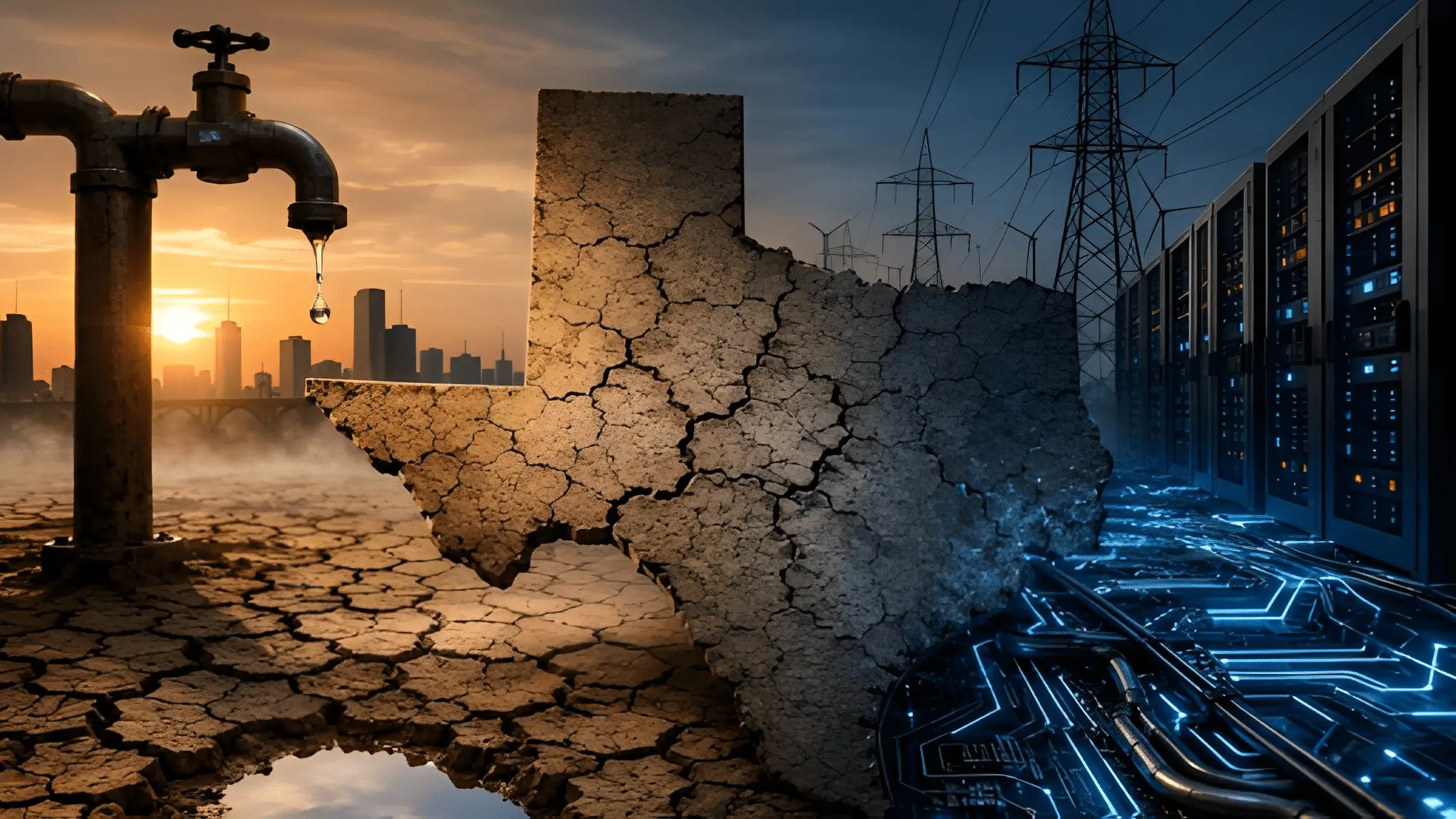
Texas Wanted The AI Boom. It May Not Like The Bill
Texas spent years positioning itself as the perfect landing zone for hyperscale infrastructure. Cheap land, aggressive incentives, flexible regulation, and an energy market built around industrial expansion made the state irresistible to cloud giants and AI infrastructure developers. Now the strategy is working exactly as intended, perhaps too well.

The AI buildout accelerating across Texas no longer looks like a traditional technology expansion story. It increasingly resembles an infrastructure expansion race carrying significant resource implications.
Every new hyperscale campus arrives wrapped in the language of innovation, economic growth, and national competitiveness. Yet the deeper conversation unfolding underneath the investment headlines sounds far less optimistic. Communities are starting to recognize that AI infrastructure does not simply consume electricity. It consumes physical stability, water reserves, grid resilience, utility capacity, and long-term environmental flexibility.
That changes the political equation around AI entirely. The central issue is no longer whether Texas can attract AI infrastructure. The state has already won that competition. The more uncomfortable question is whether Texas is building faster than its resources can realistically sustain.

Silicon Valley Is Exporting Its Resource Problem
For years, the technology sector framed digital services as something weightless and abstract. AI has shattered that illusion. Modern AI infrastructure is intensely physical. Massive GPU clusters require extraordinary cooling capacity, constant energy availability, and increasingly aggressive water consumption patterns. In states already dealing with heat stress and drought vulnerability, that reality creates a contradiction the industry still struggles to address publicly.
The AI economy markets itself as futuristic. Its infrastructure demands look increasingly industrial. Texas now sits at the center of that contradiction. The state’s environmental pressure points were already visible before the AI boom accelerated. Water scarcity concerns, grid instability debates, and population growth have shaped policy discussions for years. AI infrastructure did not create those vulnerabilities. It amplified them.
That amplification matters because hyperscale facilities operate at a scale most local infrastructure systems were never designed to absorb rapidly. Utility expansion timelines move slowly. AI deployment cycles do not. The result is a collision between private-sector acceleration and public-sector limits.
Critics increasingly argue that parts of AI’s infrastructure burden may ultimately shift toward public utility systems and local communities. Residents may not directly benefit from the compute capacity being built around them, yet local utilities and infrastructure systems could still absorb much of the operational pressure attached to it. That perception carries long-term political risk.
Water Is Quietly Becoming AI’s Most Controversial Commodity
The AI debate still focuses heavily on chips, model performance, and power demand. Water remains the less visible issue, which may explain why it is emerging as one of AI infrastructure’s most politically sensitive constraints. In Texas, water already functions as a politically sensitive resource. Drought conditions, rising temperatures, and expanding urban development have intensified pressure across multiple regions. AI infrastructure now enters that environment as another industrial-scale consumer with continuous operational requirements.
The concern is not simply about usage volumes alone. It is about prioritization. Communities are beginning to question what happens when AI infrastructure and public sustainability goals start competing for the same finite resources. The optics become particularly difficult during periods of conservation pressure or heat-related utility stress. At that point, the narrative around AI expansion changes rapidly.
What once looked like technological progress can begin to resemble infrastructure imbalance. The debate shifts away from innovation and toward allocation. Who gets access to critical resources? Who absorbs the long-term costs? And who benefits most from the tradeoff? Those questions become harder to ignore as AI campuses grow larger and cooling requirements intensify. The uncomfortable reality is that water may soon become more strategically important to AI infrastructure than many policymakers anticipated when the investment race began.
The Bigger Risk Is Political, Not Technical
Texas has built its economic identity around scale and speed. AI infrastructure fits naturally into that philosophy. But infrastructure politics changes when essential public systems start appearing subordinate to hyperscale growth priorities. That is where the current trajectory becomes more fragile. Most residents will never see the inside of an AI facility.
They will not interact with the GPUs, cooling systems, or fiber networks driving the expansion. What they will notice are higher infrastructure pressures, conservation messaging, utility debates, and visible resource strain during extreme weather events. That visibility matters more than the technical details. Technology companies still largely frame AI expansion as a clean economic story centered on jobs, innovation, and future competitiveness. Critics increasingly see something else: a race moving faster than its oversight structure.
The regulatory environment surrounding hyperscale AI infrastructure still appears reactive rather than fully prepared. Existing frameworks were largely designed around earlier generations of data center demand. AI has altered the scale equation dramatically, particularly around cooling intensity and continuous power requirements. Yet states competing aggressively for AI investment remain under pressure to streamline approvals rather than slow projects down with deeper scrutiny.
That incentive structure creates a dangerous imbalance. No governor wants to lose a major AI investment announcement to another state. No local official wants to appear hostile to economic growth. But political enthusiasm for hyperscale expansion often moves faster than long-term infrastructure planning. That gap is where future conflict is likely to emerge.
Texas May Become The First Warning Sign
The broader AI economy increasingly depends on physical infrastructure systems that many regions already struggle to stabilize under climate pressure. Texas simply happens to be one of the earliest large-scale examples of that collision unfolding in real time. The state is not failing to attract investment. It may be succeeding too aggressively without fully confronting the consequences attached to hyperscale growth. That distinction matters because the infrastructure decisions being made now could shape regional sustainability pressures for decades.
AI companies are unlikely to slow expansion voluntarily. Investor expectations, competitive pressure, and global compute demand continue pushing the market toward larger campuses and denser infrastructure deployments. States competing for that capital face enormous incentives to accommodate the buildout. But eventually the political conversation moves beyond investment totals. It moves toward public cost. That remains one of the less publicly discussed dimensions of large-scale AI expansion. Every hyperscale expansion project depends on resources that communities also depend on to function sustainably.
Water systems, electrical infrastructure, and environmental resilience are not abstract technology variables. They are public necessities. Texas may still emerge as one of the defining AI infrastructure hubs of the decade.
But the state also risks becoming an early example of what happens when the race for compute begins outpacing the systems required to support it.And that possibility no longer feels hypothetical.












