
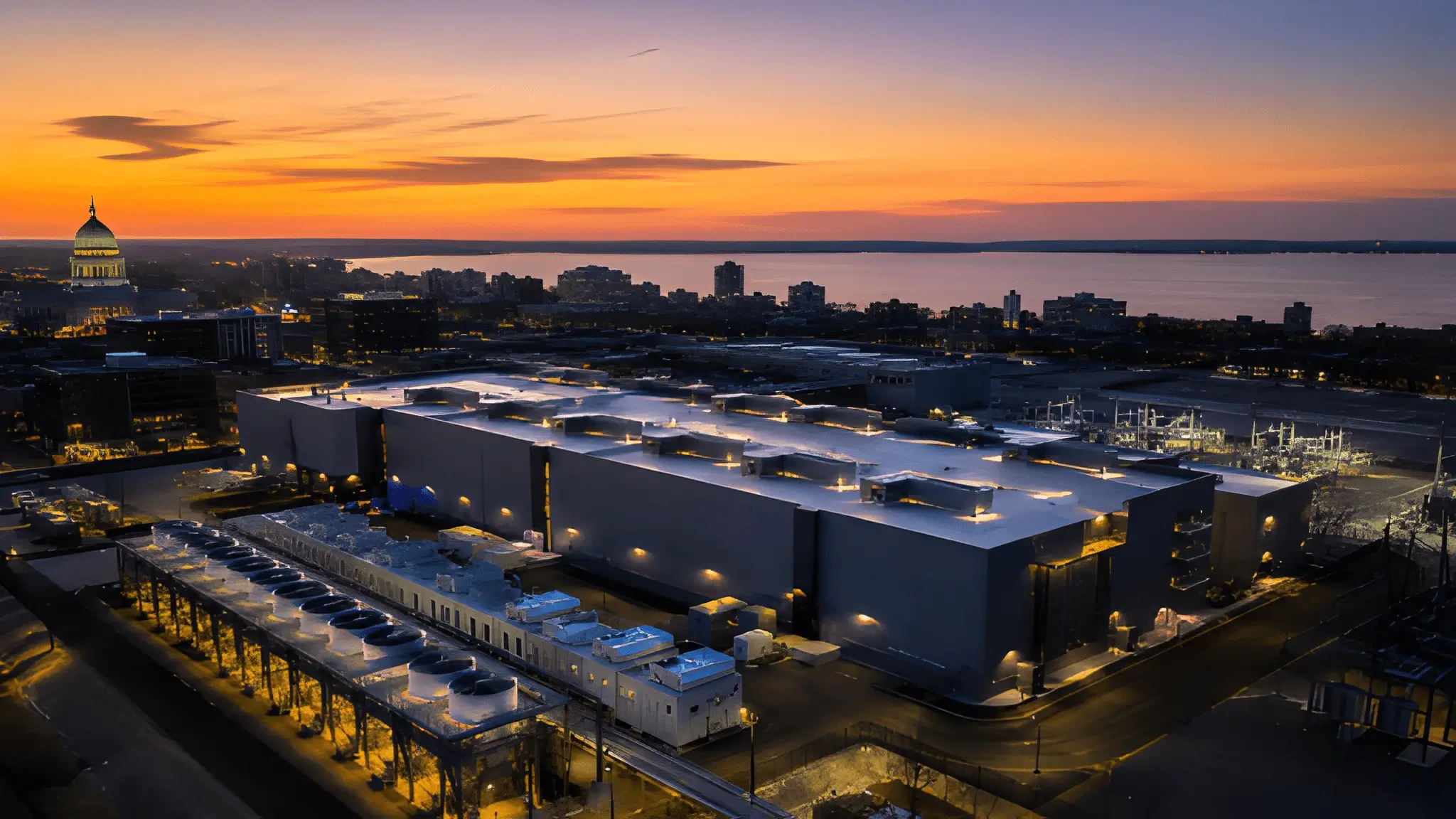
Economic development has entered unfamiliar territory. The competition no longer revolves around manufacturing campuses, logistics corridors, or corporate headquarters. Instead, states increasingly measure opportunity through electrical capacity, high-voltage transmission, fiber density, and development-ready land capable of supporting hyperscale computing. Wisconsin reflects that transition. Every announcement involving new data center capacity reinforces a familiar narrative about construction spending, property taxes, supplier contracts, and regional investment. Those outcomes deserve attention because they represent tangible economic activity. Yet they also encourage a narrower interpretation of success.

Infrastructure investment can transform a local economy, but infrastructure alone does not automatically create one. That distinction matters because AI infrastructure is changing what economic development means. States now compete to host computing power rather than people-intensive industries. The result could become one of the defining economic questions of the AI era: Is regional prosperity becoming increasingly dependent on infrastructure owned and operated by a relatively small group of global technology companies? The answer carries consequences far beyond Wisconsin.
Megawatts have become economic currency
Electricity has always enabled economic growth. Today it increasingly determines where digital growth happens. A region with available transmission capacity can suddenly become attractive for billions of dollars in investment. A region without sufficient power capacity may lose opportunities regardless of workforce quality or business incentives. Economic competitiveness therefore begins with infrastructure planning instead of traditional industrial recruitment. That represents a significant shift in policy priorities.
Governments increasingly discuss transmission upgrades, interconnection queues, substations, renewable procurement, and fiber expansion alongside workforce development. None of those investments exist solely because residents demand them. They exist because hyperscale computing requires them. The infrastructure itself becomes the product. Unlike industrial parks built around diverse employers, AI infrastructure often concentrates enormous investment within comparatively few facilities. Those campuses generate substantial economic value while serving customers located across continents rather than inside surrounding communities. That changes how economic success should be measured.
Investment should not become the only scoreboard
Large capital investments create impressive headlines because they are easy to quantify. Construction spending reaches billions of dollars. Local suppliers receive contracts. Municipal tax bases expand. Utility infrastructure improves. Those outcomes represent genuine economic gains. Yet commentary often stops there, as though investment itself confirms long-term resilience. Economic history suggests otherwise. Communities rarely achieve lasting prosperity simply because capital arrives. They succeed when investment produces broader economic circulation through local entrepreneurship, specialized education, supplier ecosystems, research partnerships, and skilled employment that continues evolving after initial construction ends.
That distinction separates infrastructure from an economic ecosystem. A data center may operate for decades with relatively stable staffing levels after construction concludes. That operating model reflects technological efficiency rather than economic failure. However, it also means policymakers should avoid assuming every dollar invested automatically multiplies throughout the regional economy at the same rate as other industries. Infrastructure creates opportunity. It does not guarantee economic diversification.

Wisconsin’s opportunity is larger than hosting servers
Wisconsin possesses several structural advantages that make digital infrastructure increasingly attractive. Reliable power planning, central geographic positioning, manufacturing expertise, educational institutions, and expanding connectivity create favorable conditions for continued investment. Those strengths should not remain confined to real estate development. The greater opportunity lies in building industries that exist because computing infrastructure arrives. Advanced electrical engineering firms, cooling technology manufacturers, cybersecurity specialists, semiconductor suppliers, AI software startups, university research partnerships, digital construction companies, and skilled technical training programs all represent economic layers capable of expanding around infrastructure investment. Those secondary industries create resilience because they serve multiple customers rather than depending upon a single category of infrastructure owner.
Public infrastructure deserves public economic returns
Transmission lines, roads, utility upgrades, workforce initiatives, and educational partnerships frequently support large-scale infrastructure development. Those investments often benefit entire regions, making them valuable regardless of individual projects. The more difficult question concerns distribution. How much economic value ultimately reaches local businesses? Do regional colleges produce graduates who remain employed inside emerging technology ecosystems? Do smaller engineering firms gain long-term contracts? Does local innovation accelerate because computing infrastructure exists nearby? Or does most economic value remain concentrated among global operators while surrounding communities primarily provide land, electricity, and permitting capacity? Those questions deserve greater attention than simple investment totals. Economic resilience depends less on attracting capital than on ensuring capital generates continuous regional capability.
Agriculture offers an instructive comparison. Monocultures often maximize production under favorable conditions. They also increase vulnerability because disruptions affect large portions of the system simultaneously. Economic development can exhibit similar characteristics. Regions heavily dependent upon one infrastructure category may experience strong growth while demand remains robust. Yet concentration limits flexibility if market priorities evolve. That possibility does not argue against data center development. It argues against allowing one infrastructure category to define an entire economic strategy. Balanced economies typically combine manufacturing, research, services, logistics, healthcare, education, entrepreneurship, and technology rather than expecting one sector to sustain long-term prosperity independently. AI infrastructure should strengthen that diversity instead of replacing it.
Wisconsin’s biggest advantage may depend on what happens after construction ends
The most significant measure of success will probably not appear when another data center opens. It will appear years later. Success will become visible if universities produce AI infrastructure specialists who launch companies inside Wisconsin. It will emerge if local manufacturers expand into advanced electrical equipment. It will strengthen when engineering firms export expertise developed through regional projects. It will become durable if smaller businesses capture meaningful portions of expanding digital supply chains. Those outcomes indicate economic multiplication rather than infrastructure accumulation.
The AI economy unquestionably requires physical infrastructure. States capable of providing reliable power, connectivity, and development certainty will continue attracting investment. The larger challenge involves ensuring those assets become platforms for broader economic participation instead of isolated symbols of technological progress. Wisconsin may indeed win as data centers continue growing. The more consequential question is whether Wisconsin ultimately becomes known for hosting the AI economy, or for building one that belongs to far more people than the infrastructure itself.











