
AI Infrastructure Is Changing the Data Center Operations Job
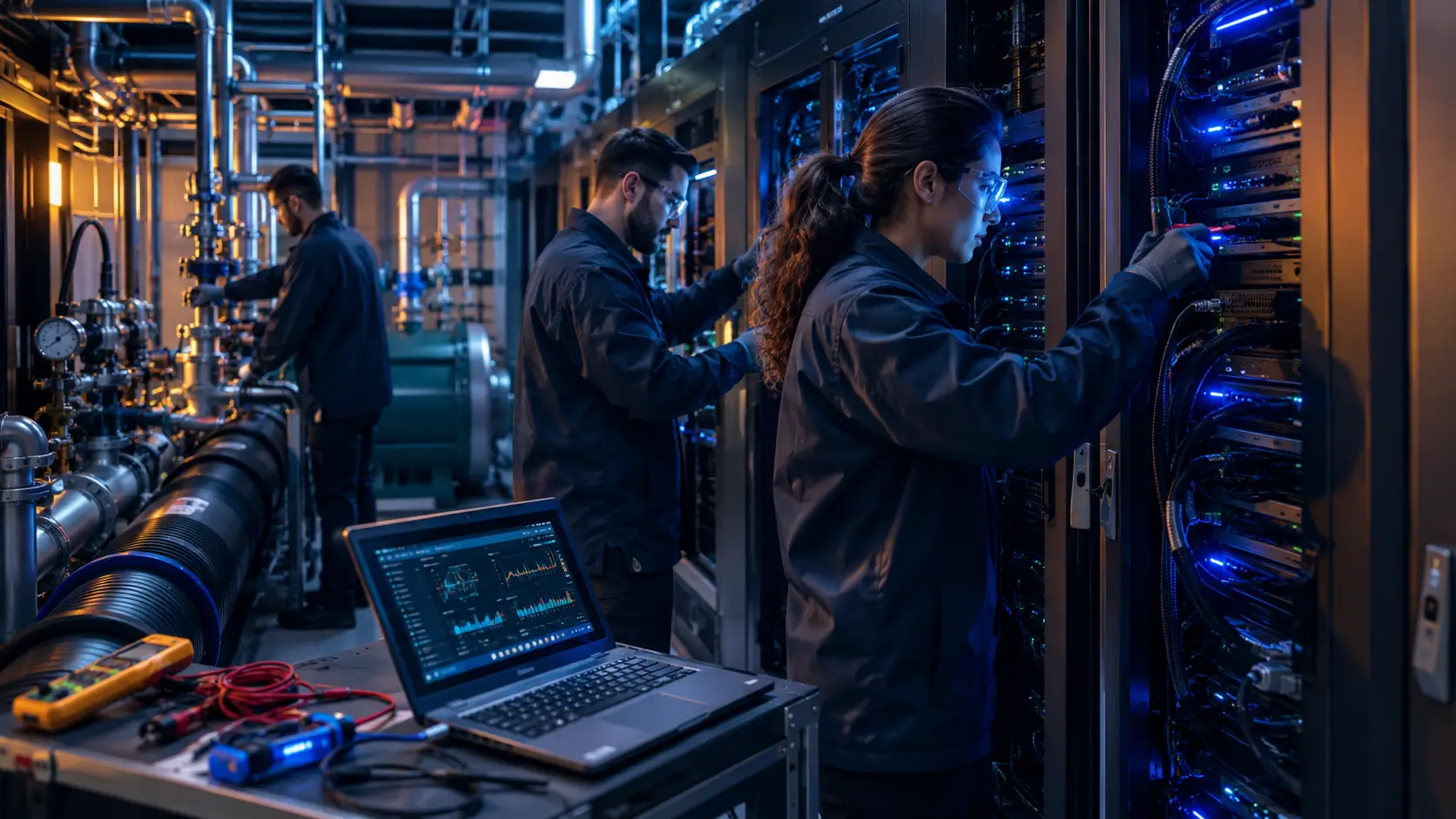
The rapid expansion of AI infrastructure is changing what data center operators need from their engineering and technical teams. Modern AI clusters combine high-performance compute, dense rack configurations, accelerated networking, advanced cooling systems and demanding electrical architectures within tightly integrated environments. These systems increasingly benefit from personnel who understand how individual infrastructure layers interact, particularly as power, cooling, networking and compute become more closely integrated in high-density AI environments. The growing integration of power, cooling and IT infrastructure means facility and IT teams increasingly need awareness of how changes in one system can affect the operation of another.

The staffing challenge therefore extends beyond headcount because AI infrastructure roles increasingly span multiple technical areas, including compute, networking, power and cooling. A technician working around a liquid-cooled rack may need familiarity with coolant distribution, pumps, valves, temperature monitoring and the interfaces connecting the cooling system with IT equipment. Uptime Institute’s 2026 Global Data Center Survey found that more than half of respondents reported difficulty finding qualified candidates for open positions, while staff turnover remained a persistent challenge. The operational challenge increasingly involves technical depth, cross-domain awareness and disciplined operating procedures alongside the need to maintain adequate staffing levels. The resulting workforce requirement is becoming closely connected to how effectively operators can manage increasingly integrated infrastructure rather than simply how many people they can place on a shift.
Why Traditional Data Center Skills Are Under Pressure
Traditional data center operations already depend on electrical, mechanical, controls, networking and facilities expertise, but AI deployments increase the interaction between these disciplines. Higher-density computing changes the thermal profile of racks and can require cooling approaches that differ from conventional air-cooled deployments. As rack power densities rise, electrical teams increasingly need to account for the effects of higher loads on power distribution, redundancy and operating procedures. Networking teams must manage high-throughput interconnects that support communication between large numbers of accelerators within tightly coordinated clusters. Facilities teams increasingly need awareness of how changes in IT load influence cooling requirements and electrical capacity across the data hall.
The emerging skills requirement does not always fit neatly into traditional job descriptions built around separate mechanical, electrical or IT responsibilities, particularly for high-density AI deployments. Uptime Institute has identified continuing shortages in operations management as well as electrical and mechanical trades, demonstrating that workforce pressure already extends across several operational disciplines. The AI buildout adds another layer because technicians supporting high-density deployments may need familiarity with technologies such as liquid-cooling interconnects, high-density cabling, DC busbar power delivery and AI cluster validation. Organizations can address part of this requirement by developing existing personnel while also creating structured pathways that help workers from adjacent technical disciplines build data center-specific operational competencies.
High-Density Compute Requires Different Operational Awareness
High-density compute changes the physical and operational relationship between IT equipment and facility infrastructure. Compared with many conventional enterprise deployments, AI systems can concentrate substantially more compute and thermal output within individual racks, creating different requirements for power delivery and thermal management. Uptime Institute has reported that more operators are identifying peak rack densities of 30 kW or higher as advanced computing workloads expand. Such environments increase the importance of understanding how rack-level power consumption, heat generation and airflow or liquid-flow conditions interact during normal and abnormal operating conditions. The technician’s role can extend beyond component replacement because maintenance activities may involve power, cooling or networking systems that support high-density compute.
Engineers working with AI infrastructure need visibility into operating limits and monitoring data so they can assess whether system conditions remain within the applicable operating parameters. Commissioning, maintenance and capacity changes can also require closer coordination because infrastructure behavior can change when rack populations, power loads or cooling configurations change. AI infrastructure can create tightly coupled operating conditions in which a local issue requires coordination between IT, facilities and electrical teams before corrective work begins. The resulting skills profile favors personnel who can interpret system behavior across multiple layers while still working within defined technical responsibilities and operating procedures.

Liquid Cooling Adds a New Technical Layer
Liquid cooling introduces another operational discipline because it creates a direct physical interface between facility infrastructure and IT equipment. Direct liquid cooling can use cold plates, coolant distribution units, pumps, manifolds, piping and control systems to remove heat from high-density computing equipment. These systems introduce operational considerations involving fluid movement, temperature control, monitoring, reliability and the physical interfaces between cooling equipment and IT hardware. Liquid cooling therefore represents more than a simple replacement for conventional air conditioning because it introduces additional mechanical infrastructure and operational interfaces within the data hall. Technicians working with liquid-cooled infrastructure need familiarity with fluid movement, equipment interfaces, temperature monitoring and the relationship between technology cooling systems and IT equipment.
Maintenance teams need procedures for managing and isolating cooling-system components while accounting for the thermal and availability requirements of connected IT equipment. Uptime Institute has highlighted operational considerations involving redundancy, plumbing interfaces, valves, coolant distribution and the division of responsibilities between facilities and IT teams. The capability is particularly relevant during commissioning because cooling infrastructure, monitoring and controls need to be validated as part of preparing high-density AI systems for operation. Liquid cooling therefore adds another dimension to workforce planning because personnel must understand how mechanical infrastructure interacts with the computing systems it supports.
Accelerated Networking Creates Another Skills Requirement
AI clusters depend on high-speed networking because large numbers of accelerators need to exchange data efficiently during distributed workloads. This environment changes the role of network operations because technicians must consider physical connectivity, switch configuration, optical interfaces, cabling, latency and cluster-level communication behavior. NVIDIA’s AI infrastructure certification framework reflects this broader requirement by covering compute platforms, networking, storage, infrastructure management and cluster orchestration for infrastructure professionals. Experience with conventional enterprise networking does not necessarily cover the additional physical-layer, high-density cabling, accelerator interconnect and cluster-validation requirements associated with AI infrastructure.
Network and interconnect issues can affect cluster communication and performance, making physical-layer validation and cluster-level troubleshooting relevant parts of AI infrastructure operations. High-speed interconnects further increase the importance of disciplined installation practices because connector quality, cabling configuration, topology and signal integrity can influence system performance. AI infrastructure engineers increasingly need an understanding of how networking interacts with compute platforms, storage movement and accelerator utilization within a cluster. The skills requirement does not mean every facilities technician must become a network engineer, but AI infrastructure teams increasingly need defined responsibilities across facility, power, cooling and network functions. This cross-functional understanding can help teams determine whether an operational issue requires investigation in the compute, networking, power or cooling layer.
Electrical Systems Are Becoming Part of the Same Operational Picture
Electrical infrastructure represents another area where AI deployment is changing operational requirements. Higher rack densities can increase electrical loading and place greater emphasis on distribution capacity, protection, redundancy and monitoring. Technicians supporting high-density AI infrastructure increasingly need familiarity with the relationship between power distribution equipment, redundancy arrangements and rack-level loads when investigating operating conditions. Cooling infrastructure also has electrical dependencies because pumps, controls and cooling distribution equipment require reliable power to maintain thermal conditions. Uptime Institute’s 2026 survey identifies power availability as a growing concern for data center operators alongside capacity forecasting, supply chain disruption and staffing challenges.
Electrical operations increasingly need to be considered alongside thermal and IT requirements in facilities designed for high-density compute. An electrical interruption can affect cooling equipment, while a cooling-system intervention can influence the operating conditions of IT hardware. Maintenance activities therefore require clear procedures covering isolation, redundancy, monitoring and escalation when personnel work on interconnected infrastructure. The practical workforce requirement includes electrical expertise alongside personnel who understand how power delivery interacts with the wider AI infrastructure operating environment.
The Real Gap Is Cross-Domain Experience
The emerging workforce challenge is difficult to address because high-density AI deployments bring together capabilities that traditionally sit across several technical disciplines. A mechanical specialist may have deep experience with cooling systems while requiring additional training to work with accelerator hardware and AI cluster operations. An electrical specialist may have extensive power-distribution expertise while requiring additional knowledge of liquid-cooled IT systems and networked AI infrastructure. A network specialist may have strong experience with AI interconnects while requiring additional exposure to the facility power and cooling systems that support the connected compute infrastructure.
A strong operational model can connect these areas while retaining the specialist expertise required within each discipline. Uptime Institute’s 2025 survey reported that 46% of respondents had difficulty finding qualified candidates for open positions, while 37% reported difficulty retaining staff. Data Center Dynamics has also highlighted recruitment from outside traditional data center backgrounds and structured training as potential responses to the industry’s technician shortage. Workers from electrical, mechanical, industrial controls, telecommunications and related technical fields can bring transferable capabilities that organizations can develop for data center environments. The remaining task is to provide data-center-specific training and operational experience so workers from adjacent technical fields can develop the competencies required for their assigned roles.
Training Must Move Beyond Equipment Familiarization
AI infrastructure training can extend beyond individual product knowledge by combining equipment-specific instruction with broader infrastructure, operational and troubleshooting competencies. A technician can learn the specifications of a cooling distribution unit while still requiring practical training in how the associated cooling system operates and interfaces with IT equipment. An electrical specialist can understand a switchgear lineup while still requiring site-specific knowledge of the power paths and operating dependencies associated with the connected AI infrastructure. A network engineer can configure high-speed infrastructure while still benefiting from practical exposure to AI cluster validation, fault isolation and troubleshooting procedures. Training can therefore combine classroom instruction, manufacturer-specific knowledge, practical troubleshooting, commissioning exposure and supervised work on operating infrastructure.
ASHRAE’s liquid-cooling training resources cover areas including facility cooling systems, monitoring, reliability and commissioning, illustrating the breadth of knowledge involved in liquid-cooled environments. NVIDIA’s AI infrastructure learning and certification material similarly spans compute, networking, storage, infrastructure management, power and cooling validation, physical-layer management and cluster testing. Organizations can combine external training with internal operating procedures and supervised experience to develop role-specific competency progressively. The objective is a workforce with sufficient role-specific knowledge to understand system dependencies, execute assigned maintenance procedures and escalate conditions that fall outside established operating parameters.
Operators Need a Workforce Strategy Alongside a Capacity Strategy
Data center expansion plans increasingly need to consider workforce availability alongside electrical, cooling and physical infrastructure requirements as operators address reported staffing shortages. A facility can have sufficient utility power, equipment availability and construction progress while still facing operational constraints if qualified personnel cannot support commissioning and ongoing maintenance. Workforce requirements begin before steady-state operations because commissioning demands coordination among construction teams, vendors, facilities engineers, controls specialists and IT personnel. Once a site becomes operational, organizations need coverage for routine inspections, preventive maintenance, incident response, capacity changes and equipment replacement. Staffing plans therefore need to account for the training and development required to prepare personnel for specialized data-center roles rather than relying only on immediately available candidates.
Uptime Institute’s 2026 survey shows that staffing difficulty remains a material concern as operators continue to manage increasingly complex infrastructure requirements. Retention remains important because Uptime Institute identifies staff turnover as a persistent challenge, while experienced personnel naturally accumulate knowledge of site procedures and infrastructure over time. Organizations can strengthen workforce resilience through documented procedures, structured training, cross-training and defined progression pathways for technical personnel. The ability to operate AI infrastructure reliably will therefore depend not only on the deployment of advanced computing, networking, cooling and electrical systems, but also on whether operators develop the technical workforce required to manage those systems throughout their operational lifecycle.











