 Skip to content
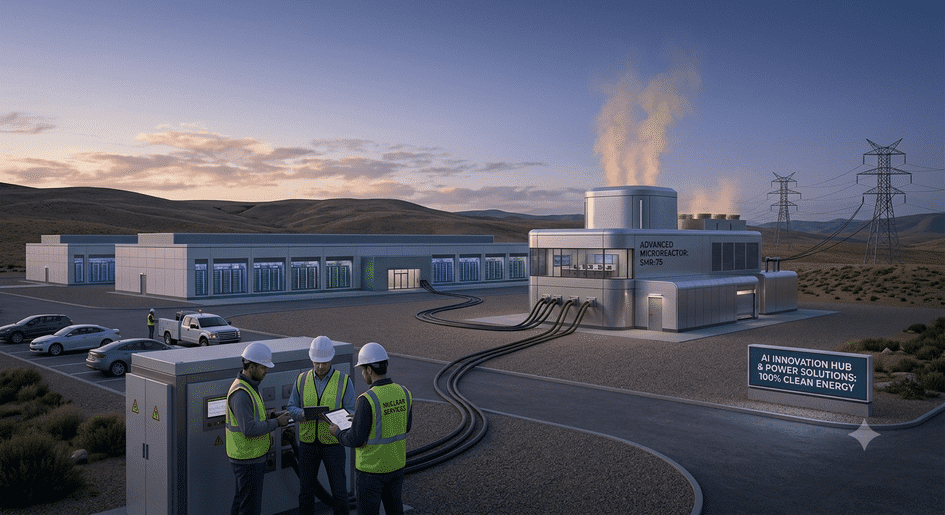
Artificial intelligence has quietly become one of the hungriest consumers of electricity on the planet. Every new model trained, every query answered, and every image generated draws power from somewhere. That somewhere is increasingly a data center straining against the limits of its local grid. Consequently, an entire industry now scrambles to find electricity fast enough to match AI’s appetite. Advanced nuclear microreactors sit right at the center of that scramble, and their moment may finally have arrived.

The Scale of the AI Power Problem
Data center electricity demand has grown at a pace few grid planners anticipated. Standard facilities once drew a few hundred megawatts at most. Today’s AI training campuses regularly target well over a gigawatt each. That single shift changes the entire calculus for power procurement. Utilities across major markets now report unprecedented capacity requests. Some grid operators have seen years of projected growth compressed into mere months. Meanwhile, the new generation struggles to keep pace with this sudden surge. Turbine manufacturers report order backlogs stretching years into the future.
Interconnection queues compound the problem further still. Projects seeking grid connection often wait years before receiving approval. For AI companies competing on speed, that delay proves genuinely costly. Every quarter without deployed compute capacity represents lost competitive ground. Against this backdrop, waiting for conventional solutions no longer looks viable. Traditional power plants take years to permit, finance, and build. AI infrastructure, by contrast, needs power within a much tighter window. This mismatch has forced operators toward faster, more flexible alternatives entirely.
Why Traditional Grids Struggle to Keep Up
Large, centralized power plants were never designed for today’s demand pattern. They require extensive transmission networks to move electricity across long distances. Building those networks takes even longer than building the plants themselves. Consequently, bottlenecks appear at nearly every stage of the process. Renewable sources add further complexity to this equation. Solar and wind remain intermittent, requiring storage or backup generation. Data centers, however, need constant, uninterrupted power around the clock. A brief outage during AI training can waste enormous computational investment instantly. Grid operators also face mounting pressure from local communities and regulators. New transmission lines often meet fierce opposition during siting reviews. Meanwhile, ratepayer advocates push back against costs shifted from data centers onto households. These pressures slow deployment even when capital and technology are both ready.
Enter the Microreactor Solution
Small, factory-built reactors offer a fundamentally different approach to this challenge. Rather than serving an entire regional grid, they power individual sites directly. This eliminates dependence on congested transmission networks almost entirely. Facilities can generate their own reliable electricity, right where it’s needed. Manufacturing these reactors in centralized factories brings real advantages too. Standardized production shortens construction timelines considerably compared to traditional plants. Quality control also improves when identical units roll off the same assembly line repeatedly. This approach mirrors how modular construction transformed other heavy industries decades ago.
Capacity factors for nuclear technology remain exceptionally high as well. Reactors typically run above 90% of rated output consistently. That reliability matters enormously for facilities that simply cannot tolerate downtime. Unlike solar or wind, nuclear output doesn’t depend on weather conditions. Physical footprints for these reactors also stay remarkably compact. Some designs fit within a footprint smaller than a typical warehouse. That compactness allows placement directly alongside the facilities needing power. Site-specific generation, delivered without new transmission infrastructure, solves multiple problems simultaneously.

Remote Sites and Off-Grid Demand
Not every facility needing reliable power sits near a robust grid connection. Remote mining operations, isolated communities, and frontier industrial sites often lack access entirely. Diesel generators have traditionally filled this gap, at considerable environmental and financial cost. Microreactors offer a genuinely compelling alternative for these off-grid situations. They deliver continuous power without requiring fuel deliveries or extensive infrastructure. Over a multi-year operating life, this translates into substantial savings. Communities gain energy security independent of fragile supply chains or distant grids. This use case extends naturally toward edge computing facilities too. As AI inference moves closer to end users, smaller data centers proliferate. Many of these sites sit outside traditional data center hubs entirely. Bringing dedicated, reliable power to these locations becomes increasingly valuable.
Military and Critical Infrastructure Applications
Defense installations face unique power security requirements unlike typical commercial customers. Grid outages, whether accidental or deliberate, threaten mission-critical operations directly. Self-contained generation reduces this vulnerability considerably. Portable reactor designs align naturally with military deployment needs specifically. Forward operating bases, research stations, and remote installations all benefit from independent power. Fuel logistics for these locations remain notoriously difficult and expensive. A long-duration, low-maintenance power source solves a genuine operational challenge. Critical infrastructure beyond defense shares similar characteristics too. Hospitals, water treatment facilities, and emergency response centers all require unwavering reliability. Industrial facilities running continuous processes face comparable stakes. For all these users, resilient, localized power isn’t a luxury; it’s essential.
Regulatory Momentum Continues Building
Advanced reactor licensing has historically moved slowly through regulatory channels. Recently, however, streamlined pathways for smaller, standardized designs have emerged. Regulators increasingly recognize that factory-built reactors pose different risk profiles than traditional plants. Government support for domestic nuclear manufacturing has also strengthened noticeably. Policymakers view advanced reactors as strategically important for energy security. This political tailwind helps accelerate both funding and regulatory clarity simultaneously. Companies operating in this space increasingly benefit from favorable public sentiment.
International interest reinforces this domestic momentum considerably further. Several allied nations now pursue similar advanced reactor programs of their own. Shared research, testing standards, and supply chains help accelerate progress everywhere at once. Global collaboration, in this sense, benefits every participant simultaneously. Fuel supply chains have received particular regulatory attention lately too. Many advanced reactor designs rely on specialized fuel types unavailable domestically until recently. New investment in enrichment and fabrication capacity aims to close that gap. Without secure fuel supply, even the best reactor design remains stranded on paper.
Capital Flows Toward Advanced Nuclear
Investor appetite for advanced nuclear technology has grown substantially over recent years. Venture capital, government grants, and strategic corporate partnerships all now target this sector. That capital influx reflects genuine confidence in near-term commercial viability. Partnerships between reactor developers and end users have also multiplied recently. Data center operators, industrial firms, and utilities increasingly sign early agreements. These arrangements provide developers with committed demand before construction even begins. Such demonstrated demand, in turn, attracts further investment down the line. Public markets have taken notice of this broader trend as well. Companies developing advanced reactor technology have seen renewed investor interest lately. This reflects a broader recognition that reliable, carbon-free power carries genuine strategic value. As AI’s power appetite grows, that value proposition only strengthens further.
What This Means Going Forward
Rising electricity demand from AI shows no sign of slowing anytime soon. Forecasts consistently point toward continued, substantial growth for years ahead. Traditional generation and transmission simply cannot scale fast enough to match this trajectory. Microreactor technology, once viewed as a niche curiosity, now looks genuinely strategic. It addresses speed, reliability, and site-specific power needs simultaneously. As AI infrastructure keeps expanding, these compact, factory-built systems answer real, urgent problems facing the industry. The convergence of AI’s power hunger and nuclear innovation isn’t coincidental. Both trends emerged from the same underlying constraint: the grid cannot keep up. Companies capable of delivering fast, reliable, and independent power stand to benefit considerably from this ongoing shift.












