Skip to content
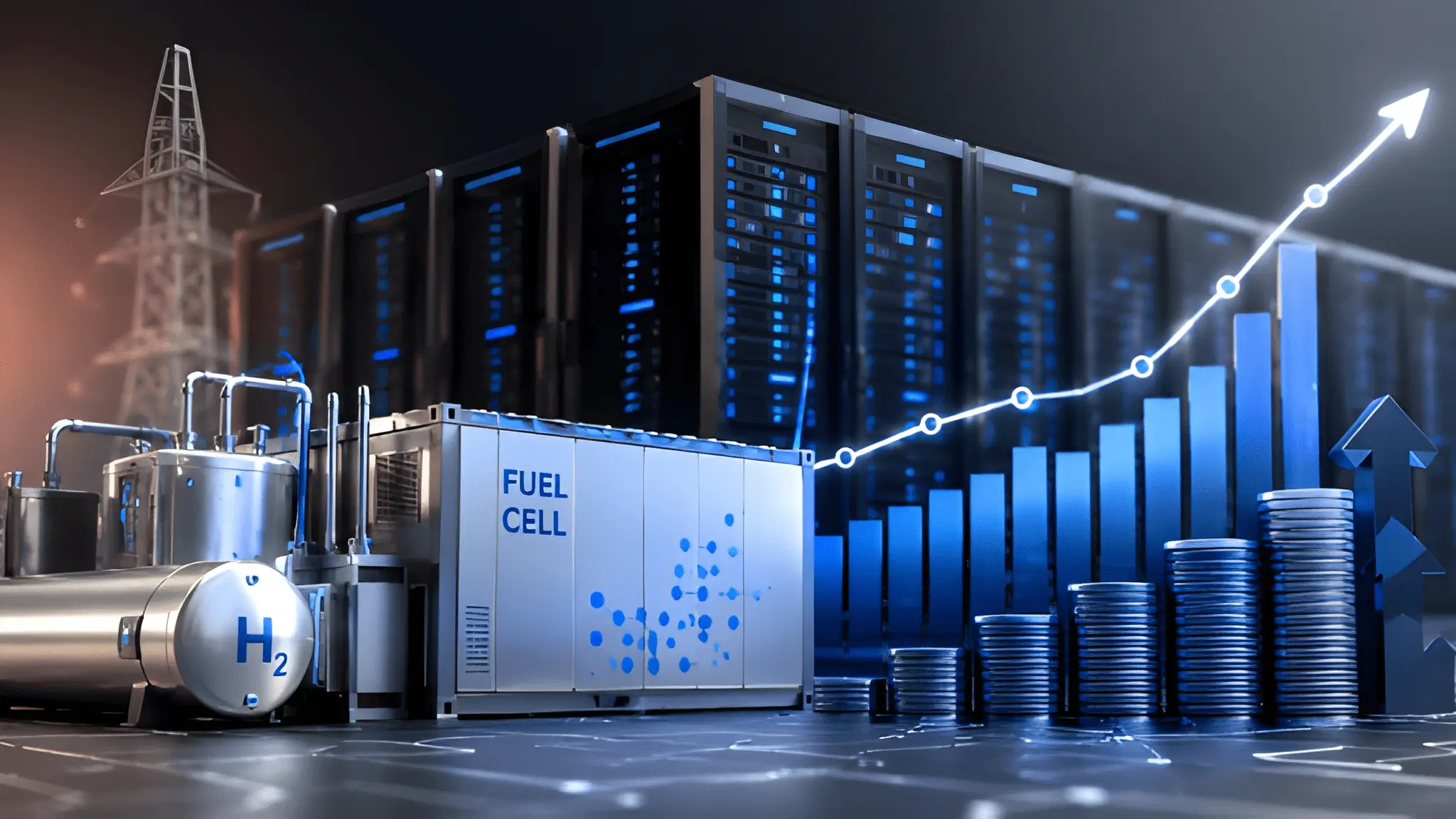
The rapid expansion of artificial intelligence workloads is forcing data center operators to rethink how they secure reliable electricity for future campuses. Power availability has become a strategic constraint as traditional grid connections face longer approval timelines and rising demand from hyperscale facilities. Fuel cells are emerging as an alternative energy pathway because they can provide dedicated on-site generation designed for the continuous power needs of data center environments. Rystad Energy research and analysis projects the fuel cell market for data centers could experience a major acceleration this decade, with revenues expected to rise from around $2.8 billion in 2025 to approximately $30 billion by 2030. The shift reflects a broader transformation in digital infrastructure where energy access is becoming as important as land, networking capacity, and semiconductor availability. Data center developers are increasingly evaluating firm power options that can support AI expansion without depending entirely on congested transmission networks.

The growing interest in fuel cells follows a contracted order book of approximately 9 gigawatts, which includes framework agreements involving major industry participants such as Oracle, AEP, Equinix, and Brookfield. These commitments show that large-scale operators are exploring alternative power models as they prepare for sustained computing demand growth. Data center developers are turning toward fuel cells partly because securing new grid capacity within required project timelines has become increasingly difficult. US grid interconnection timelines have tripled since 2015, and large electricity consumers now wait three to six years in many cases before gaining access to additional power capacity. Therefore, data center companies are adding dedicated power generation to their development strategies to achieve faster deployment cycles.
On-Site Power Becomes a Strategic Priority for Hyperscale Growth
Rystad Energy projects 10.4 GW of cumulative fuel cell demand from data centers between 2026 and 2030 as operators search for dependable electricity solutions. Around 40% of projected 2030 US data center capacity is modeled as likely to pursue dedicated on-site power generation rather than relying only on grid connections. This trend indicates that energy availability is becoming an increasingly important consideration in data center infrastructure planning. Fuel cells provide continuous power generation without requiring the same level of external infrastructure expansion associated with traditional grid-based approaches. Unlike conventional combustion-based generation methods, fuel cells can produce electricity with lower on-site emissions while maintaining the reliability needed for mission-critical facilities. The technology is therefore gaining attention as companies attempt to balance AI growth with operational resilience and environmental targets.
North America is expected to account for 91% of installed global on-site power generation capacity for data centers due to several market advantages. The region benefits from existing energy infrastructure, domestic manufacturing capabilities, policy incentives, and increasing pressure from delayed grid connections. However, the expansion of fuel cell adoption depends on whether manufacturers can increase production at the same pace as demand from the data center sector. Lein Mann Bergsmark, Vice President, Clean Tech Supply Chain Research, highlighted the industry challenge by stating: “Power availability has become one of the defining constraints on data center growth, and operators are increasingly looking beyond the grid for solutions. Fuel cells have moved from a niche application to a measurable part of the firm power mix. The question now is whether the supply chain can scale at the same pace as demand.”

Manufacturing Expansion Shapes the Future of Fuel Cell Deployment
Fuel cell manufacturers are expanding production capabilities as demand from data centers creates new commercial opportunities. Aggregate operational and planned manufacturing output is expected to reach 4 GW annually by 2030, compared with approximately 1.8 GW today. This expansion reflects efforts by suppliers to prepare for expected growth in stationary fuel cell demand, including demand linked to data center expansion. Solid oxide fuel cells, commonly known as SOFC technology, have become the leading option for always-on data center applications. SOFC systems represent around 53% of cumulative stationary fuel cell deliveries to date, reflecting their suitability for continuous electricity generation. The technology’s ability to provide steady power output has positioned it as a key solution for facilities that cannot tolerate interruptions.
Bloom Energy currently holds virtually every primary-load SOFC contract within the visible order book, creating a strong position in the growing market. This concentration provides the company with significant influence over the current fuel cell deployment pipeline for data centers. At the same time, the market structure introduces supply chain considerations if demand increases faster than manufacturing expansion. Meanwhile, competitors developing alternative electrolyte chemistries may gain opportunities if customers seek to reduce dependence on a single technology provider. The balance between market leadership and supply diversification could become a defining factor as fuel cells move deeper into mainstream data center infrastructure. The next phase of growth will depend not only on demand but also on the industry’s ability to deliver systems at scale.
Critical Materials Create New Supply Chain Considerations
The expansion of SOFC technology also brings attention to the materials required for large-scale production. Bloom Energy’s SOFC systems rely on scandium, a critical metal used within the electrolyte chemistry of the technology. At full utilization of its planned 2 GW manufacturing expansion, Bloom’s theoretical scandium requirement could approach the size of the entire global market, which is currently estimated at around 60 tonnes per year. This creates a potential supply challenge because global scandium production remains limited and concentrated among a small number of sources. The concentration of scandium supply chains, including China’s significant role, creates a potential consideration for future scaling. Therefore, material availability could influence technology choices and shape competitive dynamics across the fuel cell sector.
Alternative fuel cell designs using different electrolyte materials may avoid some of these supply constraints and create additional competition over time. The market’s evolution will depend on how quickly manufacturers improve production methods, secure materials, and reduce overall system costs. Rystad Energy projects SOFC system costs could decline by 20% to 25% by 2030 as manufacturing improves and deployment expands. The reduction will depend on broader cost optimization across the complete delivered system rather than only improvements to the fuel cell stack itself. This means supply chains, installation processes, and manufacturing efficiency will all play a role in determining future economics. The ability to lower costs while maintaining reliability will influence how widely fuel cells are adopted by major data center operators.
AI Data Centers Redefine the Future Energy Infrastructure Model
The rise of AI computing is changing the relationship between digital infrastructure and energy systems. Data centers no longer function only as technology facilities because their growth increasingly depends on access to dependable power resources. Fuel cells represent one part of a wider industry shift toward flexible and resilient energy strategies that support high-density computing environments. The projected growth toward a $30 billion market demonstrates how energy requirements are becoming central to the future of cloud, AI, and hyperscale development. Developers now consider power availability during the earliest stages of site selection and infrastructure planning. This shift signals a new era where electricity strategy gives technology companies a competitive advantage.
The coming decade will determine whether fuel cells can expand from a specialized solution into a mainstream component of data center power architecture. AI demand, grid limitations, and the need for cleaner firm power are creating strong momentum for alternative generation technologies. Fuel cell providers must address manufacturing scale, material security, and cost reduction to capture the opportunity ahead. The market’s growth will likely depend on how effectively the industry manages these operational challenges while meeting the energy demands of next-generation computing. As data center construction accelerates globally, power innovation will remain a critical factor in deciding where companies can build future digital infrastructure. Companies that effectively manage energy supply challenges will likely influence the pace of AI infrastructure expansion. Fuel cells serve as a complementary power solution for data centers facing grid constraints rather than a complete replacement for utility infrastructure.