 Skip to content
India’s Clean Energy Ambitions Enter a New Phase
India’s electricity transition is approaching a point where generating renewable power alone will no longer determine success. The country’s next challenge lies in storing that energy efficiently and deploying it whenever demand peaks, renewable generation declines, or grid stability comes under pressure. A new market assessment suggests this shift will require one of the world’s largest energy storage buildouts over the coming decade, placing batteries at the center of India’s electricity infrastructure. The scale of the transformation extends far beyond technology adoption because it will reshape investment priorities, manufacturing strategies, electricity markets, and long-term energy security. Policymakers, utilities, project developers, financiers, and equipment manufacturers increasingly view storage as the missing link between ambitious renewable capacity targets and reliable electricity delivery.

The latest India BESS Market Review, jointly released by the India Energy Storage Alliance (IESA) and Customized Energy Solutions (CES) during India Energy Storage Week (IESW) 2026, projects that India will require 888 GWh of energy storage system (ESS) capacity by 2035-36. That estimate represents a dramatic increase from the country’s current operational capacity of roughly 1 GWh, illustrating how rapidly battery deployment must accelerate to support future electricity demand and renewable generation. The report positions energy storage as an essential pillar for maintaining grid reliability while enabling India’s expanding renewable energy portfolio to operate at scale. The findings also underline that storage investments will increasingly influence how renewable projects are financed, dispatched, and integrated into the national grid. Rather than serving as an optional technology, battery systems are becoming foundational infrastructure for India’s evolving power sector.
Battery Storage Becomes the Backbone of Grid Reliability
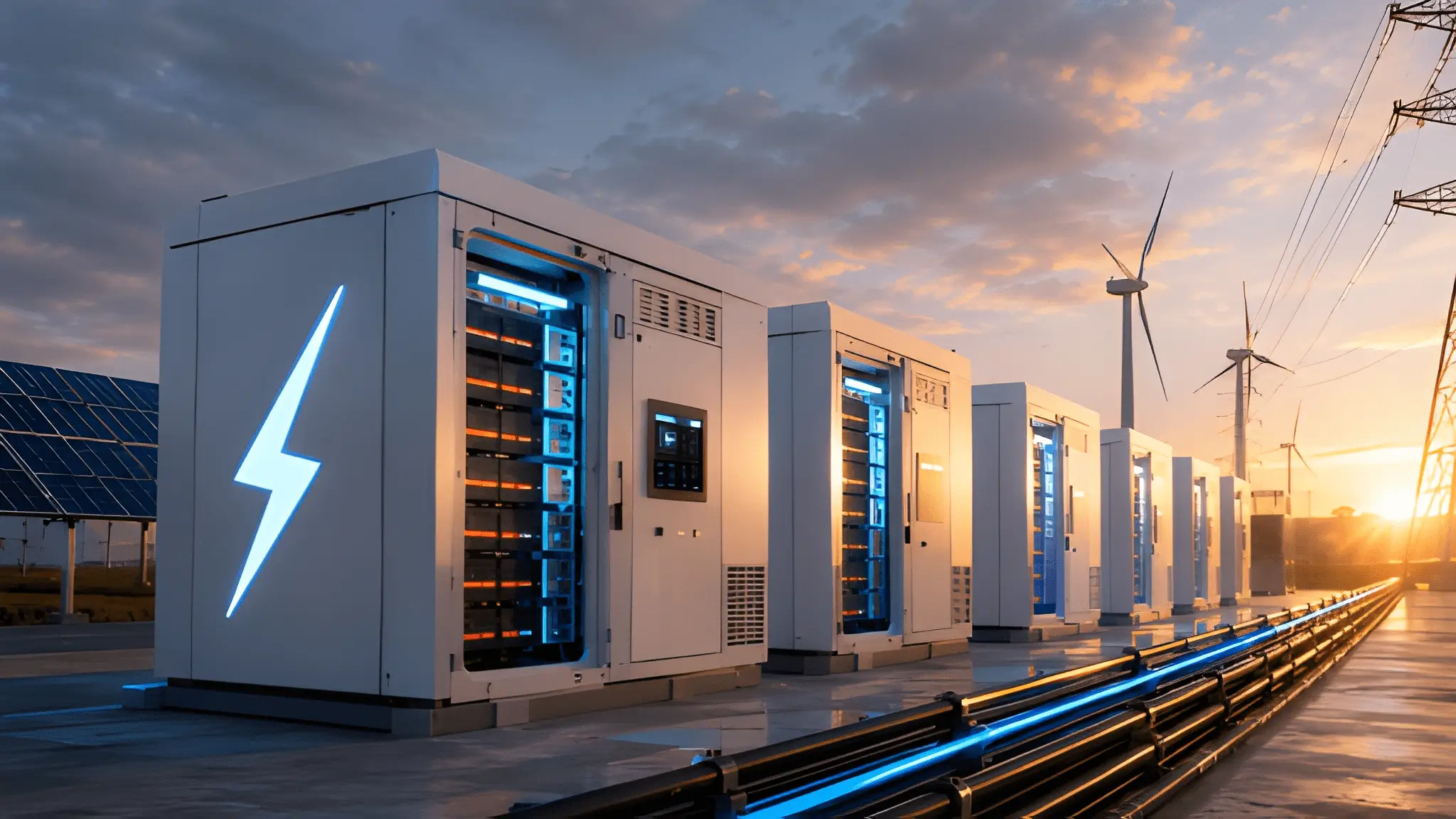
India’s renewable energy expansion has steadily reduced dependence on fossil fuel generation during daylight hours, yet intermittent solar and wind production continues to create operational challenges for grid operators. Electricity demand frequently rises after sunset when solar generation declines, requiring flexible resources capable of supplying power instantly without compromising reliability. Battery energy storage systems address this challenge by storing excess renewable electricity during periods of surplus generation and releasing it during peak consumption hours. Their role also extends to frequency regulation, voltage support, reserve capacity, and faster response during unexpected supply disruptions. As renewable penetration rises across the national grid, these operational capabilities become increasingly valuable for maintaining power quality and system stability. Consequently, storage is evolving from an auxiliary technology into a core component of India’s electricity infrastructure.
The report arrives as India’s storage market demonstrates unprecedented momentum. Installed battery energy storage capacity expanded from 0.78 GWh in December 2025 to 8.7 GWh during the first half of 2026, representing an elevenfold increase within six months. That rapid deployment reflects stronger policy support, increasing commercial viability, and growing confidence among project developers participating in competitive tenders. Industry expectations now point toward India surpassing 10 GWh of installed battery energy storage capacity before the end of 2026 if current commissioning activity continues. Such acceleration indicates that project execution is beginning to match policy ambitions after years of relatively modest deployment. The market’s recent trajectory also demonstrates how quickly storage can scale once procurement frameworks, financing mechanisms, and technology costs align.
Market Expansion Signals Growing Investor Confidence
The rapid increase in operational battery capacity illustrates a broader change in investor sentiment toward India’s energy storage sector. Early projects primarily focused on demonstrating technical feasibility, whereas recent investments increasingly target commercial deployment across utility-scale and merchant applications. The rapid increase in operational battery capacity reflects growing confidence among industry participants as battery storage deployment expands across utility-scale and merchant applications, supporting renewable integration and grid reliability objectives. The emergence of multiple deployment models, including utility-scale and merchant battery installations, is encouraging broader participation from energy companies and technology providers involved in India’s expanding storage market. Meanwhile, competitive procurement mechanisms continue to strengthen confidence by providing greater visibility into long-term demand and project pipelines. The combination of regulatory support and improving commercial fundamentals has therefore positioned India among the fastest-growing battery storage markets globally.
The report notes that 18 battery energy storage projects have already been commissioned across the country. Merchant battery installations accounted for approximately 70% of total capacity additions during the first half of 2026, highlighting increasing confidence in market-driven deployment models rather than relying exclusively on regulated utility procurement. This trend suggests that developers increasingly expect battery projects to generate sustainable commercial returns through participation in electricity markets and grid support services. Merchant projects also provide operational flexibility by responding to evolving price signals and demand conditions instead of operating solely under fixed contractual arrangements. Their growing contribution indicates a maturing storage market capable of supporting both regulated and competitive investment structures. Such diversification could prove essential as India’s electricity system becomes more dynamic over the coming decade.

Industry Leaders Frame Storage as National Infrastructure
The industry’s outlook extends beyond capacity targets to encompass the broader transformation of India’s electricity ecosystem. Executives participating in India Energy Storage Week argued that storage has become central to achieving both renewable expansion and long-term energy resilience. Their comments reflected growing consensus that batteries will influence every segment of the electricity value chain, from generation and transmission to distribution and end-user consumption. Debmalya Sen, President of IESA, said on the occasion that “the IESW 2026 is more than an industry summit; it’s a testament to how far India has come on its clean energy journey.” Radiance Renewables CEO Nitin Bhatia said he believes solar plus battery energy storage is the way forward. Tanya Singhal, Vice President, Country Head – India, Global Energy Alliance for People and Planet, said that “to build a truly flexible and resilient grid, storage must be integrated at the generation, transmission, distribution, and consumption levels.”
India’s Battery Manufacturing Race Gains Strategic Importance
Expanding battery deployment will require a parallel increase in domestic manufacturing capacity if India hopes to reduce import dependence and strengthen supply chain resilience. The market review indicates that India’s lithium-ion battery cell manufacturing capacity currently stands at approximately 2 GWh, while announced manufacturing plans collectively target nearly 110 GWh by 2030. Achieving those ambitions would significantly expand the country’s industrial base and create opportunities across mining, materials processing, component manufacturing, engineering services, and advanced battery technologies. Domestic production could help strengthen India’s battery manufacturing ecosystem by reducing dependence on external supply chains and improving domestic capabilities for energy storage deployment. Large-scale manufacturing investments increasingly align with broader industrial policy objectives aimed at building strategic capabilities in clean energy technologies. The sector therefore represents not only an energy transition opportunity but also an emerging pillar of India’s advanced manufacturing economy.
Building domestic capacity carries implications that extend beyond meeting local electricity demand. India remains one of the world’s fastest-growing renewable energy markets, creating sustained long-term demand for batteries across utility-scale projects, commercial facilities, industrial operations, and distributed energy systems. Manufacturers capable of establishing competitive production at scale could strengthen India’s domestic battery supply chain and support the country’s growing demand for energy storage systems. Investment decisions made during the next several years will therefore influence whether India becomes primarily a battery importer or develops into a globally competitive manufacturing center. Strong local production could also stimulate innovation in battery chemistry, recycling, software, power electronics, and system integration, expanding the country’s clean technology ecosystem. That industrial development would reinforce national energy security while supporting broader economic growth objectives.
Supply Chain Challenges Have Not Slowed Market Momentum
Battery markets worldwide have experienced periods of supply chain volatility driven by fluctuations in the availability and pricing of critical raw materials, logistics constraints, and shifting geopolitical dynamics. Those pressures have increased costs for manufacturers and project developers across multiple regions, prompting concerns about deployment timelines and investment returns. Even under those conditions, India’s battery energy storage sector has continued expanding at a pace that distinguishes it from many emerging markets. Strong policy support, growing renewable deployment, and improving commercial economics have helped sustain investor confidence despite higher equipment costs. Developers increasingly view battery storage as essential infrastructure rather than a discretionary investment that can be delayed during periods of market uncertainty. That resilience has become one of the defining characteristics of India’s rapidly evolving storage industry.
The report concludes that India is now recognized as one of the world’s fastest-growing battery energy storage markets despite continuing global supply chain disruptions and rising battery prices. That assessment reflects the market’s ability to maintain deployment momentum while adapting to external cost pressures and changing procurement conditions. Continued tender activity, expanding merchant projects, and growing manufacturing commitments suggest that the industry’s long-term trajectory remains positive even as international markets navigate uncertainty. Stable domestic demand also provides manufacturers and developers with greater confidence to commit capital to new production facilities and large-scale projects. The combination of supportive policy frameworks and accelerating deployment has strengthened India’s position within the global battery storage landscape. Market participants increasingly view the sector as entering a sustained growth phase rather than experiencing a temporary investment cycle.
Industry Calls for Domestic Leadership Across the Value Chain
As deployment accelerates, industry leaders increasingly argue that India’s long-term competitiveness will depend on controlling more of the battery value chain rather than relying primarily on imported technologies. Expanding domestic expertise across research, manufacturing, engineering, software, and recycling could improve resilience while strengthening the country’s position in global clean energy markets. Building those capabilities would also support cost reductions through localized production, workforce development, and supply chain integration. Companies participating in India’s storage market therefore see industrial development as closely connected with national energy security and future export opportunities. The next decade is likely to determine whether India evolves into a technology leader or remains dependent on overseas manufacturing for critical storage components. Strategic investments across the value chain could ultimately shape both economic competitiveness and the pace of the country’s clean energy transition.
Venugopal Rao Maddisetty, Chairman and Managing Director, Pace Digitek, said that “energy storage is now an indispensable national infrastructure, enabling renewable energy to become dispatchable, stabilising the grid, and enhancing resilience.” Nikhil Bhuta, Director, DC&T (Belding India), said that “to secure the future, India must build and master storage systems domestically, owning the value chain and setting cost curves for the world.” Those observations reinforce a broader shift in how the industry views battery storage. Rather than focusing solely on deployment targets, stakeholders increasingly emphasize technological capability, industrial competitiveness, and long-term ownership of strategic supply chains. That perspective aligns with India’s broader efforts to strengthen domestic manufacturing across advanced clean energy technologies while reducing external dependencies.
The Road to 888 GWh Extends Beyond Capacity Targets
Reaching 888 GWh of installed energy storage by 2035-36 represents far more than a numerical milestone because it signals a fundamental restructuring of India’s electricity system. Future power networks will increasingly rely on batteries to balance renewable generation, stabilize grid operations, improve reliability, and enable flexible electricity markets capable of supporting rapid economic growth. The sharp increase in installed capacity during the first half of 2026 demonstrates that deployment is already accelerating as procurement mechanisms mature and commercial confidence strengthens. Continued investment in domestic manufacturing, grid integration, and market reforms will determine whether India can sustain that trajectory through the coming decade. The latest industry assessment suggests that energy storage has moved from the margins of India’s power sector to its strategic center, making batteries an essential foundation for the nation’s next phase of energy transformation.












