 Skip to content
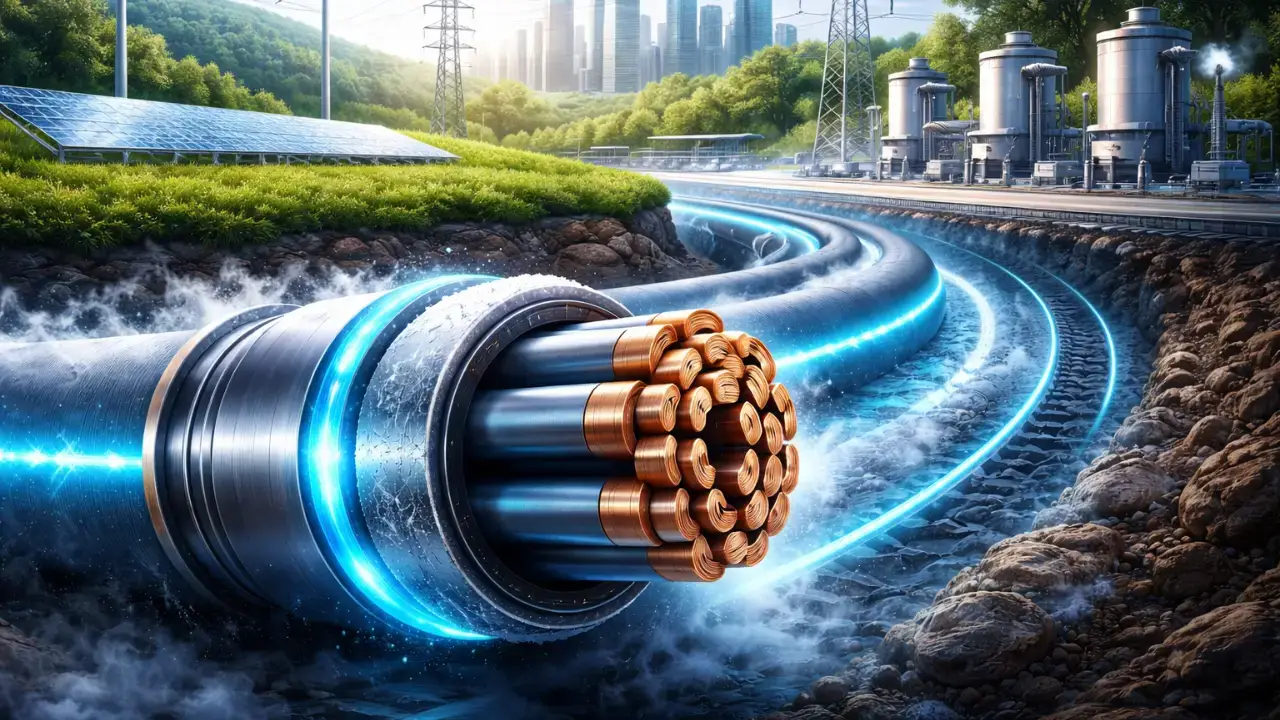
Electricity rarely draws attention until a blackout reminds cities how fragile modern life can become. Energy moves silently across landscapes through conductors that heat, resist, and quietly waste a portion of what they carry. Engineers now challenge that inefficiency with materials that behave in radically different ways under controlled conditions. High-temperature superconducting cables promise to transmit power with extremely low electrical resistance when maintained below critical temperatures, reshaping the environmental equation of transmission infrastructure. As climate targets tighten and grid congestion grows, this technology invites a deeper question about whether material science can actively reduce emissions rather than merely accommodate them. The story of superconducting cables therefore unfolds not only as a scientific advancement but as a sustainability strategy embedded within the grid itself.

Understanding High-Temperature Superconductors
High-temperature superconductors rely on ceramic compounds that, when cooled below their critical temperatures, allow current to flow with vanishingly small resistive losses within the superconducting material itself. Unlike conventional copper or aluminum conductors, these materials require cryogenic environments to maintain superconductivity and therefore operate as part of a system that includes refrigeration and thermal insulation. Engineers encase the superconducting tapes or wires within cryostats that maintain stable temperatures and protect the cable from external thermal perturbations. Consequently, they can carry much higher current densities within compact physical footprints compared to traditional conductors, provided the cryogenic system remains effective. This characteristic opens pathways for dense urban installations where space constraints challenge infrastructure expansion, while also introducing the operational requirement to manage cooling energy and ancillary equipment. By reframing conductivity in the conductor itself while accounting for system-level needs, these materials shift the efficiency baseline of electrical transmission systems.
Why Material Physics Changes the Energy Equation
The absence of resistive losses inside a superconducting material alters how transmission infrastructure behaves under load conditions, but it does not remove the need for thermal management across the whole system. Conventional conductors convert a fraction of transmitted electricity into heat, which engineers must manage through spacing, insulation, and cooling strategies; superconducting conductors remove that resistive heating inside the tape or wire but add cooling requirements for the cryogenic loop. This change reduces thermal stress on the conductor while introducing energy demand for refrigeration and for maintaining vacuum and insulation states in real operation.
Utilities therefore evaluate superconducting systems by comparing reduced resistive losses with the energy and lifecycle impacts of cryogenic support and manufacturing. When optimized, superconducting segments can offer a net system energy benefit; however, the net outcome depends on design choices, duty cycles, and integration strategy. Such performance characteristics introduce a structural efficiency advantage that extends beyond incremental grid optimization when considered holistically.
Reducing Energy Losses in Power Transmission
Traditional transmission lines lose energy through resistive heating, commonly expressed as I²R losses, and even modest percentages of loss compound significantly across long transmission distances. Superconducting cables can effectively eliminate resistive losses inside the superconducting element itself when operated below their critical temperature, reducing one major source of waste in the transmission path. That reduction can lower the required generation output to serve the same load, which translates into less fuel consumption or reduced dispatch of marginal thermal plants in systems that still rely on them. However, superconducting installations experience other system losses notably AC loss mechanisms within the superconductor under alternating fields and the electrical consumption of cryogenic refrigeration, and designers must include those in any energy-savings calculation.
The environmental implication therefore follows only when lifecycle and operational analyses demonstrate that reduced resistive losses outweigh the extra energy and embodied impacts associated with cooling and materials production. In many feasible deployment cases, particularly short, high-value urban corridors or congestion hotspots, the balance favors net energy and emissions reduction.

Grid efficiency often receives less public attention than renewable generation expansion, yet it directly influences system-wide emissions when reduced losses lower total generation needs. When transmission losses decline, the generation fleet requires less gross output to satisfy identical demand levels, and fossil-fuel-based systems can see measurable CO₂ reductions when cleaner alternatives cannot immediately replace that generation. In parallel, renewable energy utilization improves because less clean power dissipates during delivery, which increases the effective capacity of existing renewable installations. Grid operators can also manage peak loads more effectively when infrastructure operates at higher efficiency thresholds, thereby reducing reliance on peaking units that often emit more per megawatt-hour. Transmission optimization thus becomes an active participant in climate mitigation but must be evaluated using full system and lifecycle accounting to confirm real emissions benefits.
Integrating HTS into Modern Infrastructure
Urban grids present a compelling case for superconducting integration because underground corridors face severe space limitations, and substituting multiple conventional circuits with a single high-capacity superconducting link can reduce civil disruption. Cities often struggle to upgrade aging copper lines due to congestion beneath streets and buildings, and superconducting options allow engineers to increase capacity without necessarily widening existing ducts. High-capacity superconducting cables can replace multiple conventional circuits within the same duct space, but their deployment requires additional systems for cryogenics, monitoring, and protection, which must be accommodated during planning.
This consolidation reduces some forms of material use and civil works while adding system complexity that planners must manage through design and training. Renewable energy hubs near metropolitan centers therefore stand to benefit particularly when planners target superconducting segments to address localized bottlenecks. Integration becomes not just a technical shift but a strategic urban sustainability choice that trades certain civil and material burdens for operational efficiency in constrained corridors.
Utilities frequently begin with demonstration corridors that validate performance under real-world conditions; these pilots let engineers observe thermal stability, electromagnetic behavior, and maintenance needs in operational environments. Data gathered from pilot projects informs protection schemes, cryogenic reliability metrics, and regulatory standards necessary to scale deployments safely and predictably. Gradual scaling ensures that technical confidence builds before widespread replication occurs, and lessons from pilots shape procurement specifications and operational training programs. Moreover, integration strategies commonly prioritize high-demand urban nodes where congestion creates immediate value and where civil disruption costs of conventional upgrades are highest. Stepwise deployment therefore balances innovation with operational prudence, enabling utilities to quantify net energy and emissions benefits under their specific grid conditions. Over time, a portfolio of validated pilots can support broader adoption where lifecycle assessments demonstrate clear advantages.
Environmental Implications of Superconducting Technology
Lower electrical losses inside the conductor translate into potential reductions in upstream fuel combustion when the grid’s margin generation is fossil-based, but quantifying the net CO₂ benefit requires accounting for the energy consumed by cryogenic refrigeration and for embodied impacts from materials and manufacturing. Every avoided kilowatt-hour of transmission waste offers a direct emissions benefit only if the avoided generation would otherwise be supplied by carbon-intensive sources; in grids that are already very low-carbon, the marginal emissions advantage is smaller.
Superconducting cables also require less conductive metal mass for equivalent current capacity, which can reduce mining and processing pressures associated with copper and aluminum; however, superconducting tapes involve different raw materials and manufacturing steps that carry their own environmental footprints. Lifecycle assessments that include production, installation, operation (including cooling), maintenance, and end-of-life are therefore essential to determine whether superconducting systems deliver net environmental gains in particular deployment contexts. When planners perform those assessments transparently, many high-value urban and constrained corridor use cases show favorable outcomes, but results remain case-dependent.
Sustainability assessments increasingly incorporate full lifecycle perspectives rather than focusing solely on operational efficiency, and superconducting projects are no exception to this standard. Manufacturing processes for advanced ceramic materials require energy and specialized facilities, while cryogenic plant construction and maintenance add further embodied energy and materials considerations. Responsible sourcing strategies and supplier audits can mitigate environmental pressures associated with critical material extraction, and material substitution research aims to reduce reliance on geopolitically sensitive elements. Engineers and procurement teams therefore collaborate to reduce embodied carbon, improve recyclability, and optimize the balance between conductor mass and system complexity. Comprehensive evaluation ensures that technological advancement aligns with broader ecological goals and that claimed emissions benefits are supported by empirical lifecycle data.
Challenges and Industry Considerations
Despite the advantages, superconducting cables demand precise thermal management and robust cryogenic engineering that introduces operational complexity beyond traditional conductor maintenance. Grid operators must integrate monitoring systems that detect temperature fluctuations, AC loss signatures, and magnetic disturbances in real time to preserve superconducting states and to protect adjacent equipment. Skilled maintenance teams require specialized training to manage cryogenic infrastructure safely and effectively, and utilities must factor workforce development into deployment timelines. Material sourcing introduces complexity because certain superconducting tapes use rare or specialty components with concentrated supply chains, which can affect risk profiles and sustainability claims unless managed transparently. Industry stakeholders therefore weigh sustainability benefits against material security considerations, and they develop procurement and recycling strategies to reduce supply risk. Strategic planning must address these variables thoroughly rather than assuming straightforward substitution of superconducting cables for conventional lines.
Advanced transmission systems require not only material innovation but coordinated organizational adaptation across utilities, regulators, and suppliers, and workforce evolution is central to that process. Technical teams must develop familiarity with cryogenic handling procedures, insulation diagnostics, and real-time analytics for superconducting assets, and industry collaboration with universities helps create tailored training curricula. Knowledge transfer from pilot installations strengthens institutional capability for broader rollout, while regulators update safety codes and certification requirements informed by operational data. As deployment scales, supply chains and aftercare services must also mature to support maintenance intervals and component replacement strategies. Industry readiness thus depends on coordinated progress across engineering, education, and governance domains rather than on a single technical fix.
The Path Toward a Sustainable Energy Future
Interest in superconducting transmission has gained traction in specific regions where urban density, ambitious decarbonization mandates, and grid congestion coincide, and several pilot projects in Japan and Europe illustrate the technology’s practical potential as a targeted solution. Demonstrations and research collaborations reveal contexts in which superconducting segments can reduce local losses, relieve congestion, and defer disruptive civil works, though these outcomes remain region- and design-specific. Among industrial players pursuing scale and demonstration partnerships, Nexans has been visible in pilot activities and public communications about superconducting applications, and Nexans executives have emphasized the role of electrification and efficient transmission in corporate sustainability strategies.
Such firms typically pair product development with long-term testing partnerships to refine cryogenic reliability and to quantify lifecycle impacts, and public statements from leadership emphasize measured, evidence-based deployment rather than ubiquitous immediate replacement of legacy lines. Strategic partnerships with research institutions and utilities have enabled iterative testing and learning that influence how grid operators perceive advanced transmission materials. Through deliberate planning that aligns engineering innovation with climate commitments, industrial partners can help utilities evaluate when superconducting segments offer net environmental and operational benefits.
Strategic Outlook for Low-Carbon Grid Architecture
Superconducting transmission systems illustrate how physics-driven breakthroughs can influence macro-level climate objectives if stakeholders evaluate them through rigorous lifecycle and system integration lenses. Engineers continue refining material compositions to enhance temperature tolerance and mechanical durability while research efforts focus on reducing cooling intensity and simplifying manufacturing processes. As grid congestion intensifies alongside electrification trends, utilities seek infrastructure solutions that deliver capacity without expanding physical corridors, but success depends on matching technology to the right use case and on validating net emissions and cost outcomes over project lifetimes. Policymakers increasingly integrate efficiency-driven upgrades into national climate roadmaps, often favoring pilot funding, standards development, and procurement incentives that reduce early adopter risk. Within that evolving framework, advanced transmission materials can support structurally lower-carbon energy futures provided adoption follows evidence from validated pilots and comprehensive environmental accounting.












