 Skip to content
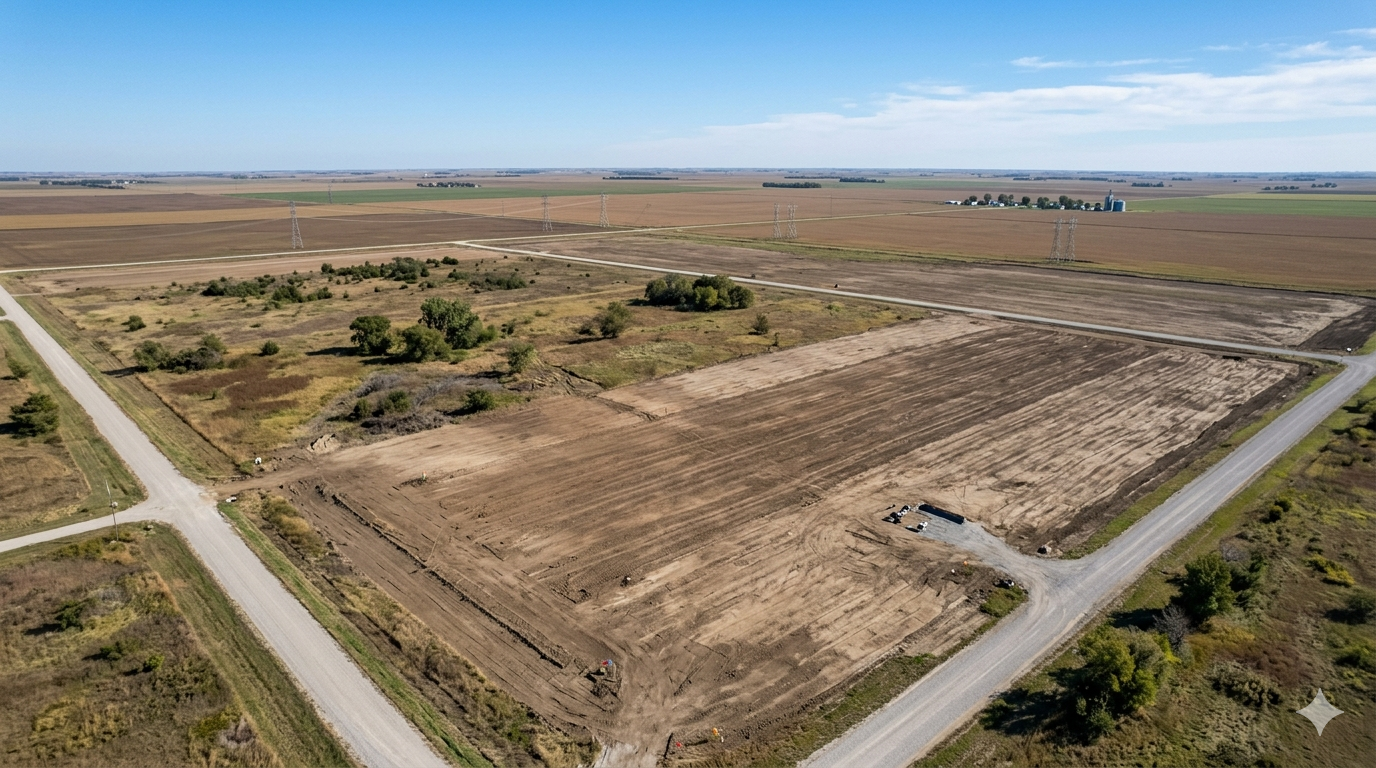
The land problem in AI infrastructure is not about availability. There is no shortage of land in the United States. The problem is, however, build-ready land. Specifically, it requires parcels with confirmed zoning for data center use, proximity to transmission infrastructure, access to water, and environmental clearance. A utility relationship that makes grid interconnection achievable within an investable planning horizon is also essential.

That combination, once relatively straightforward to assemble in tier-1 markets, is now effectively sold out in the locations that matter most. The change has, moreover, happened faster than most of the industry anticipated.
What This Means for Where AI Infrastructure Gets Built Next
The immediate consequence is geographic dispersal. Developers who cannot find build-ready land in tier-1 markets are moving to markets that were previously considered secondary. In many cases, those markets are proving to be more viable than their prior reputations suggested.
The development activity moving into these markets is not a second-best outcome for developers who failed to secure land in Virginia or Texas. It is, increasingly, a deliberate strategic choice. The genuine operational advantages of building in markets with less congestion, lower construction costs, and less strained utility relationships are real and growing.

Columbus and the Rise of Tier-2 Markets
Northern Virginia, which hosts the highest concentration of data center capacity in the world, no longer has meaningfully available build-ready parcels at scale. Phoenix and Dallas, the markets that absorbed the overflow over the past five years, are consequently running into the same constraints. The developers who recognised this earliest spent 2022 and 2023 acquiring land aggressively in these markets. They paid prices that seemed expensive at the time. Those prices have since proven to be well below what equivalent parcels would cost today. That window is, consequently, closed. The market has moved on.
Columbus, Ohio is one of the clearest examples of what comes next. Available land, utility infrastructure that can accommodate large industrial loads, and proximity to the Midwest’s fibre backbone have together made it one of the most active development markets in the country. A regulatory environment explicitly welcoming to data center investment has, furthermore, helped accelerate that momentum. Kansas City, Indianapolis, and Salt Lake City are, moreover, following a similar trajectory. Each has characteristics that make it attractive as a substitute for tier-1 markets where land is either unavailable or priced beyond viable project economics.
The Brownfield Opportunity That Is Getting Serious Attention
Beyond secondary markets, the brownfield opportunity is attracting more serious attention than at any previous point in data center development history. Former industrial sites, decommissioned power plants, closed manufacturing facilities, and retired logistics properties all represent parcels with genuinely attractive characteristics for data center development. Large footprints, existing heavy electrical infrastructure, and established utility relationships are all present. Industrial zoning either already accommodates data center use or can be amended more quickly than virgin land can be permitted.
The appeal of brownfield sites is not just about land availability. It is, rather, about the infrastructure that comes with them. A decommissioned power plant may have transmission connections sized for hundreds of megawatts. Building those connections from scratch would take years and hundreds of millions of dollars. Prologis, which owns large portfolios of industrial real estate across the United States, has been among the most visible advocates for this proposition. Logistics real estate, in its view, is a bridge between energy and digital infrastructure with the site characteristics to support both.
The conversion of these sites is not without challenges. Environmental remediation, structural assessments, and infrastructure adaptation all add cost and timeline compared to greenfield development. In markets where greenfield build-ready land has effectively disappeared, however, a brownfield site is often the faster route. Eighteen months of remediation beats five years in the interconnection queue.
International Markets Are Absorbing Demand That Domestic Land Cannot
The land constraint in US tier-1 markets is also accelerating the internationalisation of AI infrastructure investment in ways that go beyond the geographic diversification strategies that hyperscalers have always maintained. The demand flowing into European markets is partly driven by data sovereignty requirements. It is, however, also driven by a simpler recognition: US markets are constrained while European alternatives remain more accessible.
Ireland, the Netherlands, and the Nordic countries have, consequently, absorbed significant AI infrastructure investment over the past three years. The regulatory environments are not without complications. They have, however, established approval processes that are more predictable than the increasingly contested processes in US markets.
The Emerging Market Land Opportunity
The Gulf states are emerging as a more significant land opportunity than their infrastructure history might suggest. Saudi Arabia and the UAE have made land availability for AI infrastructure a national strategic priority. Dedicated economic zones, streamlined permitting processes, and utility commitments together provide confirmed power access and available build-ready land. US tier-1 markets can no longer reliably offer that combination. As we have covered in our analysis of the Gulf’s digital recalibration, sovereign capital, available land, and abundant power are attracting hyperscaler investment that would previously have defaulted to US locations.
India’s data center land situation is more complex, as we have covered in our analysis of why India’s data center boom is an execution problem. Land availability is less the binding constraint there than power access and the bureaucratic complexity of land acquisition across different state regulatory frameworks. However, for developers who have successfully navigated those constraints, India offers large parcels at prices that make US tier-1 markets look extraordinary by comparison.
What Developers Are Actually Doing About It
The most sophisticated data center developers are responding through a combination of strategies that reflect a more systematic approach to land acquisition than the market has previously required. Forward land banking is becoming standard practice. Developers acquire parcels three to five years before planned development, carrying land costs on the conviction that demand will justify the investment. That approach requires capital commitment and long-term thinking that smaller developers cannot sustain. It is one reason, consequently, that the land acquisition market has become increasingly dominated by large platforms and well-capitalised REITs.
Vertical development is, furthermore, attracting renewed interest as a response to land scarcity in urban-adjacent markets. Multi-storey data center designs that stack capacity on smaller footprints are more expensive to build than single-storey campuses. They are also more complex to cool at high density. In markets where a ten-acre parcel is simply not available at any price, however, building vertically is not a preference. It is a necessity. Several operators in Singapore, Hong Kong, and Tokyo have been building and operating multi-storey facilities for years. Land constraints in those markets made it a necessity rather than a preference. Their experience is, in turn, now being applied in US markets where equivalent pressures are arriving for the first time. The learning curve, in other words, does not need to be repeated.
The Long-Term Structural Implication
The land constraint is, notably, not a temporary shortage that will resolve as markets equilibrate. It is a structural feature of the AI infrastructure buildout that will shape the competitive landscape for the next decade. The developers who built land banks in tier-1 markets before the current demand wave made those positions prohibitively expensive are sitting on assets whose value will continue to appreciate. Those who did not are, consequently, competing for a diminishing supply of alternatives in secondary markets and international locations that come with their own complexities.
As we have covered in our analysis of how data centers are becoming power infrastructure companies, the operators building durable competitive positions in AI infrastructure treat land, power, and connectivity as strategic assets to be secured in advance rather than procurement inputs to be sourced when needed. Build-ready land in the markets that matter is not, in other words, coming back. The question for every developer in this market is whether they recognised that fact early enough to do something about it.












