
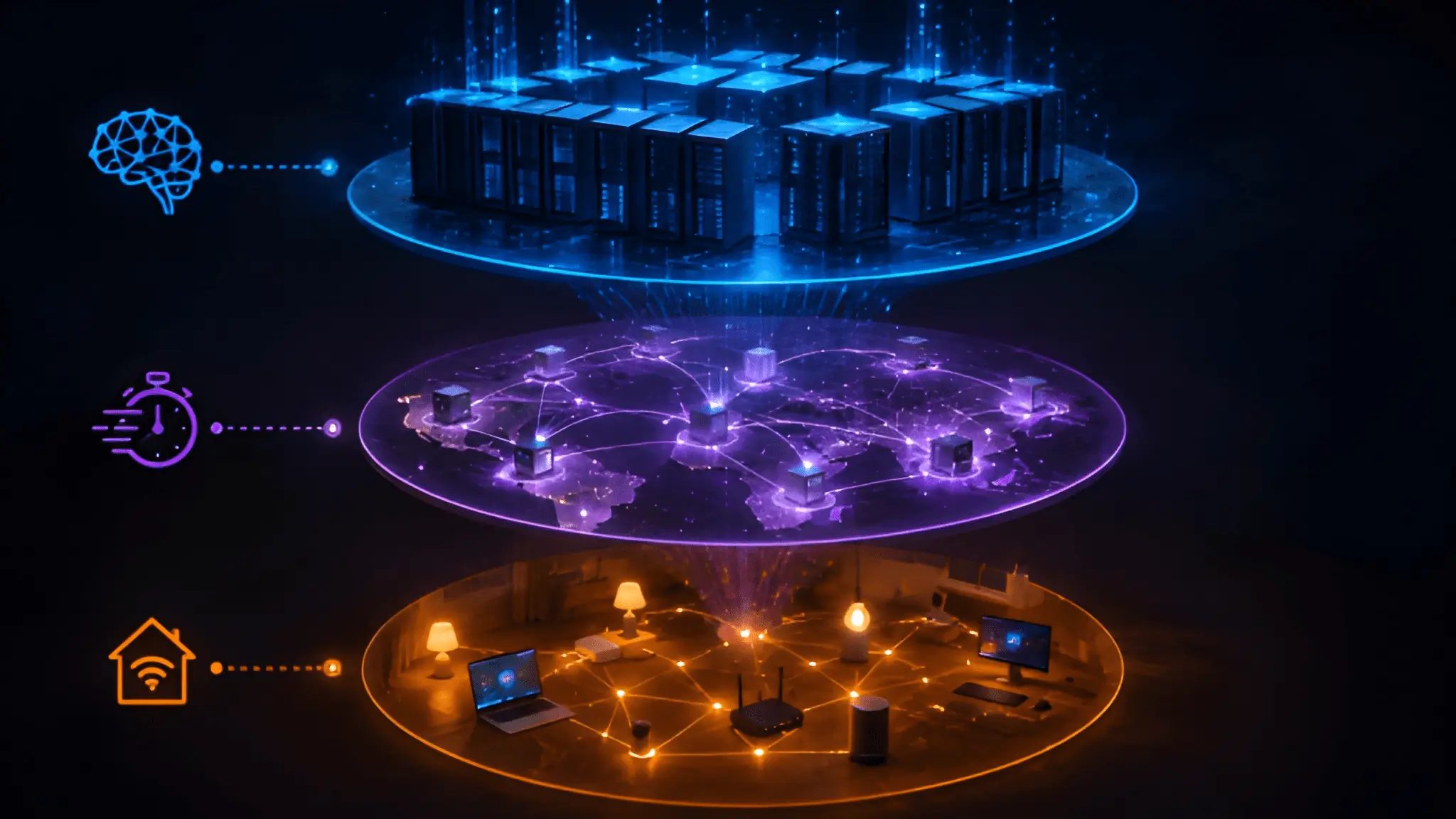
The next shift in AI infrastructure may not arrive as another larger machine, a faster accelerator, or a more imposing computing site, but as a change in where work is allowed to exist. A model can demand tightly synchronized resources while it learns, yet the same model can later need to answer a request close to where that request originates, and another class of work may care less about immediacy than about finding spare capacity whenever it appears. Those requirements do not describe one infrastructure personality because each one places a different value on coordination, proximity, continuity, and control. The resulting architecture can increasingly be understood as a distributed stack in which different computing environments accept different requirements for coordination, proximity, continuity, and resource availability.

Training Needs Cohesion, Inference Needs Proximity
The training and inference may use the same model family, but their infrastructure behavior can diverge sharply once the workload enters production. Training repeatedly coordinates computation across a large collection of accelerators, which makes communication patterns, synchronization, memory access, and network behavior part of the computational problem rather than secondary infrastructure details. A training system therefore. benefits from a tightly controlled environment in which the scheduler can reason about the participating machines with relatively stable assumptions. Inference reverses several of those priorities because the value of a response can depend on how quickly the system receives a request, where the relevant data sits, and whether a nearby resource can execute the required model without sending the interaction through a distant central environment. That does not mean every inference request belongs at the edge, since larger models, sensitive data, accelerator availability, and operational constraints can still favor centralized execution.
The missing category appears when a workload has neither the synchronization demands of training nor the immediacy requirements of interactive inference. Background model evaluation, asynchronous data processing, batch transformation, rendering, experimentation, indexing, synthetic-data preparation, and other flexible jobs can often accept a machine disappearing without turning the entire operation into a failure. That tolerance changes the economics of placement because the system no longer needs to reserve every resource as though it will remain continuously available. A scheduler can instead search for capacity across a wider and less predictable pool, provided the application can checkpoint state, resume safely, divide work into recoverable units, and move execution without corrupting results. Research into distributed and edge-cloud scheduling reflects this broader direction by treating heterogeneous resources and changing availability as conditions that the scheduler must actively incorporate into placement decisions.
Design For Interruption, Not Uptime
Designing for interruption requires the workload itself to expose a boundary at which execution can safely stop. That boundary might sit between independent tasks, inside a checkpointed computation, or around a unit of work whose output can be validated before the scheduler releases the machine. The precise implementation varies by workload, but the architectural principle remains consistent: losing a worker must not imply losing the work already completed on that worker. A scheduler can then treat availability as a variable rather than a promise, assigning tasks to machines according to the conditions visible at that moment and moving unfinished work when those conditions change. The system also needs to distinguish between a transient disappearance and a trust failure because an unavailable machine may simply have gone offline, while a machine that returns with an altered software state may require a completely different response.
A machine can contribute when its conditions fit the workload, relinquish the job when those conditions change, and later rejoin after the platform establishes that it remains trustworthy. Such a system needs more than a list of available processors because capacity without trustworthy execution has little value when the workload contains sensitive data, proprietary model artifacts, or credentials that cannot safely enter an unknown environment. The scheduler must therefore combine resource discovery with identity, software-state verification, policy evaluation, and short-lived authorization so that eligibility can change as the machine changes. Hardware-backed evidence can help establish that a particular machine is running an expected configuration, while cryptographic controls can limit what the machine receives and how long it can retain access.
The Stack Becomes A System Of Behaviors
Training clusters anchor workloads that demand coordination, predictable communication, sustained accelerator availability, and tightly managed execution. Regional computing handles work for which proximity, responsiveness, and data locality matter more than maximum centralized scale, allowing inference and other latency-sensitive services to operate closer to their users and data sources. Emerging distributed compute models can introduce another behavior by accepting intermittent resource availability for workloads that can pause, checkpoint, relocate, and resume without requiring continuous access to one machine. This broader distributed model therefore divides the problem according to workload behavior rather than forcing every application into the same infrastructure model. A distributed-cloud architecture already recognizes distinctions between core, regional, and edge resources, but the residential layer pushes that idea further by making interruption itself an explicit design assumption.

The significance of the emerging distributed layer lies in what it changes above the hardware. Applications increasingly need to declare their tolerance for latency, interruption, state movement, locality, security requirements, and resource variability so that schedulers can place them intelligently. Infrastructure then becomes less about assigning a permanent home to a workload and more about maintaining a set of trustworthy execution options that can change over time. That model does not weaken the role of large centralized computing because tightly coupled training still depends on infrastructure designed around coordination and predictable performance. Regional systems remain essential because interactive inference cannot treat every request as a background job waiting for whichever machine becomes available.
Campuses Anchor What Must Stay Together
Training remains fundamentally different from flexible distributed computing because the workload can depend on many resources behaving as a coordinated system rather than as independent workers. The value of the training environment therefore comes from more than processor availability, since network topology, memory movement, synchronization behavior, storage paths, accelerator communication, and software consistency can all influence whether the computation progresses efficiently. A scheduler that moves individual training components casually across unpredictable resources could introduce communication costs or state-management complexity that outweigh the apparent benefit of finding additional capacity. Centralized environments consequently retain a structural role even as computing spreads outward because some workloads benefit from being kept close to the resources that must operate together. This role does not disappear when regional and residential layers mature because distributed infrastructure works best when it preserves strong coordination where coordination creates value rather than treating every workload as infinitely movable.
Regional computing then takes responsibility for a different question: how close should computation be to the point where its result matters? Inference can involve repeated interaction between an application and a model, making network distance, routing paths, congestion, data locality, and available model state relevant to the quality of the experience. A regional layer can absorb this requirement without forcing every interactive request toward a distant centralized environment, while still retaining stronger operational control than a residential machine can provide. The layer can also act as a transition point between centralized model development and distributed execution, receiving updated models or model components from larger environments and serving them closer to applications that require predictable access. The three-layer model consequently becomes clearer when viewed as a sequence of workload personalities rather than a geographic hierarchy, with each layer accepting the constraints that make its particular form of computing useful.
Residential Capacity Absorbs What Can Move
Intermittently available computing becomes more suitable when the scheduler can identify work that does not require permanent possession of a machine and can resume that work when another eligible resource becomes available. That requirement favors jobs with explicit checkpoints, recoverable state, bounded execution units, and outputs that another machine can validate or reproduce without reconstructing the entire computation. It also favors a security model that can establish machine identity and execution state before protected workloads or data reach a participating device, because physical accessibility to a machine does not establish computational trust. Remote attestation can provide evidence about the environment in which a workload intends to execute, while protected execution and controlled key release can restrict access to sensitive material until the destination satisfies defined conditions.
The scheduler can place background work where suitable capacity exists, release that placement when the machine needs to return to its primary purpose, and resume the job elsewhere after verifying the destination. The objective is not maximum utilization at every instant because chasing every available processor can create excessive movement, coordination, validation, and data-transfer costs. Instead, the system should seek useful progress while preserving the ability to abandon a placement when its conditions deteriorate. This principle makes relocation a first-class operation and gives the emerging distributed layer a clear architectural purpose: it absorbs computation that benefits from flexibility without demanding that the rest of the infrastructure become equally flexible. The resulting hybrid model therefore does not require one enormous pool in which every machine appears interchangeable, but can instead coordinate different resource environments according to the workloads they can support.











