 Skip to content
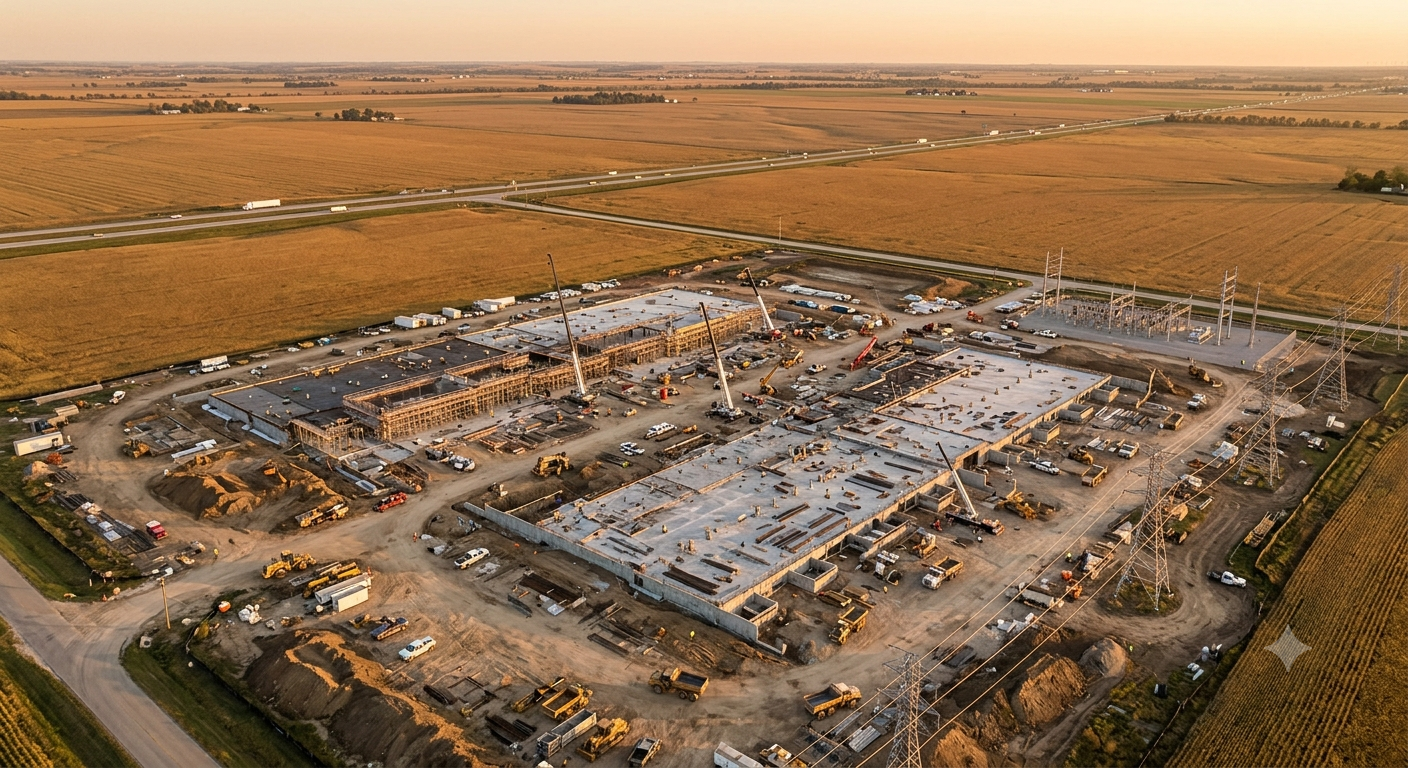
Montgomery County, Missouri has a population of approximately 11,000 people. As of June 2026, it is home to roughly 2,000 acres of committed hyperscale data center infrastructure, backed by a combined $25 billion from two of the world’s largest technology companies. Amazon announced a $10 billion campus on June 15, 2026. Google announced a $15 billion campus on May 20, 2026 the largest single technology investment in Missouri’s history. Neither company chose this location for its proximity to a major city, an established fiber hub, or a dense talent market. Both chose it for the same reason: power availability, scalable land, and a utility partner willing to build a regulatory framework that protects ratepayers while enabling hyperscale growth. Missouri’s emergence as a data center destination is not an anomaly. It is the latest expression of a structural shift in how hyperscalers select sites and it carries implications for every state, utility, and infrastructure investor watching from the sidelines.

Why Montgomery County, Missouri
The New Florence corridor sits roughly 90 minutes west of St. Louis along Interstate 70. It is not a technology hub. It does not have the fiber density of Northern Virginia, the established colocation ecosystem of Dallas-Fort Worth, or the renewable energy profile of the Pacific Northwest. What it has is flat land, available at cost levels that are structurally lower than any saturated primary market, and direct access to Ameren Missouri’s transmission infrastructure a utility that has demonstrated both the willingness and the regulatory framework to accommodate hyperscale power demand at speed.
Amazon’s Project Green occupies approximately 1,000 acres near New Florence, with Google’s campus sitting directly adjacent on more than 900 acres creating a combined 2,000-acre hyperscale corridor in a single rural county. Matt Kimball, vice president and principal analyst at Moor Insights & Strategy, summarized the site selection logic without ambiguity: this is not about Montgomery County or Missouri specifically — it is about power and economics. As data center buildouts in traditional locations stalled due to power constraints, space limitations, and local opposition, hyperscalers began branching outward into markets that could deliver on the fundamentals. Iowa, Ohio, West Texas, and now Missouri represent that outward search in practice. Google’s New Florence campus will occupy more than 900 acres near Interstate 70, directly adjacent to Amazon’s previously announced $35 billion campus. The project represents the largest economic development investment in Ameren Missouri’s service territory.
The Power Framework That Made It Possible
The single most consequential element of both announcements is not the capital figure. It is the power framework both operators agreed to before breaking ground. In most contested data center markets, the question of who pays for grid infrastructure — the operator, the utility, or the general ratepayer has become the primary source of community opposition, regulatory friction, and project delay. Missouri resolved that question before it became a controversy. Google worked with Ameren and Evergy to bring the Capacity Commitment Framework to Missouri, a structure ensuring that large energy customers pay for their own electricity and infrastructure needs, actively protecting local ratepayers and supporting the long-term resilience of the electrical grid. The framework was not pre-existing. Google helped design it, in partnership with the utilities and state regulators, specifically to enable hyperscale deployment without creating the ratepayer backlash that has complicated data center politics in Virginia, Oregon, and Nevada.

Amazon committed to paying 100% of the costs to provide electric service to the Montgomery County campus, including all costs associated with connecting to the energy grid, with no incentives or discounts on electric rates. That commitment directly addresses what AI strategist Ihab Osman described as the two questions that now determine whether large data center projects can move: who pays for the infrastructure, and who absorbs the local resource impact. Both Amazon and Google answered those questions in their announcement materials, pre-empting the objections that have stalled comparable projects elsewhere. Google contracted to bring more than one gigawatt of new electricity generation capacity to Missouri, and through its Ameren partnership supported development of at least 500 megawatts of additional capacity. Securing that generation commitment before announcing the campus — rather than applying for grid connection after the fact is precisely the sequencing that avoids the seven-year interconnection queue that now defines constrained primary markets.
Water, Community, and the New Calculus of Social License
Power availability explains why Missouri was selected. The specific commitments both operators made around water, community investment, and ratepayer protection explain why the projects have advanced more smoothly than comparable announcements in more established markets. Google committed to advanced closed-loop, non-evaporative air cooling technology for the campus, limiting water consumption to domestic uses such as kitchens and bathrooms only. The decision eliminates one of the most contentious points of community opposition in data center permitting the large-scale water consumption associated with evaporative cooling towers in water-stressed or drought-prone regions. Missouri is not a water-scarce state, but the commitment signals that Google is engineering to community tolerance, not just operational sufficiency.
Amazon partnered with agricultural technology company Arable Labs to implement irrigation efficiency technology for Missouri farmers, with the project expected to reduce water use by 100 million gallons. That commitment is directly tailored to the agricultural character of Montgomery County a recognition that community acceptance in rural markets requires engaging the economic identity of the region, not merely its regulatory gatekeepers. Google funded the Construction Laborers and Contractors Joint Training Fund to train more than 2,300 laborers, including 1,500 apprentices, over the next two years, and established a $20 million Energy Impact Fund to reduce household utility bills across Montgomery, Clay, Platte, and surrounding counties. These are not peripheral gestures. They are structured responses to the political economy of rural hyperscale deployment — ensuring that economic benefits reach residents who will not be directly employed by the facility but who will live alongside its power infrastructure for decades.
The Cluster Dynamic and What Follows
Kimball identified a pattern worth monitoring: one data center stakes out a claim in a region and others follow a cluster or copycat dynamic that has played out repeatedly in Northern Virginia, Dallas-Fort Worth, and Central Ohio. That dynamic is now visible in Missouri. Google announced its campus one month after Amazon’s Project Green became public knowledge. The two campuses sit directly adjacent. Whether a third hyperscaler follows or whether a colocation provider enters Montgomery County to serve the ecosystem created by two anchor tenants will determine whether the county becomes a sustained data center market or a bilateral infrastructure commitment.
Governor Mike Kehoe described Google’s investment as a testament to Missouri’s growing reputation as a premier destination for innovation and next-generation technology. The state government’s role has been active rather than passive. Governor Kehoe’s Executive Order 26-02, signed in January 2026, directed the Missouri Department of Natural Resources to investigate energy regulations and infrastructure planning to support data center power needs, with findings due to the Governor’s Office by November 30, 2026. That forward-looking regulatory posture anticipating infrastructure requirements before projects are announced rather than reacting to them after is part of what distinguishes Missouri’s current position from states that have been caught off-guard by hyperscale demand.
Missouri’s position in the national data center landscape as of mid-2026 is clear: a rural state with a cooperative utility, available land, and a state government actively aligning regulatory frameworks to accommodate hyperscale deployment has captured $25 billion in committed investment in under thirty days. The site selection variables that determined that outcome power procurement sequencing, ratepayer protection frameworks, water commitment design, and community investment structures are replicable. States and utilities that study the Missouri model carefully, and move to replicate its conditions before their competing neighbors do, are the ones most likely to capture the next wave of hyperscale capital searching for exactly what Montgomery County provided.










