
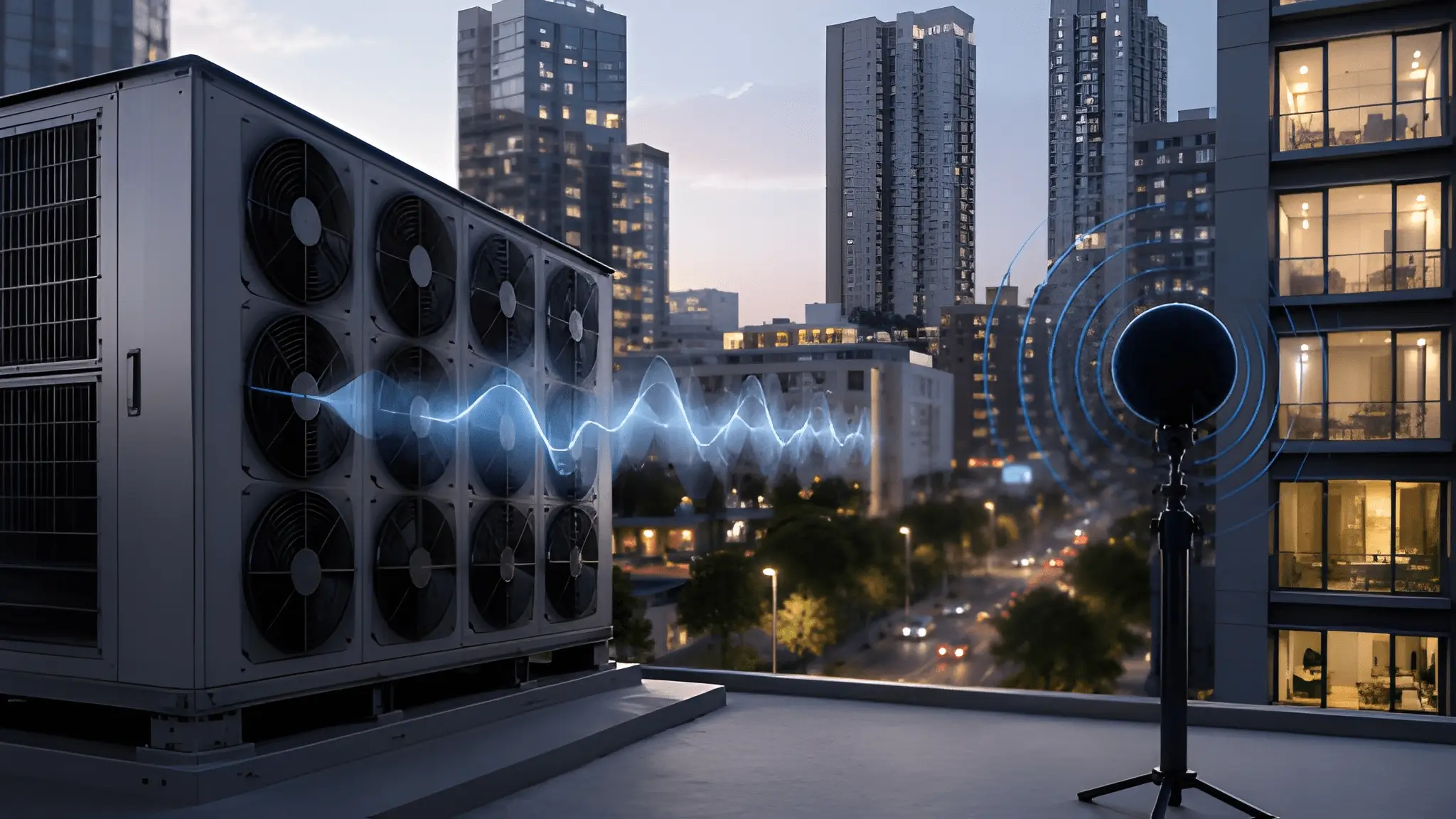
Cooling equipment rarely becomes the first topic during infrastructure planning meetings, yet it often determines whether an urban deployment survives the approval process. Edge computing strategies continue moving closer to population centers because latency objectives, service resiliency, and regional processing requirements increasingly favor distributed capacity instead of centralized campuses. Mechanical systems that comfortably operate inside remote industrial parks frequently encounter very different operating conditions once they move beside residential buildings, mixed-use developments, hospitals, or educational facilities. Air-cooled retrofits appear attractive because they avoid extensive water infrastructure and often reduce installation complexity inside existing facilities. Acoustic performance, however, is routinely evaluated alongside other environmental considerations during municipal reviews where exterior mechanical equipment is subject to local noise regulations. Infrastructure teams that overlook neighborhood sound limits frequently discover that engineering success alone cannot guarantee project approval.

Urban regulations increasingly evaluate environmental compatibility rather than treating mechanical upgrades as isolated engineering exercises. Local authorities regularly examine equipment noise alongside transportation impacts, construction schedules, emergency access, and neighborhood planning objectives before issuing mechanical approvals. High-volume cooling fans produce broadband sound signatures that propagate differently from ordinary rooftop equipment, particularly during overnight operating conditions when ambient sound levels decline. Edge deployments operating continuously cannot simply reduce fan speeds after business hours without affecting thermal stability and equipment reliability. Design decisions therefore require collaboration between mechanical engineers, acoustic specialists, architects, and planning consultants from the earliest feasibility stages. Organizations pursuing distributed infrastructure increasingly recognize that compliance begins with understanding the surrounding acoustic environment instead of selecting cooling hardware alone.
Sound Shadows and Street Canyons: Why Your Site Survey Missed It
Acoustic behavior inside dense urban environments rarely resembles the simplified assumptions used during preliminary mechanical design exercises. Buildings positioned closely together create reflective corridors commonly described as street canyons, allowing sound energy to travel farther than expected while altering perceived noise distribution across surrounding properties. Localized sound shadows may reduce measured levels at one location even as neighboring façades experience increased reflections that amplify exposure. Conventional site surveys conducted during daytime conditions may fail to capture nighttime propagation characteristics when reduced background activity makes mechanical equipment more noticeable. Wind direction, humidity, temperature gradients, and façade materials further influence how broadband fan noise travels through confined city spaces. Infrastructure planners therefore require location-specific acoustic modeling instead of depending solely upon generalized environmental assumptions during feasibility assessments.
Simulation software has advanced significantly, yet predictive accuracy still depends upon the quality of surrounding environmental inputs rather than computational sophistication alone. Three-dimensional building geometry, rooftop elevations, reflective materials, vegetation density, and neighboring mechanical systems all influence the final acoustic outcome after equipment enters continuous service. Small orientation changes involving discharge louvers or fan placement occasionally produce larger neighborhood impacts than modest increases in equipment sound power ratings. Meanwhile, post-installation measurements sometimes reveal compliance failures even though preconstruction calculations satisfied regulatory thresholds under idealized assumptions. Engineering teams increasingly supplement digital predictions with detailed field measurements, seasonal environmental observations, and iterative modeling before committing to equipment layouts. Urban edge developments benefit when acoustic validation becomes an ongoing engineering process instead of a single compliance document prepared during early project planning.

The Permit You Didn’t File: Acoustic Impact Assessments
Municipal permitting frameworks increasingly recognize acoustics as an environmental consideration rather than merely a post-construction operational concern. Some municipalities require environmental or acoustic assessments for projects involving exterior mechanical equipment, particularly when developments are located near noise-sensitive land uses or are subject to local environmental review requirements. Acoustic impact assessments typically evaluate predicted sound propagation, property-line exposure, tonal characteristics, operating schedules, and cumulative contributions from all permanent mechanical systems instead of assessing each asset independently. Review authorities may request design revisions before issuing approvals when predictive models indicate potential exceedances under normal operating conditions. Therefore, project schedules can be affected when regulatory authorities request additional acoustic documentation after mechanical designs have been submitted for review. Development teams reduce permitting uncertainty by integrating environmental acoustics alongside structural, electrical, and thermal engineering during the earliest planning activities.
Skipping formal acoustic evaluations may create downstream complications even after equipment installation reaches physical completion. Building inspectors or municipal authorities can require additional mitigation measures when operational measurements fail to align with approved environmental assumptions or applicable local regulations. Corrective actions often involve replacing fans, adding silencers, modifying discharge configurations, constructing acoustic screens, or restricting operating schedules after commissioning has already concluded. Such modifications increase capital expenditure while extending project timelines and introducing operational disruption that could have been avoided through earlier assessment. Mechanical permits rarely function as permanent protection against subsequent compliance reviews because regulatory obligations continue throughout facility operation. Organizations pursuing urban infrastructure deployments increasingly view acoustic impact assessments as practical risk management tools instead of administrative documentation alone.
Decibel Data as Due Diligence: What Landlords Are Now Demanding
Commercial property negotiations increasingly extend beyond electrical availability, floor loading, ceiling heights, and connectivity because landlords also evaluate operational compatibility with neighboring occupants. Mixed-use developments frequently combine offices, residential units, hospitality facilities, retail spaces, and healthcare services within the same property boundaries, making environmental performance an important leasing consideration. Property owners commonly seek assurance that long-term mechanical operations will comply with applicable noise requirements and minimize the potential for tenant complaints or regulatory issues. Lease negotiations may therefore include acoustic performance obligations supported by commissioning documentation, operational testing, and continuing compliance verification. Additionally, property owners and project reviewers may request technical documentation demonstrating expected sound levels before approving rooftop mechanical equipment in acoustically sensitive locations. Infrastructure providers entering competitive urban markets benefit from presenting quantified acoustic performance alongside conventional engineering specifications during commercial negotiations.
Continuous monitoring technologies also reshape how property owners manage long-term operational risk after facilities become fully occupied. Digital building platforms increasingly integrate environmental sensors capable of tracking equipment performance alongside energy consumption, vibration, temperature, and selected acoustic indicators where lease agreements require ongoing verification. Recorded operational data provides objective evidence whenever disputes arise regarding perceived equipment noise or changing neighborhood conditions over time. These datasets also support preventive maintenance because deteriorating bearings, airflow restrictions, or mechanical imbalance often alter acoustic signatures before larger reliability issues emerge. Reliable measurement practices nevertheless require calibrated instrumentation, defined monitoring methodologies, and clearly documented contractual thresholds to remain technically defensible. Urban infrastructure projects increasingly demonstrate that measurable environmental performance carries commercial value comparable to traditional operational reliability and energy efficiency.
The New Quiet Zone: Rethinking Urban Edge Without the Fans
Urban edge infrastructure planning increasingly begins with location-specific environmental constraints instead of assuming every site can accommodate the same mechanical architecture. Cooling strategies now compete alongside planning regulations, electrical availability, structural limitations, and community compatibility as equally influential design considerations during project development. Facilities located within acoustically sensitive districts may benefit from evaluating alternative thermal management approaches where conventional high-airflow fan systems present compliance challenges under applicable local noise requirements. Design flexibility becomes especially valuable because different neighborhoods can present substantially different acoustic conditions despite sharing similar electrical and spatial characteristics. Selecting the appropriate cooling architecture therefore depends upon understanding the surrounding operating environment before equipment procurement begins. Engineering decisions achieve stronger long-term outcomes when acoustics become a primary site selection parameter rather than a compliance exercise performed after the design reaches maturity.
Urban deployment strategies will continue evolving as computing demand expands across metropolitan regions, but environmental compatibility will remain closely connected with project viability. Mechanical innovation alone cannot resolve every deployment challenge because regulatory expectations increasingly reflect broader concerns surrounding livability, predictable operations, and responsible infrastructure integration within populated communities. Successful projects will likely emerge from multidisciplinary planning that combines thermal engineering, acoustics, structural analysis, permitting expertise, and operational forecasting into a unified development process. Ultimately, incorporating acoustic evaluation early in the engineering process helps organizations identify potential compliance issues before construction and supports more informed infrastructure planning. Technical due diligence gains measurable value when every engineering assumption receives validation against real operating conditions instead of theoretical design intent alone. Urban edge infrastructure can continue expanding responsibly when acoustic performance becomes an engineering requirement from the first site survey through the entire operational lifecycle.











