Skip to content
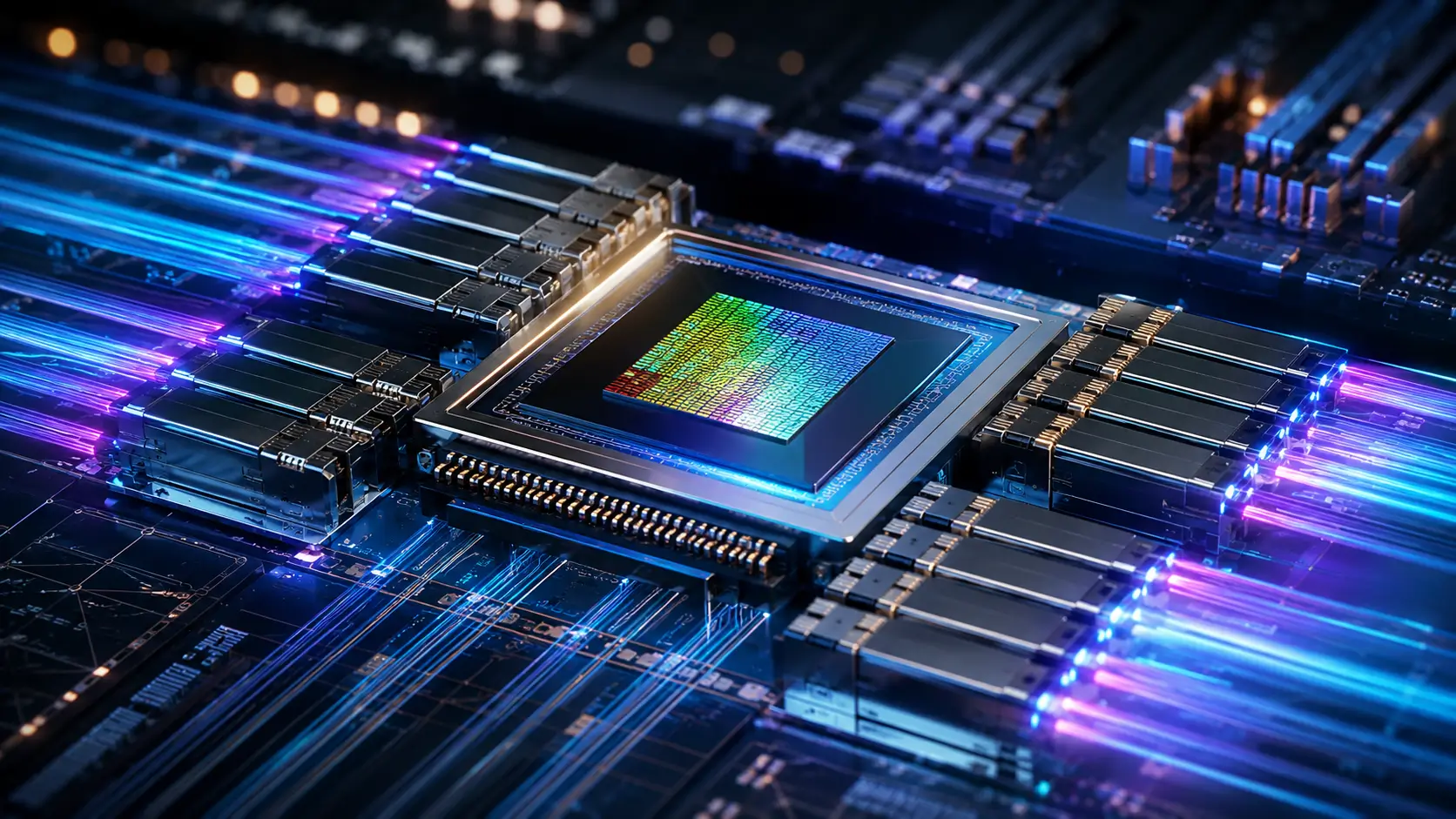
A large AI cluster can deliver enormous compute capacity while still losing efficiency when data cannot move between resources quickly enough. Thousands of accelerators, memory devices, switches, and storage systems must exchange information continuously during training and inference workloads. That traffic creates pressure on bandwidth, latency, power consumption, packaging, cabling, and network design at several levels. The discussion around AI infrastructure is therefore shifting from processor capability toward the engineering required to connect those processors effectively. Silicon photonics, co-packaged optics, and optical I/O address important parts of that challenge, but they do not eliminate physical connectivity. For infrastructure operators, the important question is how connectivity architecture will influence performance, serviceability, expansion, and operating costs as clusters become more demanding.

Why Data Movement Has Become an Infrastructure Constraint
AI workloads create a demanding networking profile because distributed accelerators frequently exchange large quantities of information rather than operating as isolated compute resources. Training systems distribute model parameters, gradients, activations, and other data across processors, making communication performance directly relevant to overall cluster utilization. Optical networking has emerged because electrical connections face practical limits involving bandwidth density, reach, signal integrity, and energy consumption. Intel describes silicon photonics as a technology that combines integrated photonics with silicon manufacturing to provide high-bandwidth connectivity with greater reach. STMicroelectronics similarly identifies 800Gbps and 1.6Tbps optical interconnects as important targets for data-center and AI-cluster connectivity. These developments highlight why network architecture has become an important engineering consideration alongside compute, memory, and power systems in AI infrastructure.
From an end-user perspective, the problem appears as wasted compute capacity rather than as a networking specification. A processor that waits for data cannot deliver the same useful throughput as one receiving information at the required rate. Network congestion can also create uneven utilization across a cluster, complicating capacity planning and making performance less predictable for large workloads. Optical links can increase bandwidth and extend reach, yet operators still need to manage cables, connectors, transceivers, switch placement, and physical routing. The resulting infrastructure remains a carefully engineered collection of components whose physical arrangement affects reliability and maintenance. That reality makes connectivity design an operational concern rather than a narrow component-level decision for semiconductor or networking teams.
Silicon Photonics Moves Optics Closer to Compute
Silicon photonics changes the location and integration model of optical connectivity by bringing photonic functions closer to switching and computing silicon. Traditional optical modules place conversion components away from the switch ASIC, requiring electrical signals to travel across part of the system before reaching the optics. Co-packaged designs shorten that electrical path by placing optical components directly alongside switching silicon within the package architecture. NVIDIA reports that its silicon-photonics switching approach can reduce power consumption compared with conventional pluggable transceiver designs while also reducing signal-path length. Intel has demonstrated an optical compute interconnect chiplet co-packaged with a processor, showing how optical I/O can become part of the computing package itself. For system architects, this evolution matters because connectivity can increasingly become an element of processor and switch design rather than an external attachment.

The shift toward integrated optics does not mean conventional networking equipment immediately disappears from production environments. Operators must balance bandwidth requirements against deployment flexibility, replacement procedures, component availability, and the maturity of manufacturing ecosystems. Pluggable optics remain attractive because they allow individual modules to be replaced without replacing an entire switch or compute package. Co-packaged optics can shorten signal paths, but integration also changes how technicians diagnose and service failures inside the system. NVIDIA’s architecture separates the laser source from the optical engine, an approach that can support access to the laser components without placing the laser itself alongside the switch ASIC. End users therefore need to evaluate not only peak bandwidth but also how each connectivity architecture affects serviceability, replacement procedures, upgrade paths, and operational requirements.
The Cable Problem Extends Beyond Bandwidth
Increasing optical bandwidth solves one part of the connectivity equation, but it does not remove the physical infrastructure required to deliver those signals between endpoints. Deployed optical links still require fiber routing, connectors, optical assemblies, and physical organization within racks or between equipment locations. Higher-density systems can increase the importance of cable management because installation access and airflow pathways become more difficult to preserve as connectivity density rises. Marvell’s work on 1.6T silicon-photonics light engines illustrates the industry’s effort to support rack-scale AI networking while reducing electrical limitations associated with longer passive copper connections. The engineering objective therefore extends beyond raw throughput toward a system that can deliver bandwidth without creating disproportionate installation and operational complexity. For customers deploying large AI environments, that distinction becomes important because network expansion can influence physical layout, routing capacity, equipment placement, and future installation requirements.
Serviceability introduces another constraint that performance specifications alone cannot capture. A connectivity component can meet bandwidth requirements while still creating operational friction if technicians cannot easily access, isolate, replace, or validate it. Physical connections also create dependencies between equipment placement and network topology, which can make future expansion more complicated when the original layout leaves limited routing capacity. AI clusters amplify these considerations because higher accelerator counts require more communication paths and greater coordination between compute, switching, and optical infrastructure. A scalable architecture must therefore account for installation effort, fault isolation, spare components, connector reliability, and the physical accessibility of critical interfaces. Those requirements place greater emphasis on designing connectivity as an operational system rather than treating each cable or optical module as an independent component.
What Comes After Faster Interconnects?
An important architectural question is how AI systems can combine fixed physical connectivity with increasingly flexible optical networking approaches. Photonic technologies can improve bandwidth and energy efficiency, but physical optical links still require installation, routing, monitoring, maintenance, and eventual replacement. Optical circuit switching offers another direction by allowing optical paths to be reconfigured rather than permanently assigning every resource to fixed physical connections. Research into photonic fabrics describes architectures designed to provide flexible optical connectivity between distributed computing resources. Such architectures could support more dynamic allocation of compute and memory resources when workloads change their communication requirements. The practical value for end users would come from better resource utilization and simpler scaling rather than from optical technology itself.
This direction also changes how infrastructure teams should evaluate future AI platforms. Instead of comparing accelerators only through compute performance, buyers increasingly need to examine how processors communicate, how networks scale, and how connectivity behaves under sustained workload pressure. A platform with exceptional accelerator specifications may deliver limited practical value if its communication architecture cannot maintain efficient data exchange across the intended cluster size. Conversely, a carefully balanced system can extract more useful performance from its compute resources when networking, memory, packaging, and power systems operate within compatible limits. The practical issue is how copper, optical modules, silicon photonics, and optical switching can be combined across different connectivity requirements. The more useful question for C-level decision makers is which architecture can provide predictable performance while controlling deployment complexity, operating expenditure, maintenance requirements, and future expansion constraints.
Designing AI Infrastructure Around the End User
For infrastructure customers, connectivity decisions ultimately translate into application performance, capacity utilization, reliability, and the economics of operating an AI cluster. Training teams care about completing workloads efficiently, while inference operators need predictable latency and sufficient capacity during changing demand patterns. Facilities teams must also account for power and cooling implications because higher-density networking equipment contributes to the overall infrastructure load. Procurement teams face another challenge because emerging optical architectures depend on component availability, manufacturing maturity, standards, and supplier ecosystems. These concerns can make connectivity a cross-functional decision involving engineering, operations, procurement, facilities, and financial leadership rather than a choice limited to network specialists. A successful architecture should therefore be measured against the workload and operating model it supports instead of against an isolated bandwidth figure.
The broader lesson is that AI infrastructure cannot scale efficiently by adding compute alone when communication becomes a limiting factor. Silicon photonics and co-packaged optics provide credible approaches for increasing bandwidth density and reducing some electrical connectivity constraints. Optical I/O can move communication functions closer to processors, while optical switching may eventually provide more flexible ways to connect distributed resources. None of these technologies removes the need for disciplined physical design, because connectors, packaging, service access, thermal conditions, and installation practices still influence operational outcomes. Infrastructure leaders should therefore treat connectivity architecture as a long-term platform decision that affects performance, expansion, reliability, and total cost of ownership. Planning around those constraints can help organizations improve compute utilization and reduce avoidable infrastructure bottlenecks without assuming that faster processors alone will solve the next connectivity challenge.