 Skip to content
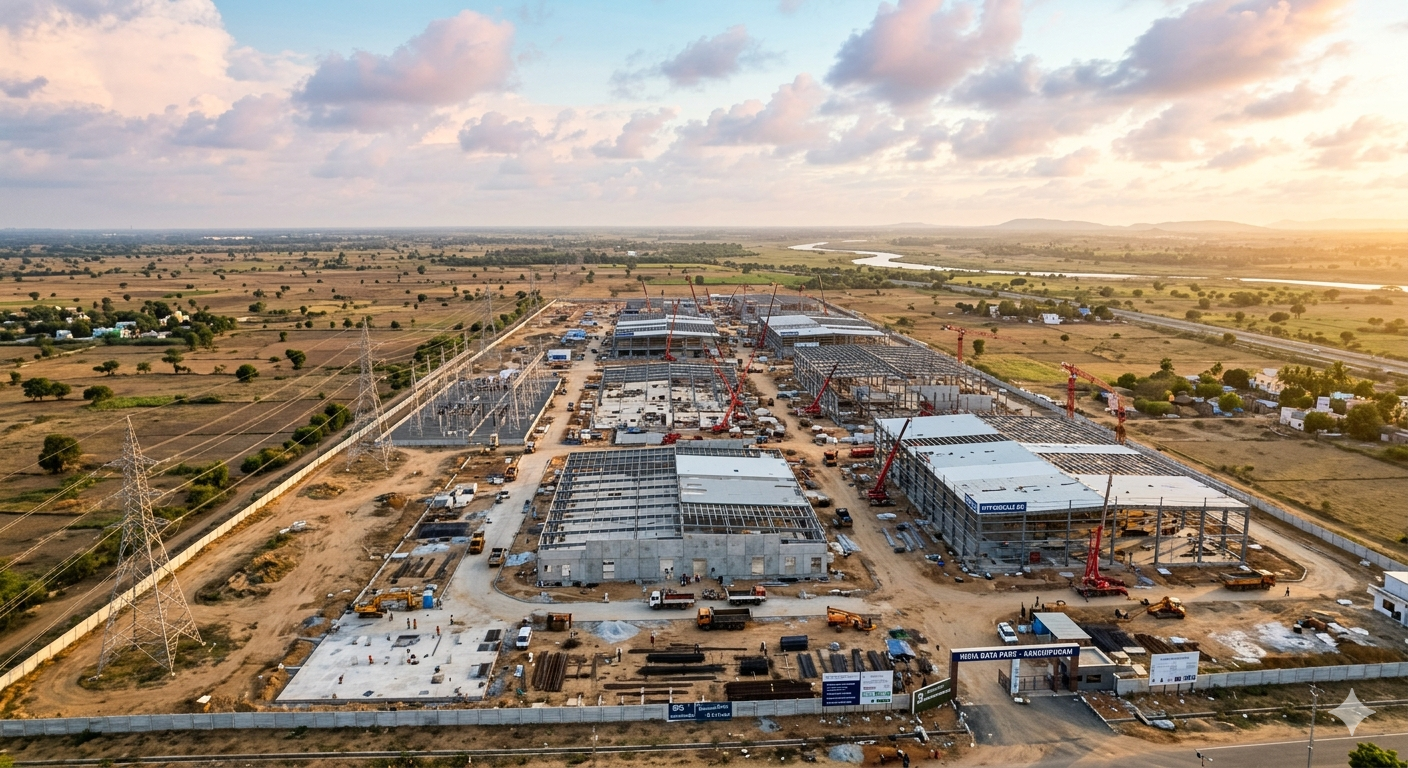
On February 1, 2026, India’s Finance Minister Nirmala Sitharaman presented a Union Budget that contained a clause with implications extending well beyond a single fiscal year. Buried within the direct tax proposals was a 21-year tax holiday for foreign companies that use Indian data centers to serve global clients effective immediately and running through March 31, 2047. Paired with a 15% safe harbor provision for transfer pricing and capital incentives of 25 to 35% for green technologies, the framework represents the most structurally significant data center policy initiative India has ever introduced. For hyperscalers, institutional investors, and enterprise decision-makers tracking the next phase of global AI infrastructure, this budget clause deserves close and careful reading.

The Policy Framework in Detail
The tax holiday introduced under the Finance Bill 2026 is not a standard incentive. The Finance Ministry has formally classified data centers as essential infrastructure, placing them in the same policy category as power grids and national highways a classification that carries regulatory weight beyond the tax exemption itself.
The exemption operates through a structured eligibility framework. A foreign company qualifies if it is formally notified under the relevant provisions, procures data center services from an Indian company operating a notified facility, and delivers services to Indian customers exclusively through an Indian reseller entity. The mechanism is designed to ensure that the tax benefit flows through Indian infrastructure rather than being captured by offshore arrangements. Cloud services delivered via qualifying Indian data centers are carved out of the Indian tax base entirely, replacing interpretational risk around nexus and attribution with a condition-based legislative certainty that legal analysts at S&R Associates and The Legal 500 have described as a structural shift in the risk-return calculus for global investors.
The transfer pricing safe harbor at 15% of cost for associated enterprises providing data center services from India directly addresses one of the most persistent friction points for multinationals operating Indian subsidiaries transfer pricing disputes that have historically created cost uncertainty and compliance burden. Automating that margin removes a material deterrent for foreign cloud providers structuring Indian operations. KPMG’s technology sector analysis of the budget described the combination of the tax holiday and the rationalized transfer pricing framework as proposals seeking structural reform and certainty, rather than headline rate adjustments a characterization that places the measures in the category of long-term investment enablers rather than short-term fiscal concessions.
Why the Timing Is Strategically Significant
The budget landed at a moment when India’s data center market was already accelerating. Installed capacity crossed 1.6 GW in early 2026, up from approximately 950 MW in 2024. Mumbai remains the primary market, with Cushman & Wakefield projecting it will surpass 1 GW of operational capacity alone by end of 2026. Secondary markets Hyderabad, Chennai, Delhi NCR, Pune, and Bengaluru are growing at double-digit rates. India generates approximately 20% of global data against roughly 5.5% of global data center capacity, a demand-supply gap that independently justifies investment regardless of fiscal incentives.
The tax framework does not create India’s data center opportunity the underlying demand fundamentals do. What it does is materially reduce the policy risk premium that has historically slowed foreign capital deployment in Indian digital infrastructure. Mondaq’s legal analysis of the budget described India as having moved from optionality to necessity for global cloud infrastructure strategies. CNBC reported that the 20-year tax exemption positions India as more competitive relative to Singapore, the UAE, and Ireland the three jurisdictions most commonly cited as comparable data center hubs when hyperscalers evaluate Asia-Pacific and emerging market infrastructure strategy.

The state-level policy environment reinforces the national framework. Rajasthan, Karnataka, Telangana, Tamil Nadu, Maharashtra, Odisha, Uttar Pradesh, and Haryana have each formulated state-specific data center policies with their own exemption and incentive packages. The Union Budget tax holiday adds a national layer above these, creating a stacked incentive architecture that gives operators both federal and state-level certainty within a single investment decision.
Capital That Followed the Policy
The hyperscaler response to India’s data center investment environment shaped by both the budget framework and the pre-existing demand fundamentals has been large and accelerating. Microsoft has committed $17.5 billion to Indian data center infrastructure. Google broke ground on its first gigawatt-scale AI hub in Visakhapatnam, Andhra Pradesh, in April 2026 a three-campus complex developed in partnership with AdaniConneX and Nxtra by Airtel, representing the first phase of a $15 billion, five-year investment aligned with the government’s Viksit Bharat 2047 vision. Amazon has signaled up to $35 billion in India by 2030. Meta signed a 168 MW data center lease with Reliance Industries in Jamnagar in June 2026, with an option to scale the first major hyperscale tenancy for Reliance’s emerging digital infrastructure platform.
Adani Group’s February 2026 announcement of $100 billion in renewable-powered AI data center investment by 2035 intended to scale AdaniConneX from 2 GW to 5 GW nationally and catalyse an additional $150 billion in related infrastructure represents a domestic capital commitment that rivals the hyperscaler announcements in scale. Collectively, the combined investment pipeline directed at Indian data center infrastructure across domestic and foreign operators exceeds $300 billion in announced commitments, with the CBRE projection that total investment could exceed $100 billion by 2027 representing only a portion of the longer-horizon commitments.
The India data center market, valued at $9.79 billion in 2025, is projected to reach $21.03 billion by 2031 at a 13.5% CAGR, according to ResearchAndMarkets. Capacity is forecast to reach 9 GW by 2032 from the current 1.6 GW a more than fivefold increase in six years that would require approximately $30 billion in infrastructure investment to execute at projected scale.
The Structural Gaps the Tax Holiday Cannot Fill
The budget framework addresses policy risk effectively. The constraints that remain are operational, and they are significant.
Power grid alignment is the most immediate challenge. India’s data center power requirement stands at approximately 1 GW today and is officially projected by the Ministry of Power to reach 13.56 GW by FY 2031-32. The IEEFA estimates that data centers could consume approximately 3% of India’s total electricity by 2030, up from under 1% currently.
Union Minister Piyush Goyal has publicly stated that India’s 500 GW national grid one of the few genuinely national unified grids among major economies provides sufficient capacity to absorb that growth. India’s renewable installed capacity exceeded 258 GW by mid-2025, and the country met its revised Nationally Determined Contribution target five years ahead of schedule. CtrlS Datacenters signed an MoU with NTPC Green Energy in November 2025 to develop approximately 2 GW of dedicated renewable capacity for data center supply. However, last-mile grid connectivity the physical infrastructure required to move power from the national grid or dedicated renewable sources to individual data center campuses remains inconsistent across secondary markets. Grid interconnection timelines in several Indian states still stretch years, a constraint that the tax holiday does not address.
Talent supply is the second structural gap. India’s data center workforce requires engineers with certifications in high-voltage systems, mission-critical mechanical operations, and data center infrastructure management a skills profile that universities have not historically produced at scale. Drishti IAS analysis cites a shortage of trained professionals as one of the primary risks to operational reliability in the sector. The same analysis notes that large data centers have become targets for cyberattacks and physical sabotage, raising the requirements for both technical and security workforce capability simultaneously.
Water consumption is a third constraint emerging in operator planning. The Business Wire analysis of India’s data center market through 2031 notes that while power challenges are expected to reduce over the coming years through renewable integration and in-house grid systems, water consumption is likely to become the more acute operational challenge as liquid cooling adoption increases — particularly in water-stressed regions.
What the Window Actually Looks Like
The Legal 500’s analysis of the budget framework makes the investment logic precise: the Finance Bill shifts the analytical question away from interpretational tax risk and replaces it with a condition-based eligibility framework moving the discussion from risk to process. For institutional investors and enterprise infrastructure teams, that distinction carries real weight. Policy risk has historically been the largest single deterrent to large-scale foreign capital deployment in Indian digital infrastructure. The 21-year tax holiday, codified in legislation and running to 2047, removes that deterrent in a way that shorter-term incentives cannot.
The capacity expansion required to reach India’s 2030 and 2032 targets from 1.6 GW today to 9 GW by 2032 needs approximately $30 billion in infrastructure investment. The announced pipeline of hyperscaler and domestic operator commitments already exceeds that figure in aggregate, suggesting that capital availability is not the binding constraint. The binding constraints are the operational ones: power delivery at individual sites, talent availability, and permitting timelines at the state level. Operators who engage with those constraints as solvable engineering and procurement problems rather than waiting for them to resolve systemically are the ones who will secure the site positions, grid connections, and workforce pipelines that underpin viable delivery on announced timelines.
For enterprise decision-makers evaluating cloud strategy in India, the budget framework is most directly relevant in procurement terms: qualifying cloud services delivered through notified Indian data centers now carry a materially different tax profile than they did before February 2026. That difference should be reflected in total cost of ownership calculations for any workload with a viable India-hosted path. The policy window is long 2047 is two decades away but the infrastructure positions being secured today will define which operators can actually deliver on it.












