 Skip to content
The Continent That Wants to Lead AI and Regulate It Into Submission
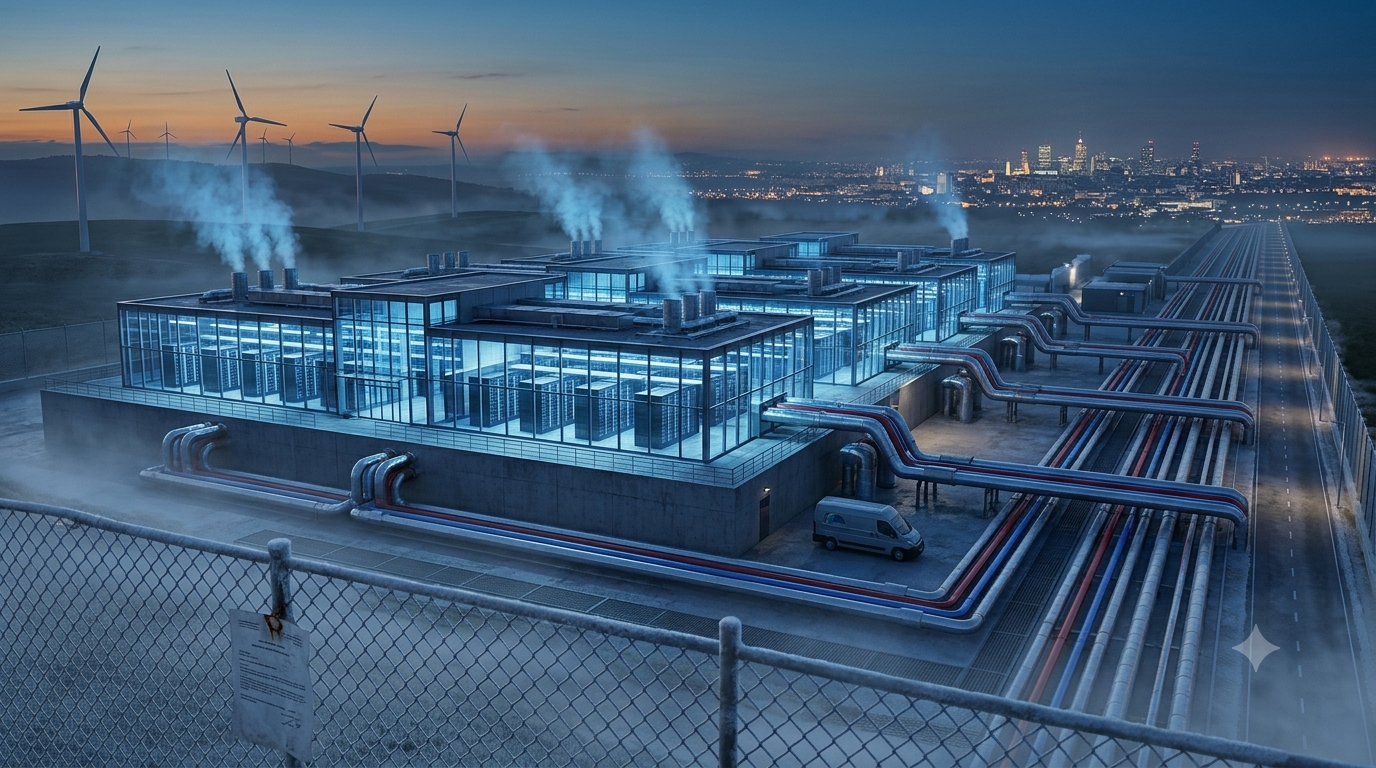
Europe has never had a simple relationship with the infrastructure of the digital economy. The continent that produced the world’s most comprehensive digital privacy framework, the world’s first binding AI risk regulation, and the world’s most granular data centre sustainability reporting regime is simultaneously the continent most anxious about its own AI competitiveness gap. The European Commission’s AI Continent Action Plan, launched in April 2025, commits to tripling the EU’s data centre processing capacity within five to seven years. The InvestAI initiative mobilised €200 billion for AI investment. Nineteen AI factories are planned across the continent, using Europe’s supercomputing network as a backbone. The political will is genuine and the capital ambition is real. What sits between the ambition and its execution is a regulatory architecture — the Energy Efficiency Directive, Germany’s Energieeffizienzgesetz, France’s national thresholds, the Climate Neutral Data Centre Pact, and the incoming Data Centre Energy Efficiency Package that was designed to make European data centres the world’s most sustainable and is now confronting the physical reality of what AI-grade compute actually requires.

The confrontation is not hypothetical. AI data centres are not conventional facilities that can be made more efficient by replacing fluorescent lighting with LEDs or installing variable-speed drives on cooling fans. NVIDIA’s GB200 NVL72 rack operates at 132 kilowatts. Next-generation Blackwell Ultra and Rubin architectures target between 250 and 900 kilowatts. NVIDIA’s OCP keynote at its 2025 Summit unveiled rack designs requiring up to one megawatt. These are not edge cases or experimental configurations they are the production systems that AI infrastructure operators are deploying now and will be deploying at scale through 2027 and 2028. The cooling technologies required to manage this thermal density — closed-loop direct-to-chip liquid cooling, single-phase and two-phase immersion systems, and the entire fluid management architecture that connects them — require capital expenditure, operational expertise, and facility design that European regulations are simultaneously mandating and, in some configurations, making practically difficult to deploy within the timelines the policy rhetoric demands.
The result is a regulatory tension that European data centre operators, hyperscalers, and colocation providers are navigating in real time with imperfect maps. The EU hosts only approximately 5% of global AI compute capacity, according to Epoch AI research, compared to roughly 75% in the United States. European data centre IT installed capacity reached 12 gigawatts in 2025, compared to 39 gigawatts in the US and 19 gigawatts in China. McKinsey estimates that total data centre demand in Europe will grow from approximately 10 gigawatts in IT load in 2024 to 35 gigawatts by 2030 — a tripling that, if achieved, would require an annual buildout rate that Europe has never historically approached, delivered under a regulatory framework that is adding requirements faster than the construction sector can absorb them. The AI Continent Action Plan is the ambition. The thermal lock is the constraint.
The EU Energy Efficiency Directive: What the Law Actually Requires
The Reporting Framework That Became a Rating System
The Energy Efficiency Directive formally Directive 2023/1791, which entered into force on October 10, 2023 is the foundational document of Europe’s data centre sustainability governance. Its Article 12 provisions apply to all data centre operators with installed IT power demand of at least 500 kilowatts, requiring them to report annually to a European database on a set of key performance indicators that define the sustainability envelope within which compliant European facilities must operate. The four sustainability indicators calculated from this data — Power Usage Effectiveness (PUE), Water Usage Effectiveness (WUE), Energy Reuse Factor (ERF), and Renewable Energy Factor (REF) — are published in granular form, differentiated by data centre type and size, in a public dashboard that the Commission described in its July 2025 assessment as providing “transparency and the sustainable development of the industry.” The reporting obligation applies even in member states that had not transposed the Directive by its deadlines: as of late 2025, only 16 EU countries had adopted national transposition measures, and the Commission had opened infringement proceedings against the remainder.

The reporting framework is the first layer of a regulatory architecture that is actively being extended upward. The Commission launched a call for feedback in March and April 2026 on a draft regulation for a common EU-wide rating scheme for data centres — a label that will communicate each facility’s energy and water use to customers, operators, and investors in standardised terms. Following the rating scheme, the Commission has signalled its intention to introduce minimum performance standards, which would convert the current transparency requirements into binding efficiency floors below which facilities could not operate within EU jurisdiction. The Data Centre Energy Efficiency Package, planned for release alongside the Strategic Roadmap on Digitalisation and AI for the Energy Sector, will formalise this progression from voluntary code to mandatory standard. White & Case’s analysis of the evolving regulatory landscape described the trajectory precisely: the various Omnibus packages have not yet targeted the EED for simplification, and the Commission’s direction is toward greater specificity, not less, on data centre environmental performance requirements.
The Climate Neutral Data Centre Pact adds a layer of industry self-regulation that, under its June 2025 structural shift, now relies on EED mandatory reporting for verification. The Pact’s commitments are concrete and enforceable through reputational mechanisms: new facilities in cool European climates must meet PUE of 1.3 or below as of January 2025, with existing facilities required to reach the same threshold by 2030. Renewable energy commitments require 75% renewable or carbon-free electricity by December 2025 and 100% by December 2030. The discomfort of the Pact’s first certification round — in which only 11 of 67 eligible signatories achieved independent certification — suggests that the gap between commitment and verified performance is wider than the policy architecture anticipated. The Climate Neutral Data Centre Pact’s own trade association, the CNDCP, published a July 2025 paper arguing that first-round EED data was incomplete and that hasty imposition of minimum performance thresholds could eliminate the majority of existing European operators from the compliant market a striking admission from the industry body most invested in making self-regulation work.
Germany’s EnEfG: The Most Demanding Framework in the World
Germany has chosen, as it typically does with environmental regulation, to exceed the EU baseline by a significant margin. The Energy Efficiency Act Energieeffizienzgesetz, or EnEfG which took effect on November 18, 2023, introduces binding, legally enforceable provisions that go substantially beyond what the EED requires at European level. For data centres commissioned on or after July 1, 2026, the law mandates a PUE at or below 1.2 a target that the most advanced hyperscale facilities in the world achieve only through aggressive liquid cooling deployment, cold-climate siting, and continuous operational optimisation. For facilities commissioned before that date, the law requires PUE at or below 1.5 by July 2027, tightening to 1.3 by July 2030. From January 2027, all covered data centres must source 100% green electricity. Germany has also lowered the EED’s 500-kilowatt reporting threshold to 300 kilowatts for public sector facilities and 1 megawatt for private sector facilities meaning that more German facilities fall into regulatory scope than the EU baseline would suggest. From January 2026, the establishment of an energy or environmental management system is mandatory for facilities above 1 megawatt connected load for the private sector and 300 kilowatts for public sector operators.
The PUE 1.2 requirement for new builds from July 2026 onward is the number that concentrates minds in European data centre planning. Air cooling achieves PUE in the range of 1.4 to 1.8 in typical configurations. Rear-door heat exchangers with free cooling achieve approximately 1.2 to 1.35. Direct-to-chip liquid cooling achieves 1.1 to 1.25 regardless of ambient conditions. Single-phase immersion cooling achieves 1.02 to 1.10, and two-phase immersion can reach as low as 1.01 to 1.05. The German law does not specify which technology must be used to meet the PUE target — it specifies the outcome and leaves the engineering path to operators. But the physics is unambiguous: at the rack densities that AI workloads generate in 2026, meeting PUE 1.2 without full closed-loop liquid cooling is not an engineering challenge that can be solved through operational optimisation. It requires capital investment in liquid cooling infrastructure that many European data centres particularly the existing brownfield estate — do not yet have and which carries retrofit costs that fundamentally alter project economics.
The European Commission’s report published in July 2025, covering the first round of EED reporting data submitted by European operators, provides a baseline against which future compliance trajectories will be measured. What the first reporting round revealed was an industry that is genuinely improving its average PUE performance, driven by hyperscalers whose cooling investments bring the average down, but that contains a long tail of older facilities operating at PUE levels well above 1.5 facilities that face either substantial capital investment or potential closure if minimum performance standards are set anywhere near the German new-build threshold. The Commission’s decision to treat the first reporting round as a data-gathering exercise before proposing minimum standards reflects a measured approach. The market, however, is not waiting for the Commission’s timetable.
The 80kW Inflection Point: Where Physics Meets Regulation
There is a specific tension between European regulatory design and the physical trajectory of AI hardware that the policy documents do not address directly and that the industry is navigating without clear regulatory guidance. The EU Energy Efficiency Directive and its implementing provisions establish reporting and performance requirements in terms of PUE a facility-level metric that measures total energy consumption relative to IT energy consumption. PUE is a legitimate and important efficiency indicator, but it was designed to evaluate conventional data centre operations where rack densities run between 5 and 20 kilowatts and air cooling is the baseline technology. As rack densities cross 40 kilowatts the hard physical ceiling of air cooling — and accelerate toward 80, 100, 132, and eventually 250 kilowatts for next-generation AI configurations, the relationship between PUE, cooling technology, and facility design changes in ways that the current regulatory metrics do not fully capture.
At 132 kilowatts per rack the operating density of NVIDIA’s GB200 NVL72 direct-to-chip liquid cooling is not optional and rear-door heat exchangers are insufficient. Closed-loop direct-to-chip systems with coolant distribution units, cold plates, and fluid management infrastructure are the minimum viable cooling architecture. These systems, when properly designed, achieve PUE in the range of 1.1 to 1.15 — well within the German new-build requirement of 1.2 and the EU’s Climate Neutral Data Centre Pact threshold of 1.3. On this metric, high-density AI data centres should be among Europe’s most compliant facilities. The complication is that deploying this infrastructure — procuring coolant distribution units in a market with severe supply constraints, sourcing closed-loop cold plates compatible with NVIDIA’s reference architecture, managing the fluid chemistry and water quality requirements of a primary loop running propylene glycol at PG25 specifications through copper and nickel-plated cold plates — requires a level of technical sophistication, procurement lead time, and capital that does not map cleanly onto the planning timelines that European permitting and financing frameworks assume.
The building design implications compound the procurement challenge. A facility designed for 80 to 100 kilowatt rack densities requires structural flooring rated for server weights that exceed those of conventional data centres, raised power distribution capable of delivering the per-rack amperage that GPU clusters demand, and mechanical infrastructure — fluid loops, coolant distribution headers, leak detection and containment systems — that must be integrated at the architectural level rather than retrofitted after the shell has been built. European data centre planning applications, which go through local planning authority review processes not designed for industrial-scale liquid cooling infrastructure, have no established template for these facilities. Planners assessing noise, water, and structural impact against conventional data centre benchmarks are applying criteria that were calibrated for air-cooled facilities and that do not account for the different operational profile of a liquid-cooled AI campus. The result is a planning process that consistently underestimates the infrastructure complexity of modern AI facilities while simultaneously applying sustainability requirements calibrated for conventional data centres.
The Waste Heat Mandate: Europe’s Most Ambitious and Most Logistically Complex Requirement
Of all the requirements in Europe’s data centre sustainability framework, the waste heat reuse mandate is simultaneously the most environmentally logical, the most commercially valuable when it works, and the most logistically intractable when it does not. Germany’s EnEfG requires data centres commissioned on or after July 1, 2026, to achieve an Energy Reuse Factor of at least 10% — meaning that at least 10% of the heat generated by IT equipment must be captured and reused rather than rejected to the atmosphere. This requirement rises to 15% in 2027 and 20% in 2028. France targets 15 to 25% by 2030 to 2035. Sweden and Denmark target 25 to 35% by 2025 to 2030. The Netherlands targets 20 to 30% by 2030. In aggregate, European member states are building a regulatory floor under waste heat utilisation that will, by the early 2030s, require a fifth or more of every new data centre’s thermal output to be productively reused — a requirement with no parallel in US or Asian regulatory frameworks.
A 100-megawatt data centre generates 85 to 90 megawatts of waste heat sufficient, in Nordic climates with appropriate district heating infrastructure, to supply more than 50,000 homes with heating. Microsoft is supplying data centre waste heat to district heating networks in Finland. Amazon’s Tallaght facility in Dublin supplied 92% of Trinity College Dublin’s heating needs while reducing carbon dioxide emissions by 704 tonnes in 2024. Microsoft’s collaboration with Finnish utility Fortum will reach 250,000 residents by 2026. The AWS Tallaght example, specifically, demonstrated that data centre heat reuse can function at scale, generate measurable decarbonisation outcomes, and operate as revenue-positive infrastructure when the economics of the heat offtake agreement and the proximity to district heating networks align. These are not demonstration projects — they are operational facilities delivering verified environmental and social value at scale.
The Logistical Gap Between Requirement and Reality
The Nordic examples are, precisely, Nordic examples and their replicability across the full geography of European data centre development is the logistical question that the waste heat mandate has not resolved. Viable heat reuse requires economic offtake agreements at approximately €15 to 30 per megawatt-hour thermal, proximity within approximately 10 kilometres to existing district heating network infrastructure, and temperature compatibility between the data centre’s waste heat output and the district heating network’s supply temperature requirements. When all three conditions are met, as they are in Helsinki, Stockholm, and Copenhagen — where district heating penetration is high, network infrastructure is extensive, and cold climates create year-round demand for heat — the economics of data centre waste heat reuse are genuinely favourable. When they are not met, the mandate imposes capital costs on data centre operators for heat recovery infrastructure and heat pumps that serve no functional purpose because there is no network to absorb the heat and no customer willing to buy it.
The geographic distribution of European data centre development is precisely the wrong shape for blanket waste heat mandates. Orbital Industries’s analysis identified the core structural contradiction: many data centres are built in rural locations specifically to avoid local opposition over noise, water usage, and property price effects the same locations where district heating networks do not exist and where the investment required to build them cannot be justified by a single data centre’s heat output. A data centre in an industrial park outside a mid-sized German city may be well within the EnEfG’s scope but located five to fifteen kilometres from the nearest district heating connection point, with no utility agreement in place and no municipal planning process for extending the network that can be completed within the data centre’s commissioning timeline. The law provides an exemption where waste heat reuse is not technically or economically feasible, but determining feasibility requires a multi-party assessment process involving the data centre operator, potential heat network operators, and municipal authorities — a process that the German regulatory framework has not streamlined and that can take months or years to resolve.
The temperature compatibility problem adds a second technical dimension. Conventional air-cooled data centres reject heat at 30 to 45 degrees Celsius from exhaust air — a temperature that is too low for direct injection into most district heating networks, which require supply temperatures of 60 to 80 degrees, requiring heat pump upgrades that add capital cost and energy consumption. Liquid-cooled facilities can reject heat at higher temperatures through their primary and secondary coolant loops, and direct-to-chip cooling systems operating at the warm-water conditions that the OCP and ASHRAE specifications recommend are capable of delivering heat at temperatures compatible with fourth and fifth-generation district heating networks — the low-temperature networks specifically designed for data centre heat integration. This creates an important but underappreciated alignment between the liquid cooling mandate implicit in Germany’s PUE 1.2 requirement and the waste heat reuse mandate in its ERF targets: facilities deploying closed-loop liquid cooling to meet PUE requirements are simultaneously creating the thermal infrastructure that makes waste heat reuse at viable temperatures possible. The two requirements are technically complementary, even though the planning and financing processes through which they are implemented have not been designed to take advantage of that complementarity.
The Competitiveness Trap: When Sustainability Requirements Become Investment Barriers
Europe’s data centre sustainability framework operates on top of an energy cost structure that is already severely disadvantageous relative to the United States and China. IEA data shows that energy prices for energy-intensive industries in Europe were running at roughly double US levels and 50% above Chinese and Indian levels in 2025 a gap that reflects the structural consequences of European energy market design, the phase-out of Russian gas following the 2022 invasion of Ukraine, and the higher cost of renewable integration at scale. CNBC’s May 2026 analysis of Europe’s AI energy challenge quoted HEC Paris researcher Darmouni on the downstream commercial consequence: European users of AI services will face price discrimination for AI outputs because the marginal cost of providing those services electricity is structurally higher in Europe than in the markets where US hyperscalers build their primary AI infrastructure.
The cost of securing data centre capacity in Europe’s five largest markets Frankfurt, London, Amsterdam, Paris, and Dublin — is projected to rise by an additional 12% in 2026, according to CBRE research, as supply tightens against rising demand. Grid connection wait times in the United Kingdom, Germany, and the Netherlands range from five to ten years, according to the IEA’s 2025 Energy for AI report. In London — Europe’s largest and most mature data centre market — grid connection queue times extend into the 2040s for some new projects, according to Moody’s analysis published in June 2026. These are not temporary capacity constraints they are structural features of European grid infrastructure that the energy transition has made worse, not better, in the near term, as renewable integration creates grid management complexity that transmission system operators are working through on timescales measured in decades rather than years.
OpenAI’s pause on its Stargate project in the United Kingdom citing energy cost and regulatory environment concerns — provides the clearest single data point of what happens when hyperscale AI infrastructure investment encounters European market conditions. The UK is not the most regulated data centre market in Europe. It is not subject to the EnEfG’s PUE 1.2 mandate or Germany’s ERF requirements. Its planning system, while not fast, is more flexible than the most demanding continental frameworks. If OpenAI, one of the world’s best-capitalised AI infrastructure investors, finds UK conditions insufficiently attractive to anchor a major Stargate facility, the implications for the continental European markets with more demanding regulatory frameworks are significant and immediate.
The Cloud and AI Development Act’s Dual Mandate
The European Commission is aware of this dynamic and is attempting to respond to it through the Cloud and AI Development Act, expected in late 2025 or early 2026, which aims to triple EU data centre processing capacity within five to seven years while maintaining and extending sustainability requirements. The act’s call for evidence acknowledged the potential role of financial support for data centres with high sustainability credentials, the goal of simplified permitting for qualifying facilities, and the need to increase capacity while simultaneously improving environmental performance. Sandbrook Capital’s launch of Krios Infrastructure, backed by a €200 million commitment to accelerate grid-secured land sites for large-scale European AI and data centre projects, represents a private sector bet that the regulatory framework can be navigated by well-prepared developers working with grid-secured sites from day one eliminating the interconnection wait time that has made European development so slow.
The coalition of European technology CEOs from ASML, Airbus, Ericsson, Mistral AI, Nokia, SAP, and Siemens that published a joint opinion calling for AI regulation simplification, competition reform, and accelerated capital mobilisation in May 2026 reflects an industry consensus that the regulatory architecture is adding friction faster than the Cloud and AI Development Act can remove it. The European Parliament’s Omnibus revision of the Digital Rulebook and German Chancellor Merz’s advocacy for looser AI rules for industrial applications represent political acknowledgment that the balance between regulatory ambition and investment attraction has not been correctly calibrated. Euronews’s January 2026 analysis noted the uncomfortable comparison directly: the United States has produced 40 AI foundation models, China has produced 15, and all of Europe combined has produced three. The regulatory superpower has not translated into AI infrastructure leadership, and the thermal lock the convergence of PUE mandates, waste heat requirements, energy cost disadvantages, and grid connection timelines is one of the structural reasons why.
The Countries That Are Getting It Rightand the Gap They Reveal
The Nordic countries Finland, Sweden, Denmark, and Norway represent the most coherent existing evidence of what the European regulatory framework can look like when the physical infrastructure conditions align with the policy ambitions. District heating penetration in the Nordic markets is high enough to provide ready-made offtake networks for data centre waste heat. Cold climates enable free-air economiser cooling for extended periods, reducing both energy consumption and cooling infrastructure requirements. Renewable electricity primarily hydropower in Norway and Sweden, wind in Denmark, and a combination in Finland provides the carbon-free baseload power that data centre sustainability commitments require. Finland’s electricity tax subsidy for data centres, which was removed in 2025, had attracted significant hyperscale investment, but the removal of the subsidy changed investment outlooks in ways that other regulatory environments are watching closely. Sweden’s combination of clean hydropower, cold climate, district heating networks, and stable regulatory framework makes it the most naturally aligned European market for AI data centre deployment that meets both commercial and sustainability criteria simultaneously.
The Nordic model reveals, by contrast, how much the central European markets Germany, France, the Netherlands are being asked to accomplish through regulatory mandate what Nordic geography delivers through natural endowment. A data centre in Hamburg can approach the waste heat utilisation targets of its Nordic counterparts, because Hamburg’s district heating penetration reaches 36.2% of residential buildings one of the highest penetration rates in Germany. Berlin’s 33% penetration and Munich’s 36.5% provide similar opportunities. But the majority of German data centre development is not happening in Hamburg, Berlin, or Munich it is happening in Frankfurt, the country’s dominant data centre hub, where the district heating infrastructure density and the proximity between new-build data centre campuses and existing heat network connections is less favourable. The regulatory requirement is national and uniform. The infrastructure that makes it achievable is geographically concentrated in specific cities with specific investment histories.
The Regulatory Inflection: Can Europe Build and Decarbonise at the Same Time?
The question that Europe’s regulatory and infrastructure policy communities need to answer in 2026 and 2027 is not whether sustainability requirements for data centres are legitimate — they are, and the environmental logic of requiring one of the world’s fastest-growing energy consumers to operate efficiently and to reuse its thermal output is sound. The question is whether the specific design of those requirements — the thresholds, the timelines, the geographic uniformity, and the absence of transitional mechanisms for the high-density AI configurations that are driving investment — is creating a regulatory environment in which Europe’s stated ambition to triple its data centre capacity is compatible with its equally stated ambition to enforce world-leading sustainability standards simultaneously.
The Data Centre Energy Efficiency Package, when it arrives, needs to do three things that the current framework does not accomplish. First, it needs to differentiate between conventional data centre configurations and high-density AI compute facilities, recognising that a 132-kilowatt GPU rack operates in a fundamentally different physical regime than a 10-kilowatt CPU rack and that the cooling technologies required to operate it at high efficiency — closed-loop liquid cooling at PUE below 1.15 are structurally different from the air-cooling configurations that existing PUE benchmarks were developed to evaluate. Second, it needs to create a streamlined permitting and grid connection pathway for AI-ready facilities that demonstrate compliance with liquid cooling and waste heat reuse requirements at the design stage, rather than subjecting these facilities to planning processes calibrated for legacy infrastructure. Third, it needs to address the geographic mismatch between waste heat mandate requirements and district heating network availability through either investment in heat network extension or differentiated ERF targets that reflect the infrastructure reality of specific development locations.
Europe’s AI infrastructure gap relative to the United States and China is real, measurable, and growing. The thermal lock — the convergence of PUE mandates, ERF requirements, energy cost disadvantages, grid connection timelines, and regulatory fragmentation across 27 member states — is a significant contributor to that gap, but it is not the only one. Capital market depth, venture capital availability, domestic hyperscaler demand, and the absence of large European AI anchor tenants all contribute to the same structural shortfall. What makes the regulatory dimension distinctive is that it is the dimension most directly within European policymakers’ control and most capable of rapid adjustment if the political will to do so can be mobilised. Germany’s announcement of “massive adjustments” to the EnEfG in its 2025 coalition agreement between the CDU/CSU and SPD suggests that the political awareness of the regulatory friction is growing. Whether that awareness translates into targeted, technically informed regulatory revision — rather than wholesale rollback of the sustainability framework will determine whether Europe builds its AI data centre capacity within the sustainability framework it has constructed or in spite of it.










