
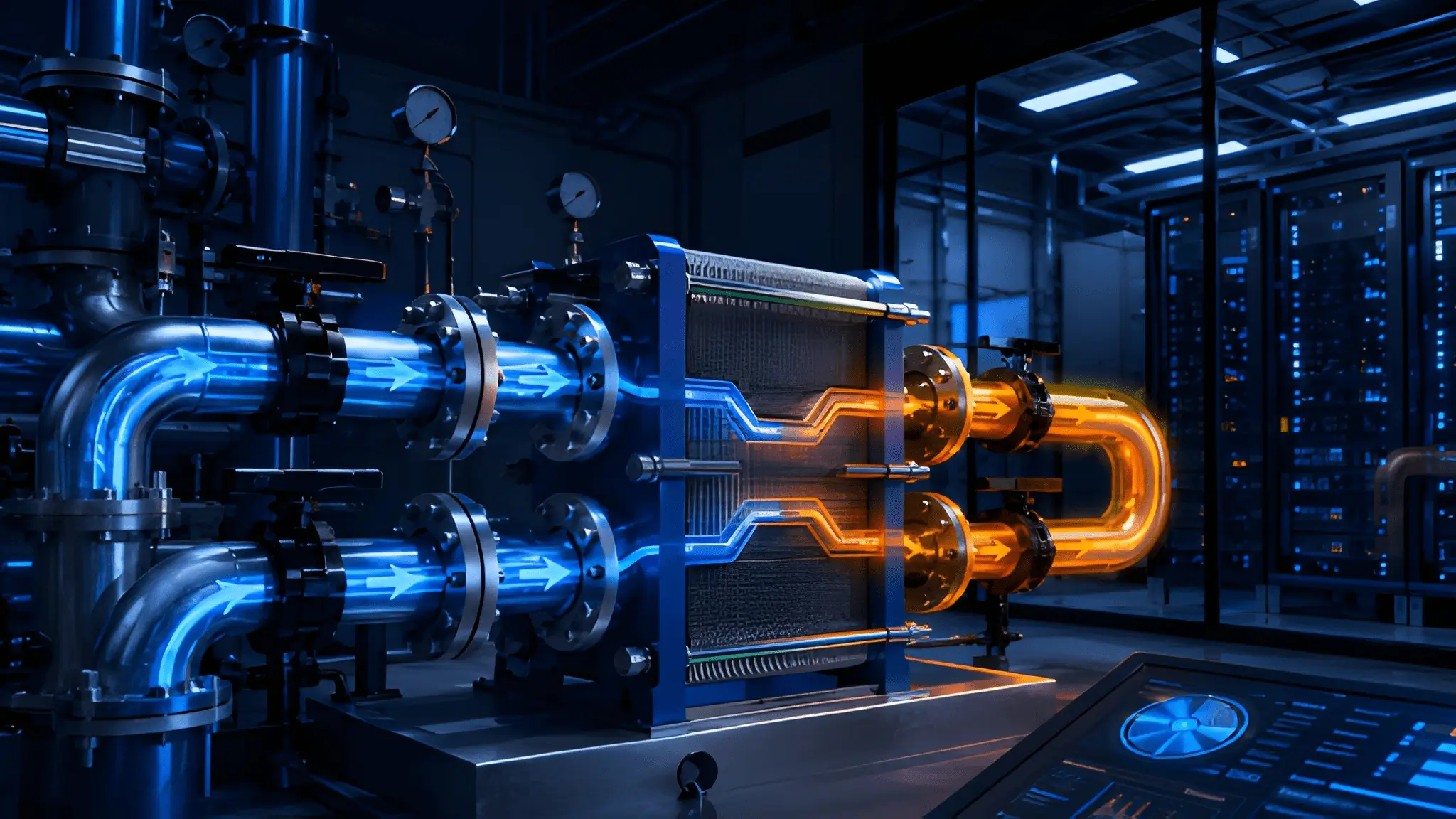
The most important pipe inside an AI-ready data center rarely connects directly to a processor. It sits between two cooling domains that appear similar on a mechanical drawing yet operate under entirely different engineering assumptions. One side belongs to the building, where cooling water serves as a transport medium that must tolerate changing loads, maintenance activities, and a wide range of operating conditions. The other side belongs to the computing hardware, where coolant becomes part of the thermal architecture surrounding CPUs, GPUs, memory modules, and power delivery components. A Cooling Distribution Unit, commonly known as a CDU, hydraulically separates the Facility Water System from the Technology Cooling System, allowing each loop to operate within its own hydraulic, thermal, and water-quality requirements while transferring heat through a heat exchanger.

Cold plates inside modern AI servers contain intricate internal flow paths that are designed to operate within specified coolant quality, flow, and pressure limits defined by equipment manufacturers to ensure reliable thermal performance and long-term hardware integrity. Building water systems, by contrast, experience operational changes that include pump sequencing, valve adjustments, filtration cycles, seasonal treatment modifications, and maintenance interventions. Engineers therefore design liquid cooling around isolation rather than direct connection because thermal performance alone cannot guarantee hardware longevity. The CDU transforms an ordinary cooling interface into a managed protection layer that shields sensitive equipment from environmental conditions originating outside the rack. Liquid cooling has therefore reached a stage where the discussion extends beyond moving heat away from processors. System designers increasingly evaluate coolant quality, hydraulic stability, fluid compatibility, condensation control, and operational accountability as equally important elements of infrastructure reliability.
The Two Loops Problem: Why One Pipe Can’t Serve Silicon
Although both loops transport heat using liquid, they perform fundamentally different engineering functions within the cooling architecture. Facility Water circulates through the building infrastructure where chillers, cooling towers, dry coolers, pumps, and distribution piping support many operational objectives beyond IT equipment alone. The Technology Cooling System operates as a dedicated secondary circuit whose primary responsibility involves maintaining stable coolant conditions for cold plates and other liquid-cooled components. A plate heat exchanger inside the CDU transfers thermal energy between these domains without allowing fluids to mix, thereby preserving independent hydraulic and chemical characteristics. ASHRAE guidance explicitly distinguishes Facility Water Systems from Technology Cooling Systems because each loop requires different operating practices, maintenance priorities, and water quality specifications. Treating both systems as interchangeable ignores the engineering assumptions built into liquid-cooled server hardware and increases operational risk throughout the cooling chain.
Building water frequently contains corrosion inhibitors, treatment chemicals, dissolved minerals, suspended particles, and biological control additives selected for mechanical infrastructure rather than electronic hardware. Cold plates, however, depend upon carefully managed coolant chemistry because their internal passages expose numerous metallic surfaces to continuous liquid contact under controlled flow conditions. Small changes in chemical composition can influence corrosion behavior, material compatibility, inhibitor effectiveness, and long-term deposit formation inside narrow thermal channels. Hydraulic characteristics also differ because facility loops prioritize distribution across extensive mechanical networks while Technology Cooling Systems emphasize stable delivery to sensitive computing equipment. Designers therefore establish independent circulation systems that optimize each loop for its own operational objectives instead of forcing one compromise solution across the entire cooling environment.

Isolation Creates Engineering Freedom
Separating hydraulic domains also allows each side of the cooling system to evolve without imposing unnecessary constraints upon the other. Mechanical engineers retain flexibility to optimize facility-side pumping arrangements, distribution strategies, and maintenance schedules according to building requirements instead of hardware limitations. Hardware designers simultaneously define coolant chemistry, pressure ranges, flow stability, and component compatibility around processor reliability rather than building infrastructure practices. That independence becomes particularly valuable when liquid cooling deployments expand over time because infrastructure upgrades rarely occur simultaneously across every mechanical subsystem. A CDU therefore functions as an engineering contract between two operational environments instead of merely serving as another thermal component. Successful liquid cooling depends upon maintaining that contract consistently throughout installation, commissioning, maintenance, and future expansion activities.
When Thermal Boundaries Become Reliability Boundaries
Every thermal interface inside a liquid-cooled AI environment also functions as a reliability boundary because coolant quality, pressure stability, and fluid compatibility determine how effectively heat reaches the CDU without compromising hardware integrity. Cold plates no longer resemble large cooling jackets with generous flow passages because manufacturers increasingly machine highly engineered microchannel geometries that maximize heat transfer while minimizing thermal resistance between silicon and coolant. Those channels demand repeatable hydraulic behavior since even localized flow disturbances can reduce cooling uniformity across processors operating at extremely high heat fluxes. Facility Water networks cannot realistically maintain that level of consistency because they respond continuously to changing building loads, mechanical equipment sequencing, and infrastructure maintenance that occur independently of computing workloads. A dedicated Technology Cooling System therefore shields server hardware from hydraulic variability before thermal energy ever reaches the Facility Water loop through the CDU heat exchanger.
Engineers also recognize that the two loops age differently over their operational lifecycles because mechanical infrastructure experiences broader environmental exposure than rack-level liquid cooling equipment. Facility Water piping may undergo modifications, repairs, flushing activities, equipment replacements, seasonal operating changes, or chemical treatment adjustments that influence water characteristics across the broader cooling plant. Technology Cooling Systems instead prioritize chemical consistency because repeated changes in coolant composition increase uncertainty surrounding corrosion control, elastomer compatibility, inhibitor depletion, and metallic surface stability inside liquid-cooled servers. The CDU prevents routine infrastructure activities from propagating those changes directly into processor cooling circuits where hardware manufacturers expect controlled operating conditions. Isolation therefore reduces cumulative operational variability instead of simply preventing one catastrophic contamination event from damaging sensitive equipment. Long-term reliability emerges from preserving stable operating conditions over thousands of maintenance cycles rather than relying exclusively on component robustness.
The Pollutants Don’t Knock: How CDUs Filter the Unexpected
Fluid contamination rarely begins inside the server because most unwanted material enters the cooling chain through upstream infrastructure during installation, maintenance, expansion, or routine mechanical operation. New piping systems often release residual welding debris, gasket fragments, sealant particles, machining residue, and corrosion byproducts despite extensive flushing procedures before commissioning. Existing cooling networks gradually accumulate suspended solids originating from oxidation, mineral precipitation, pipe degradation, valve wear, and biological activity that naturally develops within water distribution systems over extended operating periods. Water treatment programs effectively manage those risks for mechanical equipment, yet acceptable conditions for pumps, chillers, and cooling towers do not necessarily satisfy the cleanliness requirements of precision cold plates. Even microscopic particulate matter can accumulate inside restrictive flow passages where coolant velocities change rapidly across intricate internal geometries.
Construction activities introduce another contamination pathway that frequently receives less attention than routine operations because mechanical modifications continue throughout the lifecycle of many computing environments. Pipe replacements, equipment upgrades, valve installations, temporary bypass arrangements, and maintenance interventions all create opportunities for foreign material to enter Facility Water distribution systems despite careful engineering controls. Airborne dust, metallic particles, insulation fibers, and installation residue may remain suspended within water circuits before eventually reaching downstream equipment after circulation resumes. Technology Cooling Systems avoid repeated exposure to those disturbances because the CDU heat exchanger transfers thermal energy instead of transferring the water itself between hydraulic domains. Operators therefore gain the ability to perform building-side work without automatically exposing liquid-cooled hardware to every mechanical intervention occurring elsewhere within the infrastructure. Isolation transforms maintenance activities into localized events rather than system-wide contamination risks that extend directly into processor cooling circuits.
Creating a Clean Environment for Cold Plates
Modern CDUs accomplish more than simple hydraulic separation because they establish conditions that allow Technology Cooling System fluid quality to remain measurable, controllable, and repeatable throughout continuous operation. Secondary loops typically incorporate dedicated filtration, controlled fill procedures, compatible coolant formulations, expansion management, and monitoring practices designed specifically for electronic cooling rather than mechanical infrastructure. That controlled environment significantly reduces opportunities for suspended particles, treatment chemicals, corrosion products, and biological contaminants to circulate through processor cold plates after commissioning. Engineers can therefore define coolant specifications according to hardware requirements instead of adapting those requirements to the broader realities of Facility Water management across an entire building. Predictable coolant quality also simplifies maintenance because technicians diagnose changes within a smaller, isolated hydraulic ecosystem rather than tracing every potential contamination source throughout the complete cooling plant.
Pressure Spikes Are Silent Killers: Taming Hydraulics at the Boundary
Mechanical cooling systems experience constant hydraulic change because pumps start and stop, control valves reposition, isolation valves close for maintenance, and standby equipment periodically enters service to maintain operational resilience. Those transitions occur routinely across Facility Water networks, yet each event generates pressure variations that propagate through connected piping with varying intensity depending upon system configuration and operating conditions. Traditional mechanical equipment is generally designed to operate within the pressure variations expected in building hydronic systems because heat exchangers, coils, pumps, and distribution piping are engineered for those operating conditions. Liquid-cooled processors operate under a different engineering philosophy since cold plates contain precisely manufactured microchannels designed to maximize thermal transfer while maintaining compact physical dimensions around advanced silicon packages. The CDU therefore hydraulically decouples the Facility Water System from the Technology Cooling System, reducing the transmission of pressure fluctuations and flow disturbances into the secondary cooling circuit supplying liquid-cooled hardware.
Pump sequencing represents one of the most common sources of hydraulic disturbance because modern cooling plants continuously optimize equipment operation according to changing thermal demand, maintenance schedules, and redundancy strategies. Every transition modifies system flow conditions, pressure distribution, and pump head across portions of the Facility Water network even when operators observe no visible impact on mechanical performance. Those changes may appear insignificant within conventional HVAC applications, yet liquid-cooled servers require considerably tighter hydraulic consistency to maintain balanced coolant delivery across multiple cold plates installed throughout densely populated compute racks. The Technology Cooling System therefore isolates processor cooling from dynamic building behavior instead of allowing every mechanical optimization event to influence rack-level coolant flow. A CDU accomplishes that objective through hydraulic decoupling, controlled pumping, and secondary-loop regulation that stabilize coolant delivery despite continuous changes elsewhere in the infrastructure.
Hydraulic Events Rarely Announce Their Arrival
Construction activities and scheduled maintenance introduce another category of hydraulic events because technicians routinely isolate sections of piping, replace valves, service pumps, and modify cooling infrastructure without permanently shutting down the broader mechanical system. Every intervention temporarily changes hydraulic resistance within portions of the Facility Water network, causing pressure redistribution that extends well beyond the immediate work area. Mechanical engineers expect those responses and design infrastructure accordingly, yet AI hardware should never become an unintended participant in those routine operational adjustments. The CDU separates those operational realities by maintaining an independently controlled Technology Cooling System whose hydraulic characteristics remain substantially insulated from upstream disturbances. That independence allows facility operations and high-density computing environments to coexist without forcing processor cooling circuits to experience every maintenance-related hydraulic event occurring across the building.
Protecting Micron-Scale Cooling Paths Through Hydraulic Decoupling
Cold plates achieve exceptional thermal performance because coolant passes through highly engineered internal structures that dramatically increase heat transfer surface area within extremely compact spaces surrounding processors and accelerators. Those intricate geometries improve cooling efficiency while simultaneously increasing sensitivity to unstable hydraulic conditions that influence flow distribution between parallel cooling circuits inside advanced servers. Consistent differential pressure therefore becomes just as important as coolant temperature because uneven flow can create localized thermal variation despite adequate overall cooling capacity. The CDU maintains stable operating conditions by regulating the secondary loop independently from fluctuations affecting the Facility Water circuit, thereby preserving predictable coolant delivery across every connected cold plate. Designers can optimize pump control, pressure regulation, and flow balancing specifically for electronic cooling instead of accepting whatever hydraulic behavior exists within the larger mechanical infrastructure.
Pressure stability also improves diagnostic confidence because engineers can distinguish genuine equipment issues from temporary disturbances originating elsewhere in the cooling plant. A sudden pressure deviation within a fully isolated Technology Cooling System often indicates a localized condition such as restricted flow, pump degradation, trapped air, or an emerging leak rather than unpredictable behavior transmitted through the Facility Water network. Maintenance teams therefore investigate a smaller and more controlled hydraulic environment where root-cause analysis becomes considerably more precise and corrective actions can occur before hardware experiences thermal consequences. That diagnostic clarity supports predictive maintenance strategies by reducing uncertainty surrounding pressure trends collected through CDU instrumentation over extended operating periods. Reliable pressure data loses much of its value when upstream hydraulic variability continuously masks developing equipment conditions within rack-level cooling systems. Isolation preserves the integrity of operational data while simultaneously protecting processors from unnecessary hydraulic exposure throughout their service life.
Dew Point Drift: When Your Building’s Humidity Becomes a Chip Problem
Cooling engineers often focus first on liquid supply temperatures because processor performance depends upon maintaining sufficient heat removal capacity under sustained computational load. Thermal safety, however, also depends upon the relationship between coolant temperature, surrounding air conditions, and the dew point that determines when moisture begins forming on exposed surfaces. Condensation develops whenever surface temperatures fall below the ambient dew point, creating liquid water precisely where electrical components, connectors, and printed circuit assemblies require dry operating conditions. Modern AI servers incorporate numerous metallic manifolds, tubing sections, fittings, and cold plates that remain physically exposed to the surrounding air despite carrying coolant internally through sealed circuits. Those external surfaces respond directly to coolant temperature, making environmental humidity an operational factor that extends well beyond traditional room cooling considerations. The CDU therefore becomes an active control boundary where thermal management and environmental conditions intersect before condensation can threaten hardware reliability.
Ambient humidity rarely remains perfectly stable because building occupancy, seasonal weather patterns, ventilation strategies, fresh air intake, and mechanical operating modes continuously influence indoor environmental conditions throughout the data center. Cooling systems designed solely around fixed liquid temperatures cannot automatically compensate for those changing atmospheric conditions without additional intelligence that considers both thermal and psychrometric behavior. Technology Cooling Systems therefore require coordinated control strategies capable of maintaining coolant temperatures above the prevailing dew point while still delivering sufficient cooling capacity to processors operating under variable computational demand. CDU control systems, often operating together with facility environmental monitoring and building management controls, can regulate Technology Cooling System supply temperatures to maintain coolant conditions above the prevailing dew point and reduce condensation risk. Engineers thereby avoid relying upon static temperature limits that may become unsuitable as indoor humidity changes throughout normal facility operation.
Temperature Alone Does Not Define Safe Cooling
Moisture formation presents risks that extend beyond visible droplets because repeated condensation and evaporation cycles gradually influence material integrity, electrical interfaces, and long-term equipment reliability. Electrical connectors, solder joints, metallic fasteners, exposed conductors, and structural assemblies all experience environmental exposure whenever liquid water forms on external hardware surfaces. Even brief condensation events can introduce localized corrosion mechanisms or contamination pathways that remain difficult to identify during routine inspections after moisture has evaporated. Technology Cooling Systems therefore prioritize maintaining operating conditions that prevent condensation from developing rather than attempting to mitigate its consequences after exposure occurs. The CDU supports that objective by ensuring coolant temperatures remain compatible with prevailing environmental conditions before chilled liquid reaches sensitive hardware. Preventative thermal control consequently protects processors through environmental stability instead of depending upon hardware tolerance for repeated moisture exposure.
The CDU as the Guardian of Thermal Stability
The Technology Cooling System depends upon consistent inlet temperatures because processors achieve predictable thermal behavior only when coolant enters cold plates within carefully managed operating limits. Facility Water temperatures may fluctuate throughout the day as cooling towers respond to outdoor conditions, chillers optimize energy consumption, or heat rejection equipment adjusts to varying thermal loads across the mechanical plant. Directly transmitting those variations into rack-level cooling circuits would unnecessarily expose hardware to environmental changes unrelated to processor operation. The CDU isolates those external influences by regulating secondary-loop temperatures independently through controlled heat exchange between the Facility Water circuit and the Technology Cooling System. Stable coolant delivery therefore reflects hardware requirements rather than temporary variations occurring elsewhere within the building’s thermal infrastructure. Isolation converts temperature regulation from a building-wide compromise into a hardware-centered engineering discipline focused on silicon protection.
Temperature stability also improves workload consistency because processors increasingly adjust operating behavior according to thermal conditions observed across multiple onboard sensors during continuous computation. Rapid coolant temperature fluctuations may trigger unnecessary thermal management responses that reduce operational predictability even when average temperatures remain within acceptable limits. Maintaining a consistent thermal environment therefore supports both hardware reliability and computational stability across demanding AI workloads that depend upon sustained processor performance. The CDU contributes directly to that stability by minimizing external thermal disturbances before coolant enters the Technology Cooling System supplying cold plates throughout the rack. Predictable inlet conditions allow server-level thermal controls to respond primarily to computational activity rather than building-side environmental variability. Stable cooling consequently enhances operational confidence without requiring unnecessary reductions in thermal performance margins.
Fluid Hygiene as a Contract Line Item: Defining Clean for the TCS
Fluid cleanliness within a Technology Cooling System cannot rely on visual inspection because coolant may appear perfectly clear while carrying dissolved contaminants or exhibiting degraded chemical characteristics that gradually compromise hardware reliability. Engineers therefore define coolant quality through measurable parameters that describe the condition of the circulating fluid rather than subjective observations made during routine maintenance activities. Conductivity, pH stability, particulate concentration, inhibitor condition, dissolved oxygen, and suspended solids collectively provide a more meaningful representation of coolant health than generalized descriptions such as clean or non-conductive. Those parameters directly influence corrosion behavior, galvanic compatibility, deposit formation, and long-term stability across metallic components exposed continuously to circulating coolant. Cold plates manufactured from copper, aluminum, stainless steel, or mixed-metal assemblies depend upon that chemical stability because incompatible fluid conditions accelerate material degradation even when thermal performance initially appears unaffected.
The phrase non-conductive coolant often oversimplifies the engineering requirements of modern liquid cooling because conductivity represents only one characteristic within a much broader fluid management strategy. A coolant may satisfy conductivity expectations while simultaneously experiencing depleted corrosion inhibitors, elevated particulate loading, biological contamination, or chemical imbalance that threatens system integrity over extended operating periods. Engineers therefore monitor multiple indicators together to understand how coolant evolves throughout its service life instead of treating any single measurement as a definitive indicator of health. Those measurements become significantly more valuable when they originate from an isolated secondary loop where external influences remain tightly controlled and easier to interpret. The Technology Cooling System provides that controlled environment because the CDU prevents routine changes within the Facility Water circuit from masking gradual degradation occurring inside the hardware cooling loop.
Clean Coolant Requires Measurable Engineering Criteria
Coolant specifications also influence component compatibility because elastomers, seals, brazed joints, tubing materials, manifolds, and metallic surfaces respond differently to long-term chemical exposure throughout continuous circulation. Hardware manufacturers therefore evaluate coolant formulations alongside mechanical design to ensure predictable interaction between circulating fluids and internal system materials over the expected operational lifecycle. Maintaining those validated conditions requires preserving coolant composition after installation rather than allowing gradual dilution or contamination through uncontrolled interaction with broader building water systems. CDU isolation protects that validated environment by limiting opportunities for unintended chemical exchange between independent hydraulic domains operating under different maintenance priorities. Fluid quality therefore remains aligned with the assumptions embedded within hardware qualification testing rather than drifting toward conditions established for general mechanical infrastructure. Engineering consistency begins with measurable chemistry because thermal performance alone cannot compensate for chemically unstable coolant operating within precision liquid cooling systems.
Isolation Turns Specifications into Operational Accountability
Engineering specifications provide meaningful operational value only when teams can verify compliance throughout the lifetime of the Technology Cooling System using repeatable monitoring and maintenance practices. CDU isolation creates that opportunity by establishing a defined hydraulic boundary where coolant quality remains largely independent from broader Facility Water conditions that continuously change during normal building operation. Operators can therefore establish measurable service limits for conductivity, pH stability, particulate cleanliness, inhibitor concentration, and filtration effectiveness without uncertainty introduced by upstream infrastructure activities. Those measurable limits transform coolant management from a maintenance recommendation into an operational requirement supported by objective engineering evidence collected directly from the isolated secondary loop. Maintenance decisions consequently depend upon observed fluid conditions rather than assumptions about how the building water system might have influenced coolant chemistry over time. .
Routine sampling becomes substantially more valuable within an isolated Technology Cooling System because engineers evaluate fluid behavior inside a controlled environment rather than interpreting measurements affected by unpredictable external variables. A gradual increase in conductivity, a measurable shift in pH, declining inhibitor performance, or elevated particulate concentration often indicates a localized condition requiring investigation before hardware reliability begins to deteriorate. Those observations provide actionable maintenance information precisely because CDU isolation narrows the range of possible causes that influence coolant quality across the secondary loop. Without hydraulic separation, identical measurements could reflect unrelated treatment changes, infrastructure maintenance, or environmental influences originating elsewhere within the Facility Water network. Diagnostic confidence therefore increases alongside coolant stability because the operating environment remains intentionally constrained and easier to analyze. Predictive maintenance becomes more effective when engineering data originates from a system designed specifically to preserve measurement integrity throughout continuous operation.
The Retrofit Reckoning: Isolation as a Bridge for Legacy Sites
Very few liquid cooling deployments begin inside entirely new mechanical environments because many AI installations occupy buildings originally designed for conventional air-cooled IT equipment or lower-density computing loads. Those existing cooling plants often continue providing reliable thermal transport across the Facility Water network, yet their original design assumptions rarely anticipated the stringent hydraulic and chemical requirements associated with direct-to-chip liquid cooling. Pipe materials, water treatment strategies, distribution layouts, control philosophies, and maintenance practices typically reflect broader building objectives instead of the precision expected by modern Technology Cooling Systems. Replacing every component within those mechanical networks before introducing liquid-cooled racks would significantly increase project complexity while extending deployment timelines beyond practical operational requirements. Engineers therefore seek architectural approaches that preserve the value of proven mechanical infrastructure while creating controlled operating conditions around sensitive computing hardware.
Legacy cooling systems frequently contain operational characteristics that remain entirely acceptable for conventional mechanical applications despite falling outside the preferred operating envelope for precision liquid cooling equipment. Long-established distribution piping may exhibit gradual material aging, variable water chemistry, or hydraulic behavior influenced by decades of incremental modifications carried out to accommodate changing building requirements. Those conditions do not automatically indicate poor infrastructure because mechanical systems often continue delivering dependable service when operated according to their intended design objectives. Directly exposing advanced cold plates to those same conditions, however, introduces unnecessary uncertainty into processor cooling where hardware manufacturers expect tighter operational control over coolant quality and pressure stability. Hydraulic separation therefore enables both systems to perform according to their respective engineering capabilities without forcing either environment to conform completely to the operational assumptions of the other.
Modern Liquid Cooling Must Adapt to Yesterday’s Infrastructure
Cooling modernization increasingly depends upon incremental implementation strategies because computing demand often expands faster than organizations can redesign entire mechanical plants from the ground up. Liquid-cooled racks may therefore appear alongside conventional air-cooled systems, creating mixed environments where legacy Facility Water infrastructure continues supporting a growing range of thermal management approaches. The CDU provides the flexibility necessary for that coexistence by allowing Technology Cooling Systems to operate according to modern liquid cooling requirements without disrupting the established hydraulic behavior of the broader cooling network. Engineers gain the ability to introduce advanced rack cooling progressively while preserving mechanical stability across infrastructure that continues serving other operational areas within the building. That staged transition reduces implementation risk because cooling evolution occurs through carefully managed interfaces rather than abrupt system-wide transformations.
Isolation Enables Future Expansion Without Rebuilding the Past
The long-term value of CDU isolation extends beyond immediate deployment because it establishes a scalable framework capable of accommodating future hardware generations without requiring repeated changes to the building cooling network. Processor architectures continue evolving toward higher thermal densities, more sophisticated cold plate designs, and increasingly refined coolant management requirements that may exceed the assumptions embedded within older Facility Water systems. Maintaining an isolated Technology Cooling System allows engineers to adapt rack-level cooling strategies as hardware evolves while minimizing disruption to the broader mechanical infrastructure supporting the building. Cooling improvements therefore occur primarily within the secondary loop where operational variables remain controlled and modifications affect a comparatively limited hydraulic domain. Facility Water infrastructure continues performing its fundamental role as a heat transport system while the Technology Cooling System evolves alongside advances in processor cooling technology.
Operational flexibility also improves because isolated secondary loops simplify commissioning, validation, maintenance, and troubleshooting activities associated with newly deployed liquid cooling equipment. Engineers can verify coolant chemistry, hydraulic performance, filtration effectiveness, and temperature stability inside the Technology Cooling System without introducing unnecessary uncertainty from unrelated changes occurring elsewhere within the Facility Water network. That controlled commissioning process provides greater confidence that cooling performance reflects hardware design rather than unpredictable interactions with legacy infrastructure operating under different maintenance priorities. Future capacity additions likewise become more predictable because each new liquid cooling deployment integrates through an established CDU boundary instead of requiring extensive modifications throughout the building’s primary cooling distribution system. Standardized hydraulic interfaces encourage repeatable engineering practices while reducing operational variability across successive deployment phases.
Modern Liquid Cooling Must Adapt to Yesterday’s Infrastructure
Retrofitting ultimately succeeds when engineers recognize that modernization does not require replacing every proven mechanical asset before introducing advanced liquid cooling technologies. Existing Facility Water systems continue providing substantial value as thermal transport infrastructure even when they cannot independently satisfy the stricter operating expectations associated with precision Technology Cooling Systems. The CDU bridges those two realities by preserving the operational strengths of legacy infrastructure while creating a carefully controlled cooling environment tailored to modern processors and accelerator platforms. That separation protects current hardware investments while establishing an adaptable foundation capable of supporting future cooling innovations without repeated disruption to the broader mechanical plant. Liquid cooling therefore becomes compatible with incremental infrastructure evolution rather than dependent upon complete facility reconstruction before meaningful deployment can begin. Isolation serves not merely as a protective barrier but also as the architectural mechanism that allows modern cooling technology to coexist confidently with established mechanical systems.
Sensor Storytelling: What the CDU Boundary Reveals About Risk
A modern CDU functions as an instrumentation platform as much as a thermal interface because it continuously measures operating conditions across both the Facility Water loop and the Technology Cooling System. Every temperature, pressure, flow, conductivity, and pH measurement contributes to a broader operational narrative that describes how effectively the two hydraulic domains exchange heat while remaining physically isolated. Engineers gain far greater insight by interpreting those values as relationships across the CDU boundary rather than evaluating each sensor independently within its own subsystem. A gradual divergence between inlet and outlet temperatures may indicate changing heat transfer efficiency, while pressure variations across the secondary loop can reveal developing flow restrictions before processors experience measurable thermal impact. Conductivity and pH trends often identify subtle coolant degradation that remains invisible during routine visual inspections yet gradually influences long-term material compatibility inside cold plates and manifolds.
Temperature monitoring becomes especially valuable when engineers compare multiple measurement locations across the CDU because thermal relationships frequently reveal conditions that individual sensor values cannot explain in isolation. Stable Facility Water temperatures accompanied by increasing secondary-loop temperature differentials may indicate fouling within the heat exchanger, declining coolant circulation, or emerging restrictions inside rack-level cooling circuits. Conversely, simultaneous changes across both hydraulic domains often point toward broader cooling plant conditions rather than localized issues within the Technology Cooling System. That comparative analysis significantly reduces diagnostic uncertainty because engineers understand whether an observed trend originates inside the isolated secondary loop or within the upstream Facility Water infrastructure. Maintenance teams therefore investigate the correct portion of the cooling chain without unnecessary disruption to unrelated equipment operating normally elsewhere in the mechanical system.
Every Sensor Reading Describes a System, Not Just a Component
Pressure data provides equally important operational context because hydraulic stability directly influences coolant distribution throughout increasingly complex cold plate networks supporting advanced processors and accelerator assemblies. Gradual pressure changes within the Technology Cooling System often develop long before noticeable thermal symptoms appear at the processor level, allowing maintenance teams to investigate potential restrictions, pump performance changes, trapped air, or localized leakage while cooling margins remain intact. Comparing pressure behavior across the isolated CDU boundary further distinguishes internal cooling system issues from transient events occurring elsewhere in the Facility Water loop. Engineers therefore avoid unnecessary troubleshooting across the broader mechanical infrastructure when operational evidence indicates that hydraulic changes remain confined to the secondary circuit. Diagnostic precision improves because the CDU separates hydraulic influence just as effectively as it separates coolant chemistry and thermal management responsibilities.
Predictive Maintenance Begins at the Hydraulic Boundary
The value of CDU instrumentation extends beyond individual alarms because long-term operational trends often reveal developing conditions that remain well within normal operating limits during any single observation. Engineers increasingly analyze gradual changes in conductivity, pH stability, pressure differential, coolant temperature, and flow consistency to understand how the Technology Cooling System evolves throughout continuous service rather than waiting for threshold violations to trigger maintenance activities. Slow deviations frequently indicate progressive fouling, inhibitor depletion, filtration challenges, or material degradation that would otherwise remain undetected until thermal performance begins declining. Monitoring those variables inside an isolated secondary loop improves confidence because measurements reflect conditions intrinsic to the Technology Cooling System rather than unpredictable influences originating throughout the Facility Water network. Trend analysis therefore becomes substantially more meaningful when hydraulic separation minimizes external variables capable of masking early indicators of degradation.
Leak detection also benefits from CDU-centered monitoring because isolated hydraulic circuits simplify the process of identifying abnormal coolant behavior before hardware experiences operational consequences. Unexpected pressure decay, unexplained make-up fluid demand, changing conductivity patterns, or subtle flow imbalance collectively provide evidence that engineers can investigate within a well-defined hydraulic environment rather than across an entire building cooling network. The Technology Cooling System intentionally limits the number of possible variables influencing those measurements, allowing maintenance teams to narrow fault isolation more rapidly and with greater confidence. Early investigation reduces the likelihood that minor issues will develop into larger reliability concerns affecting processor cooling or hardware availability during extended operational periods. Instrumentation therefore supports operational resilience not by eliminating failures but by improving the ability to recognize developing conditions before they compromise thermal stability.
Isolation Isn’t Optional. It’s Your Hardware’s Last Defense
Liquid cooling has fundamentally changed the engineering conversation surrounding high-density computing because the coolant circulating through a processor is no longer simply a transport medium for unwanted heat. That fluid now forms an integral part of the processor’s thermal environment, making its chemical stability, hydraulic behavior, and operating consistency just as important as its ability to absorb thermal energy. Every engineering decision affecting the Technology Cooling System therefore extends directly to hardware reliability, service life, and operational predictability across increasingly dense AI infrastructure. The Facility Water loop continues performing the essential role of transporting heat away from the building, yet its operational priorities differ substantially from those governing precision processor cooling. Attempting to merge those distinct responsibilities into a single hydraulic domain introduces avoidable uncertainty that neither infrastructure nor hardware benefits from over the long term.
The importance of that separation will continue increasing as liquid cooling evolves alongside processor architectures that incorporate higher thermal densities, more sophisticated cold plate geometries, and increasingly refined coolant management strategies. Future improvements in computational performance will almost certainly place greater emphasis on maintaining consistent hydraulic conditions, preserving fluid quality, and collecting operational data capable of identifying subtle changes before they influence hardware availability. The CDU already provides the framework through which those objectives become achievable because it combines thermal exchange, hydraulic decoupling, environmental protection, and continuous monitoring within a single engineering boundary. Rather than serving solely as a heat-transfer device, the CDU establishes hydraulic separation and controlled operating conditions that support the reliable operation of downstream liquid cooling components within the Technology Cooling System.











